Only after experiencing multiple painful lessons will investors distance themselves from the game of flipping.
Written by: 1912212.eth, Foresight News
A meme coin flipping game involving LIBRA has caused an uproar in the crypto community. On February 15, the Argentine president announced the launch of the meme coin LIBRA and revealed its contract address, which subsequently skyrocketed, reaching a market cap of over $4 billion at one point. However, within hours, the coin's price plummeted significantly, currently priced at $0.36, with a market cap of less than $400 million. Just hours after the tweet, the Argentine president deleted the previous promotion of the meme coin, stating, "I thought it was just casual support for a private entrepreneurial project unrelated to me. I was not aware of the project's details, and after learning more, I will definitely not promote it again (this is also the reason for deleting the tweet)."
Investors who jumped into the dog coin frenzy suffered heavy losses. Solayer developers Chaofan Shou and Tonykebot lost over $2 million in this venture and revealed the core member list behind LIBRA, which is associated with the kip protocol, vowing to hold them accountable. The losses extend beyond these two individuals; according to monitoring by lmk.fun, a total of 24 traders lost over $1 million on LIBRA, and 61 traders lost over $500,000. The largest loser incurred a loss of $5.17 million, having spent $5.6 million to purchase 2.1 million tokens, ultimately selling them for just $430,000. Correspondingly, as of February 15, eight wallets associated with the LIBRA team had obtained 57.6 million USDC and 249,671 SOL (approximately $49.7 million) through adding liquidity, removing liquidity, and collecting fees, totaling around $107 million in cash out.
The insider trading of meme coins, the influence of celebrities in promotion, and the game of flipping coins faster than others have once again become the focus of market attention.
Today, Paridigm researcher Samczsun, Solana co-founder Toly, and crypto KOL Coobie discussed their views on Twitter.
Conspiracy Groups and KOLs
Samczsun initiated the discussion by asking: Will this incident lead to accountability for some involved parties on a societal level?
In response, Toly expressed a pessimistic view, stating, "The social layer's group judgment is problematic because it is a passive reaction to outcomes rather than based on a set of pre-established and recognized rules." Attackers can infinitely generate failed tokens, becoming the sole bidders to acquire most of the supply, and then hand over the contract address to KOLs. In Toly's view, the only solution is to enforce social credit scores for users and reject tokens with low scores.
Samczsun followed up by asking, if meme coins controlled by insiders are bad, why not formally exclude all participants from the start? This way, in the short term, the benefits of one-time profits would not outweigh the costs of being excluded, and in the long term, such behavior would be fundamentally unprofitable.
Toly's answer was straightforward: After promoting the contract address, KOLs would be rejected by their fan base, and the conspiracy group would then turn to the next KOL.
Cobie stated that many KOLs do not even know who they are dealing with or what they are promoting. They are simply told by brokers that if they tweet about it, they will receive X coins.
If KOLs and their brokers are informed about clearly bad things, will KOLs take responsibility for their actions? Perhaps we often see certain tokens proven to have multiple insider trading and fraud cases, yet no one faces any form of punishment.
Some KOLs' reputations have indeed been affected, partly because, "How do we define good and bad in meme coins? Even in completely unintentional free market token distribution, the top 20% of holders will end up owning over 80% of the tokens." Toly provided his answer.
At this point, Cobie bluntly explained that there is currently no effective way to shame those shameless individuals. He then tweeted a lengthy comment to elaborate on his views.
"This situation existed long before meme coins appeared; it has basically been this way since I first touched the crypto industry. (These recent operations are just more efficient and obvious.) Every time someone is shamed, they use it as populist rhetoric, and some even become more popular because of it. Those accused will just turn around and accuse others, creating opposition. For example, some YouTubers have promoted scams for three consecutive cycles, and despite constant exposure, they remain popular. The cyclical nature of the crypto industry means there will always be new entrants to fill the void left by old users, so these individuals can always find new audiences.
The market lacks truth and regulation, leading to outcomes that often go unresolved.
In Cobie's view, the only people who have truly been shamed into leaving the space are either those who were relatively reputable but made mistakes or those who do not need to rely on this industry for income. Those who truly should be expelled are already aware of what they are doing and have made their choices. Exposing them does not make them feel ashamed; it only threatens their income, so they will retaliate. In the absence of "truth arbiters," debates often have no final conclusion.
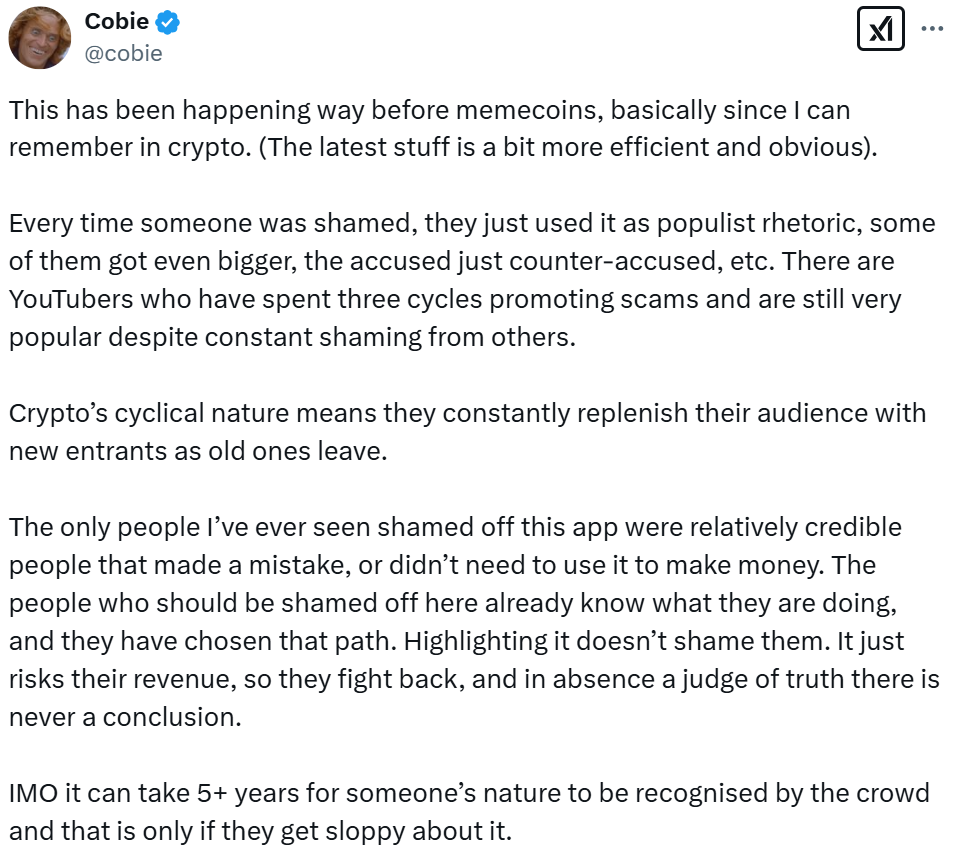
Additionally, Cobie stated that it may take over five years for the public to truly recognize human nature, and this is contingent on them making obvious mistakes in the process.
"If deceivers do not face the threat of losing their freedom, it is almost impossible to prevent them from continuing to commit fraud."
The Flipping Game Faces an Intractable Dilemma
Currently, the controversial overvalued VC coins and the fast-paced issues in meme coins have drawn sharp comments from Cobie, who stated that the current market development trajectory is that market participants, like moths to a flame, actively rush into these scams. Most are aware that these are scams, but their goal is to sell to the next buyer at three times the price. They only want to get rich in two weeks, not in 2-4 years. Players hope to win big in the next round.
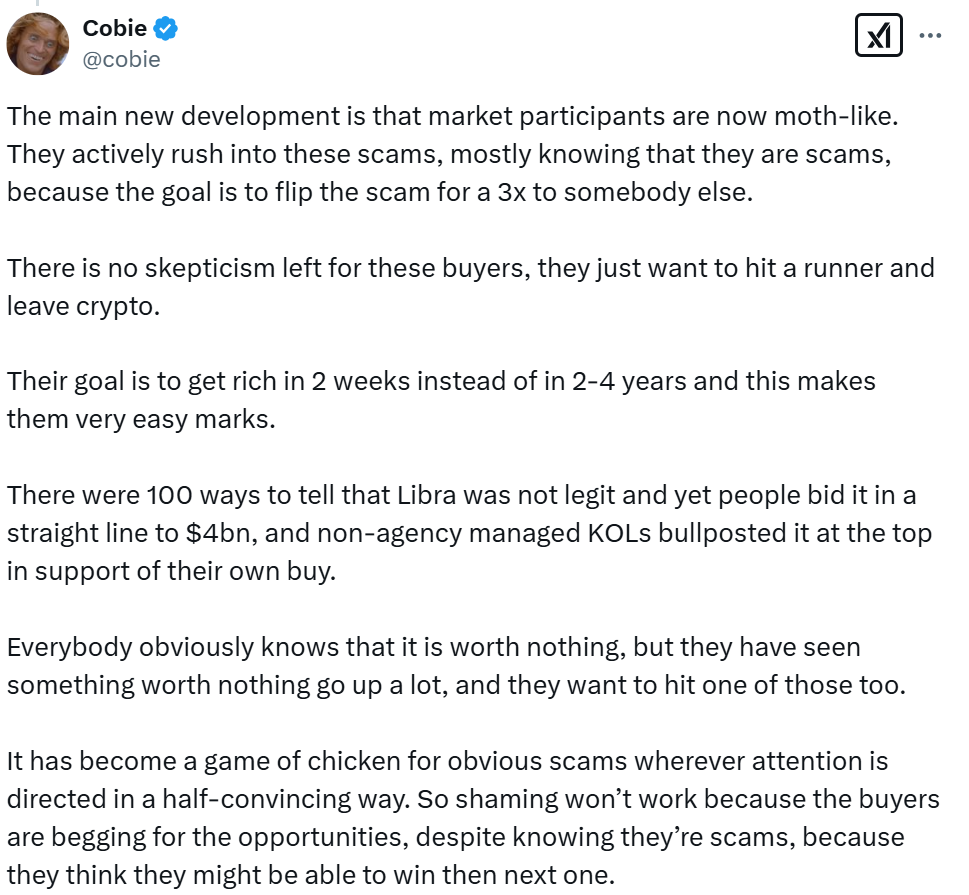
If there is no way to stop them, then avoiding participation may be a solution.
Cobie stated that the behavior of investors/players is easy to change. If you lose 10 times, you will stop playing the game. No one is buying VC coins anymore; in fact, some (very few) coins have been mispriced. They no longer buy these coins because they are tired of being drained.
Previously, Cobie wrote about high FDV low circulation VC coins, but he expressed disappointment that it did not achieve the desired goal and did not stop the public from buying these tokens. The only way to change investor behavior is for participants to incur enough losses. Only after experiencing painful lessons can this group truly realize they should avoid participation.
Cobie wrote, "This, in turn, changes the behavior of token issuers; the public will no longer buy such products, so you can no longer easily issue this type of token."
In Conclusion
If you were to launch a token echo now and had to choose between two paths:
(1) Sell 25% to venture capital firms and insiders, retain 35% for the team, and launch a token that receives revenue distribution from Echo's business to holders, issued with low circulation;
(2) Sell 0% to anyone, retain 50% for yourself, and launch a memecoin called Echo the Racist Dolphin, which has no connection to Echo other than the name, deployed from my public wallet and tweeted from a CA account;
Which do you think would have a higher market cap? Cobie provided his answer: the value of the memecoin (at least for now) would be higher than that of the VC coin. However, if the same experiment were conducted five years later, the results would be exactly the opposite.
Interestingly, in Cobie's comment section, a well-meaning individual posted a picture asking which token he mentioned.
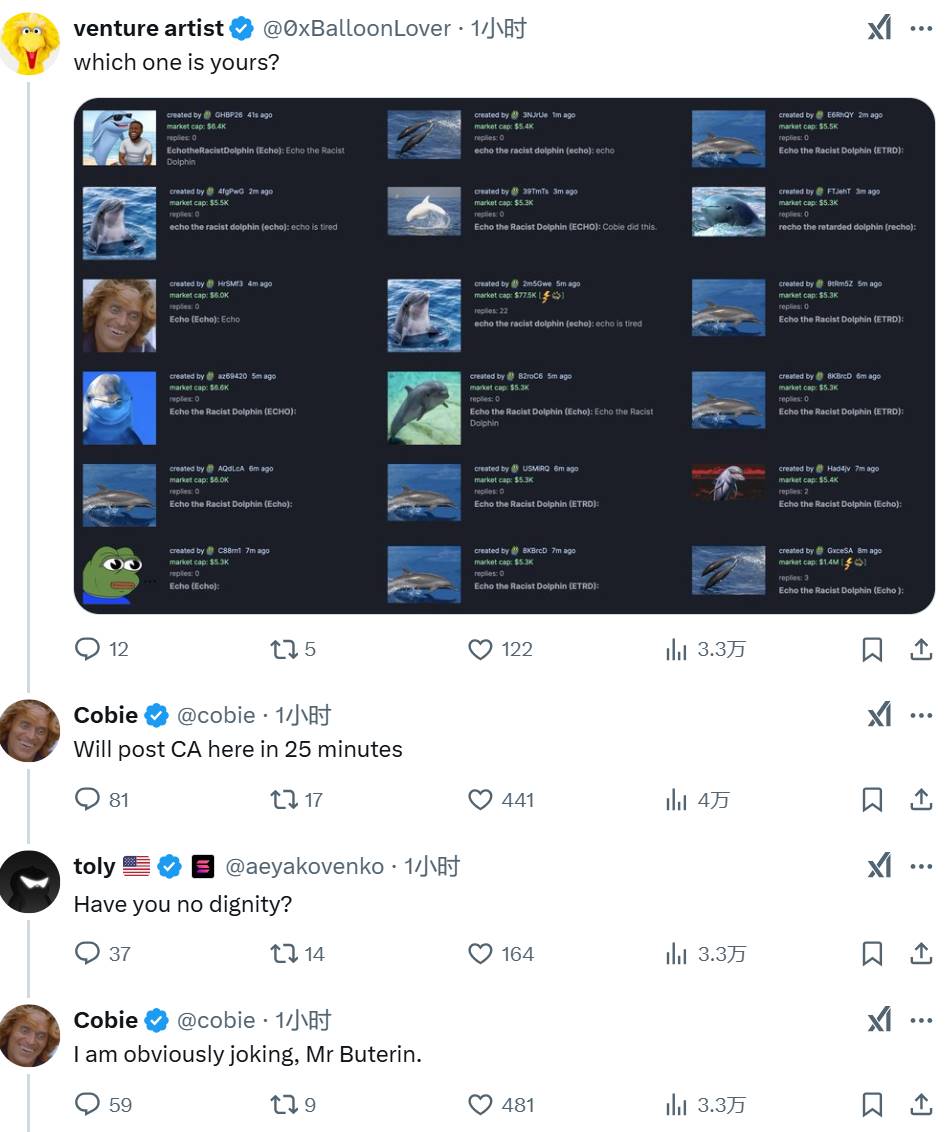
Cobie stated he would release the contract address in 25 minutes, to which Toly commented: "Do you have no shame?"
Cobie responded that it was just a joke and teased Toly using Buterin's name (the name of V God).
免责声明:本文章仅代表作者个人观点,不代表本平台的立场和观点。本文章仅供信息分享,不构成对任何人的任何投资建议。用户与作者之间的任何争议,与本平台无关。如网页中刊载的文章或图片涉及侵权,请提供相关的权利证明和身份证明发送邮件到support@aicoin.com,本平台相关工作人员将会进行核查。


