Author: Mint Ventures
1. Introduction
Hyperliquid is arguably the biggest highlight in the recent crypto market, aside from AI and Memes. Its strategy of not accepting VC investments, allocating 70% of tokens to the community, and returning all revenue to platform users has attracted market attention. The strategy of using revenue to buy back HYPE has caused HYPE's circulating market cap to quickly surpass UNI, placing it among the top 25 cryptocurrencies, while also leading to a surge in its platform business data.
This article aims to describe the current state of Hyperliquid's development, analyze its economic model, and evaluate the current valuation of HYPE, providing an answer to the question of whether "HYPE is expensive or not."
This article reflects the author's thoughts as of the time of publication, which may change in the future. The views expressed are highly subjective and may contain errors in facts, data, or reasoning. Criticism and further discussion from peers and readers are welcome, but this article does not constitute any investment advice.
A significant portion of this article references the research report on Hyperliquid published by ASXN in September, which is the most comprehensive and in-depth report on Hyperliquid that the author has read. Readers interested in more details about Hyperliquid's mechanisms can refer to this report.
The following is the main text.
2. Overview of Hyperliquid's Business
Hyperliquid's current business mainly consists of two parts: derivatives exchange and spot exchange. They also plan to launch a universal EVM—HyperEVM—in the future.
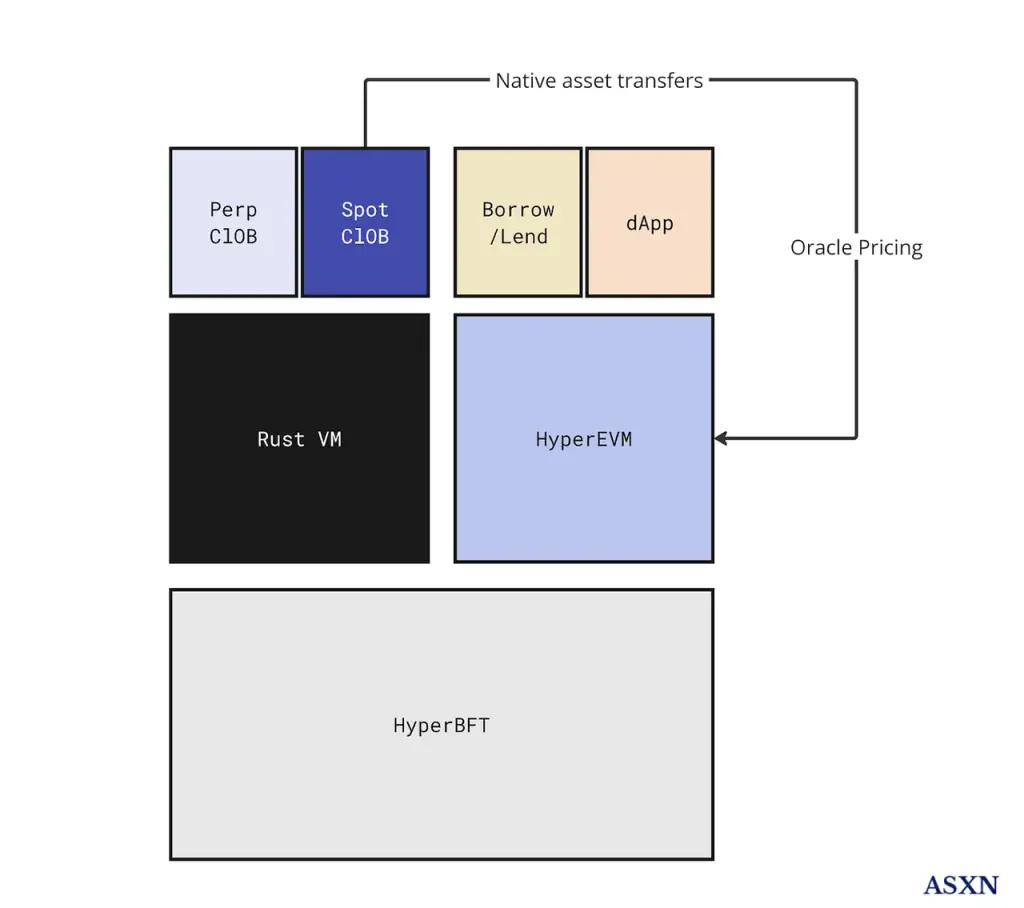
Hyperliquid Architecture Source: ASXN
2.1 Derivatives Exchange
The derivatives exchange is the first product launched by Hyperliquid and serves as its flagship product, occupying a core position in its entire product ecosystem.
In terms of the core product mechanism for derivatives, Hyperliquid has not adopted other innovative product logic (such as GMX, SNX, etc.) due to on-chain performance bottlenecks, but has instead chosen the Central Limit Order Book (CLOB) mechanism, which is the most widely used by various exchanges globally and is familiar to all trading users and market makers, while focusing on performance.
Their decentralized derivatives exchange operates on Hyperliquid L1, a PoS chain composed of a consensus layer HyperBFT and an execution layer RustVM.
HyperBFT is a consensus algorithm modified by the Hyperliquid team based on LibraBFT developed by Meta's former blockchain team, capable of supporting up to 2 million TPS. With strong performance support at the underlying level, Hyperliquid has put core components of the derivatives exchange, such as the order book and clearinghouse, on-chain, ultimately forming its decentralized derivatives exchange architecture.
For end users, the experience on Hyperliquid is almost identical to that of centralized exchanges like Binance, not only in terms of trading experience and product structure but also in trading fees and discount rules. The only difference from centralized exchanges is that Hyperliquid does not require KYC.
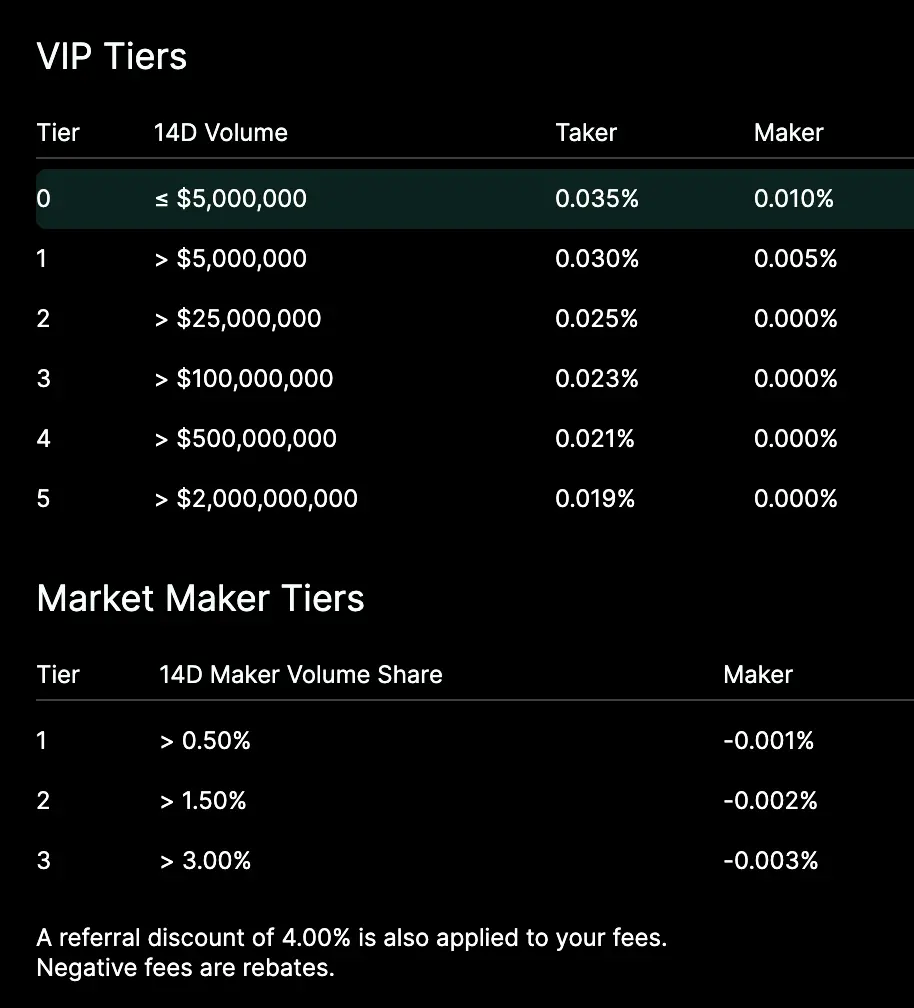
Hyperliquid's Fee Structure
In addition to trading products, Hyperliquid has provided a Vault function since the establishment of the product. The Vault is similar to "copy trading" in centralized exchanges, where anyone can invest funds into any Vault, managed by a Vault operator who makes investments. 10% of the profits are allocated to the Vault operator, and to maintain aligned interests, the operator must hold at least 5% of the Vault.
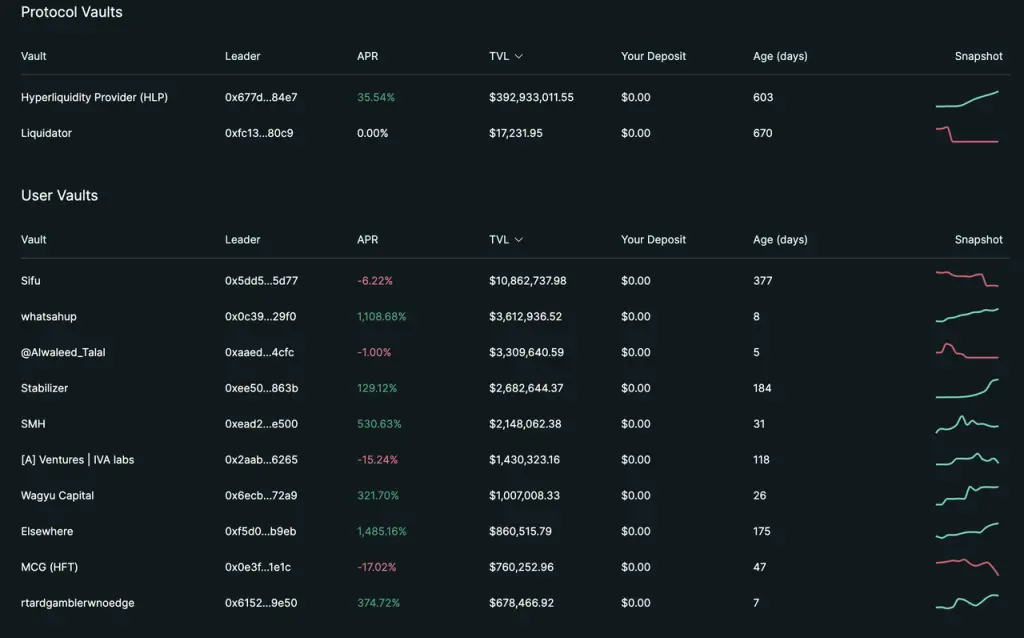
Source: Hyperliquid Official Website
However, based on the current TVL, 95% of the TVL is in the official Vault HLP.
Unlike general Vaults, HLP, being the official Vault, effectively acts as a counterparty for a significant amount of trading on the platform, allowing HLP to earn a portion of various platform fees (trading fees, funding fees, clearing fees). From this perspective, HLP is somewhat similar to GMX's GLP, with the distinction that GLP acts as a counterparty for all trades on the platform, and its strategy is passive and public; whereas HLP's strategy is non-public, and the counterparty for user trades could be either HLP or other users, with HLP's strategy adjustable at any time.
Since its launch in July 2023, HLP has maintained a net short position, providing liquidity for retail trading and remaining profitable with a net short position during the long-term bull market. Currently, the TVL is $350 million, with a PNL of $50 million. From the overall PNL curve of HLP and the PNL of three strategy addresses, the Hyperliquid team is using fees to maintain a relatively positive APR for HLP.
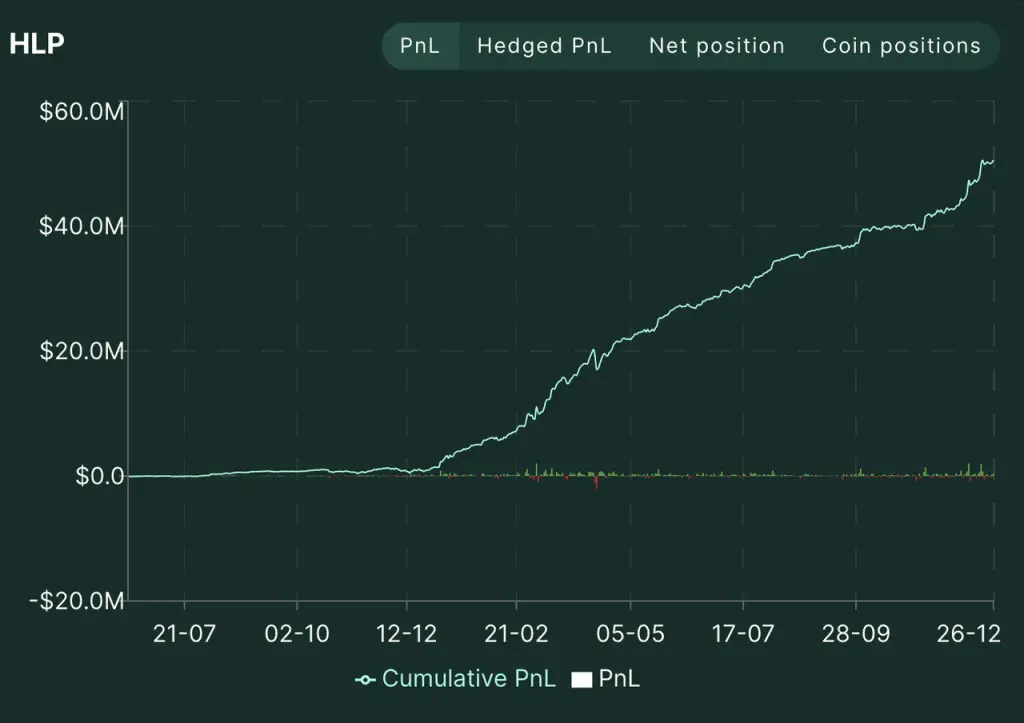
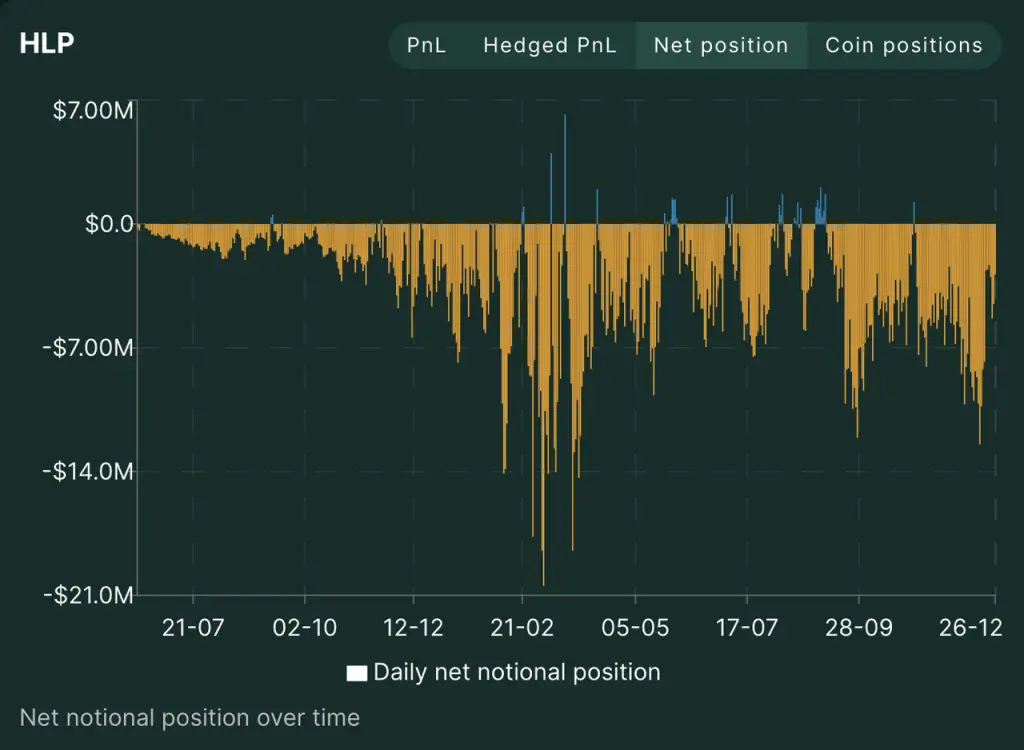
Source: Hyperliquid Official Website
In terms of trading volume and open interest, Hyperliquid has developed rapidly, especially in the last two months. With the $HYPE airdrop and continuous price increases, various platform metrics peaked between December 17-20.
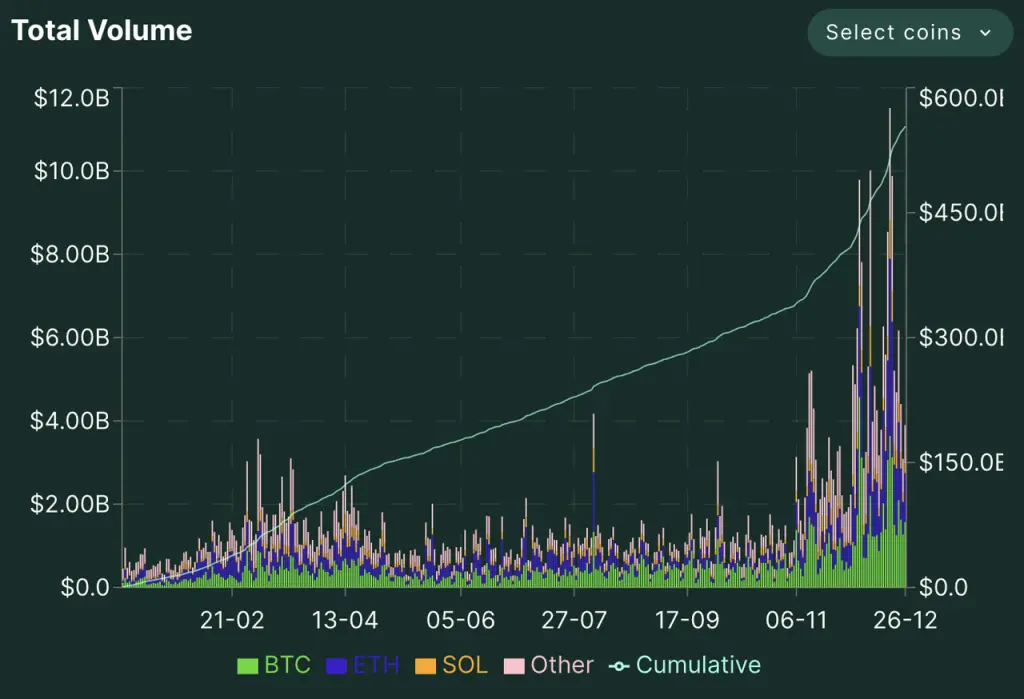
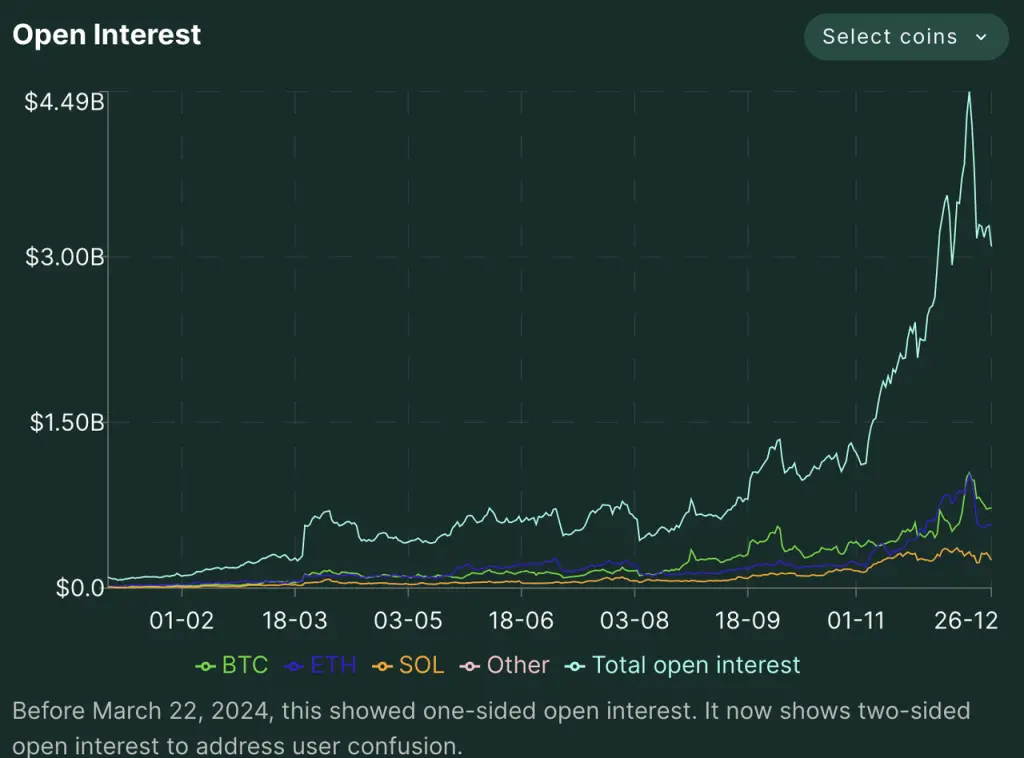
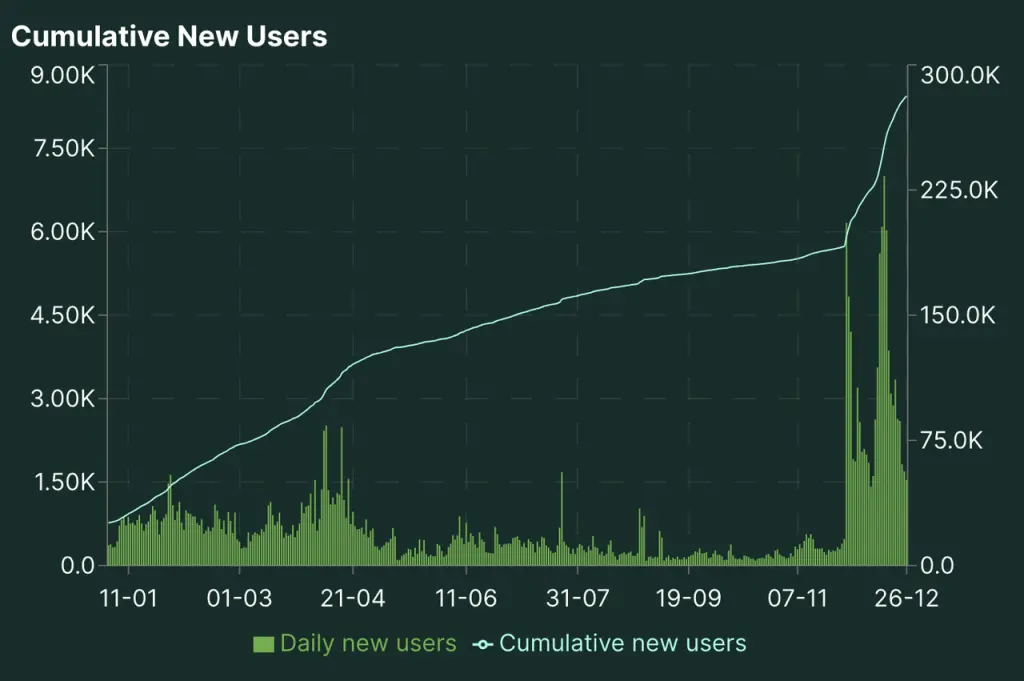
Hyperliquid's trading volume, open interest, and number of traders since 2024 Source: Hyperliquid Official Website
In the decentralized derivatives market, Hyperliquid has held a leading position since June this year, and the gap between Hyperliquid and other decentralized derivatives exchanges has further widened in the last two months, now reaching an order of magnitude difference.
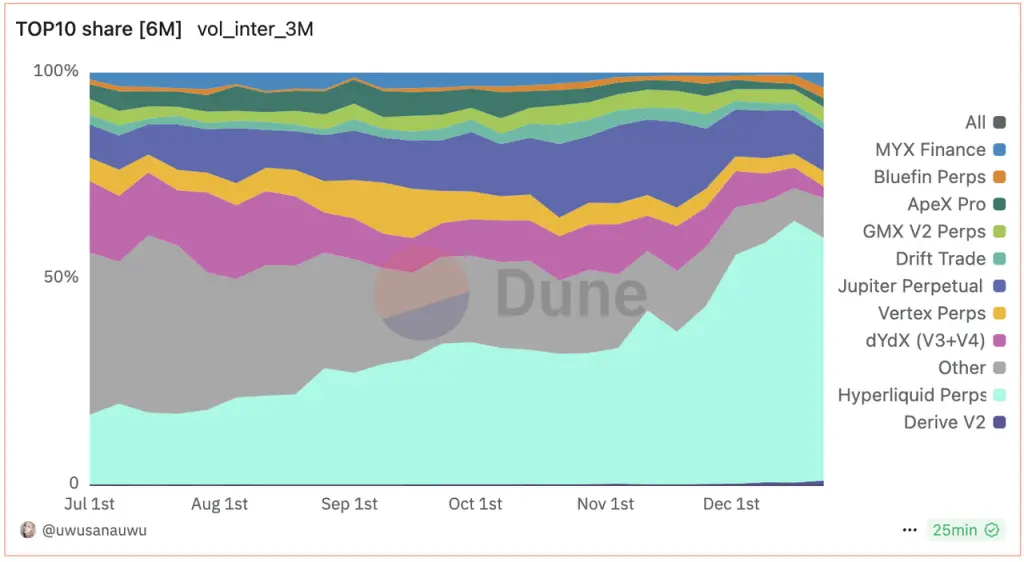
Trading volume share of decentralized derivatives exchanges Source: Dune
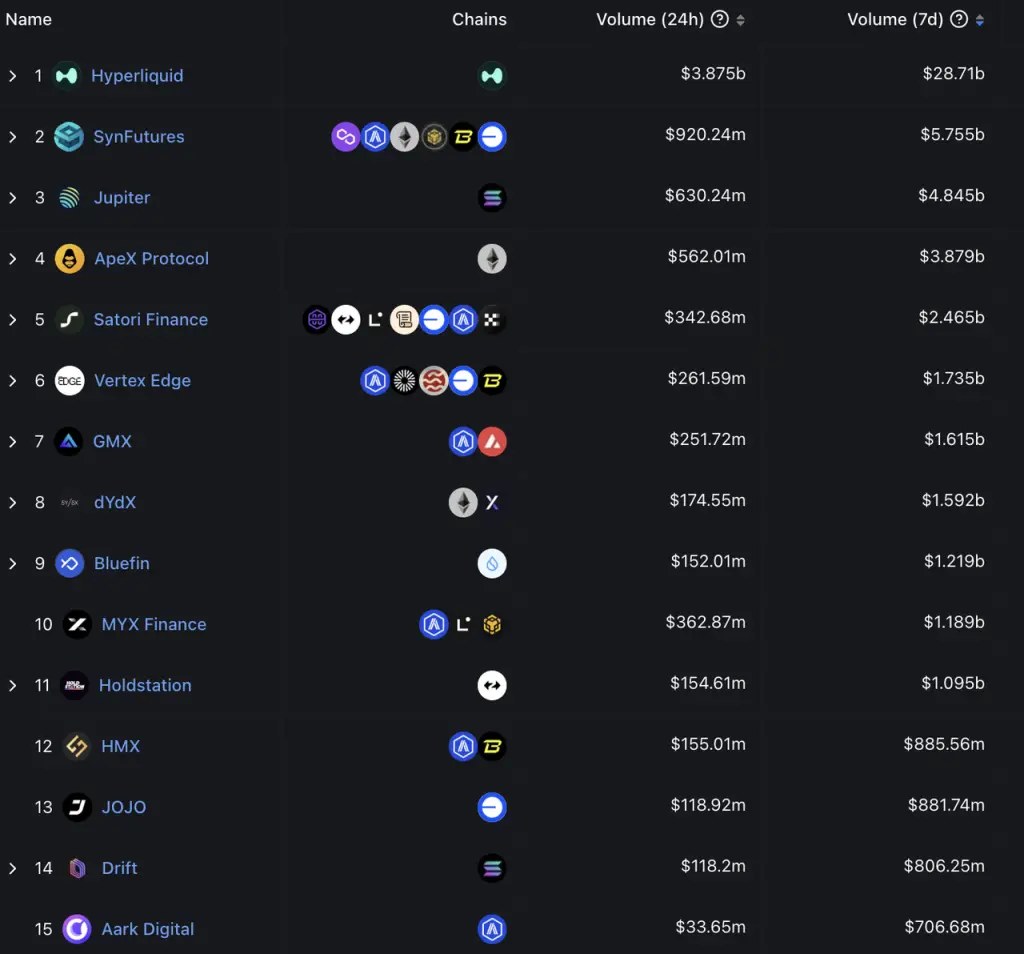
Ranking of 7-day trading volume for decentralized derivatives exchanges Source: DeFiLlama
In terms of valuation and trading volume, Hyperliquid is currently more comparable to centralized exchanges.
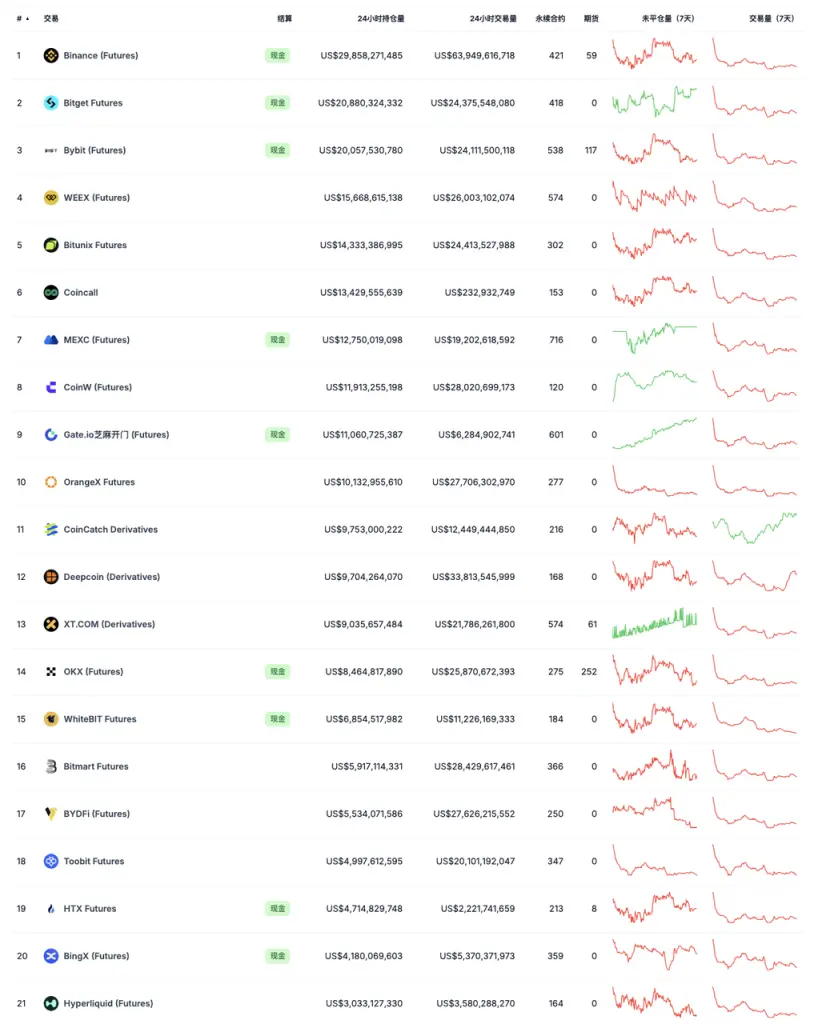
Screenshot Date: December 28, 2024 Source: Coingecko
Hyperliquid's recent data has shown a significant decline (with a peak single-day trading volume of $10.4 billion, and recent daily trading volumes below $5 billion), but its open interest still accounts for 10% of Binance, and its trading volume is 6% of Binance; open interest and trading volume are roughly equivalent to 15% of Bitget and Bybit. At its peak (December 17-20), Hyperliquid's open interest reached 12% of Binance, and trading volume reached 9%; both open interest and trading volume data were close to 20% of Bybit and Bitget.
Overall, Hyperliquid's derivatives exchange has developed rapidly, establishing a solid leading advantage in the decentralized derivatives exchange space, and the gap compared to leading centralized exchanges has narrowed to within 10 times.
2.2 Spot Exchange
Hyperliquid's spot exchange also adopts an order book model, with consistent product architecture and fee standards as the derivatives exchange.
Currently, Hyperliquid's spot exchange only lists native assets that meet the HIP-1 standard and does not list tokens from other chains.
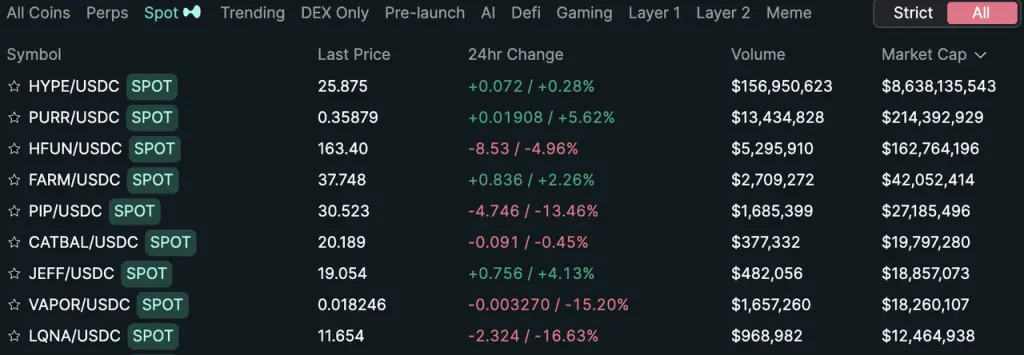
Hyperliquid's currently top-ranked spot tokens
HIP-1 (Decentralized Token Listing)
HIP-1 is similar to ERC-20 or SPL-20, serving as the token standard for the Hyperliquid network. However, unlike ERC-20 and SPL-20, the cost of creating a HIP-1 token is relatively high, as the successful creation of a HIP-1 token also means eligibility for listing on Hyperliquid's spot exchange.
The HIP-1 tokens are publicly auctioned in a Dutch auction format, specifically:
Anyone can participate in the auction, with the initial bidding price set at twice the last auction's closing price, and it linearly decreases over 31 hours to 10,000 USDC (this value is adjustable; it was previously lower and has recently been adjusted to 10,000 USDC). The first developer to successfully bid will gain the right to create a TICKER, which can be listed on Hyperliquid's spot exchange, with the bidding amount paid in USDC.
Recent auctions and closing prices:
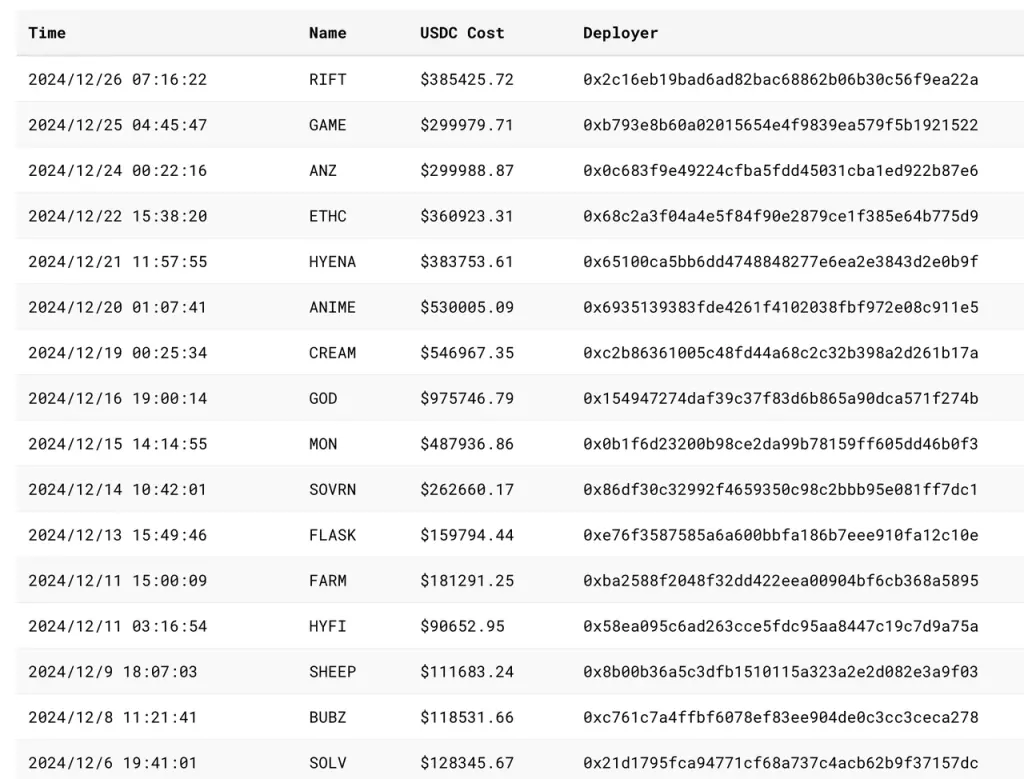
Source: asxn
Notable created Tickers (in descending order of auction amount) include:
GOD: A game backed by Pantera
CREAM: The well-established lending project Cream, troubled by hackers, associated with Machibigbrother
ANIME: The token ticker for Azuki, rumored to have been acquired by the AZUKI team, though not officially confirmed
MON: Issuer of the game Pixelmoon
SWELL: A staking & re-staking protocol in the Ethereum ecosystem
RIFT: A game protocol based on Virtual, J3ff
GAME: Rumored to be acquired based on Virtual, though not officially confirmed
ANZ: A stablecoin protocol on the base chain
SOVRN: Formerly BreederDAO (a game asset platform invested in by a16z and Delphi in the previous cycle), set to release a game on Hyperliquid
FARM: Hyperliquid's native AI pet game, launched through the Hyperfun platform
ETHC: A mining project associated with Machibigbrother
SOLV: A Bitcoin ecosystem staking protocol, backed by BN labs, currently yet to issue tokens.
SOLV can be seen as a dividing line for HIP-1 auctions; prior to this, the focus was mainly on meme and domain logic, with tickers often holding symbolic significance, and the hype centered around uniqueness within the ecosystem.
After SOLV, most projects are competing for ecological positions and listing qualifications, with prices gradually increasing, peaking at nearly $1 million for GOD. The projects are primarily focused on entertainment, with games and NFTs making up the majority, but there are also DeFi projects like Solv, Swell, and Cream.
Additionally, it can be observed that as an exchange, Hyperliquid's recent spot "listing fee" has stabilized above $100,000, which is now quite close to the listing fees of some second-tier centralized exchanges.
Through HIP-1, Hyperliquid has established a public mechanism for "decentralized token listing," where the listing fees are determined by market participants, avoiding the issues faced by centralized exchanges. On the other hand, the collected listing fees will be used for HYPE buybacks and burns, which is beneficial for HYPE's price performance and valuation metrics.
HIP-2 (Hyperliquid's AMM)
Since Hyperliquid's spot trading operates in an order book format, ensuring liquidity for new tokens can be challenging. Hyperliquid has proposed HIP-2 to address the initial liquidity issues for tokens created through HIP-1.
In simple terms, HIP-2 provides a set of automated market-making systems that allow developers to automatically market-make for tokens generated through HIP-1. The market-making logic involves linear market-making within a specified range, where developers set the upper and lower price limits for the market-making range, as well as the buy-sell boundary. The system automatically market-makes at every 0.3% price change within the range.
The following image shows an order book using HIP-2 and its parameter settings:
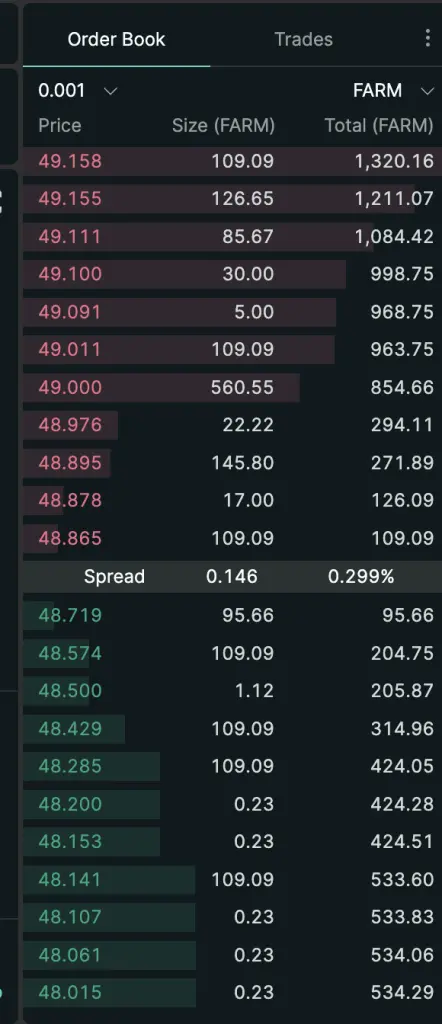
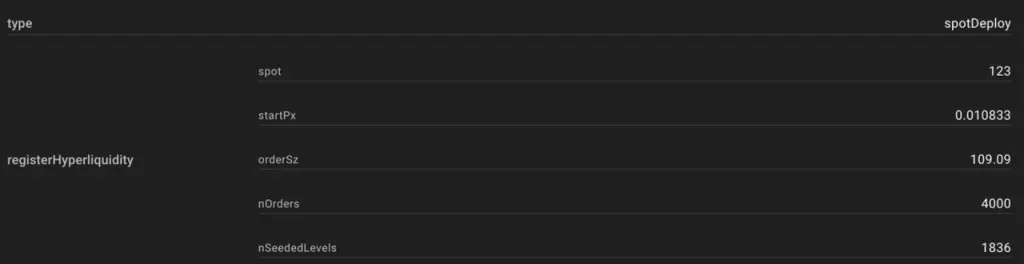
Since the launch of HIP-2, many newly created Hyperliquid ecosystem tokens have chosen to use this Hyperliquid AMM mechanism. Currently, the total USDC amount for HIP-2 has exceeded $25 million.
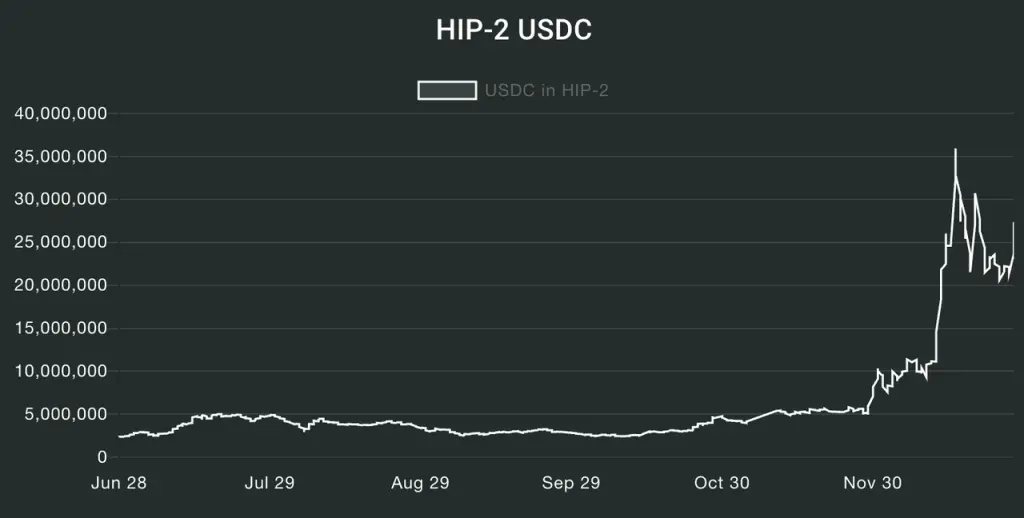
Hyperliquid's average daily spot trading volume over the last 30 days is around $400 million, ranking it among the top ten DEXs, with trading volumes comparable to Curve, Lifinity, and Orca.
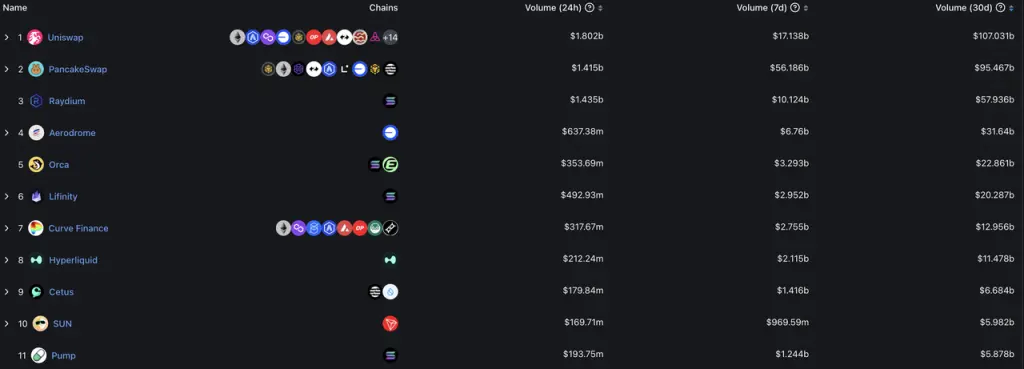
Source: DeFillama
2.3 HyperEVM
HyperEVM has not yet been launched. In Hyperliquid's official documentation, the current derivatives and spot exchanges running on RustVM are referred to as Hyperliquid L1, while HyperEVM is referred to as EVM. According to the definitions in its official documentation, HyperEVM is not an independent chain:
Hyperliquid L1 has a general EVM as part of the blockchain state. Importantly, HyperEVM is not a standalone chain but is secured by the same HyperBFT consensus mechanism as other parts of L1. This allows the EVM to interact directly with L1's native components, such as the spot and perpetual order books.
The ASXN report describes Hyperliquid's architecture as follows:
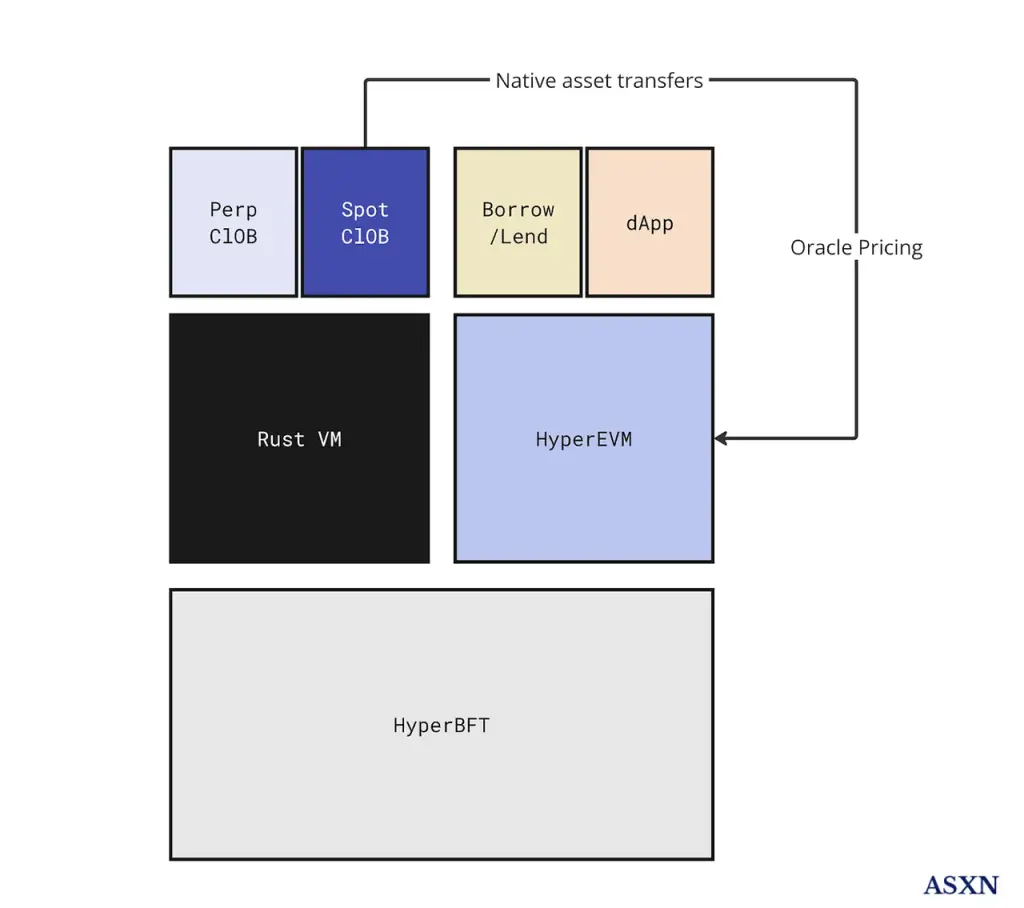
Hyperliquid operates two execution layers (RustVM and HyperEVM) on a consensus layer (HyperBFT), with its core functions for contracts and spot trading hosted on RustVM, while RustVM will focus on these two core dApps, and other dApps will be hosted on HyperEVM.
Regarding HyperEVM, according to the team's documentation, we know that:
- Unlike RustVM, which is currently used for Hyperliquid's spot and trading exchanges, HyperEVM is permissionless, meaning any developer can develop applications and issue assets (FT or NFT) on it.
- HyperEVM is interoperable with Hyperliquid's L1, allowing L1's oracles to be used by HyperEVM, and transfers of certain tokens can also be conducted between the two VMs. (Not all tokens can be transferred, as assets on L1 are "permitted," only including USDC and assets generated through HIP-1, while HyperEVM will have many more assets.)
- HyperEVM will use Hyperliquid's native token $HYPE as Gas, while Hyperliquid's current L1 does not require users to pay Gas.
I have not seen a similar product architecture in the crypto world before, and it is still unclear how typical cases of DeFi composability on Ethereum, such as "depositing ETH into Lido to obtain stETH, then depositing stETH into Aave to borrow USDC, and then using USDC to buy the meme token PEPE," can be realized on HyperEVM and Hyperliquid L1 (this may define whether it is one chain or two). However, based on my current understanding, the relationship between HyperEVM and Hyperliquid L1 may be more akin to that of an L2 with a certain level of interoperability with L1, or the relationship between a centralized exchange and its exchange EVM chain (like Binance and BNB Chain or Coinbase and Base Chain).
Currently, the HyperEVM testnet is running normally, and many validators have begun participating in the HyperEVM testnet validation, including well-known names like Chorus One, Figment, B Harvest, and Nansen.
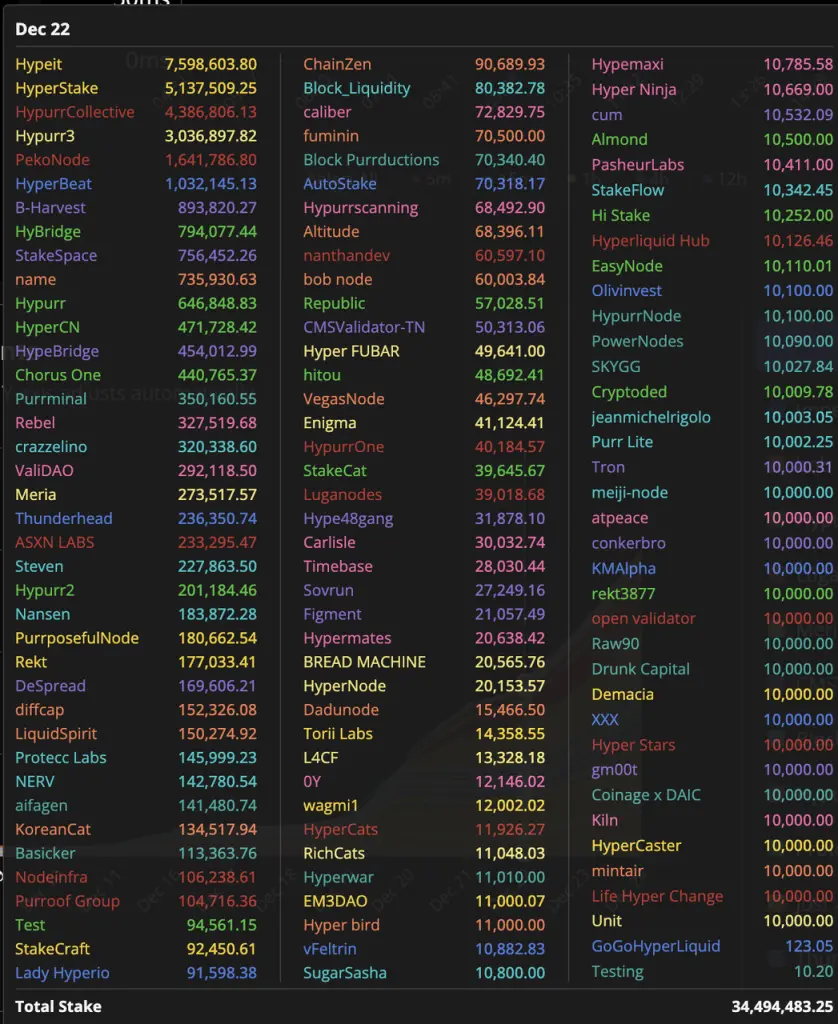
HyperEVM Testnet Validator Node List Source: ASXN
Since RustVM is not open to all developers, there are currently few applications developed based on Hyperliquid's RustVM, mostly trading auxiliary tools:
For example, Telegram trading bots like Hyperfun (token HFUN), Telegram social trading bot pvp.trade, trading terminal tealstreet, Insilico, and derivatives trading aggregator Ragetrade, among others.
HyperEVM is open to all developers, and many projects are planned to be launched on HyperEVM. In addition to the projects that have successfully obtained HIP-1 tokens mentioned earlier, the following image and the Hypurr.co website list a significant number of them.
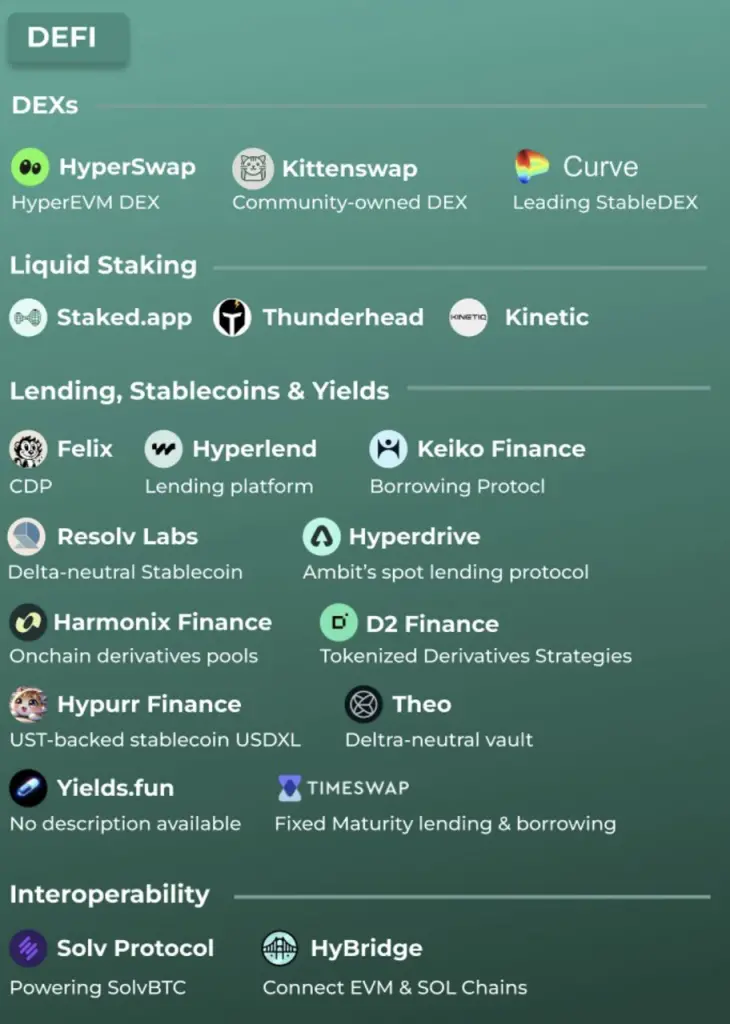
The specific mechanisms of HyperEVM and its relationship with Hyperliquid L1 will become clear once it officially launches. Currently, the official timeline for HyperEVM's launch has not been provided.
Summary: Hyperliquid's overall business positioning is similar to that of leading trading groups, with its core business being trading + L1 operations, making it a direct competitor to major trading groups. Although the business model is consistent, Hyperliquid differs from existing leading trading groups in that it chooses to build its trading business on-chain. Compared to centralized exchanges (CEX) that require permission and have opaque data, Hyperliquid's trading platform offers advantages such as permissionless access (no KYC), transparent and verifiable business data, better composability, and lower overall operational costs, allowing it to channel more revenue and profits to its token HYPE.
3. Hyperliquid Team, Token Economic Model, and Valuation
3.1 Team
Hyperliquid has two co-founders, Jeff Yan and iliensinc, who are alumni of Harvard University. Before entering the crypto industry, Jeff worked at Google and Hudson River Trading. The Hyperliquid team is quite lean; according to an ASXN report from September, there are a total of 10 team members, of which 5 are engineers, which is particularly notable for a derivatives exchange with a daily trading volume exceeding $10 billion.
From the process of building the entire product by the Hyperliquid team, especially their commitment to self-funded R&D, building a high-performance chain to achieve a fully on-chain order book, and the highly innovative HIP-1, it is impressive how the team, despite being small, consistently solves problems based on first principles.
3.2 $HYPE Economic Model
The total supply of $HYPE is 1 billion tokens, officially launching on November 29, 2024. Since there was no fundraising, there are no investor shares, and the specific distribution is as follows:
- 31.0% Genesis distribution, airdropped to early users of Hyperliquid based on points, fully circulating.
- 38.888% for future emissions and community rewards
- 23.8% allocated to the team, with a one-year lock-up before release, most of which will be released between 2027-2028, with some continuing to be released after 2028
- 6.0% Hyper Foundation
- 0.3% community grants
- 0.012% HIP-2
The overall allocation between the team and the community is in a 3:7 ratio. The current distribution of token holding addresses is as follows:
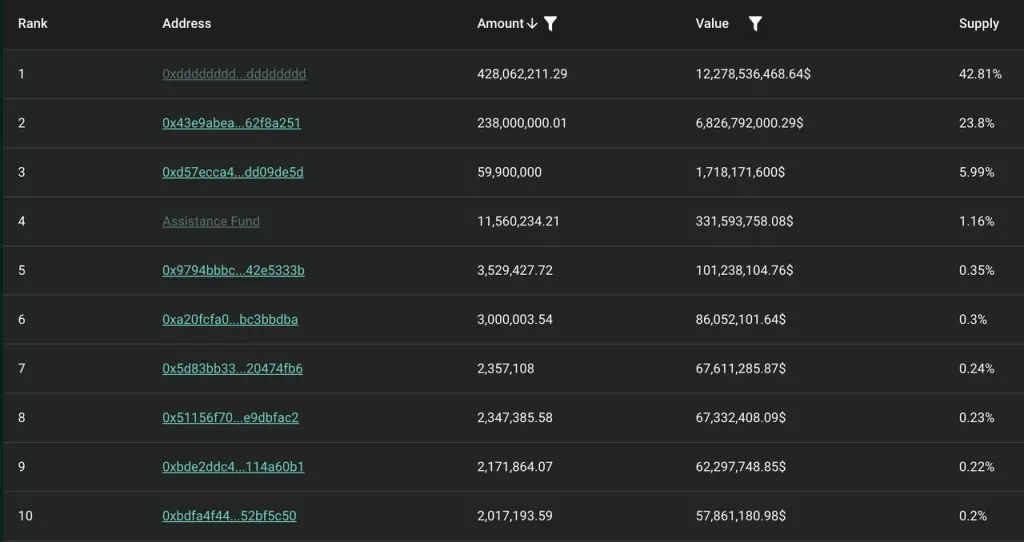
Excluding community addresses, team addresses, and foundation addresses, the address holding the most tokens currently is the Assistance Fund (AF), which holds 1.16% of the total HYPE supply, accounting for 3.74% of the circulating supply.
Currently, the parts of the entire Hyperliquid ecosystem that involve fees consist of two components: trading fees and HIP-1 auction fees. Trading fees include transaction fees for spot and contracts, contract funding fees, and contract liquidation fees. Since Hyperliquid L1 does not charge users gas fees and HyperEVM has not yet launched, Hyperliquid's current revenue does not include trading gas fees.
According to the team's statements in the documentation:
On most other protocols, the team or insiders are the main beneficiaries of fees. On Hyperliquid, fees are entirely directed to the community (HLP and the assistance fund). For security, the assistance fund holds a majority of its assets in HYPE, which is the most liquid native asset on the Hyperliquid L1.
In most other protocols, the team or insiders are the main beneficiaries of fees. On Hyperliquid, fees are entirely directed to the community (HLP and the assistance fund). The assistance fund holds a majority of its assets in HYPE, as this is the most liquid native asset on Hyperliquid L1.
All fees belong to HLP and AF. However, the team has not explicitly disclosed the ratio of fees between HLP and AF.
Fortunately, the data on Hyperliquid L1 is publicly accessible. According to the logic inferred by @stevenyuntcap in his tweet, as of early December, Hyperliquid has cumulatively subsidized HLP with $44 million since its launch, while the initial funds for AF to purchase HYPE amounted to $52 million. This leads to the conclusion that Hyperliquid's cumulative revenue from its launch to early December is $96 million, with the distribution ratio of total protocol revenue between HLP and AF being 46%:54%. (Additionally, we can calculate that Hyperliquid's cumulative trading volume during this period was $428 billion, which translates to an average contract fee rate of approximately 0.0225%.)
Since all of AF's USDC has been used to repurchase HYPE, we can simplify this to say that 46% of Hyperliquid's perpetual contract trading revenue during this period was allocated to the supply side (HLP holders), while 54% was used for repurchasing $HYPE tokens.
Of course, in addition to perpetual contract trading fees, Hyperliquid will also have two additional sources of revenue that will benefit HYPE holders: auction fees from HIP-1 and a portion of USDC from spot trading fees. Currently, both of these revenue streams are also fully directed to AF for HYPE repurchases (this also includes the HYPE portion of the HYPE-USDC spot trading fees, which is currently being directly burned, with a cumulative burn of 110,000 HYPE tokens).
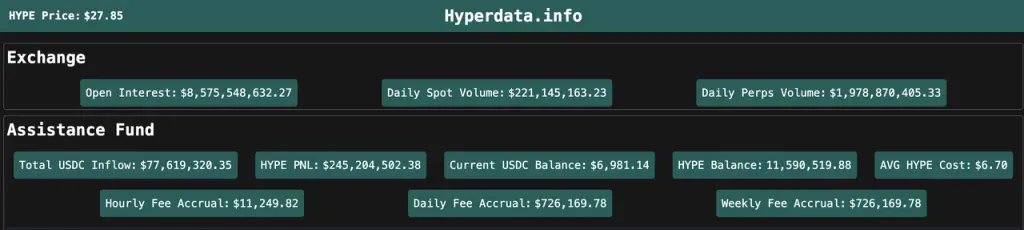
Currently, AF's strategy remains to periodically use all accumulated USDC to purchase HYPE, allowing us to track Hyperliquid's profit situation and the intensity of HYPE repurchases based on AF's USDC inflow data. According to data from hyperdata.info, AF's cumulative USDC inflow has exceeded $77 million, with over $25 million in the last month, averaging about $1 million in daily HYPE repurchases.
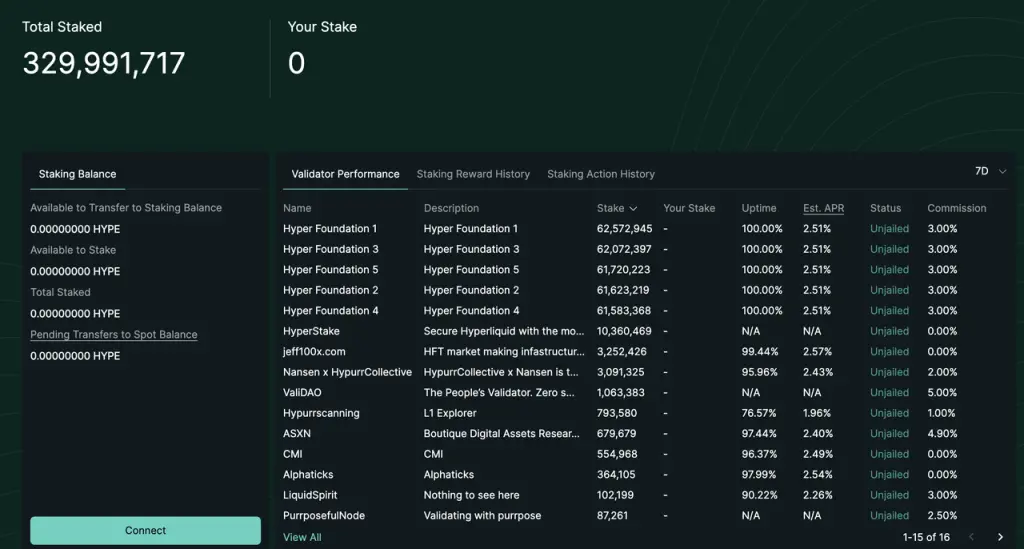
On December 30, 2024, Hyperliquid officially launched the HYPE staking feature, with the current yield for HYPE staking being approximately 2.5%. This yield only includes fixed PoS consensus layer earnings, with the yield consensus referencing the yield consensus of Ethereum's consensus layer (the yield is inversely proportional to the square of the amount of staked HYPE). Currently, aside from the 300 million tokens held by the team and the foundation, nearly 30 million user tokens are also participating in staking.
Looking ahead, there are still many potential adjustments to the economic model of HYPE, such as:
- The launch of HyperEVM,
- $HYPE used as gas for HyperEVM
- Distribution of execution layer earnings to HYPE stakers (current HYPE staking earnings only include)
- Redistribution of fees to $HYPE holders
- Discount on $HYPE staking fees
3.3 Valuation
Next, we will explore two valuation frameworks for Hyperliquid. Before we begin, it is important to note:
- The data fluctuations of Hyperliquid itself are significant—its market cap, TVL, revenue, user data, etc., have seen several-fold or even ten-fold increases over the past month, followed by a 50% retracement. The volatility of its metrics far exceeds what is reflected in the valuation indicators listed below. The following valuation frameworks are more suitable for long-term valuation reference.
- The price of HYPE is currently Hyperliquid's biggest fundamental factor, and the surge in various data points is more a result of the rise in HYPE's price rather than "Hyperliquid having such good data leading to such a price."
Framework 1: Comparison with BNB
Hyperliquid's main thesis is the "on-chain Binance" proposed by Messari:
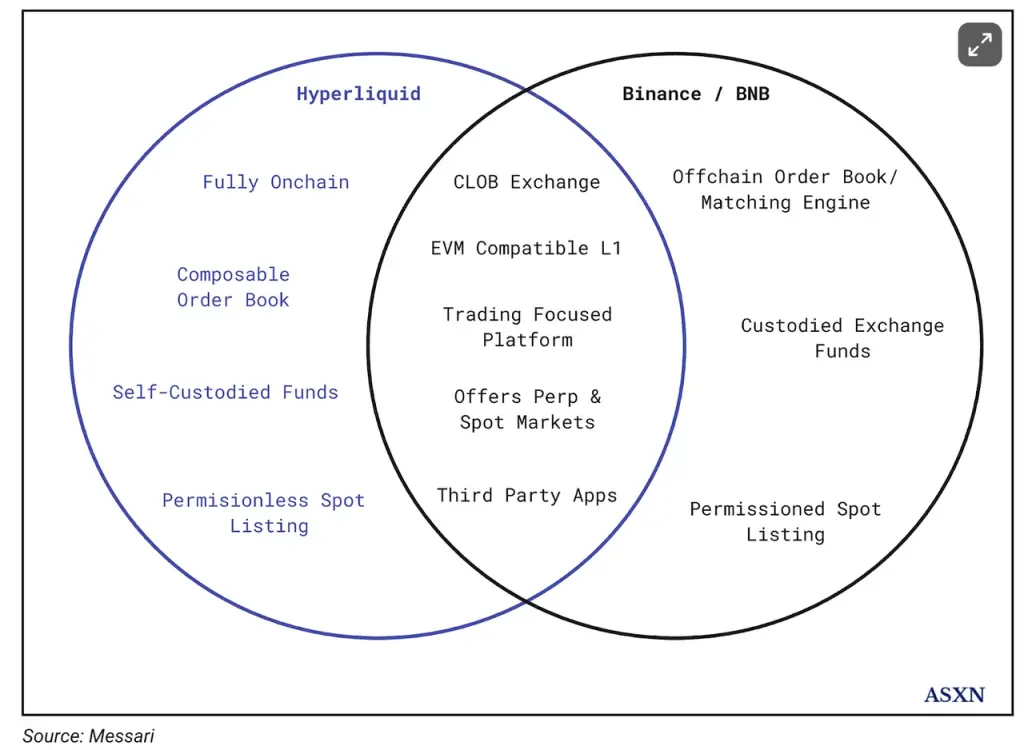
This analogy is generally reasonable and may indeed serve as a good framework; Binance/BNB is likely the most suitable comparison for Hyperliquid/HYPE.
- Hyperliquid's core business is derivatives and spot exchanges, which aligns with Binance's main business;
- HyperEVM can be compared to BNBChain; although HyperEVM has not yet launched, based on the current design, both HYPE and BNB can be used as gas for EVM chains and can be staked for rewards;
- Both HYPE and BNB can directly benefit from platform trading fees;
Next, we will compare Hyperliquid with Binance based on its architecture, dividing it into derivatives exchange, spot exchange, and EVM.
- Derivatives Exchange:
As mentioned earlier, Hyperliquid's recent position and trading volume data are around 10% of Binance's corresponding data, so we roughly estimate that in the derivatives exchange module, HYPE = 10% BNB.
- Spot Exchange:
Hyperliquid's average daily spot trading volume over the past thirty days is around $400 million, while Binance's average daily spot trading volume is approximately $26 billion after excluding the fee-free FDUSD trading pair, HYPE = 1.5% BNB.
- EVM:
Following the logic above, we believe that the relationship between HyperEVM and Hyperliquid L1 is more similar to that of Binance exchange and BNBChain.
Since HyperEVM has not yet launched, we cannot confirm how much TVL will migrate from RustVM to HyperEVM. However, from the product architecture and corresponding experience, the overall logic is still based on migrating existing users from the exchange. We list the data for Binance and Coinbase, and considering the market's enthusiastic sentiment towards HYPE, we assume that 10% of Exchange TVL will migrate to the chain (still optimistic, but currently, most articles using TVL valuation assume that 100% of Hyperliquid TVL will migrate to HyperEVM). Based on this calculation, HYPE = 3% BNB.
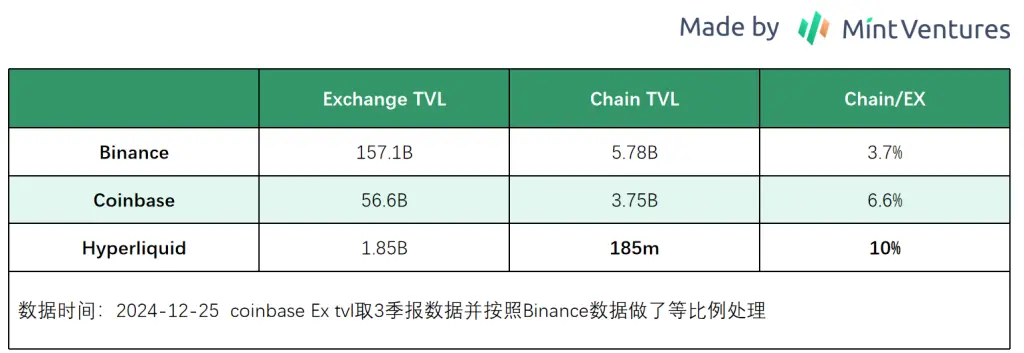
- Economic Model
In addition, we also need to consider the differences between the economic models of HYPE and BNB.
From the analysis of the HYPE economic model above, it can be seen that currently, HYPE converts 54% of the platform's gross profit and 100% of the net profit into repurchases or burns of HYPE.
Previously, BNB used to allocate 20% of Binance's net profit for repurchasing BNB according to its white paper. After decoupling the repurchase and destruction from the platform's net profit in 2021, we have no way of knowing the proportion of net profit allocated to BNB. However, based on the trend of destruction data and Binance's market position during the same period, the proportion of net profit destruction has likely remained at a similar level.
From the perspective of the (holder's) economic model, HYPE is significantly superior to BNB.
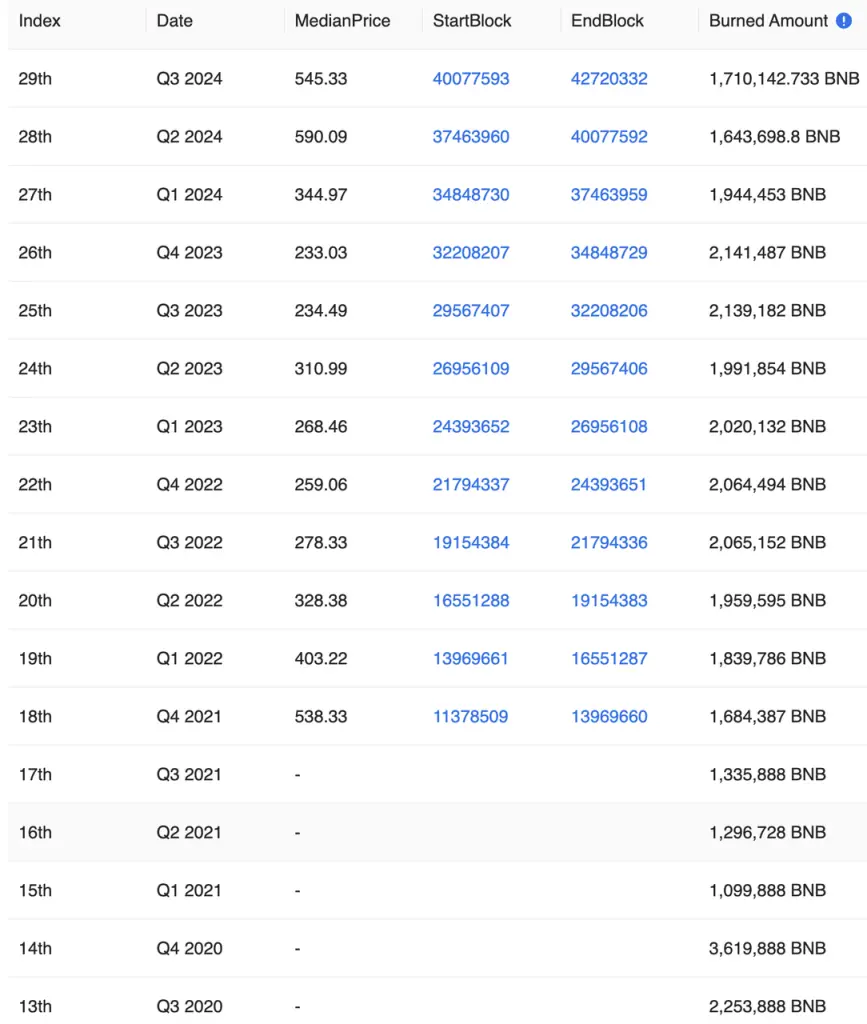
BNB historical destruction data source
Additionally, it is worth mentioning that the proportion of Hyperliquid's revenue flowing to HYPE tokens is currently 54%, and this value still has room for further increase. Due to mechanism reasons, HLP has held a large number of cryptocurrency short positions collateralized by USDC since July 2023 during a bull market where BTC has risen over 200%. Although HLP's strategy has been appropriate and has managed to maintain a break-even point, it still needs to pay an annualized APR of over 30% to retain funds within HLP.
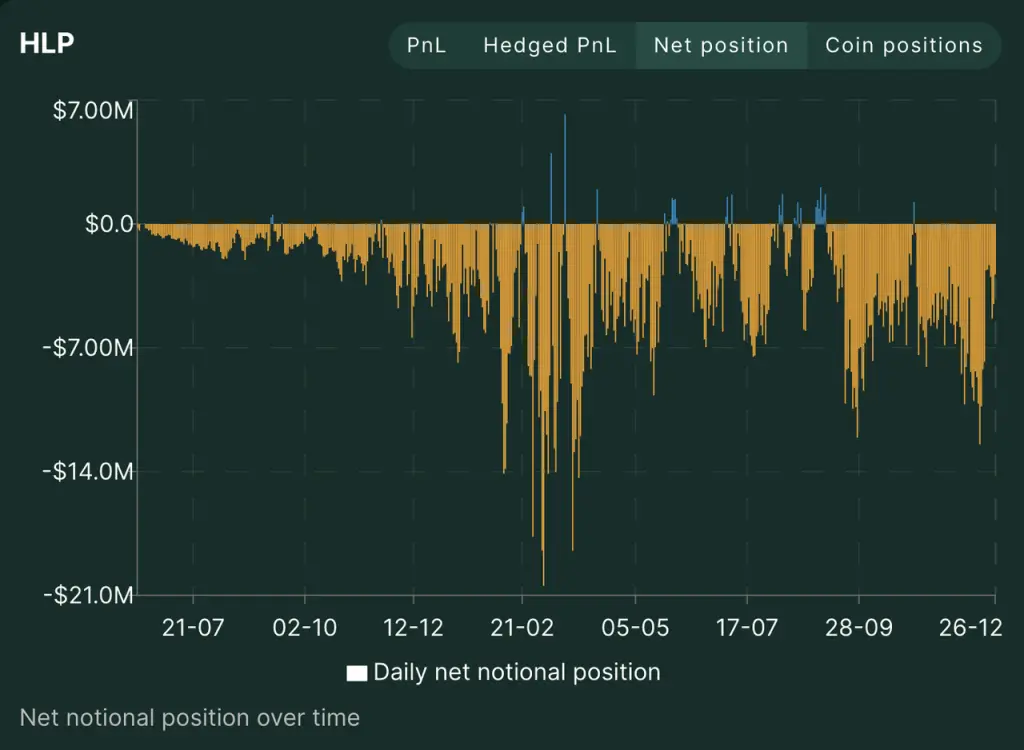
HLP historical net positions Source: Hyperliquid official website
In the future, as the market gradually peaks, the overall trend of crypto users as net long positions in derivatives will not change. The probability of HLP's strategy yielding returns will increase in a volatile and bear market (we can see a similar trend from the historical returns of GMX's GLP and GNS's Vault). Hyperliquid may not need to allocate such a large proportion of its revenue as rent payments to HLP, and Hyperliquid's net profit margin is still expected to improve further.
Speaking of net profit margin, we cannot know the specific net profit margin of Binance. However, we can glean some insights into the operating costs of centralized exchanges from the reports of the publicly listed company Coinbase.
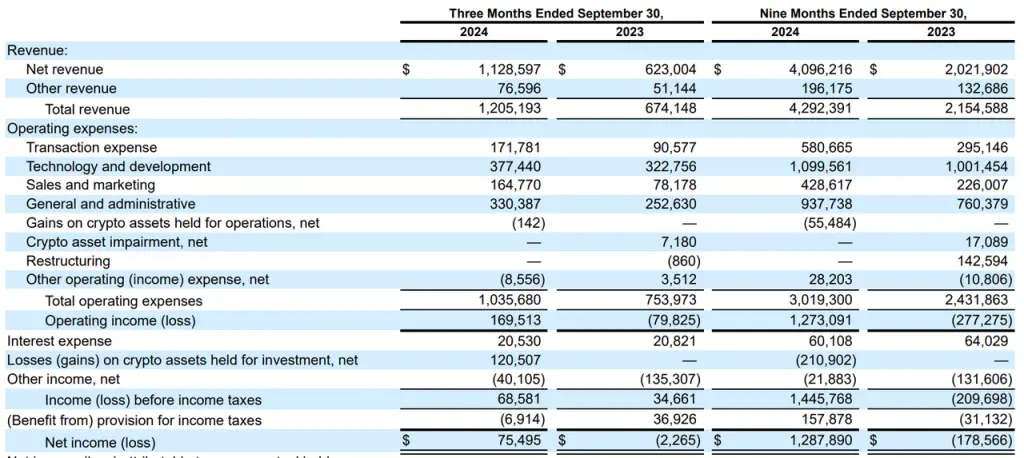
Coinbase quarterly report Q3 2024
It can be seen that in 2023, Coinbase's operating expenses (R&D, management, sales expenses, and transfer fees) averaged over $600 million per quarter, which is roughly equivalent to total revenue, resulting in a net profit margin close to 0; in 2024, as the market exploded, its net profit margin improved significantly, but it still fell short of 30%.
From the above numerical comparison, we can clearly see Hyperliquid's net profit margin (economic model) has advantages over centralized trading. We can also look at this advantage through a specific event: the handling of listing issues.
Centralized exchanges typically have a dedicated listing team responsible for tracking market trends and negotiating with various project teams to collect listing fees and/or project tokens. Centralized exchanges need to pay substantial salaries and commissions to the listing team, as well as salaries to the internal control team that monitors potential conflicts of interest during the listing process.
In contrast, Hyperliquid's listing process, HIP-1, as mentioned earlier, operates automatically based on pre-defined code, making the operational cost of new listings approach zero, allowing its income from "listing fees" to be fully allocated to HYPE holders.
In summary, as of the end of December 2024, we have the following comparisons:
Derivatives Trading: HYPE = 10% BNB
Spot Trading: HYPE = 1.5% BNB
EVM (estimated): HYPE = 3% BNB
Economic Model: HYPE is significantly superior to BNB
Circulating Market Cap: HYPE = 9% BNB
Fully Circulating Market Cap: HYPE = 27% BNB
Derivatives trading is currently Hyperliquid's main business and should carry a relatively high weight in the valuation comparison. In my opinion, while HYPE's current market cap cannot be considered cheap, it is also not overly expensive.
Framework 2: PS
HYPE has a token repurchase and burn mechanism that directly affects the HYPE token, allowing for valuation using the PS metric, as follows:
- Contract Trading Fees:
We estimate based on an average contract trading fee of 0.0225% and a profit distribution ratio of 46:54 between HLP and AF.
In the past month, Hyperliquid's contract revenue = $154.7 billion * 0.0225% = $34.8 million, of which about 54% goes to AF for repurchasing HYPE, resulting in a repurchase amount of $18.79 million, corresponding to an annualized net profit of $225.5 million.
- HIP-1 Auction Fees:
In the past month, revenue was $6.1 million, and with the 46:54 distribution ratio between HLP and AF, this portion corresponds to an annualized net profit of $39.5 million.
- Spot Trading Fees:
Hyperliquid's spot trading fee structure is the same as that of contract trading, and the distribution of the USDC portion of the fees is also the same as that of contract trading, meaning profits are distributed between HLP and AF at a ratio of 46:54; other token fees in spot trading (for example, in HYPE-USDC trading, the HYPE buyer pays USDC fees, and the HYPE seller pays HYPE fees) are directly burned.
Therefore, we need to calculate the net profit from spot trading fees for HYPE in two parts:
HYPE portion: This can be directly queried through a block explorer. The TGE of the HYPE token was exactly 30 days ago, and the number of HYPE tokens burned was 110,490, corresponding to an annualized burn of 1,325,880 tokens, valued at approximately $37 million at the current price.
USDC portion: In the past 30 days, Hyperliquid's spot trading volume was $11.5 billion, and the portion used for repurchasing HYPE in spot trading = $11.5 billion * 0.0225 * 54% = $1.397 million, corresponding to an annualized net profit of $16.77 million.
Combining the above three fee components, we annualize the calculations based on the most recent month's data, resulting in a total amount of $318,770,000 allocated for repurchasing HYPE.
Based on the circulating market cap, HYPE's P/S is 29.4, and based on the fully circulating market cap, HYPE's P/S is 88.
We have listed some circulating P/S metrics of crypto projects that are somewhat comparable to Hyperliquid:
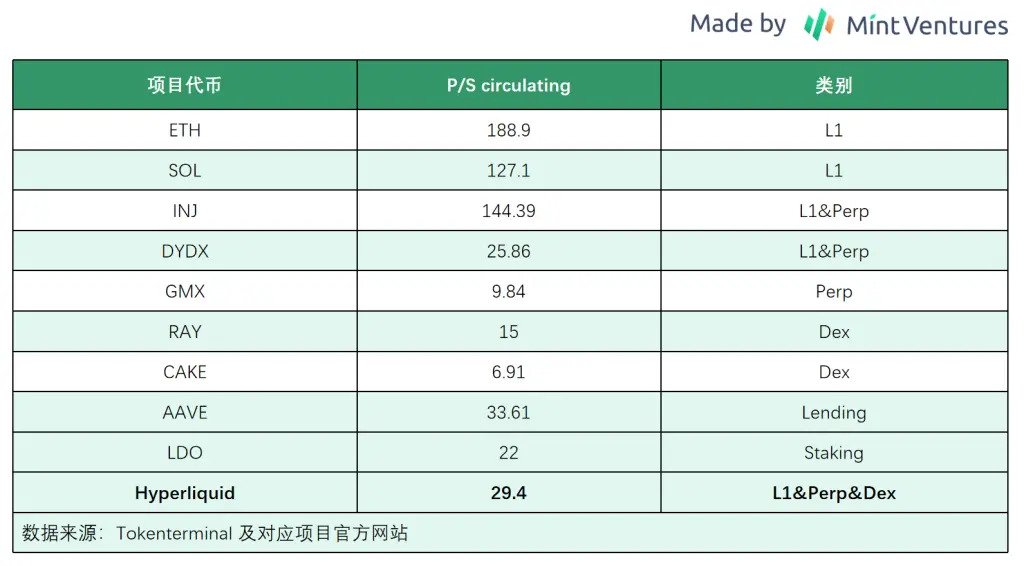
It can be seen that the P/S valuation of L1 is significantly higher than that of applications, while Hyperliquid's P/S valuation is significantly lower than that of comparable other L1s.
The above presents two frameworks for valuing HYPE. It is important to remind again that:
- Hyperliquid's data fluctuations are significant—its market cap, TVL, revenue, user data, etc., have seen several-fold or even ten-fold increases over the past month, followed by a 50% retracement. The volatility of its metrics far exceeds what is reflected in the valuation indicators listed below. The above valuation frameworks are more suitable for long-term valuation reference.
- The price of HYPE is currently Hyperliquid's biggest fundamental factor, and the surge in various data points is more a result of the rise in HYPE's price rather than "Hyperliquid having such good data leading to such a price."
4. Risks
Hyperliquid faces the following risks:
- Financial risk: Currently, all of Hyperliquid's funds are stored in its bridge on the Arbitrum network. The security of this smart contract, as well as the security of the multi-signature managed by a 3/4 team, is crucial.
- Code risk: This includes the current risks of L1 and the risks associated with HyperEVM. Hyperliquid employs an innovative architecture and consensus, and its current non-open-source status reduces the likelihood of being attacked. However, as Hyperliquid's scale and influence grow, along with the launch of HyperEVM, the potential for attacks or code vulnerabilities is gradually increasing.
- Oracle risk: This is an inherent risk for all derivatives exchanges.
- Regulatory risks leading to a loss of comparative advantage: The lack of KYC requirements is currently Hyperliquid's main comparative advantage over centralized exchanges. As Hyperliquid continues to grow, there may be regulatory requirements such as anti-money laundering from regulators.
References:
https://hyperfnd.medium.com/hype-genesis-1830a4dc2e3f
https://newsletter.asxn.xyz/p/hyperliquid-the-hyperoptimized-ord
https://data.asxn.xyz/dashboard/hl-auctions
https://hypurrscan.io/token/0x0d01dc56dcaaca66ad901c959b4011ec
https://www.prestolabs.io/research/hyperliquid-the-hype-begins#4.1-Decentralization
https://x.com/0xak_/status/1871051318267445562
https://x.com/Darrenlautf/status/1869961681671184629
https://x.com/stevenyuntcap/status/1863643385002652044
免责声明:本文章仅代表作者个人观点,不代表本平台的立场和观点。本文章仅供信息分享,不构成对任何人的任何投资建议。用户与作者之间的任何争议,与本平台无关。如网页中刊载的文章或图片涉及侵权,请提供相关的权利证明和身份证明发送邮件到support@aicoin.com,本平台相关工作人员将会进行核查。


