Author: Xiyou, ChainCatcher
Editor: Nianqing, ChainCatcher
In 2024, the "Crypto+AI" (Crypto AI) field achieved unprecedented breakthrough growth. At the beginning of the year, this sector was composed of only a handful of projects, but it has now become an independent track in the crypto market that cannot be ignored.
According to the latest data compiled by ChainCatcher, as of December 7, the total market capitalization of the crypto AI sector has surpassed $70 billion, reaching a peak market share of 2% in the entire crypto market, with an annual growth rate of 400%.
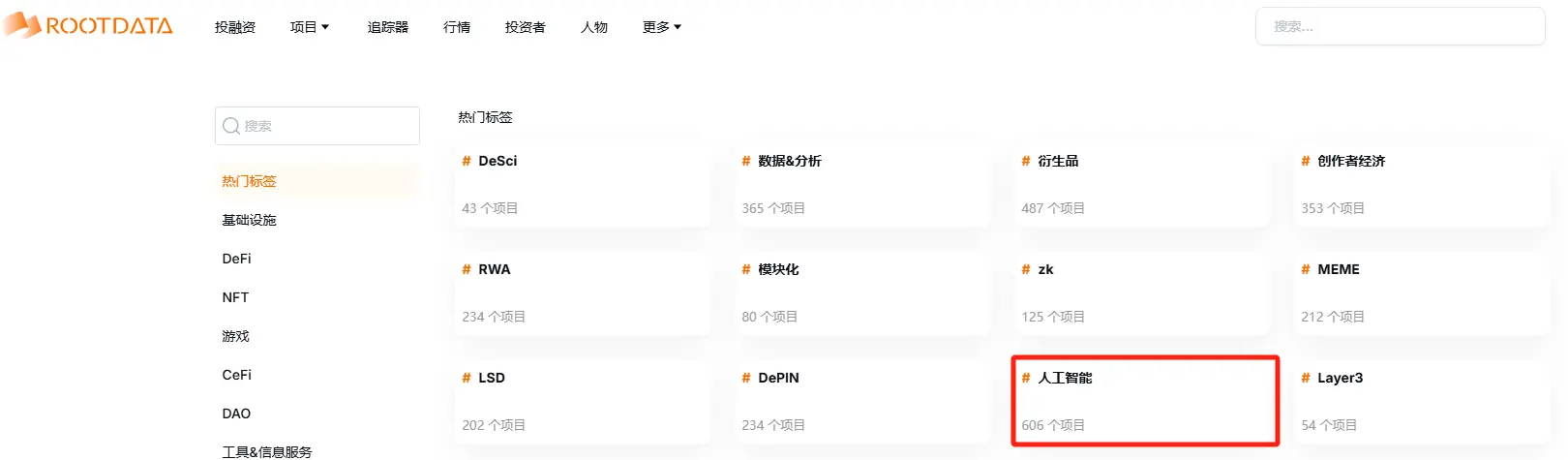
Meanwhile, the number of crypto AI projects has also seen explosive growth, now exceeding 600, covering various categories such as decentralized AI infrastructure and AI Dapps.
Looking back at 2024, the narrative of crypto AI has undergone several significant changes. At the beginning of the year, the Sora project launched by OpenAI ignited a hype around crypto AI infrastructure. Subsequently, the annual AI conference held by Nvidia brought decentralized GPUs into the spotlight, leading investors to flock to AI decentralized infrastructure. By mid-year, the crypto AI sector experienced an investment boom, with crypto VC firms announcing their involvement, and numerous crypto projects receiving funding, accelerating the development and application of technology. By the end of the year, the explosion of the AI Agent Meme pushed the narrative of crypto AI to a new climax.
Total Market Capitalization of Crypto AI Surpasses $70 Billion, Number of Related Projects Exceeds 600
According to the latest data from CoinMarketCap, the number of tokens in the crypto AI sector has reached 355, with a total market capitalization surpassing $70 billion as of December 7, peaking at $70.42 billion. Currently, influenced by the overall market correction trend in the crypto market, as of December 23, the total market capitalization of the crypto AI sector has fallen to $47 billion, with a 24-hour trading volume still reaching $5 billion.
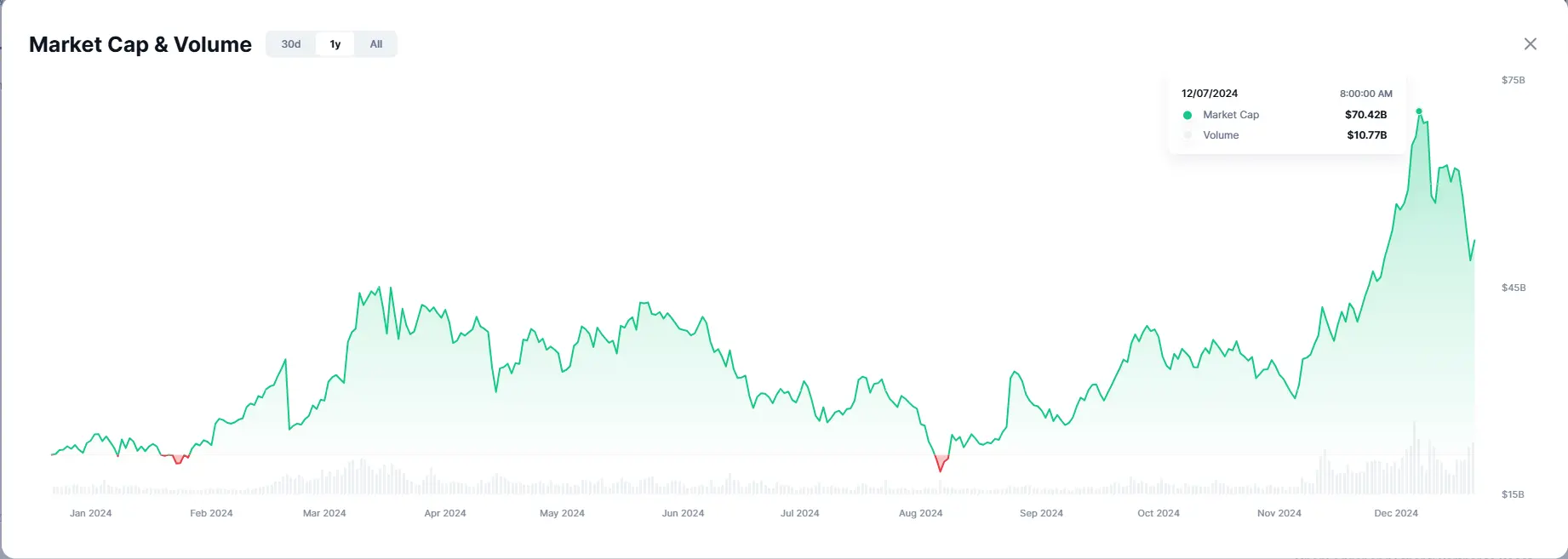
At the beginning of the year, the total market capitalization of the crypto AI sector was only $17 billion. In less than a year, this sector has achieved an increase of over 400%, showcasing the vigorous development and immense potential of the crypto AI field.
Daniel Cheung, co-founder of Syncracy Capital, expressed his views on December 12, stating that although the current crypto AI sector only accounts for about 1% of the total market capitalization of the crypto market, with the continuous evolution of market cycles and the strong momentum of AI infrastructure and AI Agents, he predicts that the market capitalization of this sector is expected to achieve a tenfold increase.
It is worth mentioning that despite the overall decline in the crypto market, the total market capitalization of the entire crypto market reached $3.4 trillion on December 23, while the market capitalization of crypto AI assets still accounted for nearly 1.4% of the entire market (with a peak market share exceeding 2%), further proving its future market growth potential.
2024 can be regarded as a pivotal turning point for the crypto AI field, transitioning from emerging prominence to full-scale explosion. At the beginning of the year, the crypto AI sector was still in its infancy, with only a few projects, mainly represented by decentralized GPU projects like Render (RNDR), AI infrastructure like Fetch.ai (FET), and WorldCoin. However, in less than a year, the crypto AI field has been subdivided into multiple tracks, covering decentralized GPUs, AI data platforms, AI infrastructure, and AI Agents, with hundreds of projects.
According to the crypto data platform Rootdata, the number of crypto projects containing AI keywords has now exceeded 600, and this number continues to grow.
2024 Crypto AI Catalysts: External Forces like OpenAI Narrative, VC Heavy Investments, and AI Agent Meme Explosion
From the data trends of the total market capitalization of crypto AI assets, the growth in 2024 shows two significant peaks: the first peak occurred between February and March, while the second occurred after October, ushering in a stronger wave of growth.
During the February to March period, the growth in the crypto AI field was primarily driven by two landmark events in the AI sector.
In February, OpenAI made a groundbreaking release of the "text-to-video" model Sora, which sparked a revolutionary change in the AI field. At the same time, this event significantly boosted the price of the token WLD for the iris authentication crypto project Worldcoin, led by OpenAI founder Sam Altman, further driving the strong growth of the entire crypto AI asset sector. During this period, high-quality projects such as the AI model incentive platform Bittensor (TAO) and the AI data platform Arkham's ARKM began to receive widespread market attention, and the rise of these projects further ignited investment enthusiasm in the crypto AI market, attracting a large influx of investors into this promising emerging field.
Following this, the grand opening of Nvidia's annual AI conference GTC in March attracted widespread global attention again, driving its market capitalization to soar and triggering a GPU chip hype. At the conference, the appearances of leading figures in the crypto industry, such as Illia Polosukhin, co-founder of Near, and Jules Urbach, founder of the decentralized GPU rendering network Render Network, injected new vitality into the crypto AI field once again. This series of events led to the emergence of decentralized GPU and other conceptual projects, among which the once-popular decentralized io.net was founded at this time.
From then on, crypto AI officially developed into an independent track, with projects related to AI infrastructure, decentralized GPUs, and decentralized AI data emerging in droves, providing the market with more choices and opportunities.
In October, the growth in the crypto AI field was mainly attributed to the explosive emergence of AI Agent Memes. The launch of the AI Agent project Truth Terminal's token GOAT triggered a wave of hype around AI Agent Meme projects, leading to the mass issuance of nearly a hundred AI Agent Meme coins. This trend allowed AI Agents to rapidly rise, becoming an independent sub-track within the crypto AI field, with products covering AI Agent Meme coins, AI Agent issuance platforms (IAO), and AI Agent underlying infrastructure. For specific projects, please refer to the article "Systematic Overview of the AI Agent Track: AI Meme, Issuance Platforms, and Infrastructure." According to Coingecko data, as of December 23, the total market capitalization of AI Agent track tokens has reached $9.8 billion, accounting for about 20% of the total market capitalization of the entire crypto AI sector ($47 billion), and the hype continues.
If the text-to-video tool Sora launched by OpenAI, the rise in Nvidia's market capitalization, and its AI summit constitute strong external driving forces for the development of the crypto AI field, then the explosive growth of AI Agent Memes is undoubtedly a fire ignited internally within the crypto market, accelerating the rise of this field. Under the combined effect of both internal and external catalysts, the crypto AI track has rapidly become a key area in the crypto world that cannot be ignored, with its importance becoming increasingly significant.
Additionally, in 2024, the crypto AI market has welcomed an unprecedented investment boom, with major investment institutions rushing in and investment amounts soaring. In this field, top venture capital firms in the crypto industry, such as Grayscale, Delphi Venture, Coinbase Ventures, Binance Labs, and a16z, have all actively laid out "Crypto+AI" projects.
Among them, Delphi Ventures expressed high optimism about the combination of Crypto and AI at the beginning of the year and invested in several related projects, such as io.net, OG Labs, and Mythos Ventures. a16z raised a new fund of $6 billion, focusing on investments in the AI field, and selected five crypto AI projects in its fall crypto startup accelerator. Entering the second half of the year, institutions such as Pantera Capital, Grayscale, Binance Labs, and Coinbase Ventures also announced their entry into the crypto AI field, establishing dedicated funds or increasing investment efforts. According to a report released by Messari, in the third quarter of 2024, crypto venture capital firms injected over $213 million into AI projects, a quarter-on-quarter increase of 250% and a year-on-year increase of 340%.
For specific actions and details of various crypto institutions in the crypto AI field, please refer to the article "2024 Crypto Venture Capital AI Layout Analysis: What Projects Have Top VCs Like a16z, Binance, and Coinbase Invested In? | Annual Review."
"Crypto for AI" Market Prospects Greater than "AI for Crypto"
Currently, the crypto AI products on the market can mainly be divided into two forms: "AI for Crypto" and "Crypto for AI."
The former, "AI for Crypto," refers to empowering Crypto with AI, primarily focusing on applying AI technology to crypto products to enhance user experience or strengthen various product performances. For example, using AI for code optimization and security audits: AI technology can automatically detect and analyze the code of Web3 projects, identifying potential security vulnerabilities and errors, thereby improving the security and stability of the projects; participating in on-chain yield strategies: utilizing AI algorithms to analyze market trends and user behavior to formulate more efficient on-chain yield strategies, helping crypto users achieve higher returns; integrating AI chatbots to answer user inquiries and enhance user experience; leveraging AI Agents to eliminate barriers in on-chain user experiences, such as automated trading and asset management, allowing users to participate in the crypto market more conveniently.
“Crypto for AI” focuses on empowering the AI industry through crypto technology, leveraging the unique advantages of blockchain technology to solve or improve certain aspects of the AI industry. For example, the privacy and transparency of blockchain technology can address privacy and security issues in the data collection, processing, and storage processes of AI models; by using tokenized model assets, communities can own or use AI models in a decentralized manner; and through blockchain's token technology, idle computing power resources can be aggregated to form a computing power market, reducing the costs of training AI models and improving the efficiency of computing resource utilization.
In summary, the essence of Web3 technology lies in its decentralized blockchain infrastructure, which operates on a token economic system, autonomous execution of smart contracts, and the powerful capabilities of distributed technology. This not only ensures precise definition of data ownership but also greatly enhances the transparency and efficiency of business models through token incentive mechanisms. This characteristic acts as a remedy for the prevalent issues in the AI industry, such as data opacity and vague business models, providing effective solutions. This aligns perfectly with the macro concept that "AI aims to enhance production efficiency, while Web3 focuses on optimizing production relationships."
Therefore, industry professionals generally reach a consensus: “Crypto for AI” presents broader prospects and potential in market applications compared to “AI for Crypto.” This trend has prompted more and more insiders in the AI industry to actively seek to leverage crypto technology to tackle the various challenges and problems faced by the AI sector.
Building a Crypto AI Ecosystem Around the Three Elements of AI: Data, Computing Power, and Algorithms
Based on the three core elements driving the development of large AI models—“data, computing power, and algorithms”—we can further subdivide them into data, computing power, and algorithm model products that encompass infrastructure and applications. Among these, data is the foundation for training and optimizing AI models; algorithms refer to the mathematical models and program logic that drive AI systems; and computing power refers to the computational resources required to execute these algorithms. These three elements are also necessary conditions for the continuous updating and iteration of models.
The specific product forms within the crypto AI product ecosystem include the following aspects:
At the data level, crypto AI data projects cover data collection, storage, and processing. First, in terms of data acquisition, to ensure the richness and diversity of data, some crypto AI projects leverage token economic mechanisms to incentivize users to share their private or proprietary data. For example, the Grass project encourages data providers through a reward mechanism, Sahara AI tokenizes AI data assets and launched a dedicated data marketplace, and Vana provides specialized or customized datasets for AI applications through data pools, among others. In terms of data processing, decentralized data labeling platforms contribute high-quality training datasets for developers, thereby improving the reinforcement learning and fine-tuning mechanisms of AI models. Projects like Fraction AI (which completed a $6 million funding round on December 18), Alaya AI, and Public AI provide developers with high-quality training datasets, optimizing the reinforcement learning and fine-tuning processes of AI models. As for data storage, solutions like Filecoin and Arweave ensure the security and permanence of data.
At the computing power level, the training and inference execution of AI models rely on robust GPU computing resources. As the complexity of AI models increases, the demand for GPU computing resources continues to rise. In response to challenges such as the shortage of high-quality GPU resources, rising costs, and extended wait times in the market, decentralized GPU computing networks have emerged. These networks create open markets and GPU aggregation platforms, allowing anyone (such as Bitcoin miners) to contribute their idle GPU computing power to execute AI tasks and earn rewards through tokens. Representative projects include Akash, Render, Gensyn, io.net, and Hyperbolic. Additionally, projects like Exabits and GAIB have tokenized physical GPUs, transforming them into financial digital assets on-chain, further promoting the decentralization and liquidity of computing power.
At the algorithm model level, the decentralized AI algorithm networks currently available on the market essentially serve as a decentralized AI algorithm service marketplace, connecting numerous AI models with different expertise and knowledge. When users pose questions, this marketplace can intelligently select the most suitable AI model to provide answers. Representative products include Bittensor, which aggregates various AI models through subnetworks to deliver high-quality content to users; and Pond, which selects the best decentralized models through competition points and incentivizes each model contributor by tokenizing AI models, thereby promoting innovation and optimization in AI algorithms.
From this perspective, the current crypto market has built a thriving crypto AI ecosystem around the three pillars of “data, computing power, and algorithms.”
What Are the Benefits for the Crypto AI Sector in 2025?
However, since the rise of the AI Agent Meme market in October, AI Agent-related products have become the new favorites in the crypto AI market. Projects like Talus Network, which announced a $60 million funding round in November, are specifically designed to create frameworks and infrastructure for AI Agents.
Moreover, the wave of AI Agent Memes has not only ignited a new hype in the crypto AI sector but has also shifted the market's focus from the original infrastructure areas of decentralized data and GPUs to a fervent pursuit of AI Agent applications. For instance, ai16z's market capitalization has surpassed $1 billion, and this trend continues to gain momentum.
In recent trend outlooks for the crypto industry in 2025 released by several institutions, a16z, VanEck, Bitwise, Hashed, Blockworks, Messari, and Framework have all expressed optimism about the development of the crypto and AI markets, specifically noting that AI Agent-related products are expected to experience explosive growth in 2025.
At the same time, the external heat in the AI field continues to rise. On December 23, Elon Musk's AI company xAI announced it had completed a new funding round of $6 billion, with its valuation skyrocketing to $40 billion, further boosting the prosperity of the AI market.
In terms of narrative, OpenAI is undergoing a transition from GPT to a general artificial intelligence agent, the AI Agent. It is reported that OpenAI plans to launch a new AI Agent product called “Operator” in January 2025, which will be capable of automatically executing complex operations such as coding, travel booking, and e-commerce shopping. It is expected to ignite the AI market once again, similar to the impact of Sora at the beginning of 2024. Additionally, Nvidia's annual AI summit will also take place in March 2025, remaining a focal point of attention for the crypto and AI industries.
Each upgrade of large models by Web2 companies in the AI field, such as Nvidia and OpenAI, tends to ignite hotspots in the AI sector, attracting new capital inflows and further igniting the crypto AI sector.
On the policy front, the newly elected U.S. President Trump has announced the appointment of former PayPal executive David O. Sacks as the head of AI and cryptocurrency affairs at the White House, responsible for guiding the government in formulating policies in the fields of artificial intelligence and cryptocurrency. This individual has dual investment experience in the crypto and AI industries, having previously invested in several crypto and AI companies, such as Multicoin, and is naturally expected to formulate policies that will promote the integration of crypto and AI.
免责声明:本文章仅代表作者个人观点,不代表本平台的立场和观点。本文章仅供信息分享,不构成对任何人的任何投资建议。用户与作者之间的任何争议,与本平台无关。如网页中刊载的文章或图片涉及侵权,请提供相关的权利证明和身份证明发送邮件到support@aicoin.com,本平台相关工作人员将会进行核查。


