On November 2, 2024, the number of self-built nodes in the Roam network ranked second on the DePINscan data platform, closely following the then first-ranked WiFiMap.
Just one month later, on December 3, Roam topped DePINScan, with the number of self-built nodes exceeding 910,000.
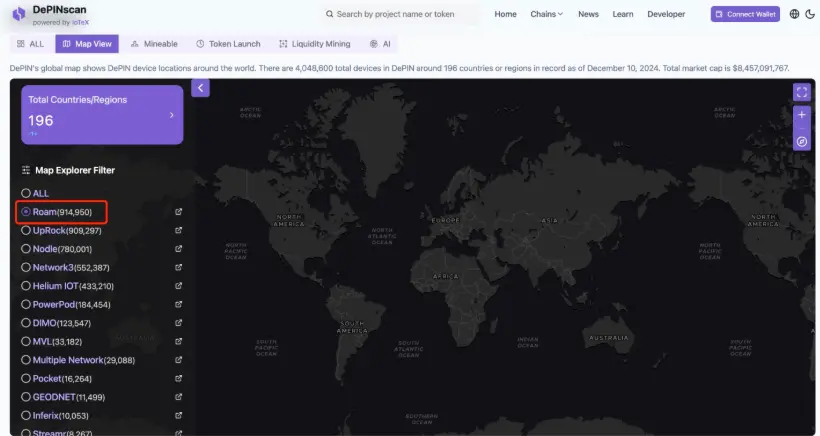
Roam's node count reaches 910,000, ranking first on DePINscan (Image source: DePINscan.io)
Roam has many similar data points reflecting this "wild growth" speed.
As the only decentralized wireless network built through the upgrade of OpenRoaming™, Roam has over 4 million OpenRoaming™ available WiFi hotspots in more than 190 countries worldwide, combined with over 910,000 self-built WiFi network nodes, bringing the total number of available WiFi nodes globally to nearly 5 million.
Roam is also the only Web3 IDP project among the 15 corporate alliances in the Wireless Broadband Alliance (WBA) OpenRoaming™ program. Most WBA members include large fixed operators like BT in the UK and AT&T in the US, as well as tech giants like Cisco and Google.
In October of this year, Roam launched a new product, Roam eSIM, completing another piece of the global wireless network access puzzle. Since its launch, the number of registered users has increased from 750,000 to 1 million in less than a month, and it currently stands at 1.63 million, with this number still rapidly growing.
These figures are proof of Roam's new business model connecting Web2 and Web3 and achieving large-scale application deployment.
So what’s next? As an explorer in the DePIN space, how will the "wild growth" of Roam further expand the reach of Web3?
Focusing on DePIN Yields, Roam Growth Product Launching Soon
In modern society, wireless networks have become almost a necessity, linking offline users with online scenarios to form a complete ecosystem. This makes optimizing and expanding network connection channels an undeniable choice. Currently, through Roam's solution, users can share public WiFi nodes via the Roam App or upgrade their own WiFi to the more secure and convenient OpenRoaming™ WiFi, helping more users connect to the network for free and conveniently; users can also earn Roam eSIM data for free through network contribution activities like check-ins, enjoying seamless roaming network services in over 160 countries and regions.
Additionally, users can choose to run Roam devices (Rainier MAX60) to deeply participate in ecosystem construction, which is the upcoming Roam Growth. As a key module in the Roam ecosystem, Roam Growth aims to create more dimensions of sustainable income for participants in the Roam Network. By collaborating deeply with other developers/ecosystem project parties, Roam Growth promotes innovation and ecological construction of more decentralized network applications, helping users turn hardware devices into powerful cooperative platforms and economic tools, allowing them to earn additional rewards seamlessly.
The first phase of the Roam Growth product, the Roam Loan Program, is a collaboration with the PayFi project Huma Finance's loan plan, enabling users to acquire Roam routers with a lower threshold. Users have two loan options to purchase router mining machines:
1) Stablecoin payment. Users pay a 30% down payment, with the remaining 70% funded by Huma Finance. (Users need to repay the loan with the router's initial airdrop rewards and mining rewards within the specified period. After the loan is settled, the mining rewards from the router will belong to the user.)
2) Pledging SOL. Users pay 4 SOL as a deposit, and the full amount for purchasing the router will be provided by Roam/Huma Finance. Similar to the above plan, the router's initial airdrop and mining rewards will be used to repay the loan. After the loan is settled, users will unlock 4 SOL, and the subsequent mining rewards from the router will belong to the user.
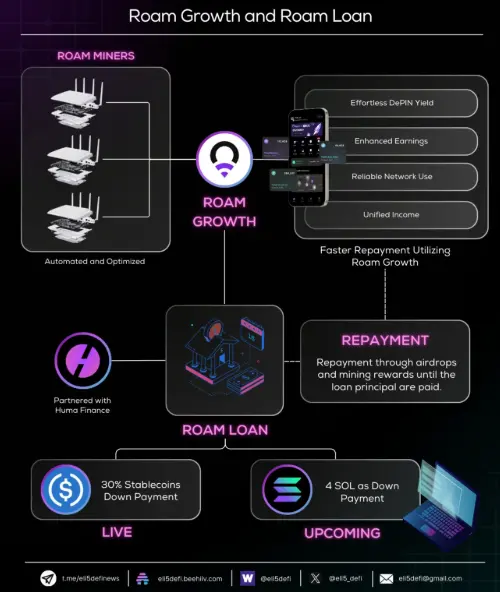
(Image source: X @eli5defi)_
Currently, Roam has officially released three types of devices: the first-generation MetaBlox OG Miner router (discontinued), and the latest AC device Rainier MAX60 and AP device Baker MAX30 router launched this January. Both devices feature excellent performance and security. The Roam Rainier MAX60 integrates Wi-Fi 6 high-speed transmission technology, providing network speeds of up to 9.6 Gbps, capable of connecting over 200 devices simultaneously, achieving seamless sharing in multi-user environments, utilizing advanced low-power design with 2TB expandable storage, and pioneering support for dApp applications, capable of running decentralized applications like CDN, network storage, and IP-based services.
These routers meet users' low-cost needs and are easy to operate, allowing anyone to complete deployment within 10 minutes. Users can easily share router nodes on the Roam network, enhancing coverage and reception range, providing and enjoying a smooth and efficient network connection experience.
Users participating in network construction through Rainier MAX60 and Baker MAX30 will receive more token incentives. Additionally, Roam announced during the ABS 2024 Asia Blockchain Summit that it will airdrop a total of 20 million $ROAM tokens to users who purchase various Roam routers and early MetaBlox NFT holders before the TGE, as a reward for their contributions to the early network ecosystem construction of the project. This airdrop activity is still open to all eligible users.
Beyond DePIN, Building a "Telecom Data Network" Connecting People and Devices
Typically, DePIN projects build independent physical infrastructure networks in a decentralized manner, covering services such as connectivity, storage, computing power, mapping, and weather forecasting, providing services to enterprises or individuals to generate revenue. From this perspective, Roam can be categorized as a DePIN project, but in fact, Roam's ecological positioning is not limited to this; accurately, Roam positions itself as the Physical Layer 1 that connects data between people, devices, assets, and AI, serving as the Telecom Data Layer that supplies the entire DePIN ecosystem.
Roam has successfully attracted a large number of real users through a free-to-use business model, building a physical device network that connects real users with the online ecosystem through wireless network connections. Ecological partners can build various applications based on Roam data scenarios on the Roam platform, and beyond user data, Roam can also collaborate with other infrastructure project parties on data storage, CDN, or IP-based service collaborations. Meanwhile, Roam will also engage in data commercialization services with trusted third-party partners, and the value generated from these collaborations will be uniformly distributed to Roam router owners in the form of mining rewards, as a return for users co-building the ecosystem. Additionally, as the WiFi advertising industry matures, revenue becomes predictable. In the future, router owners can also choose to enable advertising features to earn additional Roam Points as incentives.
Wireless network connections serve as a natural user entry point, and the deep cooperation based on user data with other ecological project parties endows Roam with the characteristics of a Physical Layer 1. Roam Growth will bring more optional ways to earn incentives and more sustainable income for users' hardware devices. As one of the four ecological modules of Roam's telecom data network, the launch of the Roam Growth product will accelerate the construction of the telecom data network, laying the foundation for building the Physical Layer 1 of the DePIN ecosystem.
Driving Web3 Towards the Mainstream
If DePIN is the key to driving Web3 into the mainstream, then Roam will undoubtedly be a key driver. Today, Roam plays a crucial role in promoting the WBA's OpenRoaming™ program, and WBA has high hopes for Roam, expecting it to undertake the task of increasing the overall OpenRoaming™ network nodes by 20% in the coming years. With its rapidly growing global WiFi node count and registered user numbers, Roam has attracted the attention and support of many traditional operators, who see the potential for revitalizing the traditional telecom industry through Roam. This is all due to its user-centered, bottom-up promotion strategy. Now, as the revenue module Growth is about to launch, we have reason to believe that more diverse and sustainable revenue methods will attract more Web2 and Web3 users to participate in the Roam network, jointly promoting WiFi—an essential element of modern life—to become safer, more convenient, and accessible to a broader audience.
免责声明:本文章仅代表作者个人观点,不代表本平台的立场和观点。本文章仅供信息分享,不构成对任何人的任何投资建议。用户与作者之间的任何争议,与本平台无关。如网页中刊载的文章或图片涉及侵权,请提供相关的权利证明和身份证明发送邮件到support@aicoin.com,本平台相关工作人员将会进行核查。


