Whether for profit or aimed at ordinary users, bots are gradually becoming the priority users on the blockchain.
Author: Mason Nystrom
Translated by: Deep Tide TechFlow
Bots are becoming core participants in the crypto economy.
Evidence of this trend is everywhere. For example, seekers deploy bots (like Jaredfromsubway.eth) to capitalize on human users' demand for convenience, profiting from front-running trades on their decentralized exchanges (DEX). Tools like Banana Gun and Maestro allow users to conveniently conduct bot-supported trades via the Telegram platform, consistently ranking high on the “gas consumption” leaderboard on Ethereum. Additionally, in emerging social applications like Friendtech, bots have quickly intervened after initially gaining adoption from human users, potentially accelerating the speculative cycle in the market.
Overall, whether for profit (like MEV bots, where MEV stands for "Maximum Extractable Value") or aimed at ordinary users (like Telegram bot toolkits), bots are gradually becoming the priority users on the blockchain.
Although the current capabilities of bots in the crypto space are still relatively simple, with the development of large language models (LLMs), bots outside the crypto space have evolved into powerful AI agents, capable of autonomously handling complex tasks and making informed decisions.

Building these AI agents in a crypto-native environment has several important advantages:
Built-in Payment Functionality: AI agents can exist outside the crypto space, but if they are to perform complex operations, they must have the ability to acquire funds. Compared to traditional methods (like bank accounts or payment processors like Stripe), crypto payment systems are more efficient in providing funding support for AI agents, while avoiding various inefficiencies common in the off-chain world.
Wallet Ownership: Through wallet connections, AI agents can own digital assets (like NFTs or yields), thus enjoying the inherent digital property rights of crypto assets. This is particularly important for asset trading between agents.
Verifiable Deterministic Operations: The verifiability of operations is crucial when AI agents perform tasks. On-chain transactions are inherently deterministic—either completed or not—which allows AI agents to execute on-chain tasks more accurately, while off-chain tasks struggle to achieve the same level of determinism.
Of course, on-chain AI agents also face some limitations.
A major limitation is that AI agents need to execute logic off-chain to enhance performance. This means that the logic and computation of the agents will be hosted off-chain, but decisions are still executed on-chain to ensure the verifiability of operations. Additionally, AI agents can use zkML (zero-knowledge machine learning) providers like Modulus to verify the authenticity of their off-chain data inputs.
Another key limitation is that the functionality of AI agents depends on the richness of their tools. For example, if you want the agent to summarize a piece of real-time news, it needs web scraping tools to search the internet. If you want it to save the results as a PDF, it needs a file system. If you want it to mimic the trades of your favorite Crypto Twitter influencers, it needs wallet access and key signing capabilities.
From the perspective of determinism versus non-determinism, most tasks currently performed by crypto AI agents fall into the category of deterministic tasks. This means that humans have pre-set the parameters of the tasks and how they are executed (for example, the specific process of token swapping).
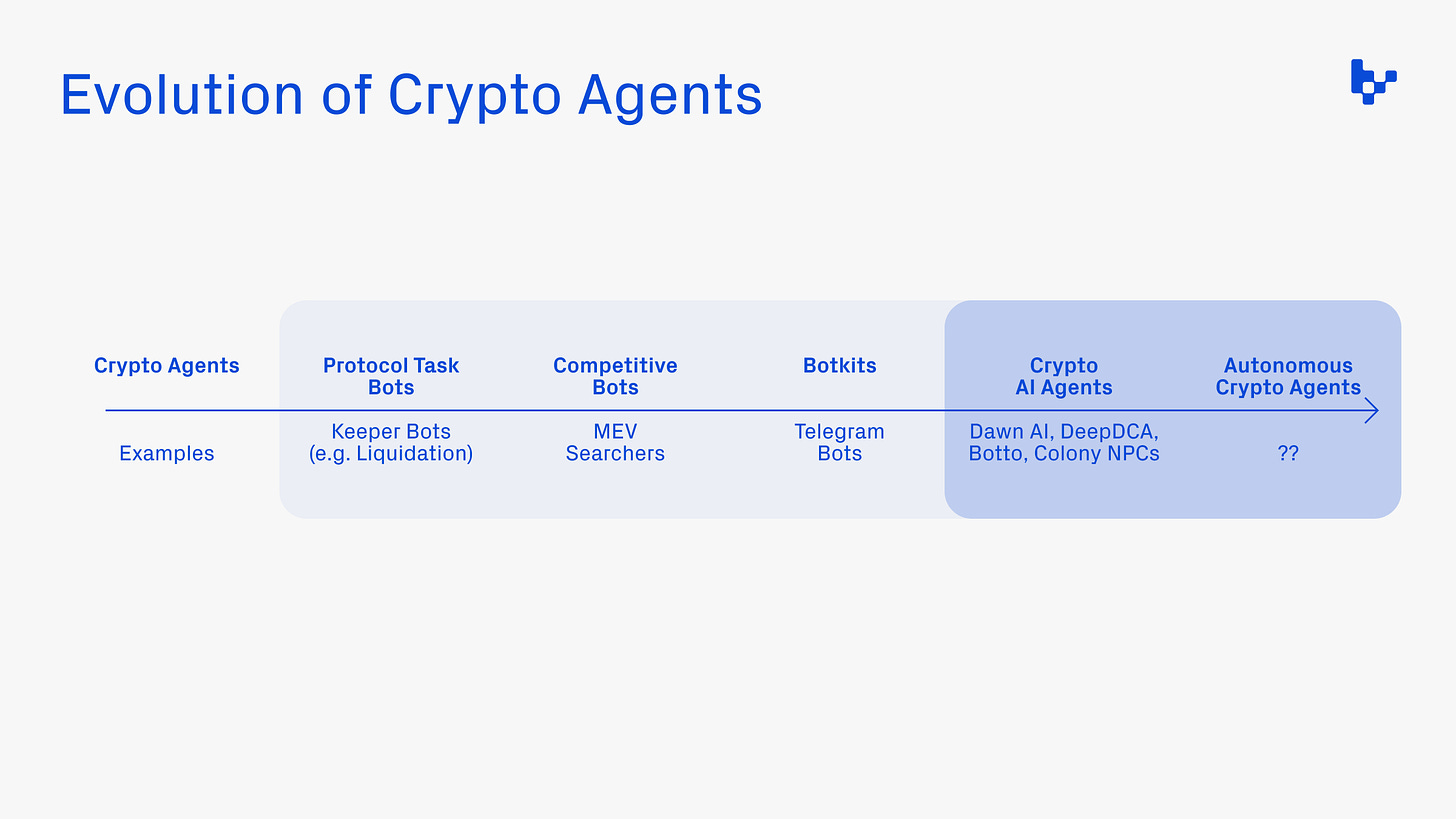
Crypto AI agents have evolved from early keeper bots, which are still widely used in DeFi and oracle services. Today, AI agents have become more complex. They can not only leverage large language models (LLMs) for autonomous creation (like the autonomous artist Botto), but also provide financial services for themselves through the trading cloud of Syndicate. Additionally, early AI agent service markets like Autonolas are gradually forming.
Currently, many cutting-edge applications are showcasing the potential of AI agents:
AI Assistants in Smart Wallets: Dawn provides users with a multifunctional assistant through its DawnAI agent, capable of helping users send transactions, complete on-chain trades, and provide real-time on-chain information (such as trend analysis of popular NFTs).
AI Characters in Crypto Games: Parallel Alpha's latest game Colony attempts to create AI characters that can own wallets and conduct on-chain transactions, adding more interactivity to the game.
Functionality Upgrades for AI Agents: The capabilities of AI agents depend on the tools they are equipped with, and current interactions with the blockchain are still in their early stages. Crypto AI agents need to have wallet functionality, fund management capabilities, permission control, integrated AI models, and the ability to interact with other agents. Gnosis has showcased a prototype of such infrastructure, for example, their AI Mechs, which encapsulate AI scripts into smart contracts, allowing anyone (including other bots) to call the smart contract to perform tasks (like participating in prediction market bets) while also paying rewards to the agents.
Advanced AI Traders: DeFi super applications provide traders and speculators with more efficient operational methods, such as: automatically dollar-cost averaging (DCA) when conditions are met; executing trades automatically when gas fees fall below a certain threshold; monitoring newly issued meme token contracts; and intelligently selecting optimal order routing without requiring users to manually find access points.
Vertical Applications of AI Agents: While large models like ChatGPT are suitable for some general conversational scenarios, AI agents need to be specifically fine-tuned to meet the needs of different industries and niches. Platforms like Bittensor encourage developers to train models focused on specific tasks (like image generation and predictive modeling) through incentive mechanisms, targeting industries including crypto, biotechnology, and academic research. Although Bittensor is still in its early stages, developers have already begun utilizing it to build applications and agents based on open-source large language models.
AI NPCs in Consumer Applications: Non-player characters (NPCs) are common in massively multiplayer online games (MMORPGs), but are still rare in consumer applications. However, due to the financial nature of crypto consumer applications, AI agents can become ideal participants in innovative game mechanics. For example, the open AI infrastructure company Ritual recently released Frenrug, an agent based on large language models that operates on the Friend.tech platform. It can automatically execute trades based on the content of user messages (such as buying or selling keys). Users of Friend.tech can try to persuade this agent to buy their own keys, sell others' keys, or even find creative ways for the Frenrug agent to use its funds.
As more applications and protocols begin to introduce AI agents, humans will use them as a bridge into the crypto economy. While today's AI agents may still seem like "toys," in the future they will significantly enhance users' daily experiences, becoming key stakeholders in blockchain protocols and even forming a complete economic ecosystem among agents.
AI agents are still in the early stages of development, but as core participants in the on-chain economy, they are just beginning to showcase their potential.
免责声明:本文章仅代表作者个人观点,不代表本平台的立场和观点。本文章仅供信息分享,不构成对任何人的任何投资建议。用户与作者之间的任何争议,与本平台无关。如网页中刊载的文章或图片涉及侵权,请提供相关的权利证明和身份证明发送邮件到support@aicoin.com,本平台相关工作人员将会进行核查。


