You might be more willing to take bigger risks with money that comes easily.
Author: Route 2 FI
Compiled by: Deep Tide TechFlow
Today, I want to talk about the "House Money Effect."
The "House Money Effect" is a phenomenon in behavioral finance where investors are more likely to take risks after making a profit because they view those gains as "windfall" rather than their own capital.
This effect originates from a concept in gambling: when gamblers win money, they often feel like they are playing with the casino's money, making them more willing to take risks than when using their own principal.
Feel free to share your thoughts on this.
House Money

Everything has its pros and cons.
Are you familiar with the concept of "House Money"? In gambling, due to cognitive biases, when gamblers use their winnings, they tend to take on greater risks rather than using their initial capital. This is because they feel that these profits still belong to the casino, not to themselves.
For example, suppose you have $10,000 and you double it by trading $DOGE, so now you have $20,000. Research shows that people are less cautious when using that extra $10,000 compared to their initial capital. This phenomenon is understandable, but it is also a trap I often fall into.
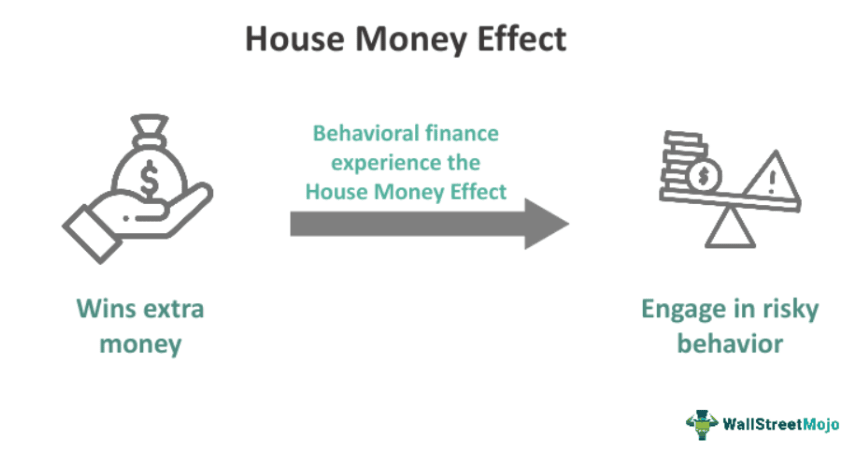
When it comes to "House Money," we often don't save as much as we do with hard-earned income. Because this money comes easily, we are more willing to spend it. Clearly, this mindset is irrational because, regardless of the source of the money, its value is the same.
Whether earned through hard work or won through luck, the actual value of a dollar is the same, but the value people assign to it and their attitude towards risk may differ. So, is there any benefit to this cognitive bias? In my view, there is. It allows us the opportunity to take on more risk, potentially leading to greater rewards. You might be more willing to take bigger bets with money that comes easily.
What if we apply this bias to another, more important "currency"? How about time?
In fact, I discussed this topic a few days ago on Twitter:
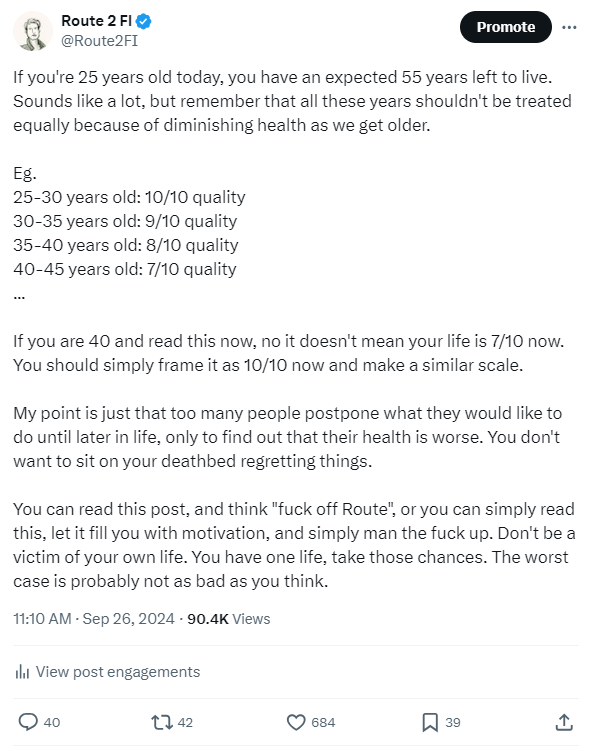
If you are 25 years old and expect to live for another 55 years, it sounds like a lot, but remember that as you age, health declines, and those years should not be treated equally.
For example:
25-30 years: Quality of life 10/10
30-35 years: Quality of life 9/10
35-40 years: Quality of life 8/10
40-45 years: Quality of life 7/10
If you are 40 years old and reading this, it doesn't mean your quality of life is now 7/10. You should view your current life as 10/10 and establish a similar standard.
My point is that too many people postpone what they want to do until later, only to find that their health declines. You don't want to have regrets at the end of your life.
You might read this article and think, "Screw you, Route," or you can let it inspire you to face life bravely. Don't be a victim of your own life. You only have one life; seize those opportunities. The worst-case scenario might not be as bad as you think.
Suppose you know you will die at 80.
If you are now 25, you have 55 years left; if you are 40, you have 40 years.
Now, let's apply the concept of "House Money" to time.
What if someone gives you an extra year right now, and you can pause life and use that year entirely as you wish?
That would be 80 years plus 1 year.
With an extra year, would you make different plans? I know that if I weren't retired, I would definitely use that year to travel, pursue interests, start a business, and do those things I don't have time for in a 9-to-5 job, simply exploring without the pressure to make money.
Maybe your goals are different from mine, but I find it hard to imagine that if you had an extra year, you would use it to pursue wealth or fame. In this case, the wisest course of action would be to do those things we usually don't dare to try.
This leads me to further ponder: if you know what makes you happy, why not do it now? What are you afraid of? What is holding you back, or is it just a mental barrier?
Perception of Time
Time is a resource we cannot get back, so we must manage it carefully.
We are often told to excel academically to get into prestigious schools and study majors that will lead to high-paying jobs.
If we feel bored, we can continue our education and get a master's degree to earn more money. However, we rarely stop to think and discover our true passions because doing so makes it harder to continue chasing the goals set for us.
At least in the Western world, many people can feel this.
For most of our teenage and early adult years, it seems we are working hard to have a luxurious corner office with a window in a skyscraper, rarely considering whether doing so truly makes us feel like our time is not wasted.
We think that arranging time this way carries no risk, but isn't that a risk in itself?
Living in a state of chasing others' goals rather than our own, isn't that the greatest risk?
We spend our precious time on things we may not truly value. Thus, we continuously pursue money, efficiency, and success, even willing to sacrifice time for it, regardless of whether these achievements truly resonate with our inner selves.
This is because accumulating these achievements is seen as a marker of success in society, while accumulating experiences is not.
We would rather trade time for something that might be valuable than spend time on the unknown. Exploration is not seen as an option because, in our society, exploring for the sake of exploring is considered not "productive" enough.
This situation gradually erases the wonder and curiosity in our lives, dulling our passion for life.
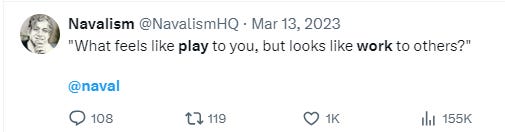
In fact, none of us knows how long we will live. So why not treat a year (or two or five) as extra time? Just like house money, it is not something we earned through hard work, but it can be used for enjoyment.
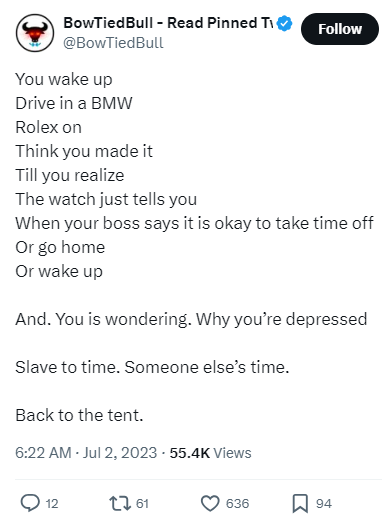
Before we meet again, consider the following tweet:
You wake up,
Driving a BMW,
Wearing a Rolex,
Thinking you have succeeded.
Until you realize,
This watch is just telling you,
When your boss allows you to take a break,
Or go home,
Or get up,
And then you start to think about why you feel frustrated.
Because you are just a slave to time, governed by others' time.
Back to the starting point.
Is your time yours? Or is it your boss's?
Don't be afraid to spend some of your "extra time" figuring out what you truly want.
…
That's all for today.
Goodbye, friend.
免责声明:本文章仅代表作者个人观点,不代表本平台的立场和观点。本文章仅供信息分享,不构成对任何人的任何投资建议。用户与作者之间的任何争议,与本平台无关。如网页中刊载的文章或图片涉及侵权,请提供相关的权利证明和身份证明发送邮件到support@aicoin.com,本平台相关工作人员将会进行核查。


