The global impact of Web3 payments is rapidly expanding.
By Liu Honglin, Founder of Shanghai Mancun Law Firm
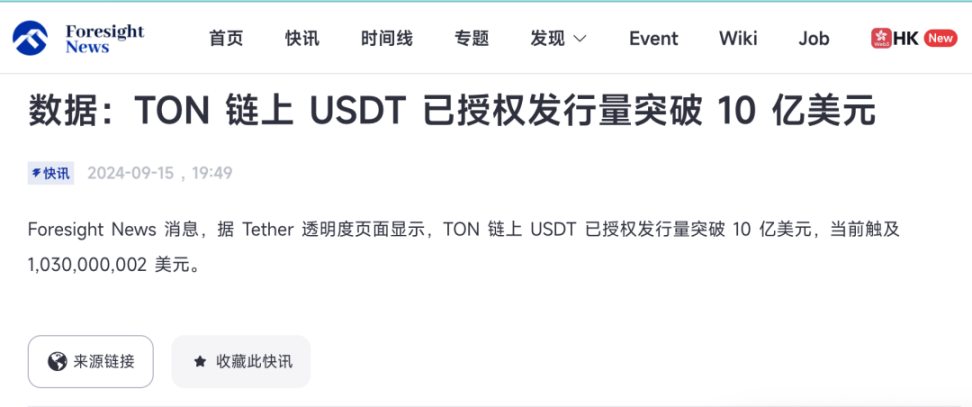
According to Foresight News, data from the Tether transparency page shows that the authorized issuance of USDT on the TON chain has exceeded $1 billion and reached $1,030,000,002. This data is not only an important milestone in the development of the TON blockchain, but also has prompted further thoughts on the future of Web3 payments by Liu Honglin, a lawyer at Mancun Law Firm.
Viewing the popularization of Web3 payments from the leap of China's internet
Globally, China's mobile payments can be said to be far ahead. For ordinary Chinese netizens, sending a red envelope or making a transfer on WeChat is just a small matter, taking only a few seconds. However, when traveling abroad, one will realize that the global payment environment is far less convenient than in China. Although mobile internet payments are well established in some developed country cities, in many countries and regions around the world, mobile payments are still a luxury. Many places lack widespread bank accounts, and even basic banking infrastructure is not in place.
For people in these areas, it may be similar to China's development of the internet, skipping the PC desktop internet and directly entering the era of mobile internet, bypassing traditional centralized and restricted mobile payment solutions like Alipay, and directly experiencing the new Web3 payment.

After all, the lack of path dependence may mean less constraint for the development of mobile payments in these local areas. Through cryptocurrencies and digital wallets, countries and regions that cannot enjoy traditional banking services can directly participate in the global financial system, which is clearly a revolutionary change. Just as mobile smartphones have a revolutionary advantage over PCs, Web3 payments have achieved significant advantages in several aspects compared to traditional payment networks:
1 Global Accessibility
Web3 payments transcend national borders, allowing users to transfer funds globally without the need for approval and delays from traditional financial institutions. Traditional payment networks rely on the infrastructure of banks and financial institutions in each country, while Web3 payments use blockchain technology to achieve decentralized cross-border payments, greatly reducing transaction times.
2 Transparency and Low Costs
Unlike traditional payments that rely on intermediaries or third-party institutions, Web3 payments rely entirely on smart contracts and blockchain technology, eliminating cumbersome fees. The costs of Web3 payments are significantly lower than those of traditional financial payment systems because they do not require high transaction fees through banks or payment service providers.
3 Decentralization and Privacy Protection
The core of Web3 payments is decentralization, which means users no longer depend on banks or payment platforms and have more privacy and autonomy. Traditional payment networks usually involve the collection and storage of user privacy data, while Web3 payments allow users to complete transactions in a decentralized environment, protecting personal privacy from infringement.
4 Flexibility of Assets
In Web3 payments, users can use not only fiat currency but also stablecoins such as USDT and other cryptocurrencies for payments. This makes the Web3 payment system more flexible and adaptable to the needs of different countries and regions, especially in places with underdeveloped financial infrastructure, where Web3 payments provide an effective alternative.
How to view the combination of Web3 payments and TON?
As the official platform of Telegram, the TON blockchain's technical advantages, large user base, and demand for stablecoins have jointly driven the expansion of Web3 payment applications on the TON chain.
The TON blockchain technology features efficiency, security, and low costs. This makes the TON chain an ideal platform for Web3 payments, with its high throughput and low transaction costs attracting more users and developers to deploy payment solutions on TON. Compared to other public chains, the TON chain has stronger performance in processing large-scale transactions while maintaining decentralization and security.

Since 2021, Telegram's user base has exceeded 700 million and has maintained double-digit growth annually. Especially in the Middle East, Eastern Europe, and the CIS countries, Telegram users rely on this decentralized communication tool for cross-border communication and payments, especially in areas with weak or restricted financial systems. Web3 payment services on the TON chain, combined with Telegram, easily reach these user groups, meeting their cross-border payment and financial needs. In the Middle East, Telegram has gradually become the main communication tool in financially regulated countries, and users in countries such as Iran and Turkey particularly rely on this platform. Due to the imperfect financial systems in these regions, the acceptance of cryptocurrencies is high, prompting USDT and other cryptocurrencies on the TON chain to become their choice for hedging against inflation and solving cross-border payments.
The rapid growth in the issuance of USDT on the TON chain directly reflects the global demand for stablecoins. This is particularly prominent in countries with high inflation or capital controls, such as Venezuela and Argentina, where users use USDT to hedge and preserve value. The combination of the TON chain with Telegram not only allows users to use stablecoins in a decentralized environment but also significantly reduces the costs of traditional cross-border payments. This combination of user base and the demand for Web3 payments makes the TON chain an ideal platform for stablecoin issuance and encrypted payments. Web3 payment services on the TON chain not only effectively fill the gaps in traditional banking systems but also further promote the application and popularization of decentralized finance.
Opportunities and Compliance Challenges for Entrepreneurs
For entrepreneurs, Web3 payments not only provide efficient payment services for global users but also expand more business opportunities through participation in the DeFi ecosystem. However, the field of Web3 payments also faces significant compliance challenges. Especially in entrepreneurial projects involving virtual currency payments and settlements, strict compliance with international standards such as KYC (Know Your Customer), KYT (Know Your Transaction), and AML (Anti-Money Laundering) is crucial to ensure business legality and compliance.
1 Compliance Requirements for KYC and KYT
In the Web3 industry, KYC (Know Your Customer) is one of the basic compliance requirements for virtual currency payment projects. Through KYC, companies can verify users' identity information to ensure their true identity and legal source of funds. However, the decentralized nature of the Web3 industry means that relying solely on KYC may not be sufficient to address potential risks. Therefore, more and more companies are combining KYC with KYT (Know Your Transaction) technology.
KYT focuses on user transaction behavior and, based on the public transparency of the blockchain, can monitor and analyze suspicious transaction activities in real time. For example, the KYT system analyzes transaction paths, asset flows, and other information to determine whether there are suspicious activities such as large transfers or frequent cross-border transactions. Similar to AML in traditional financial systems, KYT can more accurately identify potential money laundering activities and provide companies with more comprehensive risk assessment tools.
The advantage of combining KYT is that entrepreneurs can not only obtain users' basic information but also track users' behavior patterns in real time, identifying potential illegal transaction risks. This behavior monitoring method is particularly suitable for the Web3 payment field, which has high liquidity and strong anonymity, helping to compensate for the shortcomings of relying solely on KYC.
2 Anti-Money Laundering (AML) Measures
AML (Anti-Money Laundering) is a key area of global regulation for virtual currency transactions. The anonymity and cross-border nature of virtual currencies make them susceptible to being used for money laundering and terrorist financing. Therefore, entrepreneurs conducting Web3 payment businesses need to establish clear AML policies, monitor suspicious transaction activities, and report them to relevant authorities in a timely manner. This is not only a legal compliance requirement but also effectively protects companies from engaging in illegal activities, thereby reducing legal risks.
By combining KYC, KYT, and AML measures, entrepreneurs can significantly enhance their compliance levels and reduce legal risks in virtual currency payments and settlements. This not only helps prevent illegal activities but also enhances trust from users and regulatory authorities, laying a solid foundation for the long-term development of the business.
3 Tax and Cross-Border Compliance Risks
In addition, tax compliance for virtual currency payments is also receiving increasing attention from countries around the world. Entrepreneurs need to understand the tax policies of their respective countries or regions and ensure compliance with tax reporting requirements. Failure to comply with tax regulations may result in fines or even criminal liability.
Furthermore, when operating in the global market, entrepreneurs must consider the legal differences in different jurisdictions. Countries have vastly different legal attitudes towards virtual currencies, with some countries completely banning virtual currency transactions, while others have strict regulatory frameworks. Therefore, when expanding into new markets, entrepreneurs must thoroughly research the legal environment of the target market to ensure compliance with local laws.
Summary by Mancun Law Firm
The issuance of USDT on the TON chain exceeding $1 billion marks the rapid expansion of the global impact of Web3 payments. Especially in areas with inadequate coverage of traditional financial services, Web3 payments provide a new alternative, helping users in these areas overcome the barriers of traditional financial systems. Through integration with Telegram, the TON chain further expands the broad application scenarios of Web3 payments, meeting the global demand for convenient payments.
In general, the future of Web3 payments is full of opportunities, but entrepreneurs must always pay attention to compliance requirements. After all, innovation and compliance are the keys to going further.
免责声明:本文章仅代表作者个人观点,不代表本平台的立场和观点。本文章仅供信息分享,不构成对任何人的任何投资建议。用户与作者之间的任何争议,与本平台无关。如网页中刊载的文章或图片涉及侵权,请提供相关的权利证明和身份证明发送邮件到support@aicoin.com,本平台相关工作人员将会进行核查。


