Vitalik Buterin believes that if the first phase is not reached by the end of this year, it should not be considered as the second layer.
Original author: CHRISTOPHER ROARK
Translation: Alvis, Mars Finance
According to L2Beat, six Ethereum Layer 2s have reached the first phase, while most others are still at phase 0.
Ethereum co-founder Vitalik Buterin stated on September 12 that if a network has not reached "phase 1" by the end of this year, he will no longer consider it as "the second layer."
He said, "The era of rollup being beautified as multi-signature is coming to an end," and added, "The era of encrypted trust has arrived."
The question of whether a network is the second layer is not just a technical issue for the Ethereum community.
It determines whether the network relies on Ethereum's security, and therefore can be trusted to protect users' funds, or whether it is a completely independent network, possibly secure or insecure.
On June 2, the decentralized finance protocol Velocore was attacked, resulting in a loss of $2.6 million, bringing this issue to the forefront.
Velocore operates on the Linea network, which claims to be an Ethereum Layer 2. However, the team quickly stopped block production to prevent attackers from withdrawing funds to Ethereum.
Critics argue that if the network's security depends on Ethereum, such a block production halt should not have occurred. After all, authorities cannot halt Ethereum.
As a result of this incident, many critics claim that the decentralization of the Ethereum ecosystem is progressing too slowly.
Buterin had already commented on this topic a month before the Velocore attack. He stated that all Ethereum Layer 2s need to reach "phase 1" by the end of 2024. If they do not, the community should no longer consider them as "the second layer."
But what exactly is the first phase?
Phase of Decentralization
The term "Phase 1 Layer 2" comes from a post made by Buterin on the Ethereum Magicians forum on November 2, 2022.
In the post, Buterin believes that Ethereum Layer 2 is still in the early stages of development and cannot be expected to achieve full decentralization immediately.
Instead, developers should be given a grace period to fully develop their network components. Initially, these networks will be highly centralized. But over time, they will become fully permissionless, ensuring uncensored transactions.
Phase 0 networks call themselves the second layer or "aggregation," and release compressed versions of all their transactions to Ethereum.
In addition, the team also provides a "rollup full node," which can independently verify the state of the second layer as long as it has complete transaction data from both layers. Users can exit the network without the team's help as long as the team does not attempt to prevent them by publishing false state roots on Ethereum.
In Phase 1 aggregation, Ethereum smart contracts contain "fraud proofs or validity proofs" to prevent developers from publishing invalid state roots.
If developers attempt to fraudulently withdraw funds that do not belong to them or prevent users from withdrawing funds legitimately, these transactions will fail under normal circumstances.
However, developers can overturn fraud proofs with a vote from at least six out of eight members of the network security council. If developers find errors in the fraud proof system, this vulnerability exists.
Furthermore, at least three of the eight members of the security council must come from outside the development team, so theoretically, the development team cannot overturn these proofs alone.
Network upgrades must also be delayed for at least seven days unless approved by the security council.
In the two years since Buterin's post, most networks claiming to be the second layer are still at phase 0 or lower, leading to criticism that the entire Ethereum ecosystem has failed to deliver on its promises.
However, six networks have defied the odds and successfully entered at least the first phase.
Networks that have reached the first phase
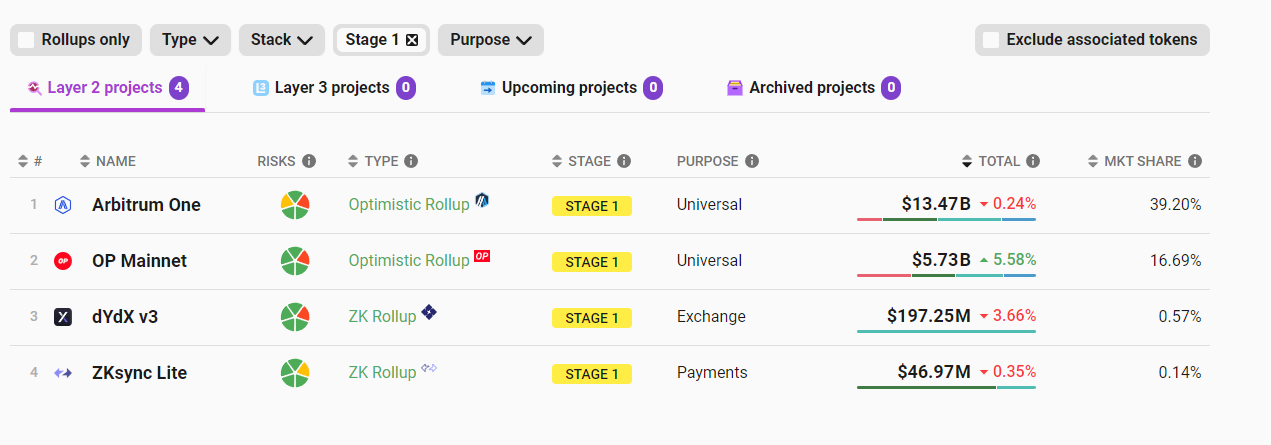
L2 first phase list, source: L2Beat
According to the research by the blockchain analysis platform L2Beat, the following is the complete list of networks claiming to be Layer 2s (L2s) and have reached the first phase. This list is sorted by total value locked (TVL), with the network holding the most assets listed first.
Arbitrum One
Abitrum One has entered the first phase. The network is operated by 14 validators who use a set of fraud proofs to process withdrawals and deposits. If validators attempt to submit fraudulent transactions, Ethereum smart contracts will reject these transactions unless these proofs are explicitly overridden.
Fraud proofs can be overturned by a 12-member Arbitrum security council. However, according to Arbitrum's documentation, no single organization is allowed to have more than three members in the security council. The development team is also not exempt from this restriction.
The Arbitrum Decentralized Autonomous Organization (ArbitrumDAO) can upgrade the network, but this comes with a delay of 12 days and 8 hours, while the council can upgrade the network without delay.
If the Arbitrum sequencer stops running, users can withdraw directly from the Ethereum network, but there will be a one-day delay after initiating the withdrawal. According to L2Beat, if users disagree with an upgrade initiated by ArbitrumDAO, they have a two-day "exit window." If they exit during this window, even if the DAO is corrupt or taken over by attackers, ArbitrumDAO cannot prevent them.
If users disagree with an upgrade executed by the security council, there is no exit window, as the council's upgrades are almost instantaneous.
Optimism
On June 10, with the implementation of the "Cannon" fault-tolerant system, Optimism entered the first phase. On August 17, after discovering errors in this system, it reverted to phase 0. However, it re-enabled the fault-tolerant feature on September 11 and is now back in the first phase.
If Optimism validators attempt to process fraudulent transactions, the fault-tolerant system in the Optimism Ethereum smart contracts will reject these transactions. The council can vote to overturn these fault-tolerant mechanisms, but no organization has enough seats to do so without the cooperation of others.
According to L2Beat, OptimismDAO cannot implement network upgrades without the approval of the council. Upgrades are implemented without delay.
dYdX v3
DYdX v3 is the first phase Ethereum L2, completely independent from the Cosmos-based dYdX v4. It uses zero-knowledge validity proofs to ensure all valid withdrawals are processed and invalid withdrawals are not processed.
dYdX validators can prevent withdrawals from being included in transactions for up to 14 days. If this happens, users can initiate a "forced exit" on Ethereum after the 14-day period to retrieve their funds.
Upgrades are normally delayed for 9 days, and if the priority controller approves an emergency upgrade, it is delayed for only 2 days. L2Beat warns that if governance is controlled by malicious actors, it can prevent withdrawals by blocking them for 14 days and initiating a contract upgrade within 9 days.
Even so, L2Beat still considers dYdX to be in the first phase because upgrades are normally delayed for 9 days, exceeding the minimum requirement of 7 days.
ZKsync Lite
ZKsync Lite uses zero-knowledge proofs to verify transactions. Under normal circumstances, the team cannot process invalid transactions or prevent the confirmation of valid transactions.
If the team initiates an upgrade, the upgrade will take 21 days to take effect. If ZKsync validators refuse to include a user's withdrawal in a transaction, the user can initiate a forced withdrawal on Ethereum and reclaim the funds within 14 days. According to L2Beat's report, the upgrade requires 21 days and provides users with a 7-day "exit window."
ZKsync Lite does not have smart contract functionality; it is specifically used for encrypted payments.
In addition to these networks, L2Beat also lists DeGate v1 and Fuel v1 as networks that have achieved the first phase. In fact, these networks are considered "Phase 2," i.e., fully decentralized. Their total TVL is approximately $51 million.
Users who agree with Buterin's standards should continue to refer to the above networks as "the second layer" after January 1, as long as they do not oppose certain analyses by L2Beat.
Unselected Four Major Layer 2s
The top four networks currently not designated as Phase 1 by L2Beat either do not meet one of the Phase 1 criteria or are still under evaluation.
All of these networks have entered Phase 0, so they still have the potential to enter Phase 1 by the end of this year.
Base
Coinbase's Base network does not run fraud proofs. It is part of the Optimism superchain, which has implemented fraud proofs. Therefore, it would be straightforward for Base to implement fraud proofs and may enter Phase 1 by the end of the year. However, it has not done so yet.
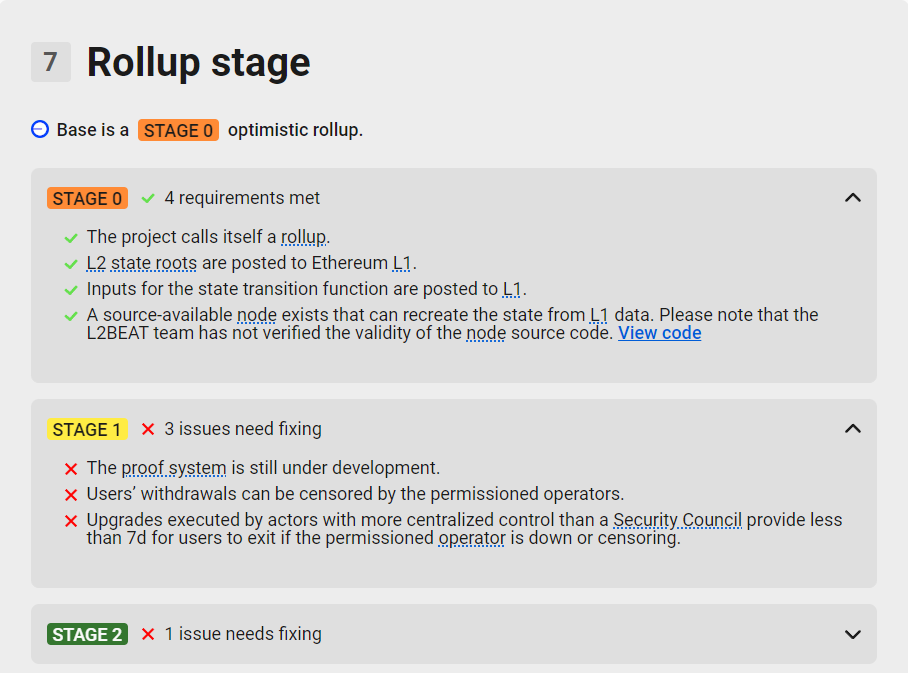
Base network Phase 1 issues, source: L2Beat
Blast
L2Beat considers Blast to be a "Phase 0" network. Users can independently run Blast nodes to verify the validity of deposits and withdrawals. However, the software only issues a warning when a withdrawal is invalid. Users cannot withdraw funds against the will of the Blast governing body.
Blast may release fraud proofs by the end of this year, in which case it will be marked as "the second layer" in 2025. But it currently does not meet all the criteria for Phase 1 aggregation.
ZKsync Era
According to Matter Labs, the developers of the ZKsync Era network use zero-knowledge proofs to verify deposits and withdrawals. L2Beat is currently evaluating the workings of this system. ZKsync Era may already be in Phase 1, or it may reach Phase 1 soon.
On September 12, the team announced a new governance system that designates "guardians" to protect users in the event of governance attacks. The team stated in the announcement that it is attempting to achieve full decentralization in the second phase.
Even so, L2Beat currently classifies ZKsync Era as Phase 0 because it has not completed the evaluation of Phase 1 elements of the network.
Starknet
Starknet has implemented zero-knowledge validity proofs in its smart contracts. However, these proofs can be overridden by whitelisted operators, and users cannot withdraw without permission from Layer 2 validators.
Since Starknet has implemented validity proofs, applying other Phase 1 network criteria will be relatively simple. Therefore, Starknet may enter Phase 1 by December 31, but it has not yet met the standards.
A few other networks with a TVL of less than $600 million are still classified as Phase 0.
These include Mode, Lisk, Polygon zkEVM, Taiko, Bob, Loopring, Zora, Kroma, Kinto, Paradex, Boba, ZKSpace, and others.
These networks have all entered Phase 0, and some networks have met at least one standard for Phase 1. However, no network has met all the standards for Phase 1.
Scroll and Linea are still below Stage 0
According to L2Beat's data, there are two networks with a TVL of over $700 million, claiming to have reached the second layer, but they have not even reached Phase 0.
The first is Scroll, with over $1.1 billion in cryptocurrency locked in its contracts. L2Beat states that Scroll "has no available node software to reconstruct state from L1 data," so users cannot independently verify its transactions.
The second is Linea, with over $780 million locked in its contracts. Like Scroll, Linea also does not have developed node software for the public to check the validity of its transactions.
These networks both meet and do not meet the definition of "the second layer" advocated by Buterin for 2025.
Ethereum supporters may continue to urge teams to make their networks more decentralized, and if they do not, they will increasingly no longer be referred to as the second layer. Some networks will continue to claim that they are working towards this, while others will claim that it does not matter. Only time will tell which side will prevail in the long run.
免责声明:本文章仅代表作者个人观点,不代表本平台的立场和观点。本文章仅供信息分享,不构成对任何人的任何投资建议。用户与作者之间的任何争议,与本平台无关。如网页中刊载的文章或图片涉及侵权,请提供相关的权利证明和身份证明发送邮件到support@aicoin.com,本平台相关工作人员将会进行核查。


