In Argentina, cryptocurrency is a tangible reality.
Author: David Hoffman, Founding Partner of Bankless Ventures
Translation: DeepTechFlow

Dear readers of Bankless Nation, I spent the entire month of August in Argentina, attending the cryptocurrency event "Aleph" held in the center of Buenos Aires.
Aleph is an event that combines the features of Zuzalu and Devconnect. Protocol Labs provided important support and coordination, bringing together hundreds of volunteers, community leaders, and ecosystem partners to create an environment that promotes the development of the next generation of cryptocurrency startups in Argentina.
At the Aleph Hub, a collaborative workspace that can accommodate 1000 people, cryptocurrency startups, venture capitalists, and the Argentine government came together for a month-long collaboration and exchange to promote mutual development.
Although Aleph is a month-long event, the sparks it ignites are expected to spread throughout Argentina and even across Latin America, creating a growth wave called "Crecimiento."

Why choose Argentina?
Argentina is a pioneer in cryptocurrency development.
In developed countries, venture capitalists and cryptocurrency enthusiasts on Twitter are still discussing use cases, adoption, and how to "attract retail investors." In Argentina, however, cryptocurrency has already been embraced by millions of people because they have an urgent need for the value and services provided by cryptocurrency.
Argentina is an ideal place for developing a cryptocurrency economy. Convenient internet access, high inflation of the currency, capital controls, and friction in traditional business have created an environment where cryptocurrency can shine.
A recent tweet by Gwart made me smile, but ironically, in Argentina, millions of "adults living a 9-to-5 life with monthly expenses and responsibilities" have found that cryptocurrency is a way to improve their lives.
Retail is coming. Adults living a 9-to-5 life with monthly expenses and responsibilities are getting ready to trade digital goods with us. Please be patient, retail is on the way.
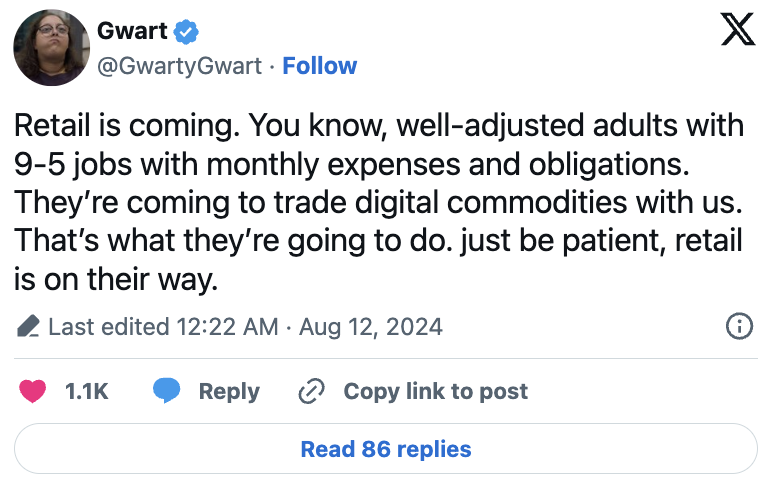
The cryptocurrency economy in Argentina is significantly different from the "use cases" and "trends" often assumed on crypto Twitter. In Argentina, locals do not always have the ability to speculate on the next hot alternative L1 or participate in meme coin trading; their currency may devalue by 1% today and another 1% tomorrow.
Of course, there are also cryptocurrency enthusiasts in Argentina, but compared to the millions of Argentinians who are not very interested in cryptocurrency, these activities seem insignificant. These individuals may not be interested in the virtual world of cryptocurrency enthusiasts on Twitter, but they still use their favorite cryptocurrency applications (such as Lemon, Belo, BuenBit, or Ripio) to combat inflation, buy coffee, and protect their wealth.
After interacting with startups in Argentina, it really makes the games of crypto Twitter and venture capital seem so absurd.
The 15th re-staked super-enhanced AltVM L2?
The 5000th political memecoin?
This DePIN, that encrypted AI
No, here are real cash flow businesses serving millions of local Argentinians.
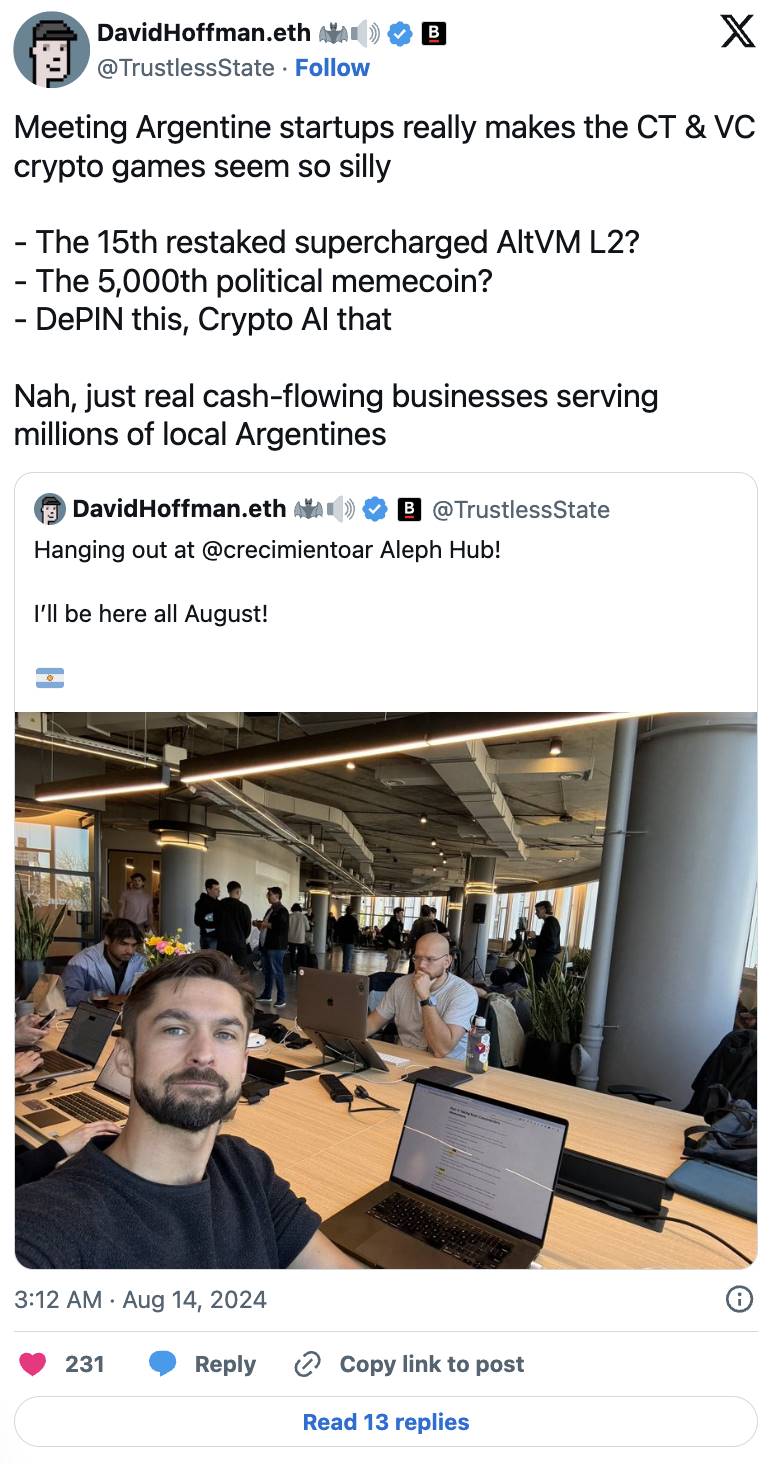
In Argentina, cryptocurrency is a tangible reality.
Bottom-up power: Creating 100 more startups
While the government of El Salvador has been praised by Bitcoin enthusiasts for its support of Bitcoin, its citizens are not excited about the government's top-down Bitcoin investment.
In contrast, the citizens of Argentina are enthusiastic about cryptocurrency, or at least remain neutral. While not every Argentine uses cryptocurrency, its use has been widely accepted and has become part of the culture. Ordinary Argentinians have either directly improved their lives because of cryptocurrency, enjoying convenient access to dollars, payment services, and financial services without a bank account, or they know someone who has had this experience.
In Argentina, the bottom-up support and acceptance of cryptocurrency is stronger than anywhere else in the world.
The core belief of Crecimiento and the temporary city of Aleph is that Argentina only needs "100 excellent startups" to trigger rapid nationwide economic growth and prosperity brought by cryptocurrency.
With just about 100 more startups creating about 5,000 cryptocurrency-related jobs, introducing the value of cryptocurrency into Argentina… Argentina could become the first country to reach "escape velocity" with cryptocurrency and become the world's first fully cryptocurrency-driven country.
At Aleph, 67 cryptocurrency startups from seed stage to Series A are working together in a shared office space, collaborating to solve problems and supporting each other in their development. There are 22 mentors from venture capital firms, cryptocurrency teams, and successful entrepreneurs who provide time, advice, and perspective at this center, passing on their wisdom to the younger generation of startups.
Every day, many renowned speakers and experts engage in face-to-face interactions with startups at Aleph—from Seba Serrano (Ripio) to Alec Oxenford (OLX), and from Nico Berman (Kaszek) to Marta Cruz (NXTP Ventures). At the Aleph center, university-level courses are presented daily, showcasing the skills needed in the Web3 field. There are workshops, lectures, and guidance highlighting some of the most cutting-edge areas in the industry.
Special thanks to ZKsync—both startup builders and hackathon participants widely mentioned the support and assistance provided by the ZKsync team to Aleph. The third week of Aleph was "ZK Week," and the ZKsync LATAM developer relations team provided exceptional English and Spanish education for builders here.

Top-down: Milei's digital transformation
Argentina is the only country in the world with a strong grassroots crypto industry and, at the same time, a government that supports cryptocurrency from the top down.
This is the potential that Crecimiento seeks to unleash.
Argentina's new leader, Javier Milei, has shown deep interest in cryptocurrency in many ways. With the new government implementing sweeping reforms in Argentina, leaders in the crypto space see an opportunity to permanently integrate cryptocurrency into Argentina's growth plans for the next decade and beyond.
Milei supports technology, investment, and rapid development. Even in his cabinet, there is a "blockchain advisor," Sergio Morales. Milei's interest in Bitcoin and cryptocurrency is part of his broader economic philosophy, including promoting dollarization of the economy (stablecoins are one option) and reducing government intervention.
Milei has drafted regulations that balance crypto innovation with investor protection and has worked with the crypto industry to provide clear regulatory guidance. Milei's initial "Economic Decree" includes the repeal of legal tender laws and allows contracts to be denominated in any currency.
These measures represent a positive step towards the legalization of cryptocurrency in Argentina, but more efforts are needed.
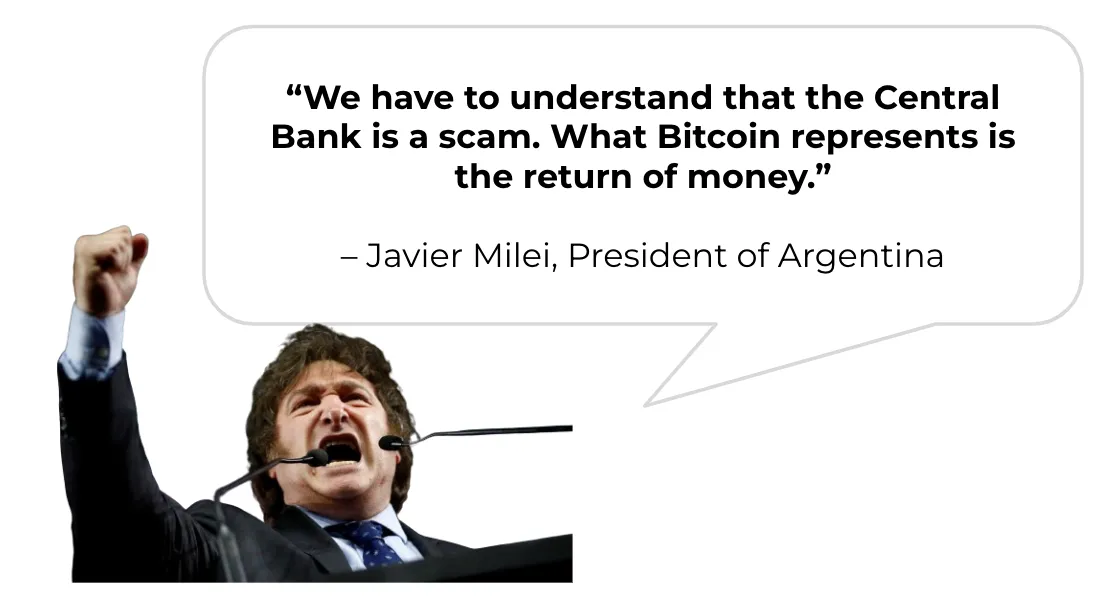
The real challenge facing the crypto industry in Argentina is whether the country can establish a robust regulatory framework that supports cryptocurrency, provides long-term legal protection for crypto entrepreneurs, and ensures the legality and protection of cryptocurrency for decades to come. Can they develop crypto protection measures that go beyond the current government? What happens if a new government tries to undo the progress made by the Milei government in supporting cryptocurrency? This situation has occurred multiple times in other industries in Argentina.
Roberto Silva, known as the Argentine version of Gary Gensler, stated at @crecimientoar Regulatory Day:
"We fully support the standardization of crypto technology."
"The model of the U.S. Securities and Exchange Commission (SEC) is to claim that cryptocurrencies are non-compliant through lawsuits. We do not adopt this model."
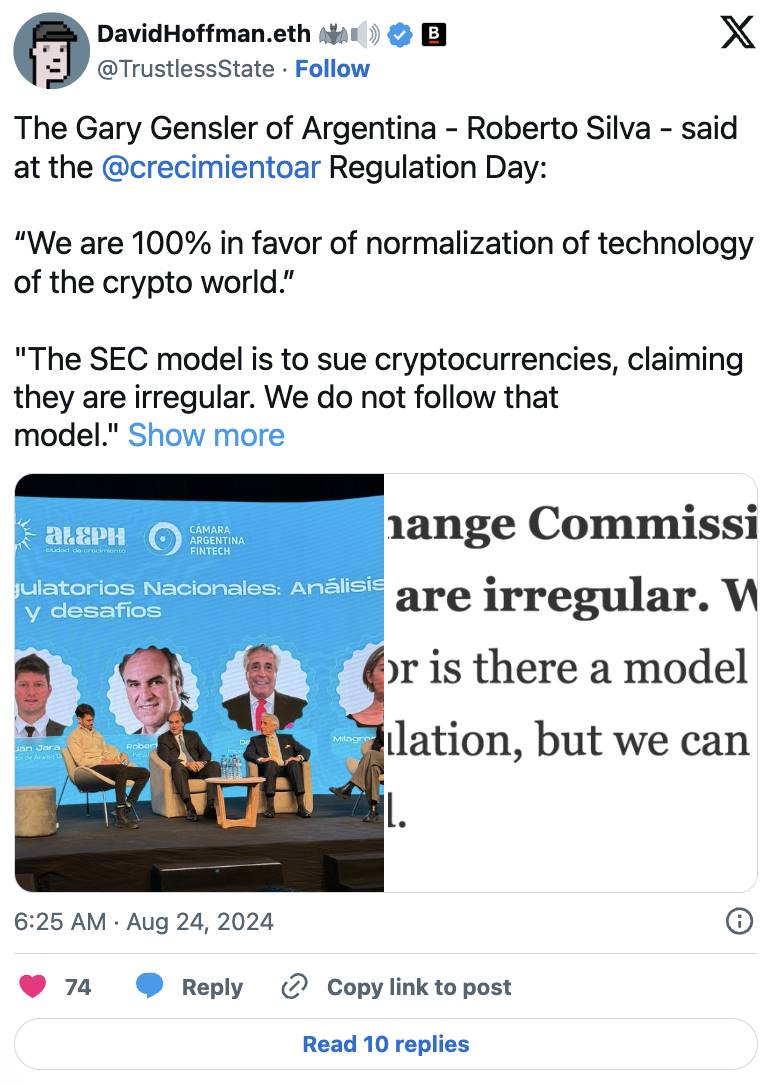
On August 22, Aleph hosted "Regulatory Day," where leaders of the Milei government came to the Aleph center for a full day of discussions and workshops, focusing on the expectations and needs of crypto businesses and startups from the Milei government.
It's not just Milei. Argentina's former president has also visited the Aleph shared office space.
@zksync's ELI5 (Explain Like I'm 5) zero-knowledge proof reading material is suitable for everyone.
Whether you're the founder of @lemonapp_ar, the president of Argentina, or the Secretary of Innovation in Buenos Aires.
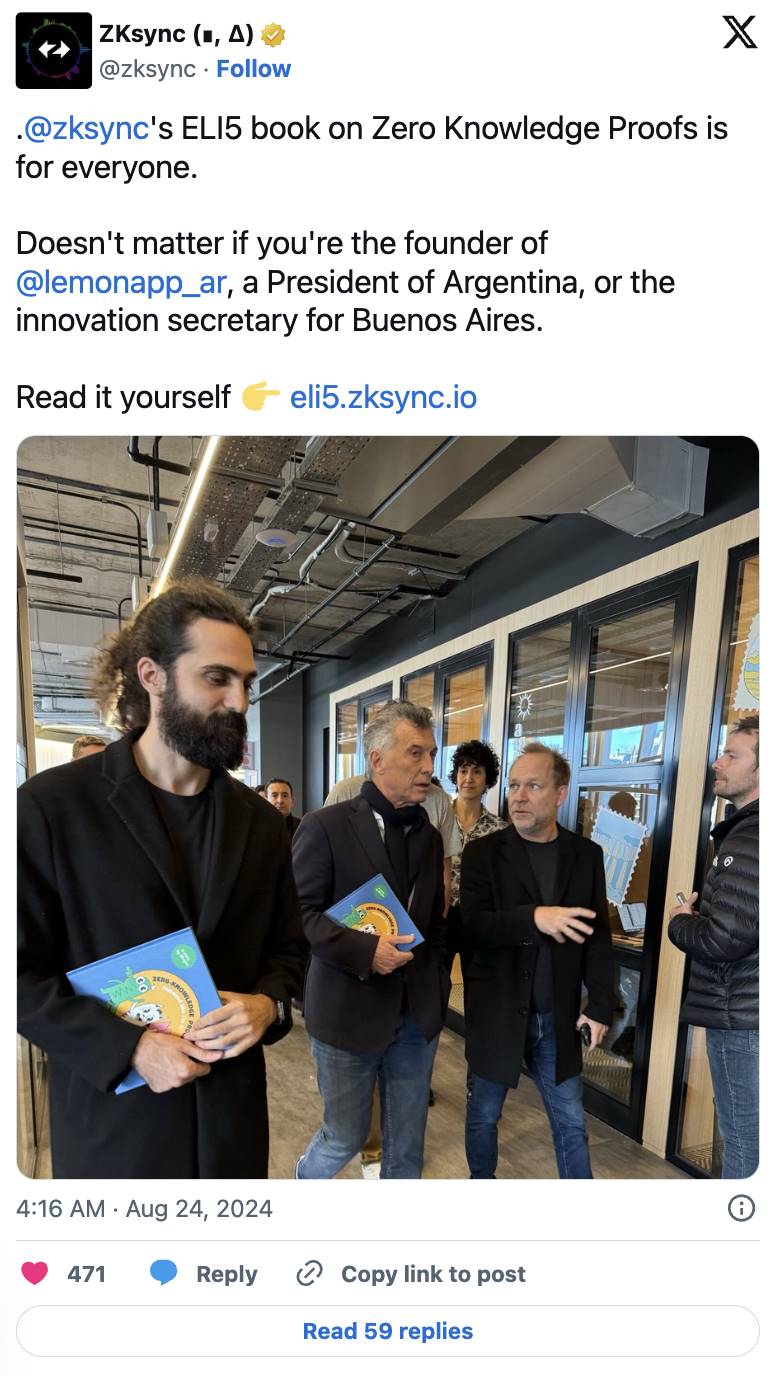
It's as surprising as Bill Clinton participating in the ETH Denver hackathon.
Unlike the United States, the crypto industry in Argentina has received high praise and encouragement from national officials.
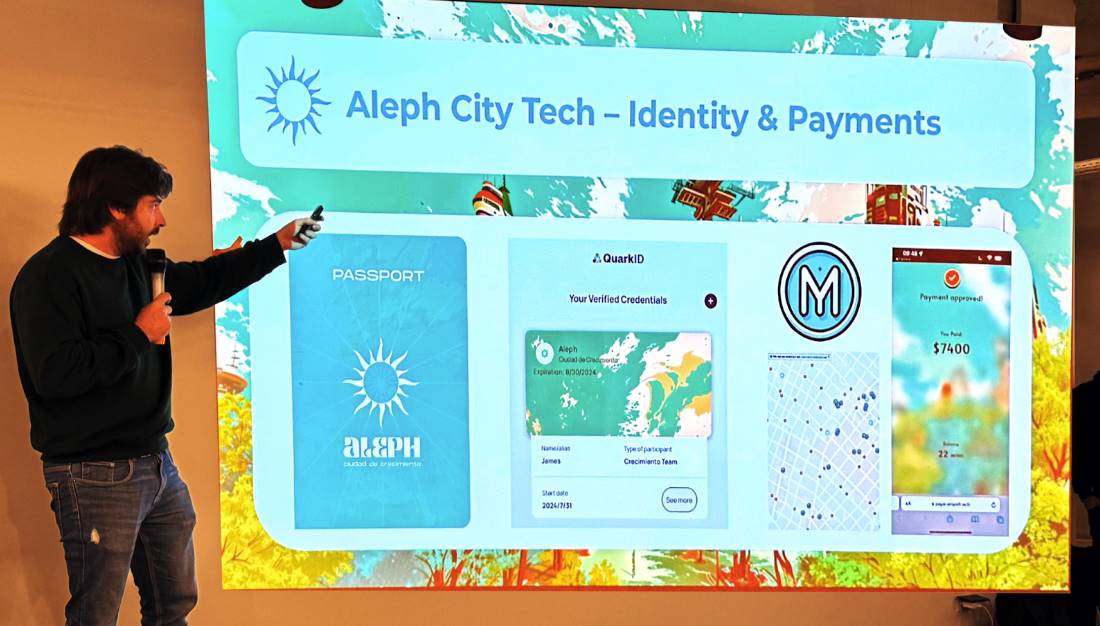
Aleph: Network Nation
Aleph is leading the development of native crypto technology, which has been widely used by over 2300 Aleph citizens.
QuarkID is an application incubated in Buenos Aires that uses verifiable credentials, decentralized identifiers, and zero-knowledge encryption to create a user-centric identity system for all citizens of Aleph.
After purchasing my Aleph ticket (i.e., citizenship), I received a verifiable credential that allowed my iPhone to open the doors of the Aleph center and access the shared office space. As a citizen of Aleph, I am entitled to a weekly allowance of 100 MORFI tokens.
MORFI tokens are ERC20 tokens running on the ZKsync Era, and local businesses accept MORFI as payment, exchanging 1000 Argentine pesos for food, coffee, or other services around the Aleph center. 1000 pesos is approximately equivalent to 1 USD (depending on the time you read this). All of this operates on the ZKsync Era mainnet, showcasing a real prototype of a network nation based on crypto technology.
You might wonder, "How did they get over 50 local businesses to accept cryptocurrency payments?" When you realize that accepting regular peso payments through financial technology channels takes 2-3 months for settlement, you'll understand that it's not difficult… this means that businesses may have already lost a significant portion of value before receiving the pesos.
Last month, Argentina experienced its lowest monthly inflation rate in five years, reaching 4%. Note that this is 4% for one month, not one year. Do you think a credit card fee of 2.9% is high? Imagine that just because the banking system takes months to pay the money to the merchants, the merchants lose 10% due to currency devaluation. When Argentine businesses learn that they can receive payments immediately, it becomes an easily acceptable transaction.
Later this year, QuarkID will build its own independent Elastic Chain on the ZK Stack and join the ZKsync Hyperchain. QuarkID plans to add more traditional services to its application, including driver's licenses and other government-issued credentials, as well as user-controlled wallets. It can be said that this will become Argentina's L2.
If you want to delve deeper into this topic, you can check out my interview with Diego Fernandez, Secretary of Innovation in Buenos Aires, from January of this year here.
Conclusion
As the Aleph event comes to an end, the foreigners, venture capitalists, and mentors will have to leave. We all have our own homes to return to. The shared office space of Aleph has signed a three-year lease and will continue to be open, providing a common hub for crypto startups. The support network has been established, and many connections, friendships, and investments have been formed.
Will Aleph become a key force driving the development of the crypto industry in Argentina?
免责声明:本文章仅代表作者个人观点,不代表本平台的立场和观点。本文章仅供信息分享,不构成对任何人的任何投资建议。用户与作者之间的任何争议,与本平台无关。如网页中刊载的文章或图片涉及侵权,请提供相关的权利证明和身份证明发送邮件到support@aicoin.com,本平台相关工作人员将会进行核查。


