Host: David Hoffman, Bankless
Guest: Ledger, Crypto KOL
Translation: Peyton, 7UPDAO Analyst
Has the bull market already started? If not, what does this mean for future prices?
David Hoffman invited Ledger to discuss some charts and describe his views on the future market.
Bankless is a media platform focused on cryptocurrency and decentralized finance (DeFi). Founded by David Hoffman and Ryan Sean Adams, it provides news, educational content, and analysis on cryptocurrency, blockchain technology, and decentralized finance. Bankless Channel is known for its in-depth market insights, practical investment strategies, and industry trend analysis, aiming to help users understand and participate in the decentralized finance ecosystem.

Ledger
Ledger Status is an active individual on social media, especially on X (formerly Twitter) platform. His content mainly focuses on the latest developments in the cryptocurrency market, industry news, and market analysis.
Ledger Status is known for his deep understanding of the cryptocurrency market and timely market updates. The content he shares includes market trends, technical analysis, and predictions of future trends, usually presented in the form of comments, articles, or videos. This content holds high reference value for investors and enthusiasts who want to keep up with the dynamics of the cryptocurrency market. At the time of writing, he has 233.5K Twitter followers.
In September 2017, he founded Ledger Status, a website for cryptocurrency and blockchain enthusiasts, containing a range of basic resources, technical analysis, and fascinating stories about the cryptocurrency industry. It aims to serve those interested in cryptocurrency and blockchain technology, with the goal of providing basic and technical analysis for various crypto assets and the organizations behind them, as well as any ideas related to the industry.
Four Charts (Four Indicators)
David Hoffman:
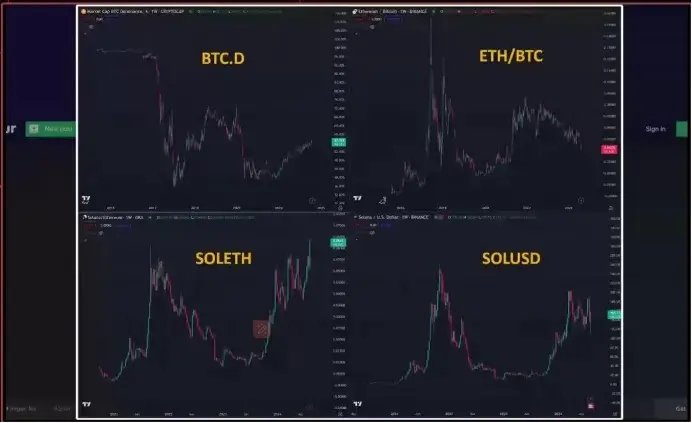
He introduced the discussion with Ledger and presented four charts: Bitcoin dominance, ETH/BTC ratio, ETH/Solana ratio, and Solana/USD price. He believes these charts can reflect the current state of the market and aims to get Ledger's interpretation.
He mentioned that recent market volatility has intensified due to the unfreezing of yen trades and suggested that this is a good time to evaluate the broader cryptocurrency market.
Ledger:
Bitcoin Dominance: Ledger acknowledges Bitcoin's strong dominance and believes that the current market phase resembles the early stage of a longer market cycle rather than the end of a cycle. He compares it to the stage in 2019, pointing out that the recent volatility may just be an experimental phase or the beginning of a new cycle.
Market Sentiment: He observes that despite some rapid fluctuations in cryptocurrencies, the public is not widely excited about buying cryptocurrencies or stocks, reflecting a relatively stable market rather than a frenzy.
Solana's Position: Ledger emphasizes the significant progress of Solana, noting its resilience and active development activities. He describes Solana as having entered the "top league," similar to Ethereum's position in the previous cycle, and emphasizes Solana's strong network effects and community involvement.
ETH/Solana Ratio: He points out that Solana has performed better relative to Ethereum and other assets. However, he also mentions that neither Solana nor Ethereum has reached their historical highs, and Ethereum's relative underperformance may be due to a lack of new participants.
Market Dynamics: Ledger is optimistic about Bitcoin, Ethereum, and Solana, viewing their relative value changes as opportunities rather than negative factors. He emphasizes that these dynamics provide opportunities for identifying value, making the current market conditions favorable for analysis and potential trades.
Market Sentiment Check
David Hoffman:
Bitcoin Market Dominance: Noted that Bitcoin dominance has been rising for a year, while the ETH/BTC ratio has been declining for two years.
Trend of Solana: Noticed that Solana's upward trend has been ongoing for nearly a year, attributing it to excessive selling during the FTX crash and the subsequent rebound driven by meme coin trends.
Market Cycle Perspective: He believes that the current period does not reflect traditional market cycles but is an isolated phase of cryptocurrency activity. He believes that traditional market cycles involve new retail participants and major trends such as NFTs or ICOs, which are currently lacking.
Current Market Status: Feels that we are currently in a stagnant state, waiting for new participants to define the next cycle, while Bitcoin's market dominance is rising and Solana's relative performance is prominent.
Ledger:
Solana's Rise: Agrees with this view and adds that Solana's rise is driven by meme coin trends, similar to Ethereum's DeFi rise. He also mentions that Solana has the potential to capture niche markets such as decentralized physical infrastructure networks or quasi-real assets.
Role of Ethereum: Points out that Ethereum focuses on durability and its role in major financial markets, carrying large-scale lending platforms.
Ecosystem Differences: Emphasizes that while Solana excels in speed and specific niche markets, Ethereum focuses on reliability and large-scale financial applications. Both ecosystems are thriving but serve different purposes.
Resilience of DeFi: Impressed by the resilience of cross-chain DeFi, despite challenges such as Curve's liquidation or attacks on platforms like Compound.
Market Cycle Perspective: Expresses skepticism about extremist views and believes that we are in a consolidation phase rather than the end of a market cycle. He points out that the lack of new major narratives or external capital entering the market indicates that the pessimistic view of the cycle ending is incorrect.
Price Discovery
David Hoffman:
Bitcoin and Ethereum Price Levels: Observed that Bitcoin briefly exceeded its all-time high only in 2021, reaching $72,000 in March and $71,000 in May, but failed to sustain these highs. Ethereum also failed to maintain above $3,000, struggling to reach its previous high of $4,000, making its all-time high seem out of reach.
Performance of Solana: Noted that Solana also failed to reach its old all-time high, despite news related to ETFs (exchange-traded funds), indicating a lack of new users in the cryptocurrency field and no significant new price discovery.
Ledger:
Market Cycle Assumption: Challenges the four-year cycle assumption based on halving, believing that ETFs may have a greater impact on demand. He also points out that global market and election-related uncertainties may affect the cryptocurrency market.
Trend of Consolidation: Believes that consolidation after reaching all-time highs is normal and suggests patience. He believes that while Bitcoin consolidates, other areas of the market may experience growth, leading to a reallocation of funds into a broader market.
DXY and Cryptocurrency: Emphasizes that the DXY (US Dollar Index) measures the strength of the US dollar, and its decline is usually favorable for cryptocurrencies. Long periods of consolidation are normal, and a weak dollar is usually associated with the bullish phase of cryptocurrencies.
Economic Background: Agrees with David's potential for a soft landing, pointing out that if inflation remains under control and the economy balances without excessive money printing, it could be positive for assets like Bitcoin and Ethereum.
Position of Ethereum: Points out that Ethereum is relatively weaker compared to Bitcoin and needs significant developments or adoption to surpass it. He believes that if Ethereum's technology gains widespread financial or government use, there is potential for an upward trend.
David Hoffman:
The future of Ethereum: Agrees that Ethereum needs real-world applications and significant developments to regain and surpass previous highs.
ETH/BTC Ratio
David Hoffman:
ETH/BTC Ratio: Points out that the ETH/BTC ratio has approached levels close to parity with Bitcoin's market cap. This implies that Ethereum could potentially equal Bitcoin in market cap, reflecting the concept of "flippening."
Ledger:
Discussion on flippening: Acknowledges the term "flippening," which once referred to Ethereum surpassing Bitcoin in market cap and was a significant point of discussion, but is no longer common. While not expecting Ethereum to surpass Bitcoin, Ledger still sees potential for Ethereum to regain strength.
Target range: Sets more realistic targets, expecting ETH to reach a range of 0.075 to 0.08 relative to Bitcoin, possibly reaching 0.1, indicating strong performance by Ethereum but not surpassing Bitcoin.
Performance and moving averages: Points out that the ETH/BTC ratio has been declining in recent years, with Ethereum underperforming Bitcoin and Solana in the previous cycle. Historically, Ethereum's support for Bitcoin during bear markets has had a limited impact on ETH relative to the 200-week moving average. Currently, Ethereum is below this moving average, indicating its relative weakness.
Future outlook: Despite current challenges, Ledger believes that Ethereum is still an investable asset, with the potential to reach new all-time highs if Ethereum's technology gains widespread financial or government use. He notes that removing Grayscale ETH from the ecosystem may improve market dynamics.
Impact of ETFs: Believes that ETFs can provide significant purchasing power for retirement accounts and large investment pools, benefiting Bitcoin and Ethereum. However, addressing existing challenges is crucial to fully realize these benefits.
David Hoffman:
Market environment: Acknowledges that Ethereum faces mixed challenges and opportunities in the current market environment, echoing Ledger's analysis.
Narrative Direction
David Hoffman:
Struggles of ETH in market dynamics: Reflects on the recent challenges faced by Ethereum, especially during the unfreezing of yen arbitrage trades, which led to significant selling pressure. He acknowledges a misconception that Jump Capital was involved but emphasizes that it was a participant with a large amount of leverage that had to exit, similar to the situation during the liquidation by Three Arrows Capital. He emphasizes that Ethereum, often used as collateral, tends to be more impacted during chain liquidations, significantly affecting the ETH/BTC exchange rate. He points out that while Ethereum has rebounded, the current market trend is unfavorable for Ethereum, with Bitcoin (BTC) and Solana (SOL) showing stronger momentum.
Ledger:
Seizing market opportunities and assessing strength: Agrees that ETH may retest the 200-week moving average and discusses the difficulty of seizing market opportunities, especially regarding the timing of ETH/BTC. He emphasizes the strength of Bitcoin and the relative weakness of Solana, partly due to the decline of meme coins. He notes that many meme coins have suffered significant losses, leading to holders diversifying or capitulating, which has had a negative impact on Solana.
Potential and risks of Solana: Believes that Solana has potential, especially if deeper projects make progress, but also sees the possibility of further weakness. He mentions that if Solana fails to consolidate or rebound from its lows, it may face challenges, especially until later this year when market conditions may improve. He suggests that strong market trends typically emerge after elections, which could bring price discovery for crypto assets in 2025.
Current market priorities: Suggests prioritizing Bitcoin over Solana and Ethereum, as Bitcoin seems to be the strongest among the three, although it still hovers within a fluctuation range below the 200-day moving average. He predicts that if Bitcoin falls to $40,000, it may pull Solana below $100 and Ethereum below $2,000, potentially leading to liquidations of leverage and speculation, especially in meme coins.
Strategic positioning: Recommends positioning oneself to take advantage of potential market downturns by the end of this year. He emphasizes the importance of being prepared to seize potential opportunities that may arise in the future, given the changing market dynamics.
Relative Weakness
David Hoffman:
Discusses the relative weakness of Solana, the apparent downward trend of Ethereum, and the concerning pattern of Bitcoin's failure to break through its all-time highs. He points out that Bitcoin has been consolidating below its all-time high for a long time, which is concerning in the impatient crypto market. He mentions the risk of prices starting to decline if there is no upward movement in the crypto space, leading to fears of the end of the cycle and potential sell-offs.
Ledger:
Underperformance compared to stock market: Emphasizes the disappointing performance of the crypto market compared to the stock market, especially the divergence in performance between stocks and Bitcoin. He adds that other assets such as gold have broken through and entered a price discovery phase, performing well in the past few months, further highlighting Bitcoin's lagging position. He mentions that a return of the 10-year Treasury yield to the mean, if there is no economic recession, would be favorable for cryptocurrencies, and an economic soft landing would be an ideal outcome.
Impact of interest rates and macroeconomics: Discusses the pressure of rising interest rates on the crypto market and the importance of a broad economic soft landing to avoid further poor performance in the crypto market. He points out that compared to cryptocurrencies, the NASDAQ has shown relatively strong performance over the past year, exacerbating the frustration of crypto investors.
David Hoffman:
Impact of ETFs on traditional cycles: Agrees that ETFs may disrupt the traditional four-year cycle, disappointing crypto traders and investors who expect more explosive growth patterns. He points out that while ETFs provide stable, reliable sources of growth, they lack the adrenaline rush that many speculators expect, dampening market enthusiasm.
Ledger:
Stable growth vs. quick gains: Acknowledges the slower growth due to ETFs but emphasizes the importance of the demand for these financial products, especially with a younger generation more open to crypto investments. He discusses the importance of long-term thinking, noting that the millennial generation entering its peak earning years provides strong momentum for future growth in the crypto market. He advocates for a 10-year investment perspective, emphasizing the potential for significant returns from major crypto assets.
Valuation and beliefs: "I think Ethereum around $2,000 is undervalued, Solana around $100 is undervalued, and Bitcoin below $100,000 is undervalued. For me, targets of $250,000 to $500,000 for Bitcoin, $10,000 for Ethereum, and $500 for Solana are completely reasonable, and I don't think these are overly aggressive predictions." Strongly believes that the current prices of Ethereum, Solana, and Bitcoin are undervalued, with the potential for significant long-term appreciation. He advises investors to avoid being distracted by short-term fluctuations and focus on long-term investments that may bring tenfold or greater opportunities in the future, emphasizing the importance of holding spot positions with conviction.
David Hoffman:
Avoiding long-term mistakes: Quotes Chris Burniske's viewpoint, emphasizing the importance of not being overly aggressive or impatient. He warns against expecting unrealistic timeframes for significant returns, noting that long-term success requires patience and composure.
Ledger:
Low leverage and long-term strategy: Advocates for low leverage and a focus on holding major crypto assets, pointing out that most people struggle with leverage and often end up losing money. He suggests investing a significant portion of net assets in spot crypto positions and gradually buying during consolidation periods or bear markets. He is pessimistic about making quick profits through leverage and trading, advising against chasing daily hot coins.
Identifying market shifts: Reflects on past market cycles, pointing out that major shifts like the 2020 DeFi boom or the 2021 NFT surge were identified by those already in the market. He emphasizes the importance of long-term participation and patience in identifying these real-time market shifts in crypto investments.
DeFi Summer Explosion
David Hoffman:
DeFi Summer Explosion: Recalling the exciting moment when Ethereum broke through from $330 to $425 and quickly surged to $1,100. He emphasizes the strong consensus and unique energy felt at that time, which has not been felt since.
Ledger:
DeFi Summer and Market Dynamics: Observing that Ethereum mostly traded sideways during the DeFi summer. The initial breakout temporarily interrupted the DeFi summer, but with Bitcoin's rise and Ethereum's stability, the DeFi summer continued. He points out that such breakouts often accompany market shifts and the gradual accumulation of strength, ultimately leading to strong price trends.
Current Market Sentiment: Shares that he currently does not feel the same market energy or momentum as before. He expects the market to continue in this state and does not anticipate any major breakthroughs immediately. He predicts that a market downturn before the elections would not be surprising and would reflect broader macroeconomic factors.
Patience and Market Timing: Advises that patience and market timing are crucial. True momentum and significant market shifts are instinctively felt through observing and understanding market dynamics. He acknowledges that while some minor trends like meme coins have shown movement, they have not had a transformative impact like major market shifts.
Market Heat and Opportunities: Points out that significant market opportunities arise when the market heats up and starts to act positively. He expects that with patience, one can seize opportunities when this momentum appears in the market.
Future Outlook
David Hoffman:
Ledger and the Future of Content Creation: Curious if Ledger will return to podcasting or other forms of content while recognizing the shift in focus. Mentions the prevalent need within his community to find balance and hobbies outside of cryptocurrency.
Ledger:
Current Approach: Plans to continue participating in the market but with a more cautious approach. He acknowledges the need to slow down and operate more strategically. Despite reducing high-frequency trading, he still maintains an interest in crypto.
Trading Style and Experience: Shares his trading experience, noting the transition from frequent trading to experiencing long-term capital appreciation. Describes his trading style as swinging between major themes, reducing the frequency of trades recently while achieving significant gains.
Long-Term Gains: Reflects on the rarity of achieving long-term capital appreciation from liquid cryptocurrencies and cherishes this experience. States that while he traditionally prefers swing trading, he has found value in a more patient approach recently.
David Hoffman:
Market Dynamics: Notices the slowing pace of the cryptocurrency market and the impact of factors such as ETFs and Federal Reserve policies on this change. Sees a shift from the intense four-year cycle to a more sustainable market rhythm.
Ledger:
Embracing Change: Expresses acceptance of a slower, more sustainable market dynamic.
免责声明:本文章仅代表作者个人观点,不代表本平台的立场和观点。本文章仅供信息分享,不构成对任何人的任何投资建议。用户与作者之间的任何争议,与本平台无关。如网页中刊载的文章或图片涉及侵权,请提供相关的权利证明和身份证明发送邮件到support@aicoin.com,本平台相关工作人员将会进行核查。


