In this bull market, DePIN is a must-join track. Today's research is on a high-quality project that is not yet widely known, Roam.
It is a decentralized WiFi roaming network, and currently the global node count has exceeded that of Helium Mobile.
For modern humans, air, water, and the internet are the three essential necessities of life. We hope to be able to easily access the internet wherever we go. Cellular networks (such as 4G, 5G) and WiFi have become the two main ways for users to access the internet on a daily basis. However, when cellular networks are unavailable due to signal coverage, poor indoor positioning, or crowded areas, WiFi becomes the only life-saving remedy.
Roam aims to promote the construction of a decentralized global WiFi roaming network. Other DePIN projects mainly focus on decentralized platforms for physical devices, such as decentralized GPU computing power and decentralized broadband. However, Roam is not simply aggregating user-provided WiFi, but rather, it uses a Web3 token incentive mechanism to encourage users to jointly build a global WiFi OpenRoaming™ roaming network. In the actual use of WiFi, we often encounter such troubles. In different places such as cafes, bookstores, or airports, every time we go to a new place, we need to find usernames and passwords, which is very troublesome. In addition, public WiFi also has security issues.
The OpenRoaming™ plan, initiated by the Wireless Broadband Alliance (WBA), aims to establish a global WiFi network alliance. Promoters include Cisco, Google, AT&T, Boingo Wireless, Samsung, and others. In the OpenRoaming™ network, WiFi providers will adhere to common standards and security protocols. And more importantly, when users arrive at a location supported by OpenRoaming™, their devices can automatically connect to WiFi without any operation. Connecting to WiFi is as convenient as using 4G/5G cellular networks.
In the actual promotion of such a good thing, progress has been relatively slow due to reasons such as the interests of stakeholders, educational costs, and hardware costs. As the only Web3 project in the WBA OpenRoaming™ plan among the 11 enterprise alliances, Roam not only establishes a DePIN network that integrates OpenRoaming™, but also uses token incentive measures to promote the development of the network more quickly.
The effect is significant. In the past 8 months, Roam's nodes have increased by 400,000, surpassing Helium Mobile and becoming the second largest DeWi network. At the same time, Roam users can also access over 3.5 million WiFi nodes supported by OpenRoaming™. Furthermore, Roam has a very large growth potential, as the global scale of WiFi is 700 million, and currently less than 0.5% is supported by OpenRoaming™.
Introduction to Roam
Roam aims to build a decentralized global WiFi OpenRoaming™ roaming network. By using decentralized identities (DIDs) and verifiable credentials (VCs), users can seamlessly connect to public WiFi networks, eliminating the need for repeated logins and registrations. Roam uses advanced blockchain technology and economic incentive mechanisms to provide secure, efficient, and convenient connection services for users and network providers.
Key Advantages of Roam
- Global WiFi Roaming: Through Passpoint and OpenRoaming™ technology, Roam achieves automatic roaming of devices between different WiFi networks, providing a seamless and secure connection experience. Users only need to register once to automatically connect to WiFi roaming networks supported by OpenRoaming™ globally.
- Decentralized Identity Authentication: Roam uses DIDs and VCs for secure network authentication, ensuring user privacy and data security. Through zero-knowledge proof technology, users can verify their identity without revealing personal information.
- Web3 Token Incentives: Roam uses token incentive mechanisms to reward users and network providers, promoting the expansion and maintenance of the network. Users earn Roam tokens by adding WiFi hotspots, checking in at nodes, and participating in network activities.
- Roam Miners: Roam miners provide encrypted mining capabilities and enterprise-level connection security. Users can earn Roam tokens by deploying miners and enjoy stable network connections.
Passpoint and OpenRoaming™
First, let's introduce the core technologies used by Roam, Passpoint and OpenRoaming technology.
Passpoint is a WiFi authentication and roaming technology developed by the Wi-Fi Alliance in 2012. It simplifies the process for users to connect to public WiFi networks, while improving the security and reliability of connections. Passpoint allows devices to automatically discover and connect to WiFi networks without user intervention (such as entering passwords). Passpoint uses WPA2-Enterprise encryption and EAP (Extensible Authentication Protocol) to provide a strong security authentication mechanism, ensuring the secure transmission of user data.
Another feature of Passpoint is its support for seamless switching between WiFi networks. Devices can automatically switch between different WiFi networks without the need for re-authentication. In simple terms, Passpoint technology allows devices (such as phones and computers) to automatically connect without re-entering passwords when moving to a new location.
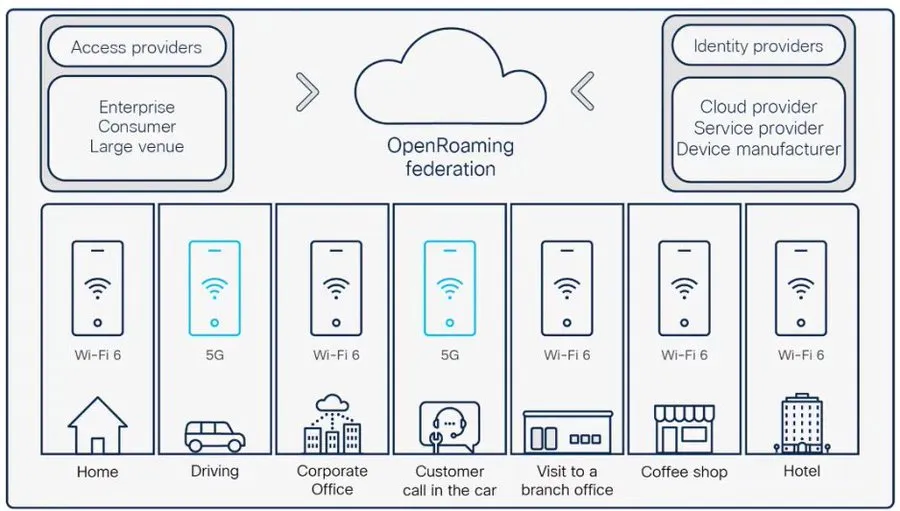
Next, let's talk about OpenRoaming™, which is an initiative launched by the Wireless Broadband Alliance (WBA) to establish a global network alliance. OpenRoaming™ connects access providers (such as public venues, retailers, airports, and large enterprises) and identity providers (such as service providers, operators, device, and cloud providers) to provide seamless WiFi access for mobile users.
The combination of Passpoint and OpenRoaming™** means establishing a WiFi alliance network composed of authenticated devices**, and all WiFi here follows unified technical standards. Then, users can automatically authenticate and connect to different WiFi networks using this network. *So, when users arrive at a location supported by OpenRoaming™, their devices can automatically connect to WiFi without any operation. Connecting to WiFi is as convenient as using 4G/5G.*
DID and VC
Now that the WiFi network alliance is established, the next step is to address identity authentication, privacy, and security. The answer to this problem is DID and VC.
Decentralized Identity (DID) is a new, verifiable, decentralized identifier used for authentication. This identity is broad, referring to any subject, such as individuals, organizations, or devices. Unlike traditional centralized identity systems, DIDs are controlled by users themselves: users can generate and manage DIDs, stored in a distributed network, ensuring the security and tamper resistance of DID data. This avoids the single point of failure and privacy leakage risks present in traditional identity systems.
Verifiable Credentials (VC) are standardized identity credential formats stored digitally on computers or mobile devices, similar to real-world credentials. For example, if I am xiaochu, then I have a library membership card, a driver's license, a university diploma, and so on. It achieves more efficient and secure identity verification. VC includes:
- Metadata: Contains issuer information, expiration date, credential ID, etc.
- Claim data: Includes the credential holder's attribute information, such as name, age, qualifications, and the issuer's authentication of this information.
- Encryption proof: A signature generated using encryption algorithms to ensure the authenticity and integrity of the credential, preventing tampering and forgery.
DID and VC form a decentralized identity credential. In the Roam network, DID and VC are widely used to achieve secure identity verification and privacy protection for the OpenRoaming service. When users access the Roam network, they use DID and VC for identity verification. The user's DID and related VCs are stored on the user's device and can prove their identity and the validity of their credentials without revealing sensitive information.
Token Incentive DePIN Network
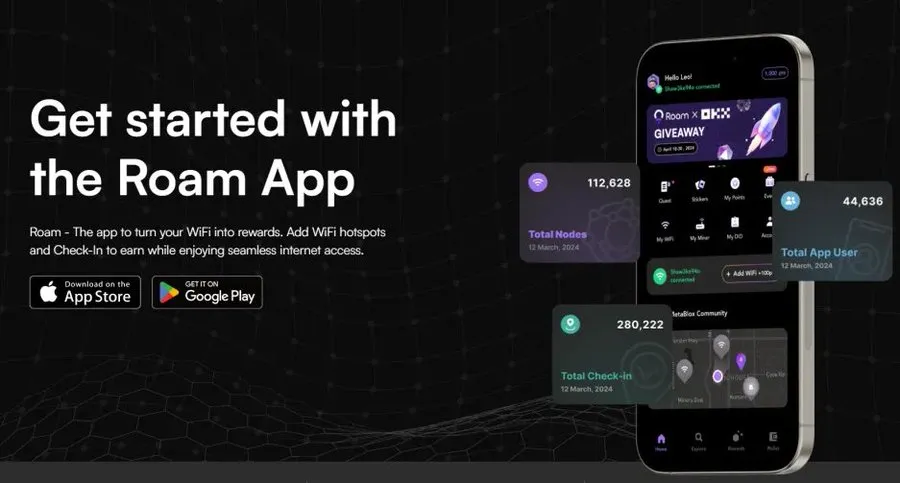
Roam has built a DePIN ecosystem, which is driven by the Web3 economic system. Based on this DePIN network, both enterprises and individual users can join OpenRoaming™ through the Roam protocol according to their own situations. A simple way to do this is by downloading the Roam mobile app to share hotspots, while professional users can purchase Roam's Rainier MAX60 router.
1. In-App
Users can download the Roam app, which supports Android and iOS. The Roam app not only allows users to connect to the OpenRoaming™ WiFi network through the app, but also provides a one-time welcome reward for new users who download the app. Additionally, the app has social reward mechanisms such as sharing and inviting to incentivize user social diffusion. Furthermore, Roam, with tens of thousands of users, collaborates with other projects, allowing users to receive airdrop rewards through various activities.
2. Roam Router
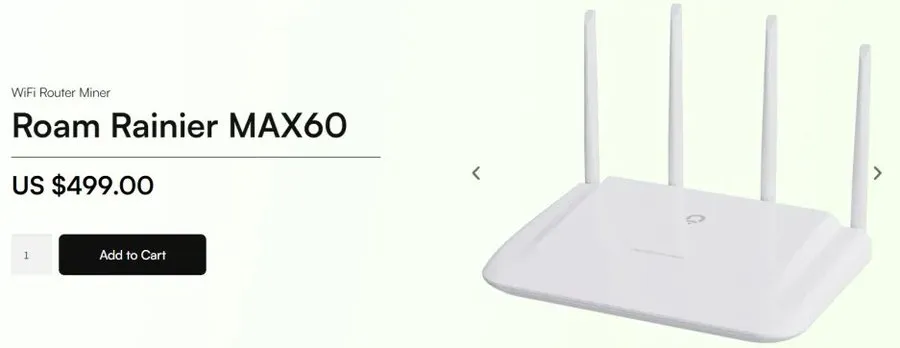
Professional users can choose the Roam router: Rainier MAX60, which is priced at $499 on the official website. Firstly, this router can be used as a daily WiFi router. The Rainier MAX60 has Wi-Fi 6 performance, supporting data transfer rates of up to 9.6Gbps, which is nearly three times faster than the 3.5Gbps of WiFi 5. It can support over 200 devices simultaneously connected in a space of 150 square meters.
Additionally, it can serve as a DePIN device for the Roam network, enabling automatic mining. Importantly, by running the Rainier MAX60 and providing users with OpenRoaming™ WiFi services, users can receive RoamPoints rewards four times greater than private WiFi access points.
The Roam-baker-max30 will also be launched in the future, with a price of only $199.
The Roam router itself has excellent performance as a daily WiFi device and, coupled with continuous economic incentives, is expected to drive a large number of WiFi nodes to join the OpenRoaming™ network.

From the data, it is evident that the number of Roam's WiFi connections is growing rapidly. The current number of WiFi connections has reached 404,000, and the number of app users has reached 523,000. Roam's rapid growth began in December 2023, and in just 8 months, it has reached 400,000. In comparison, despite being built for many years, OpenRoaming's node count is currently only slightly over 3.5 million.
免责声明:本文章仅代表作者个人观点,不代表本平台的立场和观点。本文章仅供信息分享,不构成对任何人的任何投资建议。用户与作者之间的任何争议,与本平台无关。如网页中刊载的文章或图片涉及侵权,请提供相关的权利证明和身份证明发送邮件到support@aicoin.com,本平台相关工作人员将会进行核查。


