As a leading project in the ZK hardware acceleration track, the Cysic project can be summarized in three aspects: efficiency, universality, and decentralization.
By: DeepTech TechFlow
After falling into the enchanting and illusory rabbit hole of Web3 for a long time, the public seems habitually to overlook one point: fundamentally, we live in a world supported by hardware, whether it is the demand for VR devices in the metaverse, the CPU and GPU consumption behind AI, or even the ZK track, which Vitalik Buterin views as the "future of Ethereum."
Although ZK has rigorous mathematical logic and significant advantages in security, privacy, and scalability, the current inefficiency in ZK proof generation at the algorithm level hinders breakthrough progress. ZK hardware acceleration has become the most direct and effective solution to empower ZK development. Vitalik also mentioned at the Web3 Carnival in Hong Kong in April this year that ZK hardware acceleration helps to elevate the efficiency and security of Ethereum to a whole new level.
As the potential of the ZK hardware acceleration track is increasingly valued, the upcoming ZK hardware acceleration project Cysic, which will launch its testnet in mid-July, has attracted widespread attention. In this testnet launch, Cysic will conduct a series of community incentive activities in stages. In the current stage, Cysic will invite users to become validators through a whitelist mechanism, participate in network testing, and receive corresponding rewards. In the later stage, Cysic will also open some roles for provers to the community.
As one of the first leading projects to enter the ZK hardware acceleration track, Cysic has previously completed a $6 million seed round of financing and a $12 million Pre-A round of financing, attracting participation from well-known VCs in the industry, including Polychain Capital, Hashkey Capital, OKX Ventures, ABCDE, and support from DAO5 partners, George Lambeth, the first investor of Celestia, and Ken Li, former executive director of Binance Labs.
Seizing the opportunity of the testnet launch, we conducted an in-depth exchange with Leo Fan, co-founder of Cysic, to explore Cysic's insights into the ZK and hardware acceleration track, project advantages and implementation logic, and prospects for the large-scale application of ZK technology in 2025.
In this issue, let's delve into Cysic's past, present, and future, and together explore Leo Fan's views on the ZK hardware acceleration track.
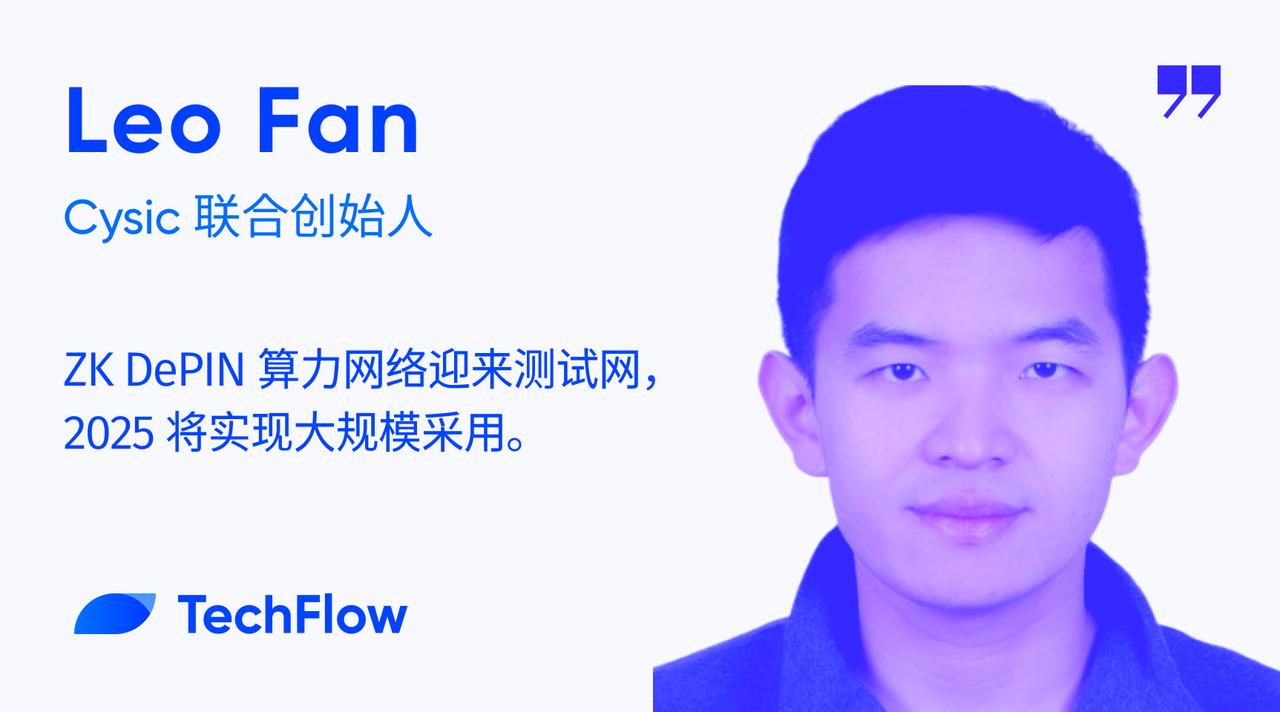
Key Points
With the arrival of the mid-July testnet, a series of incentive activities are also being prepared: Cysic will invite users to become validators through a whitelist mechanism, participate in testing, and win rewards. In the later stage of the testnet, we will also open some roles for provers to the community. For B-side users, Cysic aims to provide efficient, low-cost, and real-time ZK services for ZK project parties, and professional miners can also access the Cysic network to achieve more efficient use of hardware devices. For C-side users, even ordinary laptops can join the Cysic network as validators.
As a leading project in the ZK hardware acceleration track, the key points of the Cysic project can be summarized in three aspects: efficiency, achieved through self-developed chips for real-time proof generation; universality, providing acceleration services for almost all different algorithm types of ZK on the market; decentralization, building the ZK DePIN Network to provide services to the industry in a decentralized manner.
The advantages of ZK are: there is no need to trust specific individuals, but rather to establish trust through mathematical logic. In addition, compared to other scaling solutions, the entire architecture of Ethereum is more friendly to the development of ZK. The rigorous mathematical logic of ZK also provides higher security and fairness for Ethereum.
At Cysic, project parties have the autonomy to choose suitable Provers according to their own needs, further enhancing decentralization.
Whether in terms of cost-effectiveness or efficiency power consumption ratio, ASIC's performance is far ahead. However, due to the high cost that may result from errors in the ASIC design and production process, everyone is cautious about the design and manufacturing of ASICs.
Cysic adopts a dual-token economic model: the Native Token has uses such as gas fees and rewarding ecological contributors, while veToken can participate in governance to adjust network computing power decisions.
With the development of ZKVM and the shipment of Cysic ASIC hardware, ZK technology may achieve true large-scale adoption by 2025.
The industry's fastest ZK hardware acceleration service, Cysic testnet is coming soon
DeepTech TechFlow: First, please introduce yourself.
Leo Fan:
Hello everyone, I am Leo Fan, co-founder of Cysic.
First, let me share my educational background, which mainly revolves around cryptography and computer security: I studied at the Mathematics Base Class of Sichuan University for my undergraduate degree, and continued my master's studies at the Beijing National Key Laboratory of Information Security from 2010 to 2014. After that, I pursued a Ph.D. in cryptography and information security at Cornell University and obtained my doctoral degree in 2019.
Now, I'll share my work experience: during my time in Beijing for my master's degree, I got involved in Bitcoin and participated in early Bitcoin mining. During my Ph.D. studies, I also had several internships at companies such as IBM and Yahoo. After graduation, I first joined the National Institute of Standards and Technology (NIST) in the United States to work on cryptographic standardization, and then joined the Layer 1 project Algorand. This project was founded by Silvio Micali, the inventor of ZK technology, Turing Award winner, and MIT professor. At Algorand, I was mainly responsible for designing and implementing the Algorand State Proofs, aiming to bring trustless interoperability to the Algorand ecosystem.
It wasn't until 2022 that I found the ZK proof generation process to be very time-consuming. Initially, I tried to optimize it through algorithms and software, but the effects were not very significant. So, I thought of accelerating proof generation through hardware methods, which led to the birth of Cysic, aiming to achieve real-time ZK proof generation through hardware acceleration.
DeepTech TechFlow: The Cysic testnet will be launched in mid-July. Could you please share from the perspectives of B-side and C-side, how project parties, users, or developers can participate in the Cysic ecosystem?
Leo Fan:
From the B-side perspective, Cysic aims to provide efficient, low-cost, and real-time ZK services for ZK project parties. Currently, Cysic has launched the Early Access Program (EAP), providing enterprise-level end-to-end hardware acceleration solutions for ZK projects with computational power needs. Cysic supports a range of multi-proof systems, including Halo2, STARK, Groth16, Plonky2, ZAMA, GKR, and RapidSnark. Our powerful network is supported by over 10,000 GPU cards, ensuring unparalleled performance and reliability. Currently, 16 projects, including Scroll, Light protocol, Risc Zero, Inference Labs, Ion Protocol, Aerius Labs, and TalusNetworkEAP, have joined the EAP program, and early members will enjoy a series of ecological benefits in the future.
In addition, the B-side can also refer to professional miners who have a large number of graphics cards. In addition to accessing other networks such as the AI DePIN network, they can also join the Cysic network in the future. After joining, the graphics cards will be running tasks most of the time, entering a more efficient usage phase. In the later stages of the testnet, we will also open roles for provers to the community, and users who meet certain hardware conditions can apply to become provers, contributing to the mainnet launch and receiving testing rewards.
From the C-side user perspective, this may refer to relatively inexperienced users who may not have powerful hardware. They can also join the Cysic network as validators using ordinary laptops, contributing to the ZK ecosystem and receiving rewards. The Cysic testnet will be launched in mid-July, and related testnet incentive activities are also being prepared: at that time, we will also invite users to become validators through a whitelist mechanism, participate in network testing, and receive corresponding rewards.
DeepTech TechFlow: If you could describe what Cysic is doing in just three words, how would you describe it?
Leo Fan:
We believe that after breaking through the efficiency bottleneck, whether in the crypto industry or in the Web2 real world, ZK technology will see large-scale adoption. Cysic aims to achieve this by providing full hardware acceleration services, including FPGA, GPU, and ASIC, to achieve real-time ZK proof generation. By building the ZK DePIN Network, Cysic Network connects ZK project parties, computational power providers, and community validators, ultimately providing an efficient, cost-effective, and decentralized computing power + validation network for the entire industry. In summary, Cysic will play an indispensable role in accelerating the large-scale adoption of ZK.
Returning to the question, I think what Cysic is currently doing can be described in the following three words:
Efficiency: Cysic aims to achieve real-time proof generation through self-developed chips. Although we are currently providing ZK acceleration services for projects through GPUs, we are currently the fastest in the industry. In the future, with the progress of the project and the implementation of ASIC, we will be even faster.
Universality: In the ZK domain, there are various algorithms, and Cysic aims to provide ZK acceleration services for all algorithms in the industry, further expanding our service range and improving usability.
Decentralization: Cysic is currently building the Cysic Network, which is a ZK DePIN Network. We hope to provide services to the entire ecosystem through decentralized Provers and Verifiers, allowing participants to contribute to ZK and receive rewards.
DeepTech TechFlow: Currently, there are mainly CPU, GPU, FPGA, and ASIC ZK hardware acceleration solutions. What are the differences between these methods? Which method does Cysic prefer for ZK hardware acceleration?
Leo Fan:
In fact, Cysic has a say in this matter, as ZK hardware acceleration has a competition called ZPrize. Cysic missed the first ZPrize, but this year, one of the track designers and judges for the competition.
In the entire ZK or hardware field, there are three important indicators:
First is Performance Per Dollar: This refers to the cost of purchasing the corresponding hardware to obtain the computational power. Since CPUs do not perform as well as the other options, we mainly discuss hardware acceleration using GPUs, FPGAs, and ASICs. In terms of cost-effectiveness: ASIC > GPU > FPGA, especially when the shipment volume of ASICs is sufficient, which is currently the case for ZK.
The second indicator is Performance Per Watt: This refers to the energy consumption required to run this hardware. ASICs still lead in this aspect, with GPUs slightly better than FPGAs.
The last indicator is Go to Market Time: We know that ASICs need to design chips, and tape-out is an important step in the ASIC chip design process, which involves sending the generated masks to a wafer factory for chip manufacturing. If there are errors during the tape-out process, it can lead to high costs. Therefore, everyone is currently cautious about the design and manufacturing of ASICs.
In the short term, Cysic is also following this trend. From the end of last year to the beginning of 2025, we will provide acceleration services through GPUs. However, our ASICs will probably be introduced in the second or third quarter of next year, at which point we will shift to providing ASIC services. This is an inevitable process. Cysic is committed to achieving real-time ZK proof generation. For the mainstream ZK circuits, we hope to achieve proof times of 1-5 seconds. To achieve this goal, only ASICs can do it.
DeepTech TechFlow: How does Cysic achieve real-time proof generation? What changes or innovations will this bring to ZK, Ethereum, and the entire crypto industry?
Leo Fan:
I think this will definitely bring about significant innovation. Let's take the combination of ZK and machine learning as an example. Currently, if you want to run a ZK circuit for machine learning, it will be very time-consuming: if you want to prove a GPT2 circuit using ZK, even the fastest solution will take several minutes, and using a CPU will take several hours. Such a long time is completely unacceptable in terms of user experience.
Cysic's ASIC chips will be able to achieve real-time ZK proof generation, not only promoting the combination of ZK and machine learning technology but also providing a great user experience. Additionally, the integration of crypto and AI is very close, so this example is also a very crypto-native example.
Furthermore, I believe that ZK acceleration will bring significant empowerment to Ethereum and the entire crypto industry. The biggest change is that tasks that previously took over ten minutes to complete will be shortened to a few seconds. More transactions on L2 and cross-chain transactions can be confirmed more quickly, and this confirmation is based on mathematical logic, rather than the "innocent until proven guilty" assumption, which is a huge advancement for the crypto industry.
By achieving real-time ZK proof generation in a decentralized manner, Cysic is incentivizing the ZK DePIN network with a dual-token model
DeepTech TechFlow: In past solutions, it has always been difficult to balance efficiency and decentralization. However, Cysic has achieved decentralization while achieving real-time proof generation. Can you briefly introduce how Cysic achieves this? How does the PoC consensus adopted by Cysic further enhance decentralization?
Leo Fan:
As mentioned earlier, in the ZK DePIN network Cysic Network built by Cysic, there are two important roles: provers and verifiers.
Verifiers are responsible for verifying the proofs generated by provers, and the decentralization of verifiers is relatively easy because even smartphones, laptops, and tablets can participate in verifying a ZK proof, with very low hardware requirements and verification times usually less than one second.
The decentralization of provers in the early stages (i.e., the GPU era) is somewhat challenging because to provide a good user experience, i.e., relatively short proof generation times, it means that provers need to meet high hardware requirements, which can be a barrier for many people. However, when Cysic's hardware starts shipping, this situation will be greatly alleviated. Compared to the current mainstream GPU acceleration, Cysic's hardware can achieve up to ten times the efficiency in ZK acceleration and is relatively inexpensive. Users can purchase Cysic's hardware at a lower cost to achieve the level of professional miners.
From a software perspective, Cysic is currently developing a ZK DePIN network, and we have designed a Proof of Compute (PoC) mechanism to better fit the ZK DePIN scenario. PoC is actually more like a combination of Proof of Stake and Proof of Work. For each epoch, approximately 100 blocks, a batch of nodes is selected based on the computational power of the provers. Then, based on the staking weight of these nodes, it is determined who will propose the blocks in this epoch. This not only ensures network stability but also further enhances decentralization.
DeepTech TechFlow: We noticed that Cysic has adopted a dual-token model design combining utility tokens and governance tokens. Could you introduce the advantages of the dual-token design and how Cysic achieves effective governance and incentives in the ecosystem through dual tokens?
Leo Fan:
In the dual-token model, one is the Native Token, and the other is the veToken.
The Native Token is mainly used for gas fees, rewarding ecosystem contributors, etc. However, to participate in governance and decide network computational power allocation, participants need to stake Cysic's tokens to obtain corresponding voting rights.
We know that there are many projects in the ZK space, and different projects adopt different algorithms. Therefore, how to schedule the computational power in the Cysic network becomes crucial. If the computational power is scheduled well, it will bring high returns to the Cysic network and further empower network participants. Having voting rights is equivalent to having the right to participate in computational power scheduling. For example, if a project has performed very well recently, should we provide more computational power to it? Through this mechanism, it is not only more conducive to capturing the value of the entire ZK ecosystem, but Cysic's tokens can also circulate better in the entire ZK ecosystem.
DeepTech TechFlow: ZK hardware acceleration services easily bring to mind the DePIN track. What extensions does Cysic's ecosystem construction have in the DePIN aspect?
Leo Fan:
We hope that more hardware will join the Cysic network. It is worth noting that the hardware in the Cysic network is not idle but is actually creating value through proof generation and verification. This is the biggest difference between us and many AI and DePIN projects. Currently, the Cysic network is in the internal testing phase, and hundreds of servers are constantly running at full capacity.
In addition, the Cysic network also has some touchpoints for traditional users. Due to the privacy computing advantages of ZK, we will also provide better services to traditional users through the DePIN network.
DeepTech TechFlow: Whether at last year's EDCON in Montenegro or this year's Web3 Carnival in Hong Kong, Ethereum co-founder Vitalik Buterin has clearly expressed the view that "ZK is the future of Ethereum." Why is Vitalik so optimistic about ZK? What are the advantages of ZK technology compared to other scaling solutions, and how does it empower Ethereum?
Leo Fan:
I think the reasons can be divided into two aspects:
First, ZK does not require trust in specific individuals. Unlike the "innocent until proven guilty" trust mechanism of optimistic rollups, ZK's trust is based on rigorous mathematical logic, and ZK technology has been developed for three or four decades, making this cryptographic system based on mathematical assumptions increasingly robust. Therefore, compared to other solutions, placing trust in mathematics is more secure.
Second, compared to other scaling solutions, the entire architecture of Ethereum is more friendly to the development of ZK. After generating a ZK proof, it can be quickly verified in Ethereum, and the generated ZK proof can be a block in L2, corresponding to perhaps 1000 transactions. In other words, verifying a ZK proof on Ethereum is equivalent to verifying 1000 transactions. Without making too many changes to the underlying Ethereum, ZK is a better scaling solution.
Finally, let's talk about the empowerment of ZK technology for Ethereum: I believe that the rapid development of ZK has greatly improved Ethereum's settlement time through L2. Additionally, through ZK Bridge, Ethereum can improve efficiency while avoiding many security vulnerabilities. Furthermore, ZK has a significant empowerment for how Ethereum itself generates blocks. ZK has a Verifiable Delay Function (VDF) module, which uses rigorous mathematical functions to generate random numbers and produces corresponding ZK proofs to verify that the Delay Function has been properly calculated. This provides good security and fairness for Ethereum.
DeepTech TechFlow: Faced with the current inefficiency of ZK, Vitalik has also focused on three solutions: 1. Parallelization and aggregation trees; 2. Using SNARK algos and hash to improve efficiency; 3. Using ASIC for ZK hardware acceleration. As a project focusing on ZK hardware acceleration, what are the advantages of ZK hardware compared to the other two solutions?
Leo Fan:
In fact, the first solution of parallelization and aggregation trees and the third solution of ZK hardware acceleration have a cooperative relationship. The parallelization and aggregation trees solution actually involves either implementing Parallel EVM or aggregating and batch verifying proofs, and hardware acceleration can also speed up this process.
The second solution is to use SNARK algos and hash to improve efficiency. SNARK (Succinct Non-Interactive Arguments of Knowledge) is actually ZK, and what we are accelerating is SNARK. Many projects have many parameters in their SNARK, and setting the parameters aggressively can affect security. The advantage of ZK hardware acceleration is that it can achieve acceleration without compromising security.
ZKVM assistance and Cysic's self-developed hardware shipments may lead to large-scale adoption of ZK in 2025
DeepTech TechFlow: Recently, the influence of ZK has reached Solana, where the privacy protocol Light Protocol has proposed a new primitive called ZK Compression, aimed at enabling native ZK computation on Solana to significantly reduce the costs of token and account management by several orders of magnitude. How do you view ZK Compression? What opportunities and challenges do you think it will bring to the ZK hardware acceleration track where Cysic operates?
Leo Fan:
ZK Compression is a recent ZK technology on Solana. It mainly uses the succinctness of ZK to reduce state, thereby reducing expenses. Similar technology is also used in ZK-L2 and ZK bridge. For Cysic, this technology is no different from the core technology currently being developed by Cysic. It's just the application of ZK in a new scenario (Solana), and Cysic's existing technology can provide good support.
DeepTech TechFlow: How long do you think it will take for ZK technology to be widely adopted in specific scenarios? What are the key opportunities to realize this vision?
Leo Fan:
I believe that the widespread adoption of ZK may come as early as next year, and not just limited to the crypto industry, but truly implemented in many real-world applications. This mainly comes from two opportunities:
First, on the software side, Cysic is very focused on the development of ZKVM. ZKVM aims to help developers by allowing them to write RUST or Go projects directly, rather than having to write many ZK circuits, and then convert them into ZK circuits through ZKVM, greatly speeding up ZK development and lowering the threshold for ZK software development. Cysic will continue to explore and introduce better solutions in the software aspect.
Secondly, Cysic's self-developed hardware will be shipped next year, which will greatly improve the efficiency of ZK proof generation and become a key force driving the widespread adoption of ZK technology.
DeepTech TechFlow: Could you share with us the recent significant progress made by Cysic and what the focus of Cysic's work will be in the second half of 2024?
Leo Fan:
In the past year, Cysic has made many breakthroughs. By the end of 2023, the team had roughly determined the development direction of ZK chip design. Previously, our work may have been focused on accelerating a module with a significant proportion, but at the end of last year, we determined the direction of ZK chip design based on ZKVM, giving our hardware products a very flexible form. We will have two products:
ZK Air will be a product for ordinary users, a lightweight portable ZK DePIN device, with a size close to that of a MacBook charger, which can be connected to a phone or computer via Type-C to achieve efficient ZK proof generation. ZK Air provides computational power greater than that of top consumer-grade graphics cards, comparable to 10 RTX 4090s.
ZK Pro will maximize the acceleration of ZK proof generation, providing real-time ZK proof computation for users, designed similar to traditional mining rigs. ZK Pro is more suitable for large-scale ZK projects, such as zkRollup, zkML, and other scenarios. In terms of performance, ZK Pro has seen a huge improvement compared to Air, with computational power comparable to 50 NVIDIA RTX 4090 graphics cards, according to official disclosures from Cysic.
In addition, in terms of GPUs, we have developed our own general-purpose code, which has seen a significant improvement compared to CPUs and is nearly twice as fast as open-source solutions on the market. Before ASIC is introduced, we aim to provide the industry with better ZK hardware acceleration services through GPU and other solutions.
In the upcoming year of 2024, Cysic's testnet will go live in mid-July, and the mainnet may go live in the third quarter. Most of the development work has already been completed, and we are continuing to work on stress testing and other aspects.
Additionally, another major focus for us is the hardware design based on ZKVM, aimed at providing a very specific performance for the community.
免责声明:本文章仅代表作者个人观点,不代表本平台的立场和观点。本文章仅供信息分享,不构成对任何人的任何投资建议。用户与作者之间的任何争议,与本平台无关。如网页中刊载的文章或图片涉及侵权,请提供相关的权利证明和身份证明发送邮件到support@aicoin.com,本平台相关工作人员将会进行核查。


