Can parallel blockchains break through the blockchain bottleneck and achieve a user scale of 1 billion?
Author: PAUL TIMOFEEV, MIKE JIN, AND G

Compilation | Plain Blockchain (ID: hellobtc)
If the Bitcoin, which uses a distributed ledger for accounting, is considered as Blockchain 1.0, then Ethereum, which implements decentralized applications (dApps) using a distributed state machine, is considered as Blockchain 2.0. The development of blockchain networks from 2008 to the present, spanning just over a decade, has given birth to numerous technological and business model innovations. From the Web3 infrastructure to various tracks represented by DeFi, NFT, social networks, and GameFi, the industry's vigorous development continues to attract new users, which in turn raises higher demands for user experience.
However, the blockchain impossible triangle, also known as the blockchain trilemma, states that with current technology, it is still not possible to simultaneously achieve all elements within the same system. Therefore, since its inception, various solutions have been proposed to attempt to address the performance issues. These solutions can be broadly categorized into two types: on-chain scaling solutions, such as sharding and parallel blockchains; and off-chain scaling solutions, such as the Lightning Network, sidechains, and Rollups.
Today, we will take Solana, Sei, Monad, and other cases as examples to explore the design principles and development status of parallel blockchains in the industry.
The following is the main text:
01
Blockchain Transactions
Blockchain is a virtual machine, a software computing model based on a decentralized physical computer network, which anyone can join, but it is extremely difficult for any single entity to control it.
The concept of blockchain first appeared in the Bitcoin white paper written by Satoshi Nakamoto in 2008, as the core infrastructure for achieving secure peer-to-peer payments for Bitcoin. Transactions on the blockchain are like logs for social media and internet companies, serving as the activity records of the specific network. The key difference is that transactions on the blockchain are immutable and typically publicly observable.
But what exactly are transactions?
Transactions on the blockchain involve transferring digital assets from one address on the distributed ledger to another, using public key cryptography for security protection. They can be used for decentralized peer-to-peer transfers, as well as for various authentication and verification processes to record transactions.
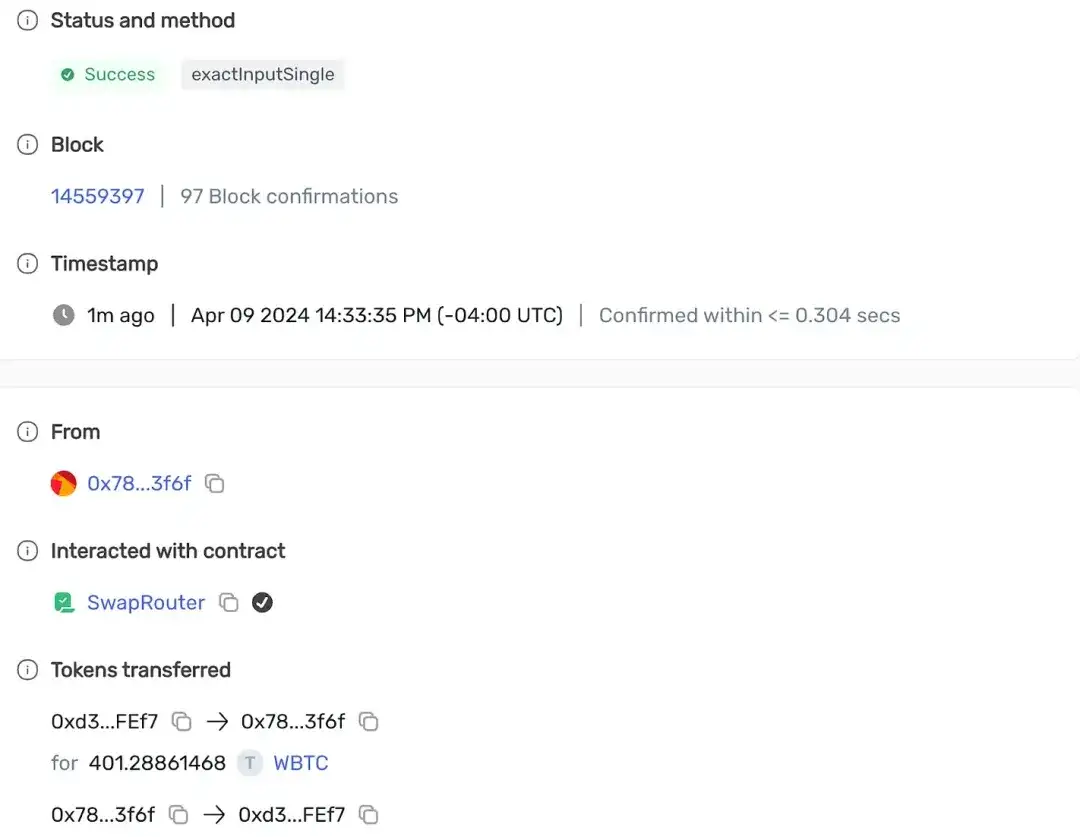
1) Working Principle of Blockchain Transactions
When a transaction is initiated, such as Bob sending some tokens to Alice, Bob's transaction is shared with the underlying blockchain network. Subsequently, a group of specialized nodes on the network begins to verify and confirm whether the transaction is legitimate. Once a sufficient number of nodes have verified the transaction, it is added to a block along with other users' transactions. When a block is filled, it is added to the chain, hence the name "blockchain." Bob's transaction now becomes a secure and transparent part of the ledger, which both he and Alice can verify.
In general, all blockchain transactions contain metadata, which helps nodes on the network identify and execute a set of given instructions and parameters to run and protect the network. Each transaction has high-level data input by the original sender, such as the amount to be transferred, the destination address, and the digital signature used to confirm the transaction, as well as various low-level data that are automatically created and attached, but the specific form of the data may vary depending on the network and design.
However, ultimately, the processes involved behind the scenes at the network layer before transaction execution will vary depending on the design of the blockchain.
Memory Pool
The memory pool (or mempool) is a common part of traditional blockchain networks, such as Bitcoin and Ethereum. The mempool is essentially a buffer or "waiting room" for pending transactions that have not yet been added to a block and executed.
To better understand, we can describe the lifecycle of transactions on a blockchain that uses a mempool:
- A user initiates and signs a transaction.
- Specialized nodes on the blockchain network verify the content of the transaction to ensure its legitimacy and include the appropriate parameters.
- Once verified, the transaction, along with other pending transactions, is sent to the public mempool.
- Eventually, based on the gas fees paid for the transaction relative to other transactions in the mempool, the user's pending transaction is selected along with others to form the next block on the blockchain. At this point, the transaction status will show as "successful."
After a period of time or reaching a threshold based on the number of blocks, the block itself is finally confirmed, and the transaction becomes an immutable log recorded on the blockchain, making it almost impossible to tamper with unless a 51% attack occurs, which is a very difficult task to carry out.
No Memory Pool (Solana)
It is important to note that some blockchains, such as Solana, do not use a memory pool and instead directly forward transactions to block producers to achieve high speed and throughput through continuous block production.
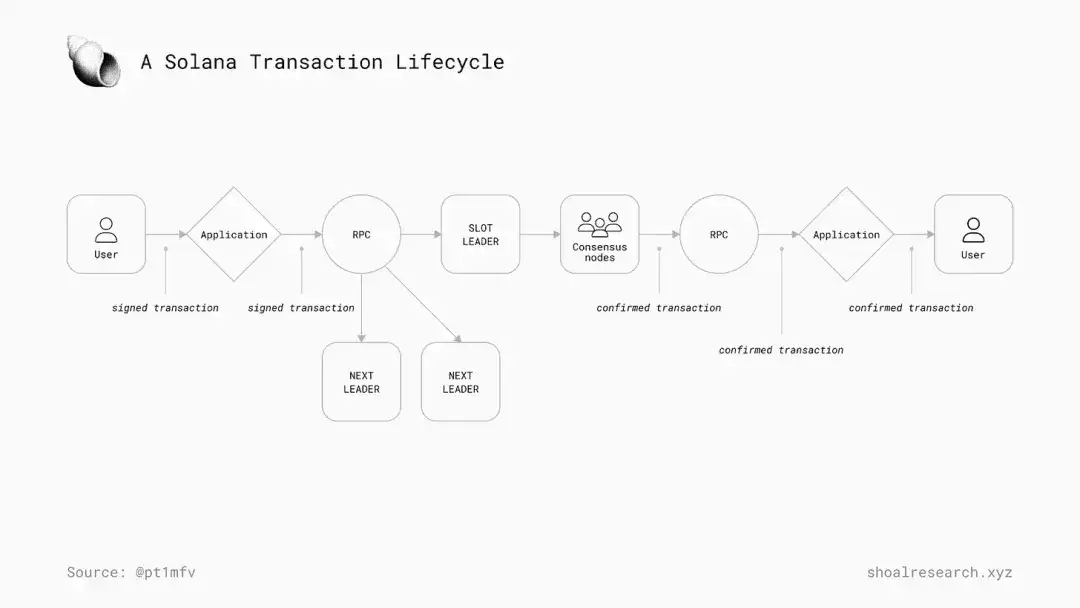
What is the lifecycle of transactions on a blockchain without a memory pool? Let's take a look together:
- A user initiates and signs a transaction for the application they are using.
- The application routes the transaction information to remote procedure call (RPC) servers.
- The RPC provider sends the transaction to the currently designated block producer and the next three producers as a preventive measure in case the current leader is unable to execute the transaction in a timely manner. Solana employs a slot leader schedule to help RPC more easily route transactions.
- The block producer sends the signed transaction to consensus nodes for verification.
- Once verified, the transaction status is returned through the path of RPC → application → user as "successful" or "failed."
Similar to blockchains based on a memory pool, the block itself is finally confirmed after a certain time or reaching a threshold based on the number of blocks.
2) Sequential Execution
Earlier blockchains, such as Bitcoin and Ethereum, adopted a sequential execution mechanism to process transactions. Each transaction added to the blockchain triggers a change in the network state, and for safety reasons, the virtual machine structure is designed to handle only one state change at a time.
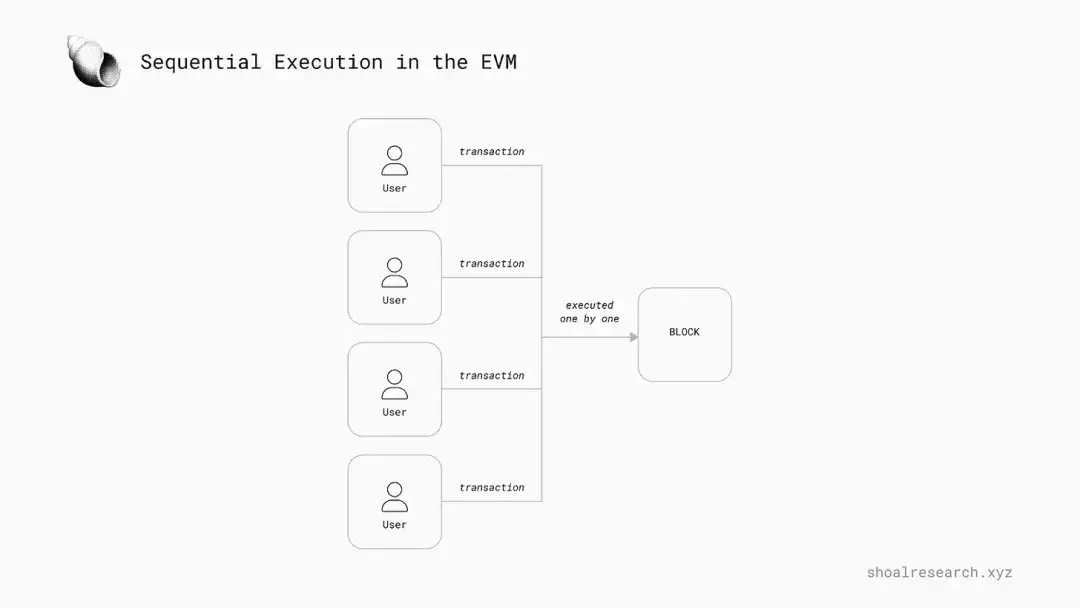
This has led to a severe bottleneck in the underlying network throughput, as the number of transactions that can be added to a block is limited, resulting in longer wait times and unprecedented spikes in transaction costs, sometimes rendering the network unusable. Furthermore, the sequential execution model is inefficient when using hardware components, thus unable to benefit from breakthroughs in computation, such as multiple processor cores.

02
Parallel Execution
1) What is Parallel Execution?
Parallel computing is a key component of computer architecture, with its origins dating back to the late 1950s, although its theory and concepts can be traced back to as early as 1837. By definition, parallel computing refers to the simultaneous use of multiple processing elements to solve an operation, breaking down a larger and more complex task into smaller tasks, and completing it more efficiently than in a serial manner.
Initially implemented only in high-performance computing systems, parallel computing has evolved into the dominant paradigm in computer architecture today, driven by the exponential growth in computational demands in the internet age.
This computing architecture standard is also applicable in blockchain, where the main task of the computer is to process and execute transactions, or transfer value from smart contract A to smart contract B, hence the term parallel execution.
Parallel execution means that the blockchain no longer processes transactions in sequence, but can handle multiple non-conflicting transactions simultaneously. This can greatly increase the throughput of the blockchain network, making it more scalable and efficient in handling higher loads of activity and demands for block space.
To provide a simple analogy, consider the efficiency of a grocery store with multiple checkout lanes compared to having only one lane for all customers to use.
2) Why is Parallel Execution Important?
Parallel execution in blockchain aims to improve the speed and performance efficiency of the network, especially when facing higher traffic and resource demands. In the context of the cryptocurrency ecosystem, parallel execution means that if Bob wants to mint the latest popular NFT collectible and Alice wants to purchase her favorite Memecoin, the network will serve both users without any compromise in performance and user experience.
While this may only be an intuitive quality-of-life feature, the network performance improvements unlocked by parallel execution provide opportunities for developing new innovative use cases and applications that can leverage low latency and high capacity, laying the foundation for bringing the next wave of large-scale users into the cryptocurrency ecosystem.
3) How Does Parallel Execution Work?
While the premise of parallel execution is relatively simple, subtle differences in the underlying blockchain design will affect the specific implementation of the parallel execution process. The most relevant feature of a blockchain designed with parallel execution capabilities is that transactions can access the underlying network state, including account balances, storage, and smart contracts.
Parallel execution on the blockchain can be divided into two methods: deterministic and optimistic. Deterministic parallel execution, as used by blockchains like Solana, requires transactions to declare all memory dependencies in advance, i.e., which parts of the global state they expect to access. While this step adds additional overhead for developers, it allows the network to sort and identify non-conflicting transactions before execution, creating a predictable and efficient optimization system. On the other hand, the structure of optimistic parallel execution is designed to process all transactions simultaneously, based on the assumption that there are no conflicts. This allows the underlying blockchain to provide faster transaction execution, although re-execution may be required in case of conflicts. If two conflicting transactions are submitted, the system can reprocess and re-execute them, whether in parallel or in sequence.
Studying the teams currently driving the forefront of parallel execution may help better understand the impact of these design details.
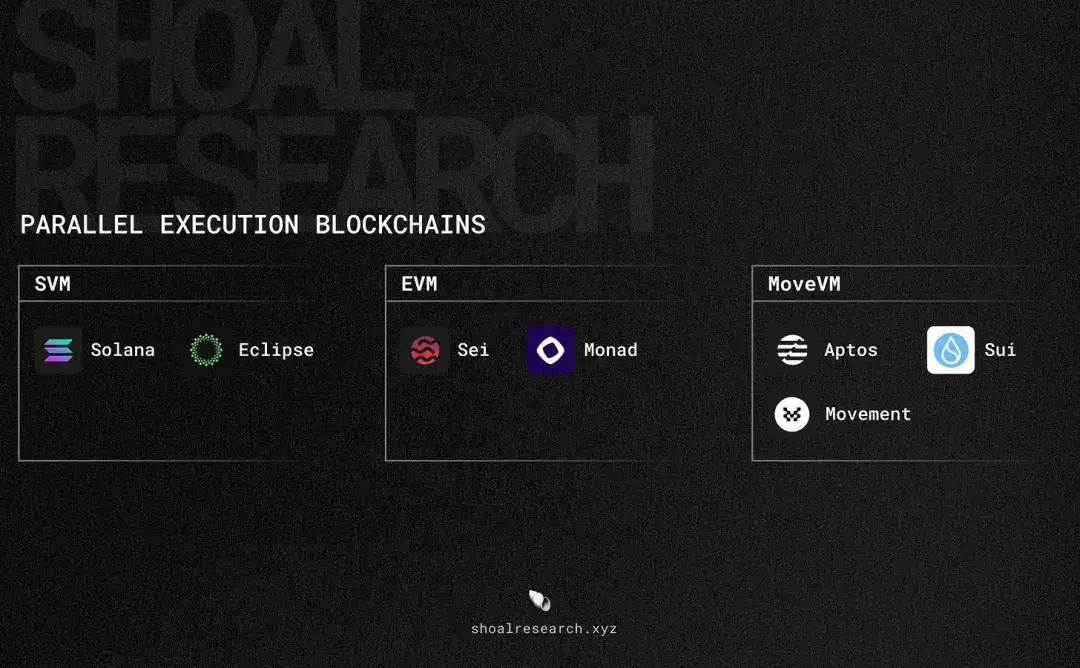
4) The Current State of Parallel Execution
Studying the teams currently driving the forefront of parallel execution can provide a better analysis of the significance of parallel execution.
03
Virtual Machine
1) Solana Virtual Machine (SVM)
Solana is the first blockchain network designed around parallel execution, inspired by founder Anatoly Yakovenko's experience in the telecommunications industry. Solana aims to provide a developer platform that operates at the speed allowed by physics, making the speed and efficiency unleashed by parallel computing a simple and intuitive design choice.
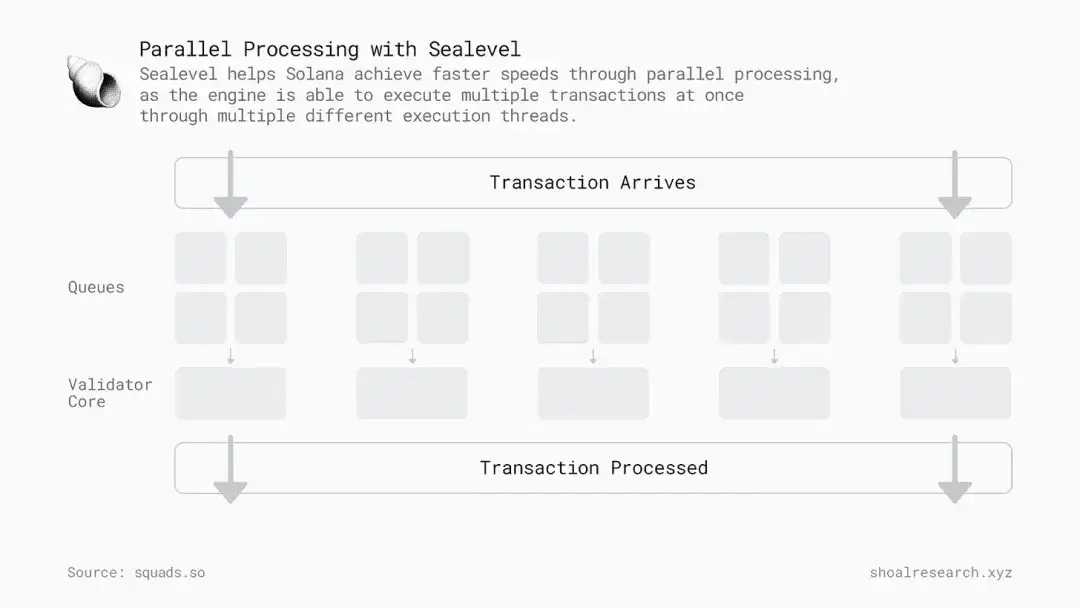
A key component of achieving Solana's fast speed and high throughput is Sealevel, a technology that provides a parallel smart contract runtime environment for the network. Unlike environments based on EVM and WASM, Sealevel adopts a multi-threaded architecture, meaning it can process multiple transactions simultaneously to match the capacity of the validating node core.
The key to achieving parallel execution in Solana is that when a transaction is initiated, the network allocates a series of instructions to execute the transaction, including the accounts and state to be accessed and the changes to be made. This is crucial for determining which transactions are non-conflicting and can be executed simultaneously, and also allows transactions attempting to access the same state to be executed concurrently. Efficiency is provided by the reference tags in the airport baggage system.
Solana also utilizes its custom account database, Cloudbreak, to store and manage state data for concurrent read and write transactions. Cloudbreak is optimized for parallel execution, distributing and managing state data across multiple nodes through horizontal scaling.
Due to its parallel architecture, Solana can handle a large number of transactions and still execute them quickly, achieving near-instant finality for transactions. Solana currently processes an average of 2,000 to 10,000 transactions per second. Additionally, use cases for SVM are gradually expanding, with the Eclipse team launching Layer 2 infrastructure aimed at leveraging SVM as the execution environment.
2) Parallel EVM
Parallel EVM describes a new blockchain execution environment designed to combine the advantages of Solana and Ethereum, with the speed and performance of Solana and the security and liquidity of Ethereum. By processing transactions in parallel instead of following the traditional EVM design sequence, Parallel EVM allows developers to build applications on a high-performance network and leverage connectivity with EVM liquidity and development tools.
Sei Network
Sei Network is an open-source Layer1 blockchain compatible with EVM, hosting many decentralized applications built around high performance. Sei aims to provide fast speed and low cost for users and developers, with parallel execution being a key component in achieving this performance and user experience. Currently, Sei's mainnet offers a block confirmation time of 390 milliseconds and has processed over 1.9 billion transactions.
Initially, Sei adopted a deterministic parallel execution model, in which smart contracts declare their required state access in advance so that the system can run non-conflicting transactions simultaneously. With the start of the V2 upgrade, Sei is transitioning to an optimistic parallel model, meaning all transactions will be processed in parallel (execution phase) after being submitted to the network, and then analyzed and verified for conflicts with previous transactions (validation phase). If two or more conflicting transactions, i.e., transactions attempting to access the same network state, are identified, Sei will recognize the conflict points and re-execute the transactions based on the nature of the conflict, either in parallel or sequentially.

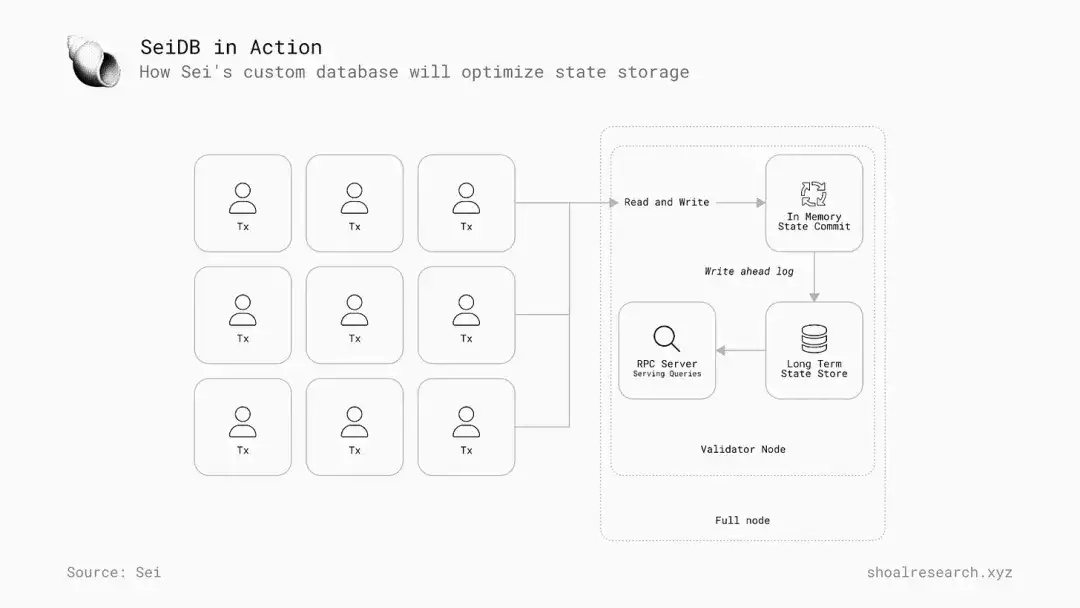
To store and maintain transaction data, Sei will also introduce SeiDB, a custom database designed to improve the shortcomings of V1 through optimized parallel execution. SeiDB aims to reduce the cost of storing redundant data and achieve efficient disk usage to enhance network performance. V2 reduces the amount of metadata required for tracking and storage and introduces a write-ahead log to assist with data recovery in case of failures.
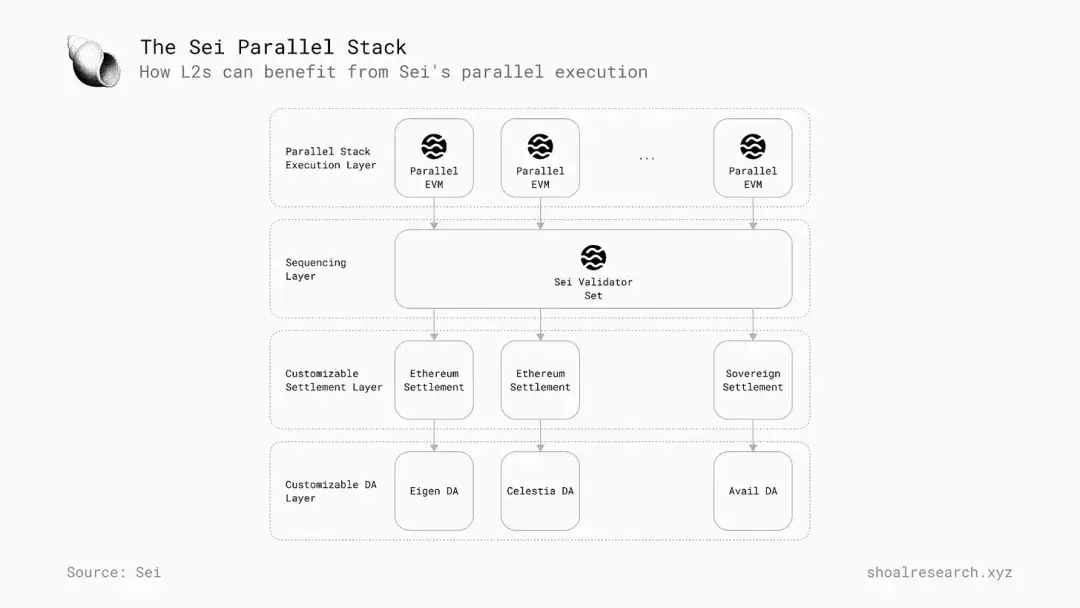
Finally, Sei recently announced the launch of its Parallel Stack, an open-source framework to enable Layer2 scaling solutions (such as Rollups) to leverage and benefit from parallel execution.
Monad
Monad is an upcoming parallel EVM Layer1 blockchain that provides full bytecode and RPC compatibility for Ethereum applications and infrastructure. Through a series of innovative technologies, Monad aims to provide a more interactive experience than existing blockchains, while reducing transaction costs through optimized performance and portability, with 1-second block time and up to 10,000 TPS finality per second.
Monad implements parallel execution and superscalar pipeline technology to optimize transaction speed and throughput. Similar to Sei V2, Monad will adopt an optimistic execution model, meaning the network will begin executing all incoming transactions simultaneously, then analyze and verify transactions to find conflicts and re-execute as needed, with the ultimate goal of achieving identical results if transactions were executed sequentially.
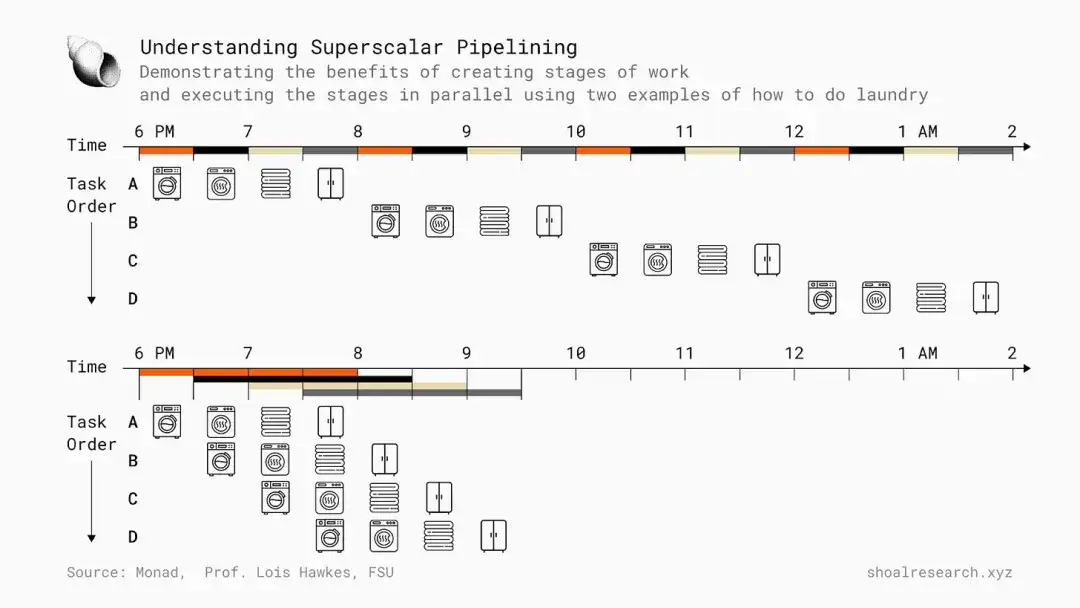
It is worth noting that to stay in sync with Ethereum, Monad orders transactions within a block in linear sequence, updating each transaction in order.
To provide more efficient maintenance and access to blockchain data than current Ethereum clients, Monad has created its custom MonadDB, natively built for the blockchain. MonadDB utilizes advanced Linux kernel features for efficient asynchronous disk operations, eliminating the limitations of synchronous input/output access. MonadDB provides asynchronous I/O access, a key feature for achieving parallel execution, allowing the system to start processing the next transaction while waiting to read the state of previous transactions.
3) Move
Move is a programming language initially developed by the Facebook team in 2019 for its now-defunct Diem project. Move aims to handle smart contracts and transaction data in a secure manner, eliminating local attack vectors present in other languages (such as reentrancy attacks).
MoveVM, as the native execution environment for Move-based blockchains, utilizes parallelization to provide faster transaction execution and higher overall efficiency.
Aptos
Aptos is a Layer1 blockchain developed based on Move, by former Diem project members, implementing parallel execution to provide a high-performance environment for application developers. Aptos utilizes Block-STM, a modification of the software transactional memory (STM) concurrency control mechanism.
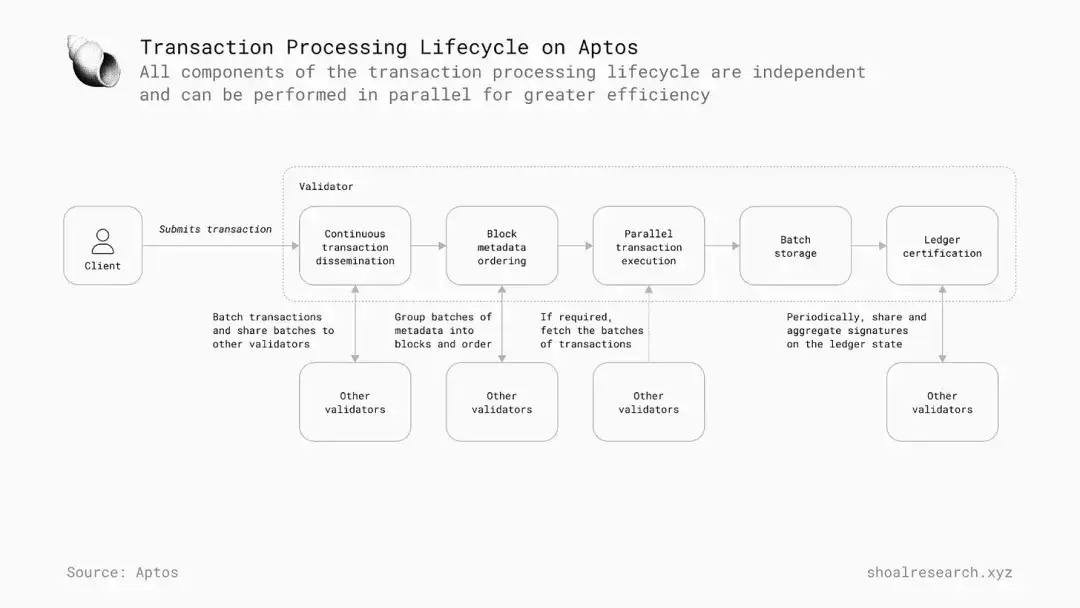
Block-STM is a multi-threaded parallel execution engine that enables optimistic parallel execution. Transactions are pre-sorted and strategically ordered within a block, a key efficient solution for resolving conflicts and re-executing these transactions. Research conducted by Aptos found that using Block-STM's parallelization technology, theoretically, it can support throughput of up to 160,000 TPS.
Sui
Similar to Aptos, Sui is a Layer1 blockchain developed by former Diem project members using the Move language. However, Sui uses a custom Move implementation, altering the original Diem design's storage model and asset permissions. Notably, this allows Sui to represent independent transactions as objects using a state storage model. Each object in Sui's execution environment has a unique ID, enabling the system to easily identify non-conflicting transactions and process them in parallel.

Similar to Solana, Sui implements deterministic parallel execution, requiring transactions to declare the accounts they need to access in advance.
What is Movement Labs?
Movement Labs is building a set of developer tools and blockchain infrastructure services to enable developers to easily leverage Move for development. As a parallel to AWS for Move developers, Movement Labs incorporates parallelization as a core design feature to achieve higher throughput and overall network efficiency. MoveVM is a modular execution environment that allows blockchain networks to scale and adjust their transaction processing capabilities as needed to support growing transaction volumes, enhancing their ability to process and execute transactions in parallel.

Movement will also launch M2, a ZK-rollup solution compatible with EVM and Move clients. M2 will inherit the Block-STM parallelization engine and is expected to achieve throughput of tens of thousands of transactions per second.
04
Conclusion
1) Challenges Faced by Parallel Systems Today
When developing parallel blockchains, it is important to consider some key issues and factors:
What trade-offs have been made by the network to achieve better performance through parallel execution? A small number of validators can improve verification and execution speed, but does this compromise the security of the blockchain, making validators more susceptible to colluding against the network? Are there a large number of validators deployed together? This is a common strategy in both encrypted and non-encrypted systems to reduce latency, but what changes would occur if a specific data center were threatened? For optimistic parallel systems, will the process of re-executing invalid transactions create bottlenecks as the network scales? How is this efficiency tested and evaluated?
From a high-level perspective, parallel blockchains face different risks in the form of inconsistent ledgers, namely double spending and changes in transaction order (in fact, this is the main advantage of sequential execution). Deterministic parallelization addresses this issue by creating an internal tagging system for transactions on the underlying blockchain; the implementation of optimistic processing in blockchains must ensure that the mechanism for verifying and re-executing transactions is secure and available, and the trade-offs made for performance can be reasonably achieved.
2) Future Outlook and Opportunities
The history of computer development tells us that parallel systems often become more efficient and scalable over time compared to sequential systems. The rise of parallel blockchains in the post-Solana era highlights the applicability of this concept in cryptographic infrastructure. Even Ethereum founder Vitalik recently mentioned that parallelization is one of the potential key solutions to improve the scalability of EVM Rollups.
Overall, the adoption of cryptography/blockchain requires systems that are more optimized than current systems, including parallel blockchains. Solana's recent network issues have highlighted the significant room for improvement in the development of parallel blockchains. As more teams seek to push the boundaries of on-chain domains and attract the next wave of large-scale users and adopt blockchain-native applications and ecosystems, the parallel execution model provides an intuitive framework for building systems capable of easily handling large-scale network activities, achieving a scale matching that of Web2 companies.
Original Title: Parallel Execution: The Next Generation of Blockchains
Original Article Link: https://www.shoal.gg/p/parallel-execution-the-next-generation
Original Authors: PAUL TIMOFEEV, MIKE JIN, AND GABE TRAMBLE
Source: https://mp.weixin.qq.com/s/JhAEG2wu02d6eDE95kXw
免责声明:本文章仅代表作者个人观点,不代表本平台的立场和观点。本文章仅供信息分享,不构成对任何人的任何投资建议。用户与作者之间的任何争议,与本平台无关。如网页中刊载的文章或图片涉及侵权,请提供相关的权利证明和身份证明发送邮件到support@aicoin.com,本平台相关工作人员将会进行核查。


