Author: IOBC Capital
During his speech at WGS in Dubai, Huang Renxun proposed the term "sovereign AI". So, which sovereign AI can meet the interests and demands of the crypto community?
Perhaps it needs to be built in the form of Web3 + AI.
Vitalik discussed the synergistic effect of AI and Crypto in the article "The promise and challenges of crypto + AI applications": the decentralization of Crypto can balance the centralization of AI; AI is opaque, and Crypto brings transparency; AI needs data, and blockchain is conducive to data storage and tracking. This synergy runs through the entire industry landscape of Web3+AI.
Most Web3 + AI projects are solving the infrastructure construction problems of the AI industry using blockchain technology, and a few projects are using AI to solve certain problems of Web3 applications.
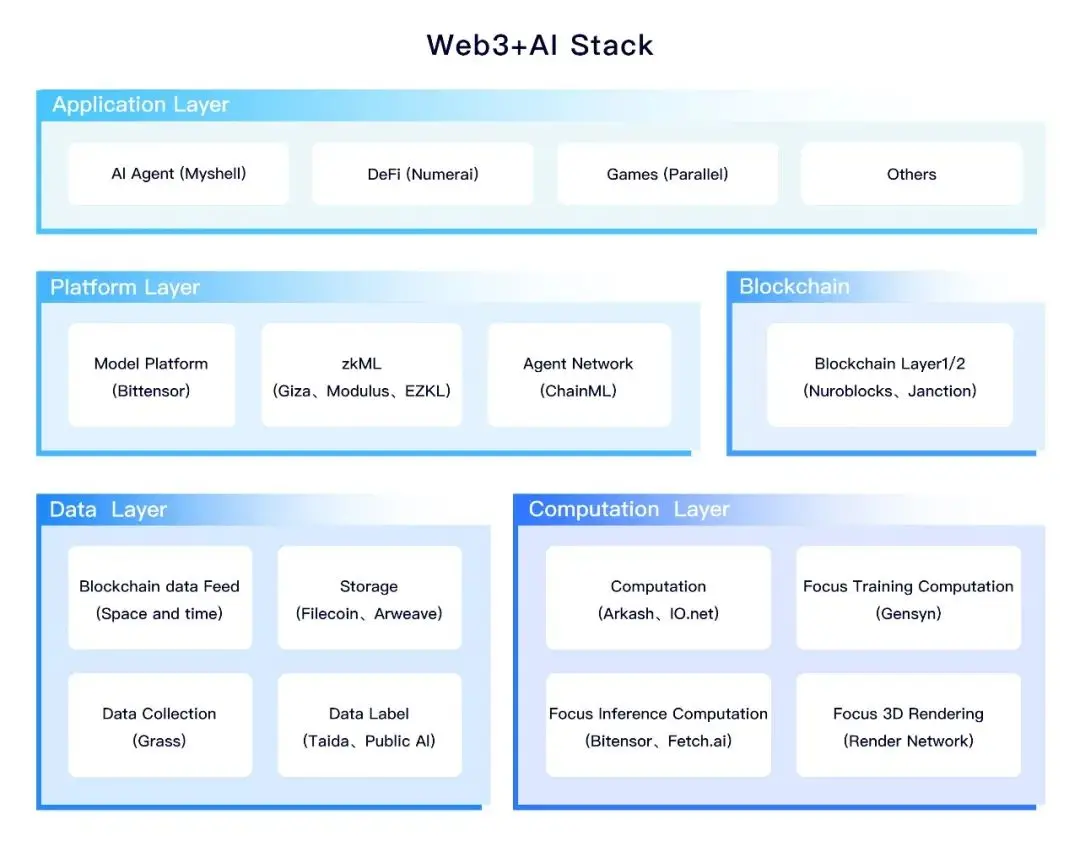
The industry landscape of Web3 + AI is roughly as follows:
The production and workflow of AI are roughly as follows:

In these links, the combination of Web3 and AI mainly manifests in four aspects:
1. Computing Power Layer: Tokenization of Computing Power
In the past two years, the computing power for training large AI models has grown exponentially, doubling almost every quarter, far exceeding Moore's Law. This situation has led to a long-term imbalance between supply and demand for AI computing power, with rapid increases in hardware prices such as GPUs, thereby raising the cost of computing power.
However, at the same time, there is also a large amount of idle mid-to-low-end computing power hardware in the market. Although the individual computing power of this mid-to-low-end hardware may not meet high-performance requirements, by building a distributed computing power network through Web3, it can still meet the needs of many AI applications through the leasing and sharing of computing power, thus significantly reducing the cost of AI computing power by utilizing distributed idle computing power.
The computing power layer is subdivided into:
- General decentralized computing power (e.g. Arkash, Io.net, etc.);
- Decentralized computing power for AI training (e.g. Gensyn, Flock.io, etc.);
- Decentralized computing power for AI inference (e.g. Fetch.ai, Hyperbolic, etc.);
- Decentralized computing power for 3D rendering (e.g. The Render Network, etc.).
The core advantage of tokenizing computing power in Web3+AI lies in decentralized computing power projects, which can easily expand network scale through token incentives, and their computing resource costs are low, with high cost-effectiveness, meeting the needs of mid-to-low-end computing power.
2. Data Layer: Tokenization of Data
Data is the oil and blood of AI. Without relying on Web3, only giant enterprises generally have a large amount of user data, making it difficult for ordinary startups to obtain extensive data, and the value of user data in the AI industry is not reflected back to users. Through Web3+AI, processes such as data collection, data annotation, and distributed data storage can be made more cost-effective, transparent, and beneficial to users.
Collecting high-quality data is a prerequisite for training AI models. Through Web3, a distributed network can be used, combined with appropriate token incentive mechanisms, to use crowdsourcing to obtain high-quality and extensive data at a lower cost.
According to the project's purpose, data projects mainly include the following categories:
- Data collection projects (e.g. Grass, etc.);
- Data trading projects (e.g. Ocean Protocol, etc.);
- Data annotation projects (e.g. Taida, Alaya, etc.);
- Blockchain data source projects (e.g. Spice AI, Space and time, etc.);
- Decentralized storage projects (e.g. Filecoin, Arweave, etc.).
Data projects in Web3+AI are more challenging in designing token economic models because data is more difficult to standardize than computing power.
3. Platform Layer: Tokenization of Platform Value
Most platform projects are benchmarked against Hugging Face, with the integration of various resources in the AI industry as the core. By establishing a platform that aggregates links to various resources and roles in the AI industry, such as data, computing power, models, AI developers, blockchain, etc., platforms can more conveniently address various needs. For example, Giza focuses on building a comprehensive zkML operation platform, aiming to make the inference of machine learning trustworthy and transparent, as the opacity of data and models is a common problem in AI, and using cryptographic techniques such as ZK and FHE to verify the correct execution of model inference is something that the industry will call for sooner or later through Web3.
There are also platforms for Focus AI's layer1/layer2, such as Nuroblocks, Janction, etc. The core narrative is the connection of various computing power, data, models, AI developers, nodes, etc., and helping Web3+AI applications achieve rapid construction and development through the packaging of general components and SDKs.
There are also platform-type projects like Agent Network, which can build AI Agents for various application scenarios, such as Olas, ChainML, etc.
Platform-type Web3+AI projects mainly capture platform value through tokens to incentivize the co-construction of various platform participants. This process is particularly helpful for early-stage projects in reducing the difficulty of finding partners such as computing power, data, AI developer communities, nodes, etc.
4. Application Layer: Tokenization of AI Value
Most of the infrastructure projects in the previous section are solving the problems of infrastructure construction in the AI industry using blockchain technology. Application layer projects are more about using AI to solve problems in Web3 applications.
For example, Vitalik mentioned two directions in the article that I find meaningful.
One is AI as a participant in Web3. For example: in Web3 Games, AI can act as a game player, quickly understanding game rules and efficiently completing game tasks; in DEX, AI has been involved in arbitrage trading for many years; in Prediction markets, AI Agents can train their models' analytical and predictive capabilities through extensive access to a large amount of data, knowledge base, and information, and productize them to help users make predictions for specific events using model inference, such as sports events, presidential elections, etc.
The other is to create scalable decentralized private AI. Because many users are concerned about the black box problem of AI and are worried about biased systems, or are concerned that some dApps may use AI technology to deceive users for profit. Essentially, this is because users do not have review and governance rights over the model training and inference process of AI. However, if a Web3 AI is created, similar to Web3 projects, with distributed governance rights over this AI by the community, it may be more easily accepted.
As of now, there are no high-ceiling blue-chip projects in the Web3+AI application layer.
Conclusion
Web3 + AI is still in its early stages, and there are differing views within the industry on the development prospects of this track. We will continue to pay attention to this track. We hope that the combination of Web3 and AI can create products that are more valuable than centralized AI, allowing AI to break free from labels such as "dominance" and "monopoly" in a more community-oriented way of "co-governing AI". Perhaps with closer participation and governance, humans will have more "awe" and less "fear" of AI.
免责声明:本文章仅代表作者个人观点,不代表本平台的立场和观点。本文章仅供信息分享,不构成对任何人的任何投资建议。用户与作者之间的任何争议,与本平台无关。如网页中刊载的文章或图片涉及侵权,请提供相关的权利证明和身份证明发送邮件到support@aicoin.com,本平台相关工作人员将会进行核查。


