The L3 layer of the blockchain has more than a 99% reduction in costs and higher data transmission efficiency compared to L2, but this advantage is technically limited, and the future may not necessarily see the emergence of L4/L5.
Author: @sgoldfed
Plain Language Blockchain Translation
Blockchain is the underlying technology of Bitcoin, with a six-layer architecture: data layer, network layer, consensus layer, incentive layer, contract layer, and application layer.
As shown in the figure, these six layers correspond to L0, L1, and L2, respectively.
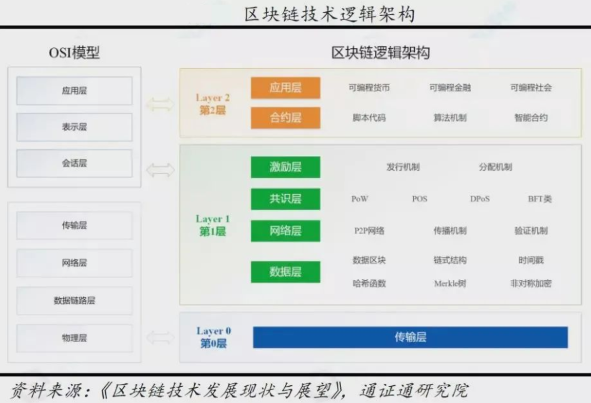
Layer 0, also known as the data transmission layer, corresponds to the bottom layer of the OSI model, mainly involving the integration between blockchain and traditional networks.
Layer 1, also known as on-chain expansion, refers to the expansion solution implemented on the underlying blockchain protocol.
Layer 2, also known as off-chain expansion, refers to increasing transaction processing speed without changing the underlying blockchain protocol and basic rules, through solutions such as state channels and side chains.
The Layer 3 mentioned in the figure refers to the client application layer that was not mentioned. Currently, with Ethereum actively pursuing merge expansion, Layer 2 development is the hottest. However, since L3 has already emerged, will L4 or L5 emerge next? How long will this development continue?
The following is the compiled original text:
@sgoldfed summarized: "Development has stopped at L3."
1. Reasons for the Attractiveness of L3
1) More than 99% reduction in access costs.
For example, if you transfer from a centralized exchange (CEX) to your chain, and your chain does not directly support CEX (which is a fact for almost every new chain release).
If your chain is L2, you need to go from CEX to L1, and then from L1 through a bridge to L2. This will involve two L1 transactions.
But if you are L3, you can go directly from CEX to L2 (because L2s like Arbitrum One have direct exchange platform support), and then from L2 to L3. This will involve two L2 transactions.
Arbitrum One's transaction costs are more than 99% cheaper than Ethereum, so your access costs will be reduced by more than 99%.
2) "Taking the bus" to Ethereum.
Updating/data release to Ethereum has a fixed cost, which is quickly amortized on L2s like Arbitrum One with many transactions.
However, if you are launching a new chain, you may experience unstable or fluctuating transaction volumes, and you will have a low number of transactions that need to pay the cost of releasing data to Ethereum (they must pass through a toll booth in the form of a car).
If you run an L3, you will release data to L2 (at a lower cost), and your data will take the bus to Ethereum along with all other L2 transactions.
Note: Configuring L2/L3 has many different ways, including different data availability choices, etc., so the exact analysis will vary depending on your configuration, but these two reasons generally make L3 more attractive.
Also note: Arbitrum Orbit supports both L2 and L3, so each team can freely weigh the pros and cons and make their own decisions.
2. Current Development Status of L3
Although L3 is attractive, interestingly, there is no further cumulative effect after L3.
Compared to L2, the cost of introducing new members has been reduced by 99%, but there is not the same degree of reduction for higher levels such as L4 or L5.
Similarly, if you launch an L3, you can "take the bus" to Ethereum. But L4 or L5 are still on the same bus (imagine a three-layer bus), and do not bring meaningful additional cost reductions to L3.
Therefore, the benefits of technically upgrading one layer stop at L3. I also do not think that we will add a level every few years as some people suggest.
That being said, I believe that over time, some L4 ecosystems will emerge. But this will be for ecosystem reasons, not for technical or financial benefits.
Furthermore, I imagine that some L3s will be very successful and develop to the extent that they want to support their own ecosystem chains. And the natural design is to let L3 be the center, with other chains above it.
So you may see similar centers emerge at the L3 level, leading to the emergence of L4 ecosystems, but not because each level up makes interactions cheaper.
Source: https://twitter.com/sgoldfed/status/1778173218496401807
免责声明:本文章仅代表作者个人观点,不代表本平台的立场和观点。本文章仅供信息分享,不构成对任何人的任何投资建议。用户与作者之间的任何争议,与本平台无关。如网页中刊载的文章或图片涉及侵权,请提供相关的权利证明和身份证明发送邮件到support@aicoin.com,本平台相关工作人员将会进行核查。


