Author: Xiyou, ChainCatcher
Editor: Marco, ChainCatcher
In the early morning of April 20th, at block height 840,000, Bitcoin completed its fourth halving. After the halving, the mining reward for each block has decreased from the original 6.25 BTC to 3.125 BTC.
In the week before the halving, the price of BTC plummeted from $70,000 to $59,600, hitting the lowest price since March. As of the time of writing, the price of BTC has stabilized around $63,000, with a cumulative 10% decrease in the past 7 days.
The essence of Bitcoin halving is to control the speed of Bitcoin supply and the inflation rate by programmatically reducing the output rate of Bitcoin, thereby reducing the issuance speed of new Bitcoins and decreasing the supply of its tokens, leading to a lower inflation rate.
After this halving, miners will reduce their daily supply to the market from about 900 BTC to approximately 450 BTC, and the BTC issuance speed will decrease from 1.8% to 0.83%.
Due to the reduction in supply, the imbalance of BTC supply and demand in the market may exacerbate the scarcity of Bitcoin and drive the price upwards.
After the first three Bitcoin halvings, BTC prices all experienced varying degrees of significant increases, closely related to the bull market cycle of the entire cryptocurrency market. Therefore, "Bitcoin halving" is also considered a catalyst for the cryptocurrency bull market and holds significant implications for the development of the entire cryptocurrency market.
Chris Gannatti, global head of Bitcoin ETF asset management company WisdomTree, once stated that "Bitcoin halving is one of the most significant events in the cryptocurrency field this year."
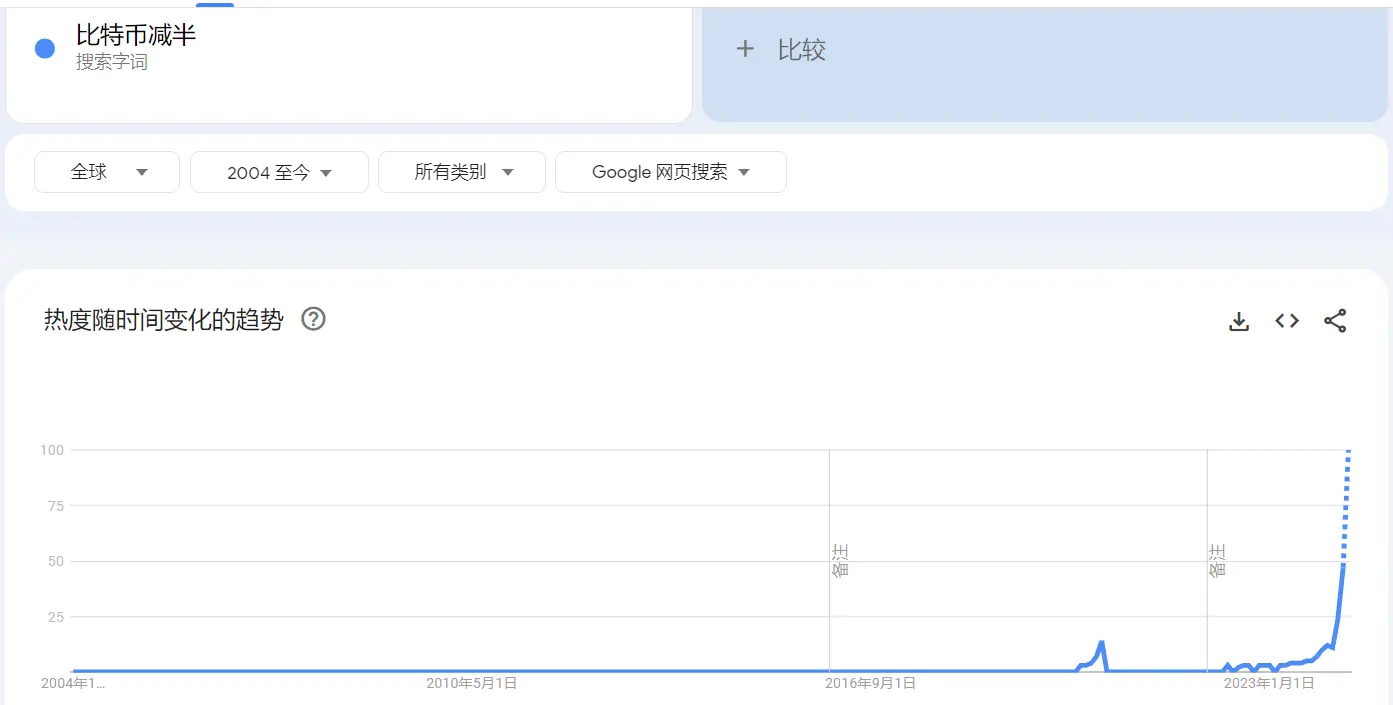
Google search data shows that the search volume for the term "Bitcoin halving" has reached a historical high, far exceeding the previous historical high set in May 2020.
Will Bitcoin's rise still come as expected every 4 years after halving?
Whenever the Bitcoin blockchain generates 210,000 blocks, the Bitcoin block reward will halve. The Bitcoin network generates a new block approximately every 10 minutes, so this halving occurs roughly every 4 years.
As of today, Bitcoin has completed 4 halvings, which occurred in 2012, 2016, and 2020. Starting from the initial block reward of 50 BTC, the first halving reduced it to 25 BTC, the second halving to 12.5 BTC, the third halving to 6.25 BTC, and the fourth halving to 3.125 BTC today.
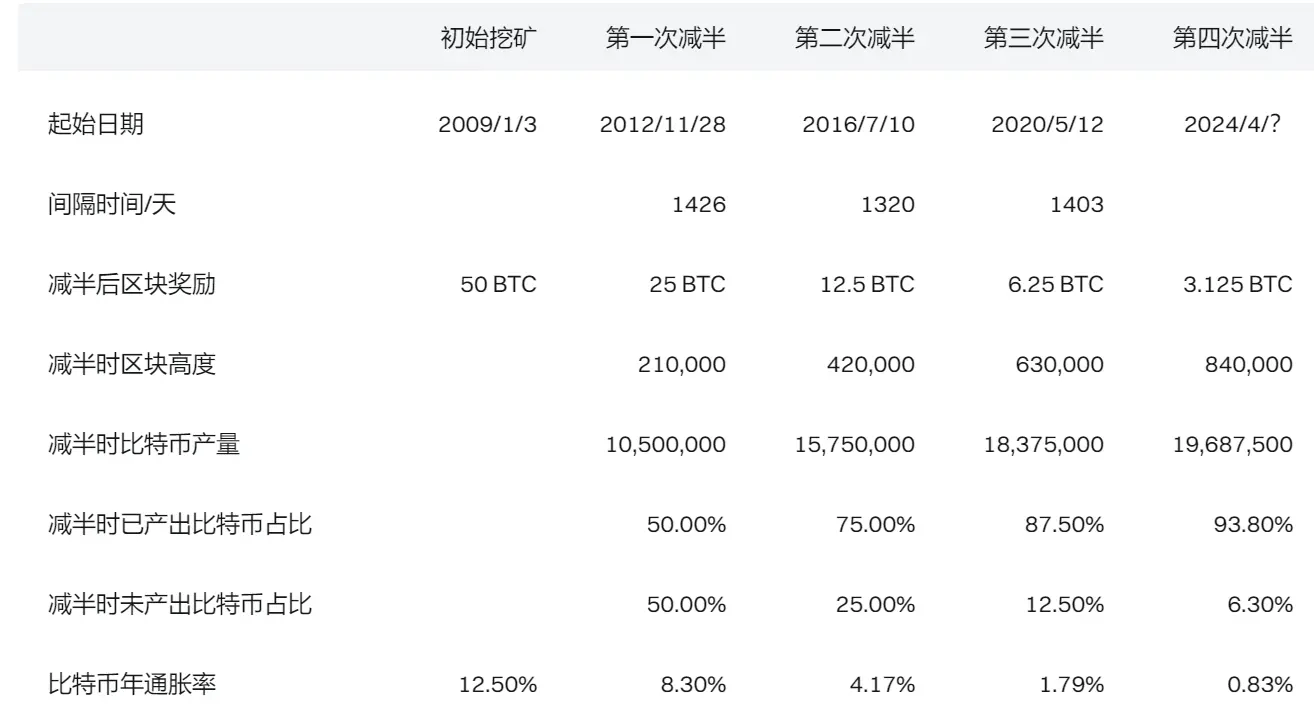
Looking back at the historical data of the 3 halvings, after each Bitcoin halving, the BTC price has rapidly risen within 6-18 months, reaching historical highs. Therefore, the impact of halving on the price trend and subsequent market conditions of Bitcoin has attracted industry attention and is referred to as an industry cycle.
The first halving was completed on November 28, 2012, and after the halving, the BTC price surged from $12 to $1,242, an increase of over 100 times.
The second halving occurred on July 9, 2016, and the BTC price surged from $648 to $19,800, a price increase of 4158%.
The third halving was completed on May 12, 2020, and the BTC price surged from $8,181 to $64,895, a price increase of 693%.

The fourth halving has now been completed on April 20, 2024, with the Bitcoin price at approximately $63,000. Will it kick off a new round of rapid price increases as expected, similar to the previous three times?
Regarding the impact of this halving on the future trend of Bitcoin, the general industry view is that the initial impact on the Bitcoin price after halving is not significant, but it is favorable in the long term. From a supply and demand perspective, Bitcoin halving reduces the speed of Bitcoin issuance, and the halving of miner block rewards can also alleviate the speed of new Bitcoins entering the market. With reduced supply and stable or growing demand, conditions for the rise in Bitcoin price have been created.
Currently, many well-known figures in the crypto market hold optimistic views on the future trend of Bitcoin after this halving and have made bullish predictions.
Plan B indicated that based on the analysis of Bitcoin's supply and halving expectations, the price range of Bitcoin after 2024 will be between $100,000 and $1 million, and predicted that the price of Bitcoin may soar to $532,000 by 2025.
Anthony Scaramucci, founder of Skybridge Capital, stated in January of this year that the price of Bitcoin may reach $170,000 or more within a year and a half after the halving, with a long-term outlook that the market value of Bitcoin will reach half of the market value of gold.
Michael Novogratz, CEO of Galaxy Digital, is betting that Bitcoin will rise significantly, and after the halving, Bitcoin may reach $150,000.
On the contrary, there are industry professionals who hold a bearish view on the future of Bitcoin. They believe that the correlation between Bitcoin halving and price increases does not imply causality, and patternizing these events based solely on historical analysis is challenging. The factors influencing the price trend of Bitcoin also include market sentiment, adoption trends, global market liquidity, and macroeconomic policies.
In addition, from a supply and demand perspective, approximately 19.7 million BTC have been mined, and the remaining unmined Bitcoins are approximately 13 million (21 million - 19.7 million), which is a very small proportion. The halving of Bitcoin has already weakened the supply of Bitcoin and cannot be the main driving force for the price increase of Bitcoin.
Michael Zhao, a researcher at Grayscale, has warned that although historical precedents indicate price increases, they do not guarantee that the price of Bitcoin will definitely rise. He pointed out that external macroeconomic factors have played an important role in the past surge in Bitcoin prices, and halving is just one of the many factors affecting the price of Bitcoin.
Arthur Hayes, co-founder of BitMEX, stated in the latest article "Heatwave" released in April that he agrees that halving will push up the price of Bitcoin in the medium to long term. However, he predicted that the price of Bitcoin will enter a period of turbulence before and after the halving, and forecasted that the price of Bitcoin will plummet after the halving.
On the eve of halving, mining stocks plummet
In addition to price trends, cryptocurrency miners are the group most affected by the halving of Bitcoin rewards, as the halving will sharply reduce the input-output ratio of the Bitcoin mining industry. The halving of block rewards means that the number of BTC rewards for newly mined blocks will directly decrease by half, making Bitcoin miners a target every 4 years. If the price of BTC remains unchanged, while the investment and operating costs remain the same, and mining returns decrease, the investment return period for mining machines will be extended. Coupled with the outbreak of current geopolitical conflicts and the uncertainty of energy costs, the survival pressure of the mining industry has also increased significantly.
Analyst Mark Palmer of Benchmar previously warned that most publicly traded Bitcoin mining companies have already initiated or announced plans to increase their power and computing capabilities as a means of adjusting their income and gross profit situation.
Bloomberg predicts that the entire cryptocurrency mining industry will incur losses of approximately $10 billion after this halving.
Before the halving, the stocks of leading listed mining companies had experienced significant declines. The stock prices of Bitcoin mining companies such as Marathon Digital Holdings (MARA), Riot Platforms (RIOT), Iris Energy (IREN), and CleanSpark (CLSK) had been continuously falling for three days. The largest publicly traded Bitcoin mining company, Marathon Digital Holdings, saw a decline of over 20% in its stock price in the past month, while Riot Platforms fell by nearly 25%.
However, CleanSpark, a mining company, emphasized in an interview that Bitcoin halving does not equate to halving of mining company income, as the difficulty of Bitcoin mining will decrease by as much as 15% after the halving, which will bring additional rewards to miners.
Impact of Halving Weaker Than Bitcoin Spot ETF
However, this halving is different from the previous three, as the entire cryptocurrency industry and Bitcoin itself are undergoing some interesting new changes. The Bitcoin market has become increasingly mature, with more exchanges, financial products, and traditional financial investors participating. The on-chain ecological products such as Ordinals, Inscriptions, BRC20, Bitcoin Layer2, and others are flourishing, and users need to rethink and reevaluate Bitcoin as an asset from a new perspective.
"Cold Qing," an old OG who has experienced three Bitcoin halving cycles, shared his feelings about this halving.
He explained that the hype around the fourth Bitcoin halving is far less than the previous three. The first two halvings in 2016 and 2020 attracted high attention in the crypto market, with various discussions about the halving flooding major communities, and news about the halving, AMAs, offline events, and even tokens like BCH and LTC being hyped up months in advance of their halvings. After the 2016 halving, there was the Ethereum ICO, and in 2020, there was the DeFi Summer and the public chain battle. However, the community's attention to the fourth Bitcoin halving seems to be low, with very little discussion among community users, and even scarce and scattered news reports about the Bitcoin halving.
Another OG stated that not only is there a lack of hype around this halving, but the excitement around this round of Bitcoin's rise is also lower than usual. Bitcoin quietly broke through $70,000, and it seems that users only became active after surpassing $70,000.
In response, community user Lin stated that a major reason behind this is that the current round of price increase is mainly driven by Bitcoin spot ETFs, with institutions playing a dominant role and retail investors making up a smaller proportion.
Furthermore, with the development of blockchain technology in several bull markets, the cryptocurrency market has diversified from Bitcoin and Ethereum to various Layer1 and Layer2 solutions, LST, Bitcoin inscription ecology, DeFi, GameFi, AI, and other niche products. Bitcoin is no longer the only choice for users, and their attention has been divided.
Currently, the cryptocurrency market has a market value of nearly $2.5 trillion, with Bitcoin accounting for approximately 50% ($1.27 trillion), while the remaining 50% consists of assets in various niche segments.
Compared to the previous halvings, the only difference in the fourth Bitcoin halving is the existence of Bitcoin spot ETFs, which have an impact on the supply and demand dynamics of Bitcoin that even surpasses the halving. More and more institutional investors are beginning to include Bitcoin in their portfolios, and these institutional investors have more funds and resources. Their participation will trigger larger market fluctuations.
Since the approval of Bitcoin spot ETFs in the United States in January, the weekly inflow of funds into Bitcoin ETFs has ranged from $1.2 billion to as high as $2.5 billion, with a cumulative inflow of over $10 billion into the cryptocurrency market.
Currently, the daily average trading volume of ETFs for BTC spot is estimated to be between $4-5 billion, accounting for 15-20% of the total trading volume on centralized exchanges worldwide.
On April 19th, Glassnode data showed that the total assets under management of spot Bitcoin ETFs are close to $60 billion, holding approximately 851,000 BTC, accounting for about 4.3% of the total circulating supply of Bitcoin.
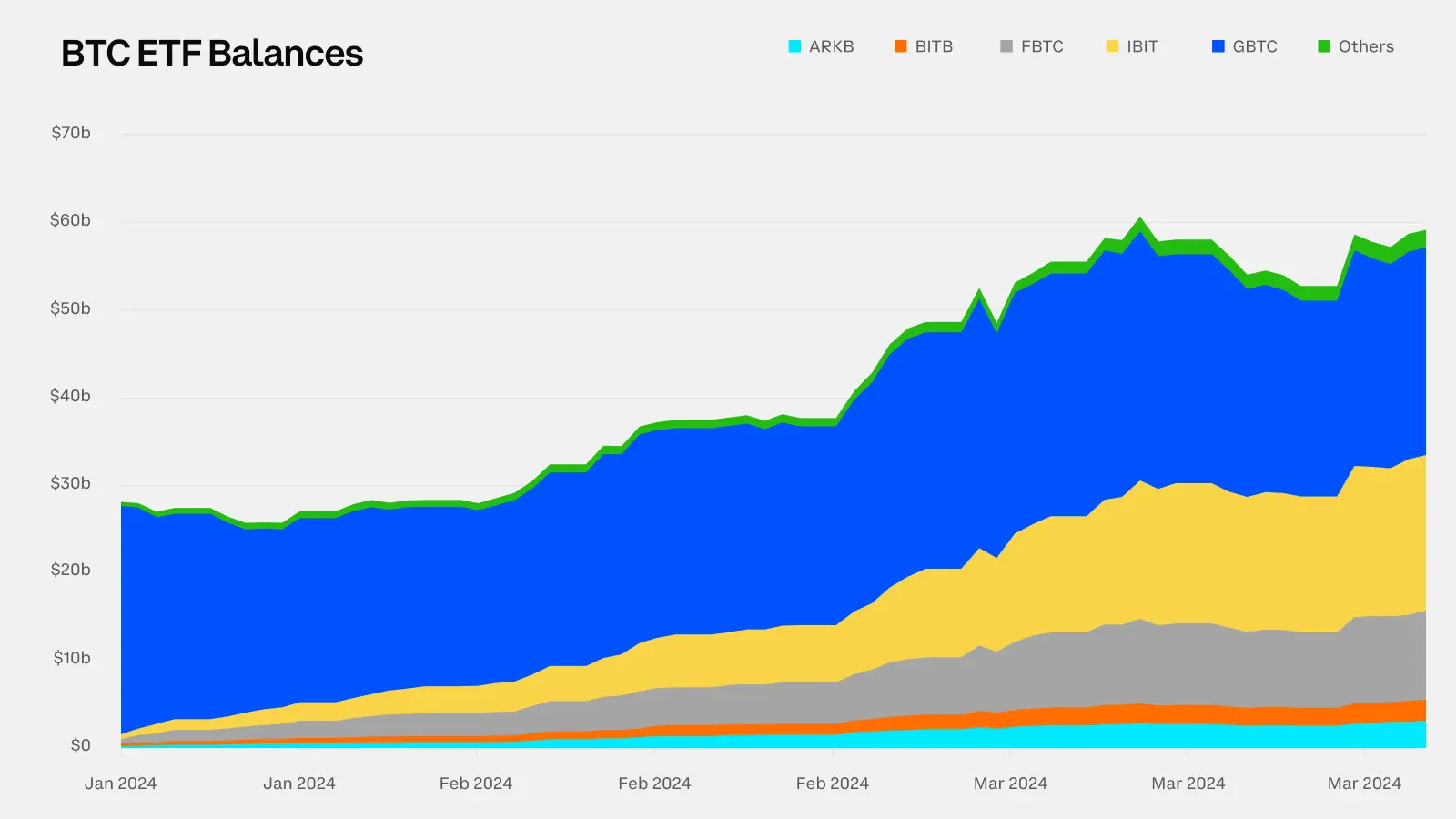
On April 15th, Hong Kong approved Bitcoin spot ETFs.
The launch of spot Bitcoin ETFs has greatly changed the supply and demand dynamics of BTC and established a new benchmark for BTC demand. Essentially, through large and sustained purchasing activities, ETFs have reduced the available supply of BTC in the market.
Glassnode charts show that the amount of Bitcoin absorbed by ETFs from the market far exceeds the amount of Bitcoin mined by miners every day.
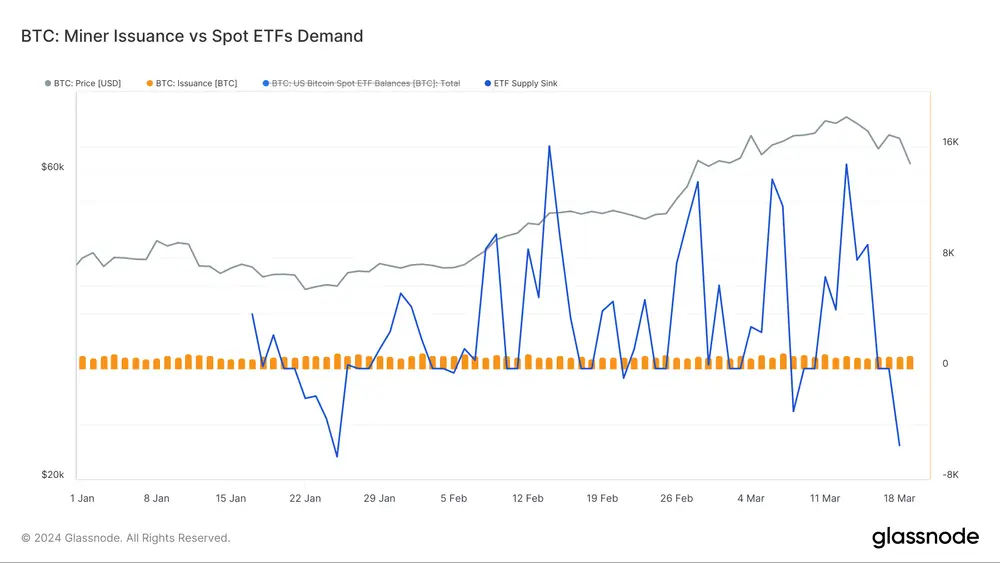
The impact of newly mined and circulated Bitcoin is becoming increasingly insignificant compared to the surging demand from ETFs.
Shen Yu also stated that the current market players are different from those in the past, and the main feature of this cycle is that incremental funds are mainly flowing into Bitcoin through ETFs and other channels.
免责声明:本文章仅代表作者个人观点,不代表本平台的立场和观点。本文章仅供信息分享,不构成对任何人的任何投资建议。用户与作者之间的任何争议,与本平台无关。如网页中刊载的文章或图片涉及侵权,请提供相关的权利证明和身份证明发送邮件到support@aicoin.com,本平台相关工作人员将会进行核查。


