Recently, a Spore DOB-0 protocol[1] on the Spore GitHub has piqued my great interest.
Spore is a universal digital object creation protocol deployed on the CKB blockchain. It supports various content types such as images, links, videos, audio, text, and code (such as Lua scripts, Markdown), and the generated DOBs (Digital Objects) are not only tamper-proof but also completely stored on the chain.
The Spore DOB-0 protocol is the first protocol built on top of Spore and is more application-layer oriented, similar to the difference between the HTTP protocol and the TCP protocol. According to the description, this Spore DOB-0 protocol aims to create a flexible DNA byte rendering process, in simpler terms, it introduces how to parse the DNA of Spore DOB. Although the content of this protocol is very brief, its potential is immeasurable.
Implementation of the Spore DOB-0 Protocol
The Spore DOB-0 protocol sets a new standard for the "text" content type, which is to store the most important thing of the DOB — DNA — in the Cell of the CKB blockchain, rather than ordinary text. Then the on-chain Decoder decodes the DNA based on the Pattern, and finally renders and displays the DOB to the user at the front end.
Specifically:
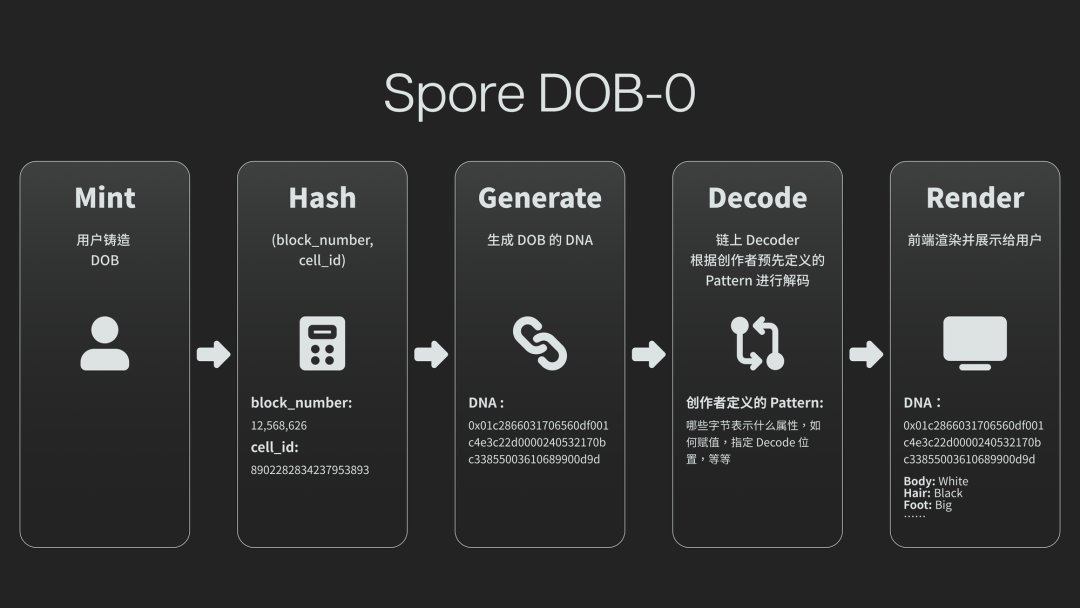
- When a user forges a DOB, the on-chain contract reads the current block height and Cell ID, and calculates their hash value, which becomes the DNA of the DOB.
- The Decoder deployed on the CKB blockchain decodes the DNA according to the Pattern predefined by the creator or artist. The Pattern is a segment of bytes, which can be binary numbers, strings, or any format, determined by the Decoder. It needs to be defined and uploaded by the creator or artist before the user forges the DOB. The Pattern defines which bytes represent what attributes, how to assign values, and specifies the location of the Decoder's code, and so on.
- Finally, the front end (wallet, browser, trading platform, etc.) renders and displays the DOB based on the content decoded by the Decoder.
From the above process, we can see that for creators and artists, they need to create Patterns and Clusters in advance. In the Pattern, creators and artists need to define and assign various attributes of the DOB, so the Pattern is like a codebook that determines how the Decoder decodes the DNA of the DOB.
It is reported that in order to lower the user threshold and facilitate operations, the development team will later release a tool that allows creators and artists to create a Cluster Cell on the chain that already includes the Pattern, similar to completing a fill-in-the-blank exercise. A Cluster is similar to the concept of a Collection, but more flexible and independent than a Collection. By creating a Cluster and filling in the corresponding ID in the DOB, a Spore DOB belonging to this Cluster can be forged, so the Cluster can also be seen as an index of Spore DOBs.
For protocol developers, they need to deploy the Decoder contract on the CKB blockchain in advance and make its address public. The Decoder acts as a decipherer or decryptor, mainly responsible for deciphering the information expressed by the DNA string according to the "codebook" (i.e., the Pattern mentioned above). Since CKB is a permissionless public chain, it is foreseeable that as more and more DOBs adopt the Spore DOB-0 protocol standard, more and more developers will deploy various Decoders, and even customize Decoders specifically for certain projects, for creators and artists to choose from.
For users, as long as they know the Cluster ID published by the creator or artist and fill in the ID when forging the DOB, they can easily forge a Spore DOB belonging to that Cluster.
Originating from Loot, Beyond Loot
The inspiration for the Spore DOB-0 protocol comes from Loot. Loot is randomly generated and stored on the Ethereum blockchain as adventurers' equipment. It consists of only a few lines of text, without numbers, images, or anything else intentionally omitted, allowing others to interpret and use them in any way.
Loot writes the attribute pool, which is the Pattern, into the contract, so the Decoder and Pattern are tightly coupled. Therefore, one Loot contract can only correspond to one Loot NFT theme. The Spore DOB-0 protocol decouples the Pattern and Decoder, further enhancing composability. The same set of Decoders, when combined with different Patterns, can result in completely different DOB themes.
In terms of random number generation, Loot only has one dimension, which is to generate a random number, and then all attribute pools use this single random number. When forging a DOB through the Spore DOB-0 protocol, a DNA string is generated, and different segments of the DNA are used as random numbers for different attribute pools in the Pattern, broadening the dimension of randomness.
Furthermore, in terms of overall design philosophy, Spore DOB is clearly more aesthetically pleasing than Loot.
Firstly, forging a DOB requires obtaining CKB tokens as "raw materials," and melting a DOB allows the retrieval of the occupied CKB. This gives the DOB a body and soul, as well as the concept of life and death.
Secondly, the world is composed of time and space, and PoW is essentially a decentralized clock, while the Cell is a space that can store any content type. The combination of PoW + Cell allows the CKB blockchain to construct a decentralized universe. In this decentralized universe, when a DOB is born, it calculates the time and space (block height and Cell ID) to obtain its "destiny" (i.e., DNA). Therefore, when forging a DOB through the Spore DOB-0 protocol, there is a certain degree of randomness, echoing the randomness in the birth process of living organisms in real life.
One of the characteristics of a hash function is collision resistance, meaning that changing a single character in the input information will produce a completely different hash value. This ensures that the DNA of each DOB is unique, just like the DNA of each living organism in the real world.
The Chinese meaning of the word "Cell" is a cell, which stores DNA, containing the most important information of an organism. By cultivating cells, we will eventually obtain a living organism, which can continue to mate, reproduce, and evolve continuously. DOBs forged through the Spore DOB-0 protocol have strong flexibility and composability. Users can enrich the content expressed by the DNA according to their preferences, and display it in the community through various means such as drawing, modeling, music, and textual descriptions, and even integrate with AI large models at the front end, allowing the DOB to evolve continuously with the continuous iteration of the large model.
Spore has many advantages over Loot, such as transferring DOBs on-chain without transaction fees (miner fees), and each DOB is backed by CKB tokens, and so on. It is recommended to read the previous article "Understanding the Spore Digital Object Creation Protocol on the CKB Chain" and refer to the Spore documentation[2], which will not be introduced here.
Vision for the Future of the Spore DOB-0 Protocol
The DeFi Lego blocks have made everyone realize the powerful potential of "composability," where different DeFi protocols are used together, integrated at different levels, and solidify and expand the boundaries and heights of the DeFi world. In the design of the Spore DOB-0 protocol, the separation of Pattern, DNA, and Decoder brings flexibility and composability, providing unlimited possibilities for the subsequent ecological development.
"As one begets two, two begets three, and three begets all things." Because the DNA only contains the most important attributes of the DOB, it is highly abstract. Therefore, DOBs forged based on the Spore DOB-0 protocol are the initial "one," and anyone can continue to build, improve, enrich, and supplement this "one," and create derivative works based on the DOB: those who like images can feed the decoded result of the DOB DNA to AI drawing tools like Midjourney to generate images in various styles; those who like film and television works can feed the decoded result of the DOB DNA to AI video tools like Sora to recreate the DOB in film and television works; those who like literary works can set the DOB as a character in a novel, and so on.
Furthermore, DOBs forged through the Spore DOB-0 protocol also have openness and scalability. Other blockchain projects can reference these DOBs (Cell is a referenceable storage unit). For example, a full-chain game or a GameFi project can directly reference DOBs as the underlying database of character, weapon, and equipment information in the game project. Moreover, the same set of DOBs can be used in different games, overcoming the limitations of traditional Web2 games where items and weapons cannot be used across games.
In conclusion, the openness, flexibility, composability, and scalability of the Spore DOB-0 protocol provide unlimited imaginative space, allowing it to be used to construct various possibilities. No one can accurately predict what will happen in the future, but the ecological development based on the Spore DOB-0 protocol is definitely worth looking forward to.
Links mentioned in the article:
[1]https://github.com/sporeprotocol/spore-dob-0
[2]https://docs.spore.pro
免责声明:本文章仅代表作者个人观点,不代表本平台的立场和观点。本文章仅供信息分享,不构成对任何人的任何投资建议。用户与作者之间的任何争议,与本平台无关。如网页中刊载的文章或图片涉及侵权,请提供相关的权利证明和身份证明发送邮件到support@aicoin.com,本平台相关工作人员将会进行核查。


