Original Title: "How Liquid Are Liquid Restaking Tokens?"
Original Author: Kairos Research
Original Translation: Ladyfinger, Blockbeats
Editor's Note:
The launch of EigenLabs' data availability AVS and EigenDA represents the beginning of the restaking era on the mainnet. This article aims to provide a comprehensive analysis of Liquid Restaking Tokens (LRT), exploring their integration in the DeFi ecosystem and comparing them with traditional staking tokens. We particularly focus on the current state of market liquidity and the potential opportunities and challenges in the lending market. Through this report, readers can gain a clear understanding of this emerging market and how LRT will impact staking and restaking strategies globally.
EigenLayer's First AVS Lands on Mainnet
Recently, EigenLabs released its data availability AVS, and EigenDA officially went live on the mainnet, marking the beginning of the restaking era. While the road for the EigenLayer market is still long, one trend is already very clear: Liquid Restaking Tokens (LRT) will become the primary avenue for restakers. Over 73% of all EigenLayer staking is done through LRT, but what about the liquidity of these assets? This report delves into this issue and discusses the overall details of EigenLayer.
Introduction to EigenLayer and LRT
EigenLayer enables the reuse of ETH on the consensus layer of Ethereum through a new cryptographic economic primitive called "restaking." ETH can be restaked on EigenLayer in two main ways: through native ETH restaking or using Liquid Staking Tokens (LST). The restaked ETH supports additional applications called Active Validation Services (AVS), allowing restakers to earn additional staking rewards.
The primary concern for users regarding staking and restaking is the opportunity cost of staking ETH. For native ETH staking, this issue has been addressed through Liquid Staking Tokens (LST), which can be seen as liquidity receipts representing the amount of ETH staked by someone. The LST market on Ethereum is currently around $486.5 billion, making it the largest market in the DeFi space. Today, LST accounts for approximately 44% of all staked Ethereum. With the continued popularity of restaking, we expect the Liquid Restaking Token (LRT) industry to follow a similar growth pattern, or even more aggressively.
While LRT shares some similarities with LST, their missions are fundamentally different. Each LST's ultimate goal is essentially the same: to stake users' ETH and provide a liquidity receipt token. However, for LRT, the ultimate goal is to delegate users' shares to one or more operators who support some AVS. How each operator allocates their delegated shares to these different AVS depends on the individual operator. Therefore, the operator delegating shares for LRT has a significant impact on the overall activity, operational performance, and security of the restaked ETH. They must also ensure appropriate risk assessment for the unique AVS supported by each operator, as risk reduction may vary depending on the services provided. It is important to note that most Active Validation Services (AVS) have almost no risk reduction at launch, but over time and as the staking market gradually opens up and becomes permissionless, we will gradually see these protective measures being removed.
However, despite the different structural risks, LRT reduces the opportunity cost of restaking capital by providing liquidity receipt tokens that can be used as productive collateral in DeFi or to mitigate withdrawal periods. This last point is particularly important because the main benefit of LRT is to bypass the traditional withdrawal period, which is 7 days for EigenLayer. Given this core principle of LRT, we expect them to naturally face net selling pressure, as the barrier to entry for restaking is low, but the barrier to exit is high, making their liquidity their lifeline.
Therefore, as EigenLayer's Total Value Locked (TVL) continues to rise, it is crucial to understand the drivers of protocol growth and how these forces will affect capital inflows/outflows in the coming months. As of the writing of this article, 73% of all EigenLayer deposits are completed through Liquid Restaking Tokens (LRT). To provide some context, on December 1, 2023, LRT deposits were approximately $71.74 million. Today, on April 9, 2024, they have grown to around $10 billion, an increase of over 13,800% in less than four months. However, as LRT continues to dominate the growth of EigenLayer's restaking deposits, there are some important factors to consider.
Not all LRTs are composed of the same underlying assets. In the long run, LRTs will have different delegations to AVS, but little change in the short term. Most importantly, the liquidity characteristics of different LRTs vary significantly.
Given that liquidity is the most critical advantage of LRT, much of this report will focus on this point.
Currently, the bullish sentiment of EigenLayer deposits is mainly driven by the speculative nature of Eigen Points, which we can assume will translate into some form of airdrop distribution of potential EIGEN tokens. With no AVS rewards currently live, this means there are no additional incremental returns on these LRTs. To drive and maintain a TVL of over $133.5 billion, the AVS market must naturally find a balance between the incremental returns desired by restakers and the security price AVS are willing to pay.
For LRT depositors, we have already seen EtherFi's significant success at the outset with its ETHFI governance token airdrop, which currently has a fully diluted valuation of around $6 billion. Considering all these factors, it becomes increasingly likely that some capital will gradually flow out of restaking after the release of EIGEN and other anticipated LRT airdrops.
However, in terms of reasonable returns, users will find it difficult to find higher staking returns in the Ethereum ecosystem that do not involve EigenLayer. There are several interesting earning opportunities in the Ethereum ecosystem. For example, Ethena is a synthetic stablecoin supported by staked ETH and hedged through ETH futures, currently offering around 30% annualized yield on its sUSDe product. Additionally, as users become more accustomed to interoperability and bridging to new chains, those seeking returns may look elsewhere, potentially driving capital outflows from Ethereum on a large scale.
Nevertheless, we believe it is reasonable to assume that there will be no event in the Ethereum ecosystem that offers greater incremental staking returns to restakers than the potential EIGEN token airdrop, and large, blue-chip AVS with valuations in the high nine figures may also issue their tokens to restakers. Therefore, it is reasonable to assume that a certain proportion of ETH will flow out of EigenLayer deposits through withdrawals after these events.
Given that EigenLayer has a seven-day cooldown period for withdrawals, and the vast majority of capital is restaked through LRT, the fastest exit route will be to convert your LRT to ETH. However, the liquidity characteristics of different LRTs vary significantly, and many LRTs cannot undergo large-scale exits at market prices. Additionally, as of the writing of this article, EtherFi is the only LRT provider enabling withdrawals.
The low trading value of LRT compared to its underlying assets may lead to painful arbitrage cycles in the restaking protocol. Imagine an LRT trading at 90% of its underlying ETH value; a market maker arbitrageur may intervene to purchase this LRT and initiate the redemption process, hoping to profit by approximately 11.1% in hedging the ETH price. From a supply and demand perspective, LRT is more likely to face net selling pressure, as sellers may avoid the 7-day withdrawal queue. On the other hand, users looking to restake may immediately deposit their ETH, with little benefit to purchasing LRT from the open market for already staked ETH.
Data Tracking
The data section of this month's report will track the growth, adoption, and liquidity of LRT, as well as any significant news we believe should be reported.
Top 5 LRT Overview and Growth:
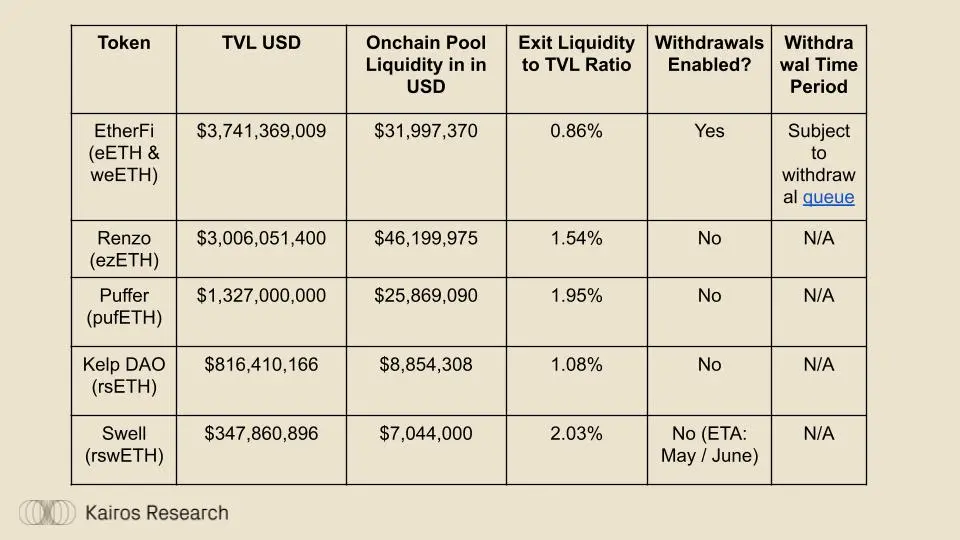
LRT Liquidity & Total Supply
Staking through LST and LRT has several key advantages over traditional staking, but if the liquidity of LRT itself is insufficient, these advantages are almost completely undermined. Liquidity refers to the "efficiency or convenience of assets being quickly converted into cash without affecting their market price." Ensuring that LRT issuers provide sufficient on-chain liquidity for large holders to exchange receipt tokens at close to a 1:1 value is crucial.
Each existing LRT has very unique liquidity characteristics. We expect these conditions to persist for several reasons:
- Some protocols may luckily gain investors and users to provide liquidity for their LRT in the early stages.
- There are many ways to incentivize liquidity through grants, token distributions, on-chain bribery systems, or through events such as "points."
- Some protocols will have more complex, more centralized liquidity providers, which will keep their LRT closely tied to the underlying assets, with less overall dollar liquidity. It should be noted that centralized liquidity is only effective within a tight price range, and any price movement beyond the selected range will have a significant impact on prices.
The following is a very simple breakdown of on-chain pool liquidity for the top five LRT groups on the Ethereum mainnet (plus Arbitrum). Exit liquidity refers to the dollar value on the cash-like side of the LRT liquidity pool.
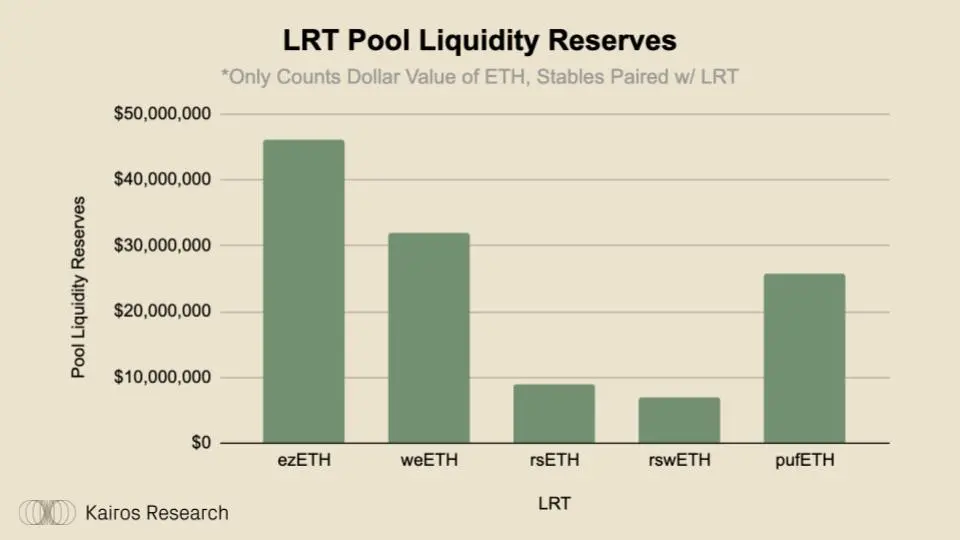
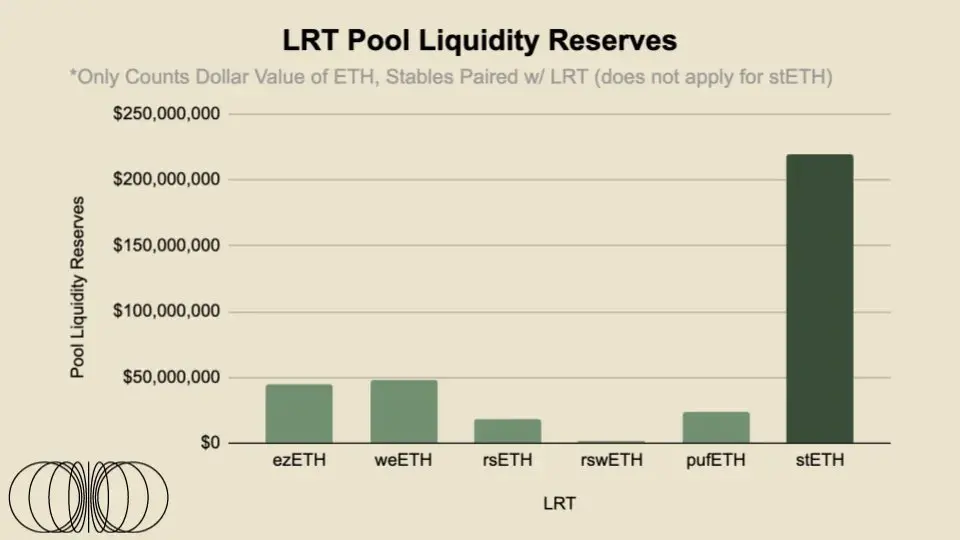
On platforms like Curve, Balancer, and Uniswap, the combined pool liquidity of these top five LRT groups exceeds $136 million, which is impressive considering the nascent nature of the restaking industry. However, to more clearly demonstrate the liquidity of each LRT, we will apply a liquidity/market cap ratio to each asset.
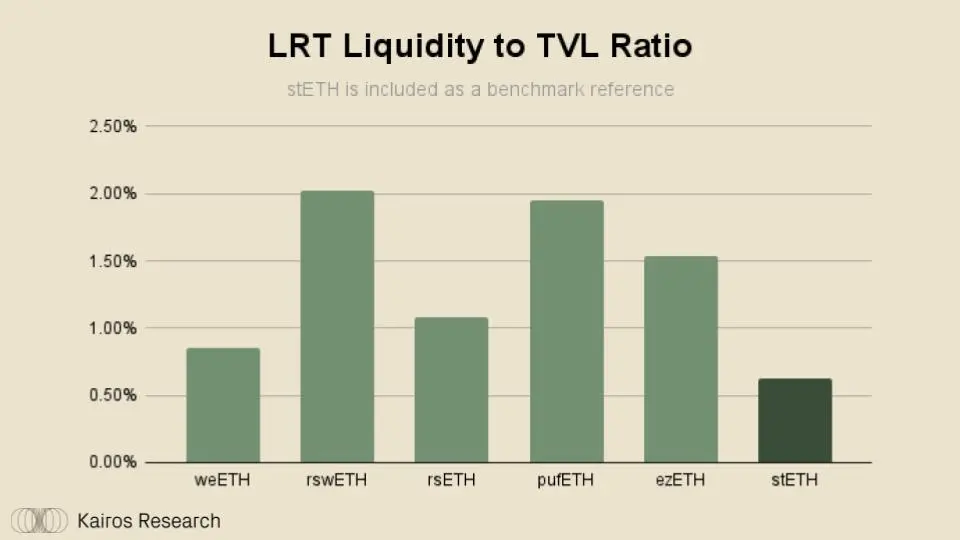
The liquidity ratio of LRT is not overly concerning compared to the top liquidity staking token stETH. However, given the additional risk layer brought by restaking and Eigenlayer's seven-day withdrawal period exceeding Ethereum's unstaking queue, the liquidity of LRT may be more important than that of LST. Additionally, stETH is traded on several large centralized exchanges, with order books managed by professional high-frequency trading firms. This means that stETH's liquidity far exceeds what is seen on-chain. For example, on OKX and Bybit, the ±2% order book liquidity exceeds $2 million.
Therefore, LRT can also collaborate with centralized exchanges, strengthen integration, and educate market makers about the risks and rewards of being liquidity providers on these centralized platforms.
LRT Data
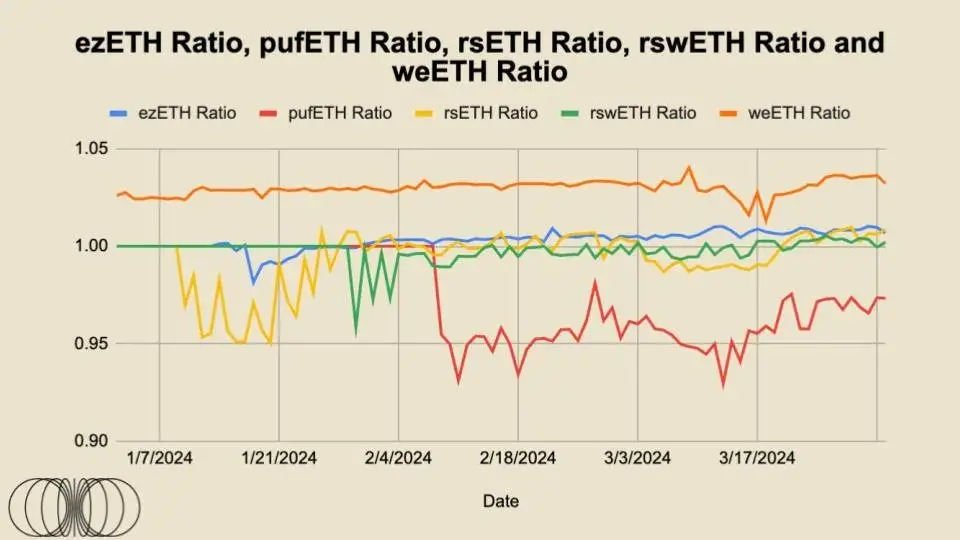
As shown in the above chart, rsETH, rswETH, and ezETH all trade relatively closely to 1:1 with their underlying ETH, with a slight premium. Due to their nature, they should all trade at a "premium" in the future. As these are non-rebasing tokens, unlike stETH, they automatically compound staking rewards, which is reflected in the token price. This is also why the current trading price of 1 wstETH is approximately 1.16 ETH. In theory, over time, the "fair value" of these tokens should continue to grow due to the factor of time*staking rewards, and this should be reflected in the increased fair value of these tokens.
The anchoring of these LRTs is crucial as they essentially represent the market participants' trust in the entire project, directly influenced by the participants' stake or arbitrageurs' willingness to trade these premiums and discounts to maintain the tokens trading at "fair value."
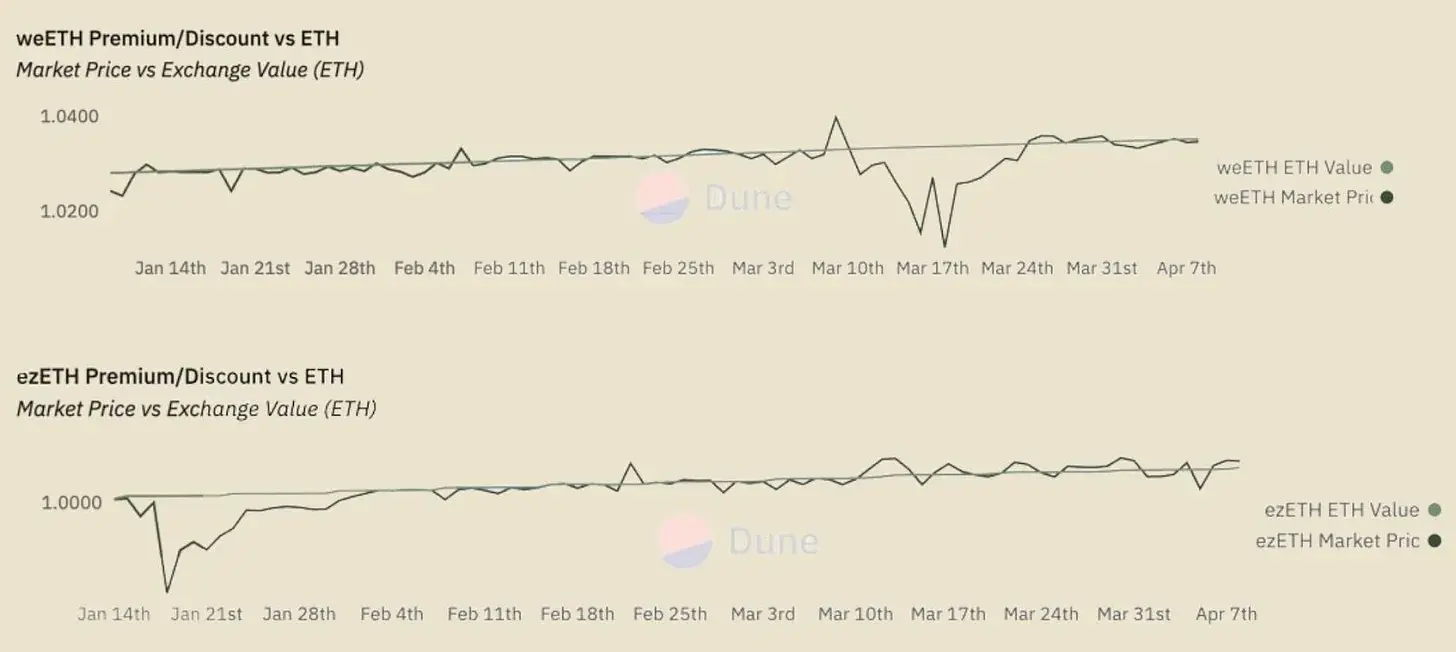
From the trading behavior of the two most liquid LRTs, ezETH and weETH, it can be seen that their trading prices remain relatively stable over time, mostly consistent with their fair value. EtherFi's weETH has a slight deviation from fair value, mainly attributed to the release of its governance token, where opportunistic farmers exchanged the token, naturally leading to other market participants intervening to trade this discounted arbitrage. A similar event can be expected once Renzo releases its governance token.
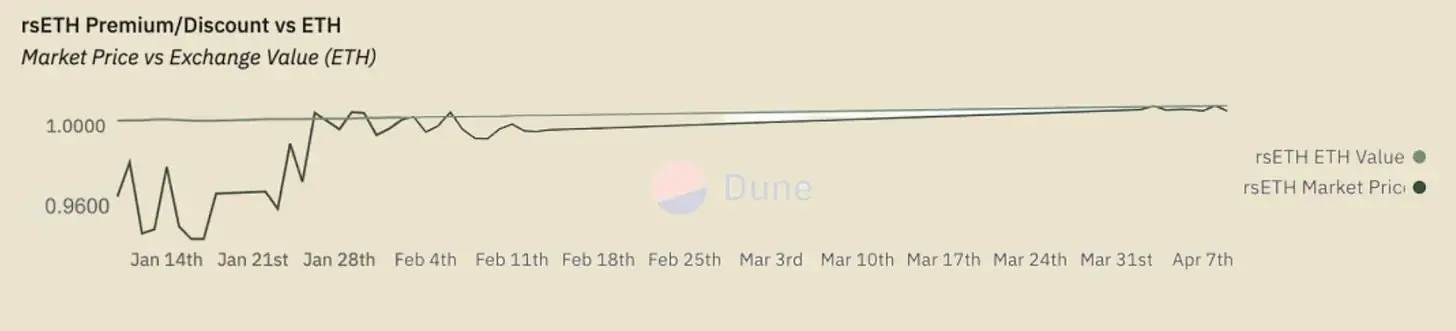
KelpDAO's rsETH initially traded at a discount to fair value upon release but has since slowly and steadily returned to parity.
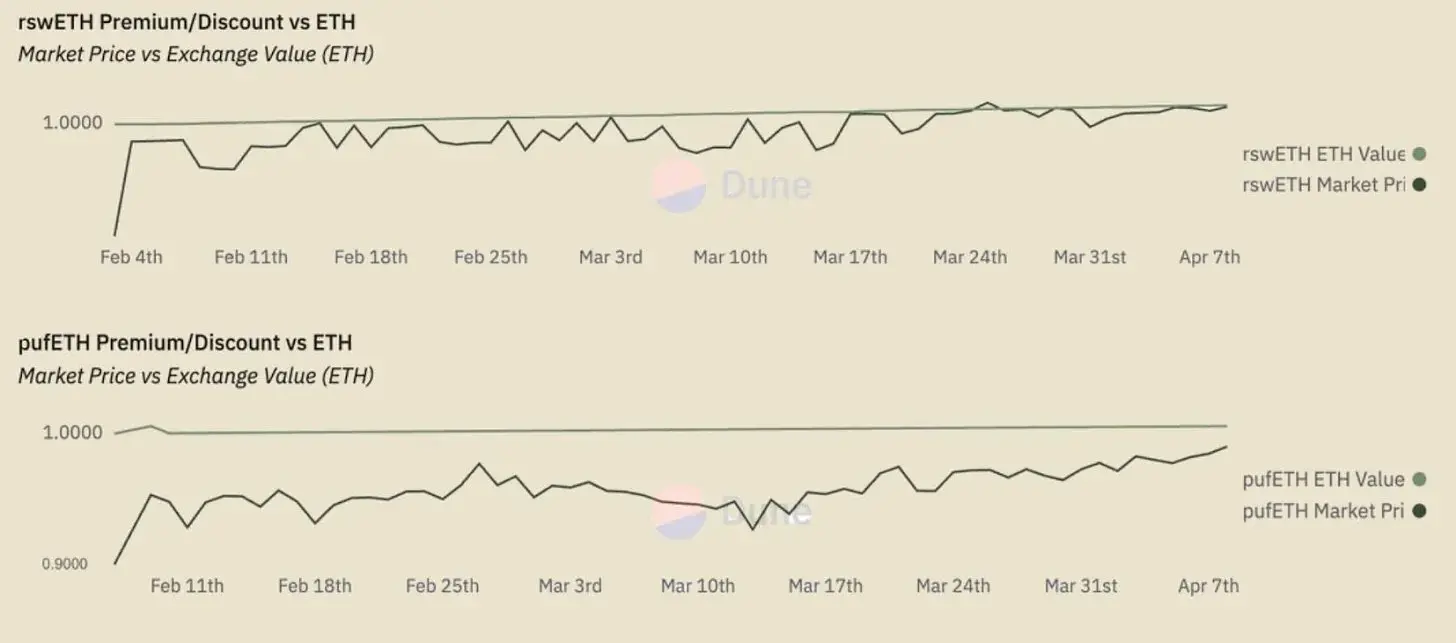
For rswETH, its trading value has been slightly lower than its fair value for most of the time, but it seems to have recently reached parity with its fair value. Among all these LRTs, pufETH is the main outlier, as it only trades at a price lower than fair value. However, this trend seems to be coming to an end, as its trading value is gradually approaching the fair value of its underlying assets.
Except for EtherFi, these LRT providers have not enabled withdrawal functionality. We believe that ample liquidity, coupled with the ability for users to withdraw funds at will, will enhance market participants' confidence in trading these discounts or premiums.
LRT in the DeFi Ecosystem
Once LRT becomes more integrated into the broader DeFi ecosystem, especially in the lending markets, its importance will significantly increase. For example, when we look at the current money markets, especially LSTs like wstETH/stETH, they are the largest collateral assets on Aave and Spark, providing approximately $4.8 billion and $2.1 billion, respectively. As LRTs continue to develop further in the DeFi ecosystem, we expect them to surpass LSTs in total amounts, especially as the market's understanding of risk and product structure deepens, making them more Lindy over time. Additionally, there are governance proposals on Compound and Aave to introduce Renzo's ezETH.
However, as mentioned earlier, liquidity will continue to be the lifeline of these products to ensure their breadth and depth of integration into DeFi and overall sustainability.
Conclusion
While stETH has gained an early lead and dominance due to the first-mover advantage, the range of LRTs mentioned in this report was launched roughly around the same time and has market momentum on their side. We expect this to be a winner-takes-most market structure, as most liquidity assets follow a power law; simply put, liquidity begets liquidity. This is also why Binance continues to dominate the market share of centralized exchanges despite all the negative news and turmoil.
Overall, the liquidity of restaking tokens is not very strong. Liquidity is decent, but each individual LRT has greater subtle differences, which will only increase as delegation strategies begin to diverge in the long run. For first-time users, understanding LRT as staking ETFs may be easier. Many will compete for the same market share, but in the long run, allocation strategies and fee structures may be the determining factors in who the winners and losers are. Additionally, as products become more differentiated, liquidity will become even more important, considering how long the withdrawal period is.
In the cryptocurrency space, seven days can sometimes feel like a month in regular time, as the global market operates 24/7. Finally, as these LRTs begin to integrate into the lending markets, pool liquidity will become even more important, as liquidators will only want to take on acceptable risks, depending on the different liquidity characteristics of the underlying collateral being discussed.
免责声明:本文章仅代表作者个人观点,不代表本平台的立场和观点。本文章仅供信息分享,不构成对任何人的任何投资建议。用户与作者之间的任何争议,与本平台无关。如网页中刊载的文章或图片涉及侵权,请提供相关的权利证明和身份证明发送邮件到support@aicoin.com,本平台相关工作人员将会进行核查。


