Author: Primal Capital
Translation: Plain Blockchain
This article focuses on the untapped potential in the Bitcoin ecosystem, a topic of great interest and debate among industry enthusiasts and experts. Our goal is to provide comprehensive insights that not only enrich your understanding of the current market, but also highlight future possibilities.
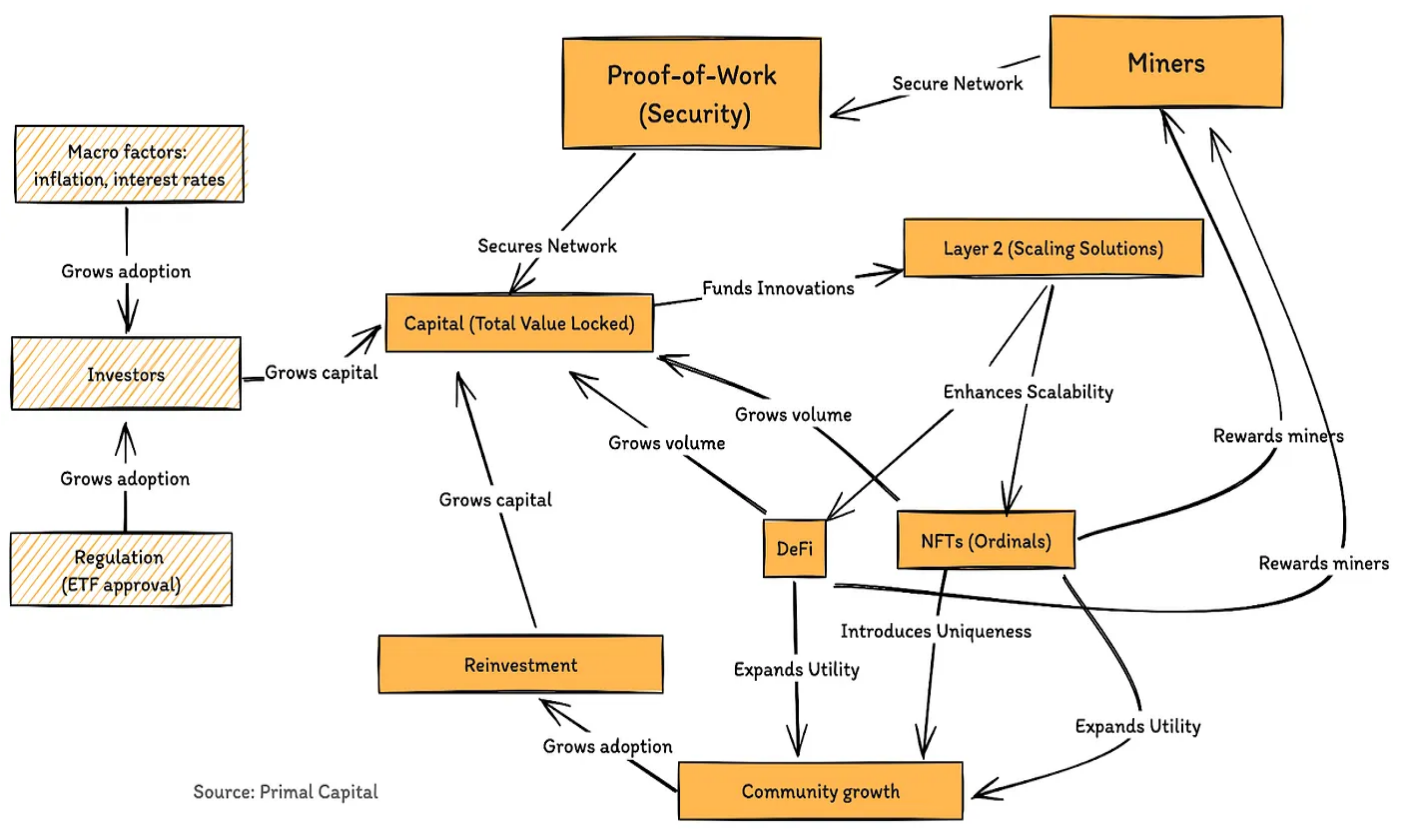
In short, Bitcoin remains the largest blockchain by market value, but compared to Ethereum, it has not developed a decentralized finance (DeFi) ecosystem as extensive as Ethereum's. Despite possessing the tools and infrastructure necessary for a native ecosystem, Bitcoin's exploration in the DeFi field has been relatively mild. However, with growing interest in Bitcoin, we may see it emerge as more than just "digital gold." This article discusses the challenges and potential strategies for developing the Bitcoin ecosystem, including second-layer solutions, community participation, and institutional adoption, highlighting the untapped potential of Bitcoin in the DeFi field.
Below is the basic flywheel model of the Bitcoin ecosystem's development:
1. Introduction
Bitcoin has always been a leader in the blockchain field, taking center stage from the beginning. Like a pioneer planting a flag in uncharted territory, Satoshi Nakamoto declared his rights at the origin of a new technology—blockchain. Indeed, Bitcoin is the pioneer of all blockchain technologies and remains the largest blockchain by market value. Given its prominent position, the emergence of a vast and vibrant Bitcoin ecosystem seems inevitable. However, this has not happened, leading us to ask: why?
As the blockchain movement has developed, many other networks have emerged, providing ecosystems and financial infrastructure that Bitcoin lacks. Among them, Ethereum was the first to do so and has become the champion platform advocating for decentralized finance (DeFi). Given Bitcoin's status and reputation, it seemed destined to enter and dominate the DeFi field. However, contrary to expectations, Bitcoin's exploration in the DeFi field has been relatively mild. For example, the largest second-layer network of Bitcoin—the Lightning Network—has a relatively small total value locked (TVL) of only $277 million, while Ethereum's largest second-layer network—Arbitrum—has a TVL of $3.3 billion at the time of writing.
Some may explain this by saying that it is because Bitcoin lacks the programmability of Ethereum. However, the emergence of second-layer networks built on Bitcoin has shattered this misconception, providing the tools and infrastructure needed for the development of a vast and diverse native ecosystem. Now, the only remaining task is to influence the vast Bitcoin user and holder community to build a comprehensive ecosystem. Bridging the gap between the immense value inherent in Bitcoin and the DeFi world may bring countless possibilities to Web3. The roadmap ahead includes adopting more layered solutions, nurturing a more collaborative developer community, and leveraging Bitcoin's unparalleled security.
2. Current State of the Bitcoin Ecosystem
Bitcoin originated from the cypherpunk community and has rapidly developed since 2008. Nevertheless, the core code of the Bitcoin protocol itself has hardly changed, and its role remains primarily limited to a medium of exchange. Indeed, the true value of the Bitcoin network still lies in being the arbiter of digital gold; Bitcoin itself. However, even in this role, the Bitcoin network faces challenges related to scalability, transaction speed, and costs, hindering its ability to process transactions and support a comprehensive DeFi ecosystem.
Currently, the Bitcoin network consists of a series of miners, nodes, stakeholders, developers, and a certain scale of second-layer networks, sidechains, and other decentralized applications (DApps). Miners and nodes support the network by validating transactions and maintaining consensus for stakeholders. This is achieved through the use of the Proof of Work (PoW) consensus mechanism, which may lead to slower ecosystem growth compared to other first-layer protocols using Proof of Stake mechanisms. Meanwhile, the developer community helps expand the native ecosystem and occasionally updates the core protocol. Consensus on upgrades within the developer community is difficult to reach, leading to a lack of change. For example, Taproot is the first major update to Bitcoin since SegWit in 2017. Here is a brief overview of the ecosystem:
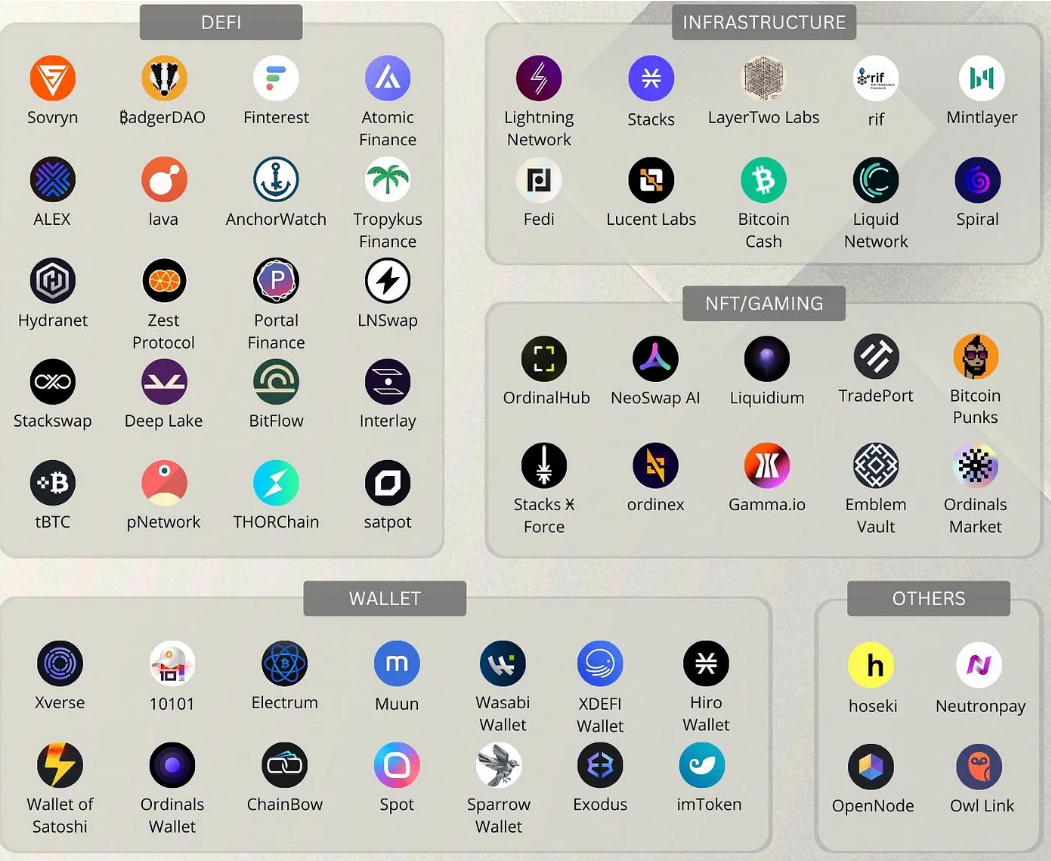
Source: Coin360
Due to infrequent updates, Bitcoin has encountered some issues in scalability and programmability. Therefore, a prerequisite for creating a DApp ecosystem on Bitcoin is the availability of smart contract functionality through extension solutions. Thus, the development of second-layer networks and sidechains on the Bitcoin network is essential to facilitate the growth of its native ecosystem.
3. Extension Solutions
Extension solutions are protocols built on top of the blockchain base layer, aiming to improve its efficiency by processing transactions outside the main blockchain. By processing transactions outside the main blockchain, they offer improved scalability, reduced transaction costs, and faster confirmation times. In addition to scalability, second-layer networks and sidechains can also introduce complex smart contract functionality.
The first extension solution to appear on the Bitcoin network was the Lightning Network. This platform is specifically designed to improve transaction speed and reduce costs on the Bitcoin network. Although the Lightning Network has performed well in this regard and attracted a total value locked (TVL) of over $277 million, it has failed to provide the smart contract functionality required for a complex native DApp ecosystem.
Fortunately, several other extension solutions specifically designed to implement smart contracts have emerged on the Bitcoin network. Some of these solutions include:
1) Counterparty
Counterparty, launched in 2014, is a pioneering smart contract platform for Bitcoin with its native token XCP. It allows token creation, crowdfunding, and is compatible with multi-signature. Although its popularity has declined, it has been revitalized through innovations like Ordinals on Bitcoin.
2) Stacks
Stacks serves as the smart contract and DApp layer for Bitcoin, using its own blockchain and adopting the Proof of Transfer (PoT) mechanism. This mechanism leverages Bitcoin's Proof of Work (PoW) to provide security. It enhances Bitcoin's functionality through DApps, DeFi, and a growing ecosystem.
3) Rootstock/RSK
RSK is a sidechain that merges mineable with Bitcoin, featuring Turing-complete smart contracts and EVM compatibility. It uses a native token called RBTC, maintaining a 1:1 peg with Bitcoin through a two-way peg mechanism. Projects like Sovryn and Money On Chain operate on RSK.
4) Liquid Network
Liquid is Blockstream's Bitcoin sidechain, providing a native token LBTC through a two-way peg mechanism. It offers decentralized trading, asset issuance, and confidential transactions. Liquid supports the creation of various digital assets, such as NFTs, stablecoins, and tokens.
5) Mintlayer
Mintlayer is a Bitcoin sidechain using the Dynamic Slot Allocation (DSA) consensus, combining Proof of Stake and Bitcoin's Proof of Work. It supports smart contracts, asset issuance, and Lightning Network compatibility. The protocol of Mintlayer also allows cross-chain transfers and anchoring capabilities.
6) RGB
RGB is the off-chain smart contract layer for Bitcoin, capable of creating tokens and NFTs, among other digital assets. It uses Bitcoin's Unspent Transaction Outputs (UTXO) as a one-time seal and provides full Lightning Network compatibility, ensuring fast settlements and scalability.
7) Omni Layer
Omni Layer is the basic smart contract and asset platform for Bitcoin, enabling token minting and decentralized exchange (DEX). Tether (USDt) was initially launched on Omni. Omni Bolt is an upgraded version with added Lightning Network compatibility, enabling faster and more scalable OmniToken transactions.
These extension solutions bring more possibilities to the Bitcoin ecosystem, enabling it to support smart contracts and complex decentralized applications. They provide higher scalability for the Bitcoin network and offer users cheaper and faster transaction experiences. Over time, as more developers and innovators join, the Bitcoin ecosystem will continue to grow, providing users with more choices and functionalities.
4. Notable Projects
With the rise of various extension solutions on the Bitcoin network, many projects have emerged, providing the foundation for a thriving DeFi ecosystem. Beyond the basic transaction capabilities of the Bitcoin network, these projects open doors for more complex financial applications and tools, many of which were previously thought to be only suitable for more flexible platforms like Ethereum. From tokens created on Bitcoin to platforms supporting decentralized exchanges (DEX), the ecosystem is dynamic and constantly evolving.
Platforms like Zest Protocol and Atomic Finance introduce peer-to-peer decentralized lending supported by Bitcoin. Zest is a portfolio company of Primal Capital, focusing on addressing counterparty risk in lending on the Bitcoin network. Bisq Network and Alex Labs are Bitcoin decentralized exchange platforms (DEX), providing a P2P trading platform and operating autonomously under decentralized autonomous organizations (DAO). Liquality Wallet offers a multi-chain Web3 wallet supporting multiple assets. These are just a few of the many DApps being built on the Bitcoin network. Each project brings unique DeFi solutions and trading platforms, catering to different user needs and emphasizing different aspects of the DeFi experience.
But the Bitcoin ecosystem is not limited to DApps. Leveraging Bitcoin's base unit, Satoshi (or Sats), Ordinals introduces a unique mechanism for creating NFTs on Bitcoin. Ordinals essentially adds value to each Satoshi, allowing it to "stamp" unique content. BRC-20Token is built on this, creating original token contracts using JSON stamping. The more advanced ORC-20Token further develops this idea, issuing tokens with more functionality using Segwit witness data and JSON. Meanwhile, Stamps and SRC-20Token use blockchain insertion of arbitrary data to create native Bitcoin digital items. Ordinals quickly gained popularity and experienced exponential growth, reaching 60 million stamps (mintings) since its launch in January 2023, just over a year ago.
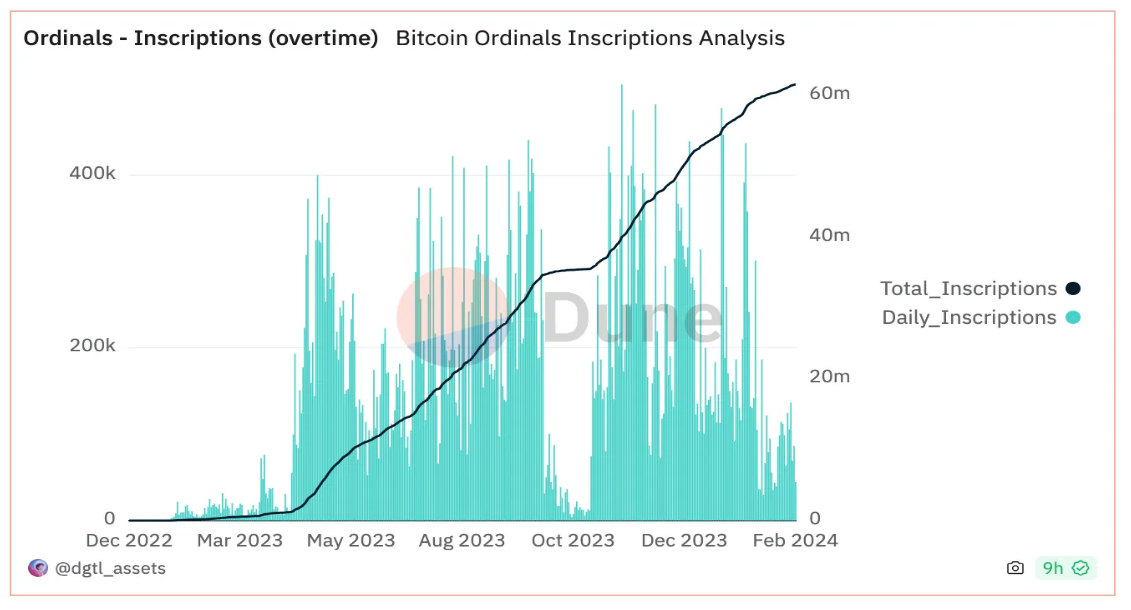
Source: @dgtl_assets, Dune
These are just a part of the many projects being built on the Bitcoin network, collectively forming the foundation of a thriving decentralized financial system. However, despite having a sizable DeFi ecosystem, the network still lags behind its competitors, especially Ethereum, in DeFi development. This underdevelopment contrasts sharply with the scale and enthusiasm of its global community, presenting a peculiar juxtaposition in the cryptocurrency world.
5. Local Community
In terms of the local user community of this ecosystem, Bitcoin has many options. The scale, enthusiasm, and dedication of the Bitcoin community are undeniable. With a global base of users, miners, developers, and evangelists, Bitcoin can be said to have the most influential and passionate community in the cryptocurrency world. This community is characterized by open-source ethics, where principles such as decentralization, collaboration, security, and transparency are crucial. From online forums like BitcoinTalk to global conferences, the community thrives on shared knowledge and the collective pursuit of financial sovereignty.
Most Bitcoin users are holders, viewing it as a form of value storage or digital gold. Bitcoin maximalists are a large subgroup within this holder community. They believe that Bitcoin is the only cryptocurrency that can stand the test of time. They argue that Bitcoin's decentralized nature, security, and first-mover advantage make it superior to all other digital currencies. Maximalists often criticize altcoins, viewing them as interference or even potential threats to the purity and mission of Bitcoin. As maximalists oppose alternative blockchains, they are a key potential audience in the local Bitcoin ecosystem.
Bitcoin also has a large network of entities and users who use Bitcoin for its intended purpose—a decentralized peer-to-peer electronic cash system. These users range from merchants accepting Bitcoin for goods and services to individuals using Bitcoin for remittances, investment, or as a hedge against economic instability. In addition to these entities, there are groups of developers and educators playing a crucial role in bridging knowledge gaps, providing resources, conducting workshops, and dispelling myths about cryptocurrencies. They are often the first point of contact for newcomers and play a key role in shaping the understanding and perception of Bitcoin.
These groups often overlap and collectively form the core of the local Bitcoin community. Each brings their own perspectives, expertise, and passion for the future of the network, making them integral parts of the Bitcoin ecosystem.
6. Developing the Bitcoin Ecosystem
Given the massive value stored in the Bitcoin network, developing the local ecosystem of Bitcoin is not just a matter of attracting new users. Instead, projects need to fully leverage the existing large user base, developers, and capital present in the network. Many stakeholders are committed to the Bitcoin network, making them valuable resources for any initiatives aimed at developing the ecosystem.
The dormant funds in the Bitcoin network are massive, accounting for approximately 70% of the total supply. If only 10% of this value is used for the Bitcoin ecosystem, it would equate to a locked value (TVL) of approximately $122 billion according to current calculations. For comparison, the estimated TVL of all current DeFi protocols is approximately $91 billion. The potential of this ecosystem is undeniable, as long as appropriate measures are taken to attract new users.
The foundation of this ecosystem has been laid, and the key now is to attract more community participation, larger investments, and build better tools. This triple challenge requires a comprehensive and coordinated approach, as each aspect plays a crucial role in the future growth and sustainability of the local Bitcoin ecosystem.
7. Changing Community Perception
The protection of the core principles and values of the Bitcoin protocol owes much to the community's resistance to change. However, this attitude is a double-edged sword, as it slows down the integration of new features and the adoption within the local ecosystem. To overcome this contradiction, joint efforts are needed to attract users and enhance user experiences. This may involve a range of initiatives, from social media campaigns to designing more intuitive, user-friendly wallet interfaces, and conducting educational activities to reveal the complexities of Bitcoin transactions, smart contracts, and network security.
For those particularly focused on the purity of Bitcoin, the key is to provide opportunities without sacrificing their core values, such as decentralization and security. Proper infrastructure and tools, as well as educational resources, are especially needed to foster their trust in the integrity of these systems. Considering the security of the Bitcoin network, decentralized extension solutions and robust smart contract frameworks can be built. Projects that can deliver on this promise may attract a large number of maximalists who hope to utilize their holdings without compromising their principles.
1) Building Better Infrastructure and Tools
```
The current pace of incremental change is not sufficient to drive any significant growth in the Bitcoin ecosystem. What is envisioned is a major shift that encompasses next-generation scalability solutions, advanced smart contract frameworks, and seamless connections with other blockchain networks. At the current state, many existing Bitcoin-based extension solutions fall short. For example, the Counterparty protocol has issues with the rigidity of its smart contract framework and the currency XCP required for certain functionalities, which may deter purists from using the platform.
Some extension solutions, such as the Lightning Network, completely lack smart contract functionality. These challenges highlight the need for a more comprehensive approach when developing infrastructure and tools within the Bitcoin ecosystem. To truly improve Bitcoin infrastructure, a multi-pronged strategy is needed:
A. Enhance Scalability
There are already many scalability solutions on the Bitcoin network, such as the Lightning Network mentioned earlier. However, most solutions fall short on one or more key standards. What is needed is a comprehensive scalability solution that provides a secure, decentralized, and efficient platform for smart contracts.
B. Promote Smart Contracts
A key advantage that has propelled Ethereum to its current heights is the network's intuitive and powerful smart contract engine, such as Solidity and EVM. To build a similar ecosystem on the Bitcoin network, local extension solutions will need to adopt powerful and developer-friendly smart contracts, and provide extensive educational resources.
C. Foster Interoperability
Building bridges and connectors to facilitate seamless interaction between Bitcoin and other blockchains will enable users to easily transfer assets across different chains and leverage the best features of each network.
D. Integrate User-Friendly Experiences
As the ecosystem develops, tools that simplify the development and deployment process are needed. This includes better wallets, development frameworks, and debugging tools. Additionally, user-friendliness is crucial for the interaction and participation of users who may have less technical knowledge.
E. Education and Community Building
A strong community is the cornerstone of any successful blockchain project. Investing in education, workshops, and community-driven initiatives can help users discover, developers build, and investors connect.
Despite significant progress in the Bitcoin ecosystem over the years, there is still much work to be done. Platforms like Stacks represent the future. They have the tools to create an ecosystem that can compete with Ethereum's L2 ecosystem. By focusing on platforms like Stacks and building better infrastructure, the Bitcoin ecosystem can lead the forefront of the DeFi movement.
2) Attracting Developers, Investors, and Entrepreneurs
A thriving ecosystem will naturally generate its own attractiveness. With strong infrastructure, an active community, and available opportunities, developers will naturally be drawn to the Bitcoin network to develop new solutions for its ecosystem. In addition to developers, investors seek returns and look for opportunities in this growing field. For entrepreneurs, this will provide an opportunity to enter a large and opportunity-filled ecosystem at its early stages. Given the growth standards, a growing user base, and untapped potential, the possibilities for new businesses will be extensive.
Once started, this cycle will quickly spiral into a network effect, where each new participant, whether a developer, investor, or entrepreneur, adds value to the network, making it more attractive to future participants. The growing network then enters a positive feedback loop, increasing the overall utility, security, and value of the system. The cascading effects of attracting developers, investors, and entrepreneurs are profound. Each group mutually reinforces, creating a synergistic effect that amplifies growth. The only thing needed is a catalyst to start the cycle, which is likely to come in the form of improved infrastructure and changing community perceptions.
3) Institutional Adoption
Over the years, the reasons for adding Bitcoin to institutional balance sheets have shifted from speculative gambling to strategic necessity. In today's world full of economic uncertainty, rising inflation, and market volatility, Bitcoin can serve as a hedge and investment to diversify portfolios. A recent significant change was the approval and launch of a Bitcoin ETF in early January 2024. The successful issuance and the influx of institutional investor funds strongly validate the value of the entire Bitcoin ecosystem.
This validation may open new pathways for direct institutional investment in newly built projects. While institutional investment depends on the effective development and successful growth of the Bitcoin ecosystem, its occurrence will be the final piece of the puzzle. Once institutional funds start flowing into projects and on-chain financial products, the network will become one of the largest Web3 DeFi ecosystems, or possibly one of the largest, attracting widespread attention.
8. Conclusion
If the Bitcoin ecosystem develops and grows according to the above standards, the results will be profound. With a large amount of stored capital available on the network, coupled with potential capital inflows from off-chain, the Bitcoin ecosystem may surpass the scale of Ethereum. Such a transformation will have a huge impact on the entire cryptocurrency space. Of course, this assumption depends on numerous factors, each of which requires the collective efforts of the community. However, a significant catalyst can trigger this evolution, whether it be a market upswing, a sudden change in community perception, or other factors. As history has proven, the only constant in the Web3 space is change, and the growth and evolution potential of Bitcoin should not be underestimated.
免责声明:本文章仅代表作者个人观点,不代表本平台的立场和观点。本文章仅供信息分享,不构成对任何人的任何投资建议。用户与作者之间的任何争议,与本平台无关。如网页中刊载的文章或图片涉及侵权,请提供相关的权利证明和身份证明发送邮件到support@aicoin.com,本平台相关工作人员将会进行核查。


