Hello, everyone, the first Newsletter of the Year of the Dragon is here!
Many friends have asked us, why "Web3Brand"?
Because we believe that Web3 represents the era of decentralization and globalization, where everyone has the opportunity to unleash their energy, become an independent brand and node, without having to rely on a centralized institution, and achieve a more free life.
Our content is also built around the above vision, including high-value information sources and tool sharing, in-depth case analysis and thinking about these Web3 or AI projects, what problems they can solve for everyone, and how they can help you go further on the path of personal branding and super-individual.
In this issue, we will introduce a project about "proof". If you are also building or seeing interesting projects that meet the above definition, feel free to recommend them to us.
Enjoy!
Join 3,000+ subscribers and get the latest cases and thoughts on how Web3 and AI empower personal brands and enterprises, becoming super-individuals in the era of globalization.
1. How to "prove" that I own Li Zhi's album?
Last month, while browsing on Jike, I saw my friend nasa giving away a fruit gift box, with an interesting condition: "prove" that you own Li Zhi (Brother B)'s album by screenshotting the "NetEase Cloud Music - Purchased List".
As a senior fan of Brother B, I couldn't miss out on such a benefit, so I quickly took a screenshot and now I'm writing this article while enjoying a waxberry.
The waxberry is indeed delicious, but to be honest, it's very easy and even costless to forge a screenshot. I'm also worried that nasa might be taken advantage of by "non-target users", so I started thinking about the question in the title:
How to "prove" that you own Li Zhi's album?
The simplest way is to bring the physical album and meet in person. This method is authentic but too costly, and in the digital age, there are very few people with physical albums.
Li Zhi has released several digital albums on NetEase Cloud Music, theoretically, NetEase Cloud Music can provide an API to query "I own Li Zhi's album".
But this is obviously not practical
- The API needs NetEase Cloud Music to actively develop it, and I first need to find the corresponding person in charge;
- Assuming I did find the person in charge of NetEase Cloud Music, developing the API is also a significant cost, usually not within the department's OKR;
- Assuming I am willing to invest in this cost, and the API is eventually developed, using it also requires solving user privacy and legal issues.
It's hard to imagine how many people/brands can overcome these three obstacles and prove what they already own.
2. Web2: Need to overcome three pain points to prove what you already own
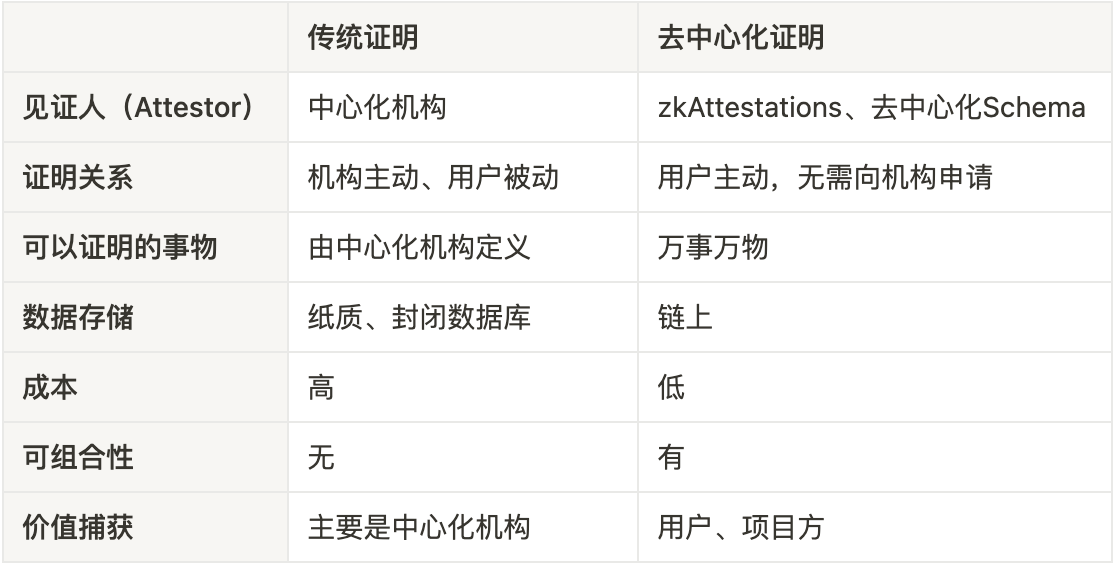
Essentially, it's because in Web2, there is no "Own", we rarely own our own data and assets, they belong to centralized institutions and not to you.
A recent example, in December, in order to apply for a Schengen visa for the European Union, in addition to personal information proof, I also needed to prepare the following proof materials:
- Employment proof: company's official letter with a seal, a copy of the company's business license
- Asset proof: original bank statements for the past 6 months for my salary card or debit (savings) card, stamped by the bank; a bank-issued proof of at least 50,000 RMB/person in savings; a copy of the property ownership certificate; a copy of the vehicle registration certificate
- Travel proof: flight tickets, hotel reservations, daily itinerary
- Family proof: Chinese-English notarized certificate of parent-child relationship
To complete the above "proofs", you need to overcome the following three pain points
- You need centralized institutions to prove the data you generate
- Need the company to prove my employment
- Need the bank to prove my assets
- Need the property management office to prove my property
- Need the vehicle management office to prove my vehicle ownership
- Need the ticketing website to prove my flight tickets and hotel reservations
- Even need a separate notary office [Hague Notary] to prove "my daughter is my daughter"
- "Proving your data" often comes with a high cost
- I need to write an email to the company to apply for an "employment proof" and explain why I'm applying
- I need to go to the bank to obtain an asset proof
- To prove "my daughter is my daughter", I first need to make an appointment with the institution, then spend 600 RMB to buy a notarized certificate! (European Union visas are really outrageous)
- Data from different institutions is scattered in different centralized institutions/servers, and it's very troublesome to combine them for use
- I have to copy all these materials and put them together, I counted, it's nearly 100 pages (passport requires every page to be copied, including blank pages). Just copying my and my family's information took over an hour…
After going through this, I probably won't apply for a Schengen visa for the next 5 years, "proving what you already own" is too difficult and time-consuming.
It's hard to imagine that we live in such a magical era, on one hand, every day is filled with headlines like "The Revolution is Coming! XX AI Big Model is Here!" and "AGI is only 1 year away"…; on the other hand, we rarely own our own data and assets, "proving what you already own" is extremely difficult.
3. Opportunities of Web3: Everything can be proven
The core of Web3 is Own, where everyone can build and own their own on-chain assets, and use on-chain records for proof.
But the current limitation is that most of our asset proofs still exist off-chain, leading to a lack of on-chain identity and limited application scenarios:
- Financial applications: lack off-chain property certificates, stock certificates, and bank deposit certificates
- Workplace applications: lack off-chain educational certificates, employment certificates
- Social applications: lack off-chain interest proof (how to "prove" I own Li Zhi's album?), relationship proof (how to prove that my older sister and Sun Ge follow me)
- ……
Some projects in the industry have also discovered this series of pain points in Web2 and the opportunities of Web3, and have built proof protocols that include both on-chain and off-chain proofs, one of which is the Sign Protocol that we are about to introduce.
3.1 Definition and History of Attestation
Let's take a moment to review the definition and history of attestation, which will help us better understand how the Sign Protocol is changing the matter of proof.
- Attestation and Verification both have the meaning of "proof", referring to the process of confirming certain information, events, or processes, but they have key differences.
- Attestation refers to a third party, usually an authoritative entity, declaring or proving the truth of certain information or the occurrence of an event. In this process, it involves a clear statement confirming that the reviewed content is correct, true, or compliant. For example, a certified public accountant auditing a company's financial statements and issuing an audit report is considered proof of its financial condition.
Verification, on the other hand, focuses more on determining the accuracy of certain information through inspection or investigation. It usually involves a series of testing, analysis, or evaluation processes to confirm whether the information or system meets specific standards or expectations. For example, the code verification process in software development ensures that the software runs smoothly and without errors.
In summary, Attestation is usually carried out by external authorized institutions/witnesses (Attestors) to prove the truth of certain information, while Verification is usually a more technical process, checking whether the information or system is correct, valid, and compliant with standards or expectations.
Based on this definition, the identity of the Attestor and the form of attestation determine the ultimate efficiency and effectiveness of Attestation.
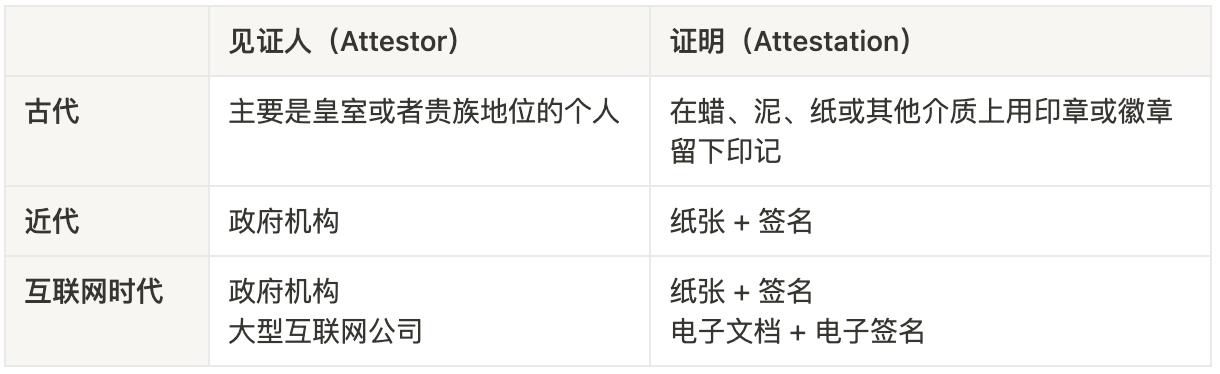
It can be seen that the form of Attestation is becoming increasingly electronic, which is indeed more convenient in some ways. However, for thousands of years, the role of the Attestor has been centralized, leading to the pain points we encountered at the beginning: you have to passively seek centralized institutions to generate proof, which is costly, inefficient, and difficult to combine for use.
However, from the definition and history of Attestation, it can be seen that it is not solving a technical and algorithmic problem, but a social consensus problem.
When it comes to "consensus", the opportunity of blockchain arises, allowing these events that can be witnessed and declared to be defined according to certain standards, and then become on-chain data that users can own through the blockchain, unleashing greater potential while improving efficiency through the characteristics of blockchain and smart contracts.
3.2 How Sign Protocol achieves "everything can be proven"
According to the official introduction, Sign Protocol is an omni-chain attestation protocol that allows users to prove their data without permission and build on-chain proofs.
The first core concept here is zkAttestations. Compared to Web2, which ensures the truth and integrity of information through centralized institutions, zkAttestations use zero-knowledge proofs to ensure integrity. Through technologies like TLSNotary, users can directly prove information from web pages and private messages without going through any centralized entity. The protocol uses zk proofs to verify that the data on the website does indeed come from the information provider's server and has not been altered.
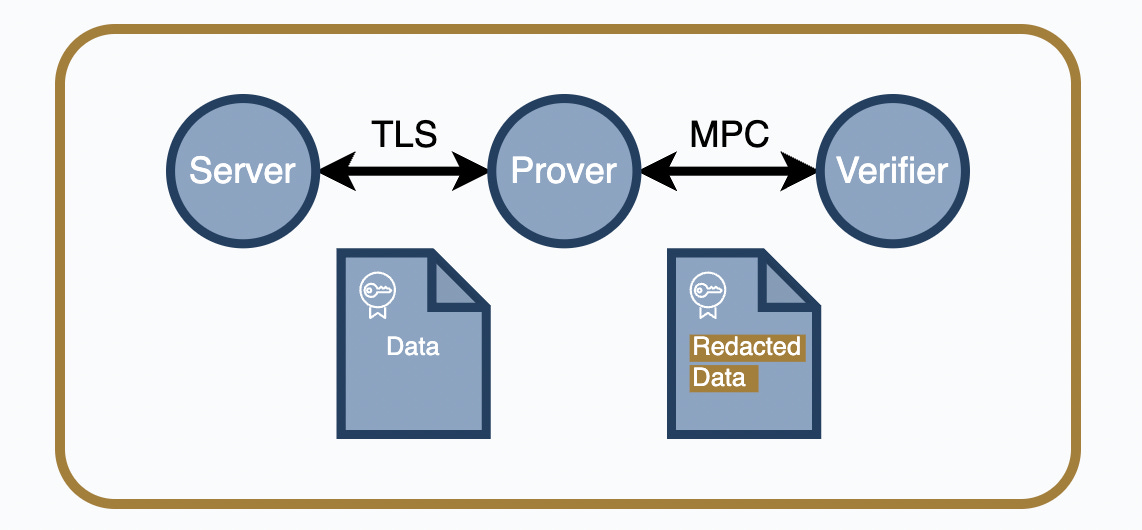 Source: tlsnotary.org
For example, when a user logs into China Merchants Bank, they can capture data from the China Merchants Bank server through a browser extension. The extension will then generate an encrypted proof to verify information such as the user's balance exceeding 200,000 RMB.
This can lead to more powerful vampire attacks, as seen in SushiSwap vs. Uniswap or Blur vs. Opensea. With zkAttestations, Web3 can conquer Web2 through simple incentive measures.
Suppose Binance or OKX wants to airdrop to US stock users, or Bored Ape Yacht Club (BAYC) or Pudgy Penguins want to airdrop to Web2 fashion players. All users have to do is interact with zkattestation once to prove their US stock trading volume or fashion consumption amount.
Through self-attestation, users do not need to disclose any personal information, and Binance, OKX, Bored Ape Yacht Club, and Pudgy Penguins do not need to seek data from the corresponding Web2 companies, yet all the above can be accomplished through airdrops and token incentives, migrating Web2 users to Web3 and moving towards mass adoption.
The configurations of these proofs, such as "my China Merchants Bank balance exceeds 200,000" or "my annual consumption on Farfetch exceeds 50,000", are called Schemas, which is the second core concept in Sign Protocol. Each Attestation Schema consists of a Header and Body, allowing the Attestor to verify if the user can pass the corresponding certification.
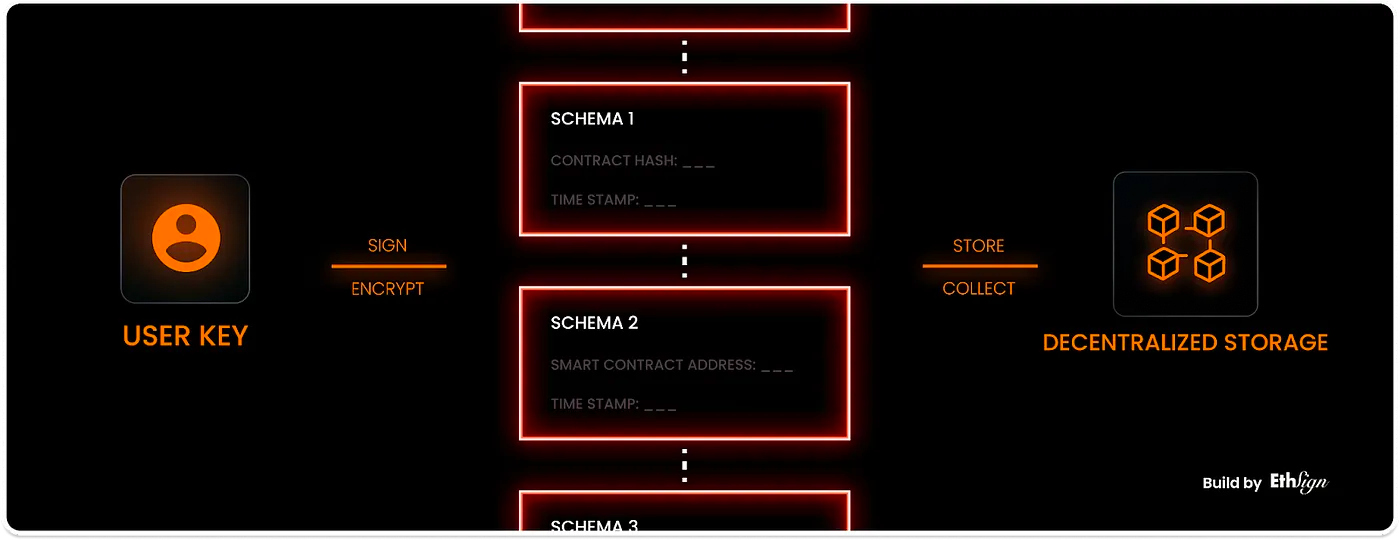 Source: EthSign Medium
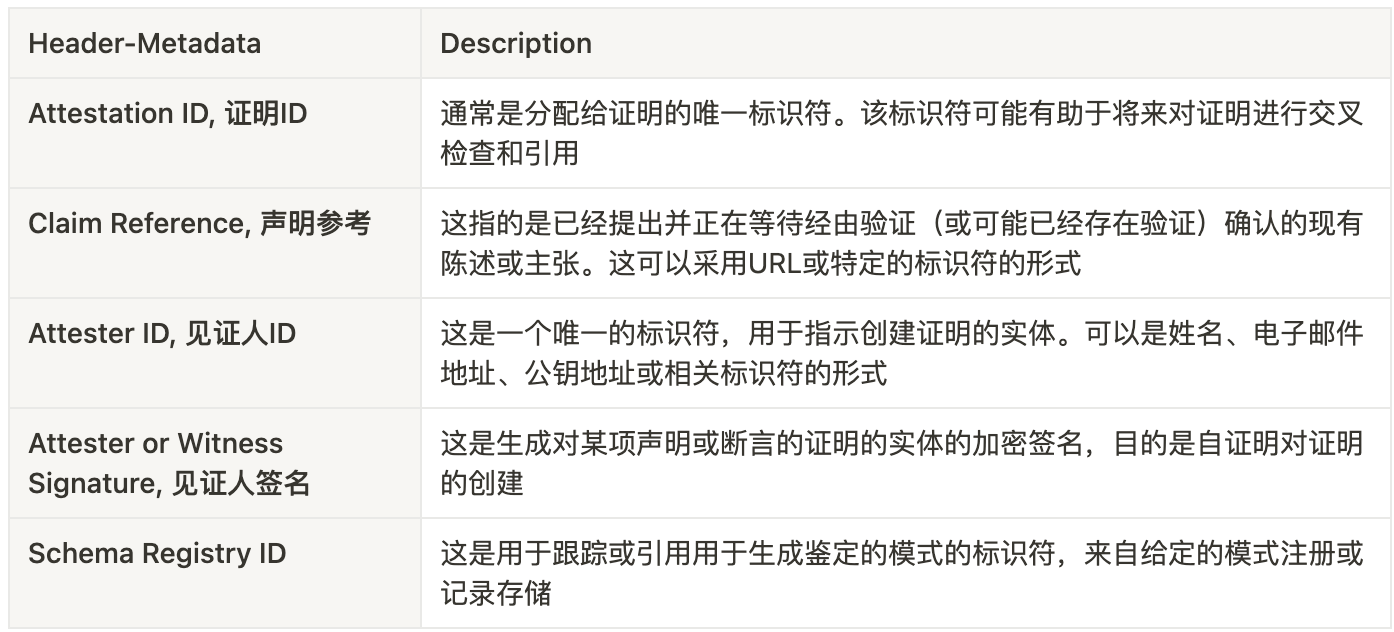
(For friends not interested in technical details, you can skip the next 2 images)
Header: Includes key contextual information for the proof, allowing the Attestor to quickly infer information related to the proof. The Header contains the following elements:
Body: Contains the complete context and metadata content of the certification. Here, the Attestor can provide extensive data and comprehensive information to confirm the given claim or assertion. The Body contains the following elements:
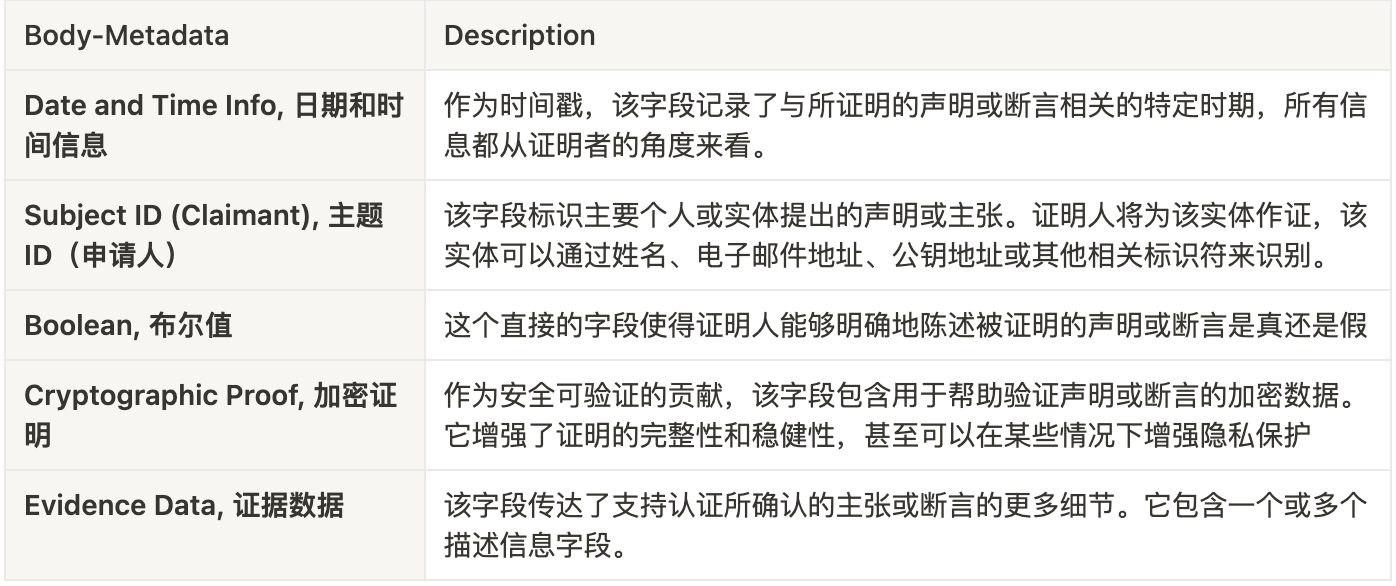
Through the combination of Header and Body, Schema provides a structured framework, precisely defining the nature of the proof, ensuring that they convey not only confirmation but also the necessary information, becoming the foundation of this on-chain proof system.
At the same time, Schemas also have composability. Taking my application for a Schengen visa as an example, if Schemas 1 to 4 already support employment proof, asset proof, travel proof, and family proof, it is easy to combine them into a Schengen visa Schema 5, completing all proofs at once, which is a delightful thought.
Unlike the Attestors of Web2, who are mostly centralized institutions, everyone can create a Schema for Sign Protocol. This means that decentralized on-chain proofs can be built based on Sign Protocol, achieving "everything can be proven".
3.3 Building new assets, unlocking new scenarios, capturing new value
zkAttestations' support for user self-attestation and Schema's support for decentralized on-chain proofs through Sign Protocol can more effectively build users' integrated on-chain and off-chain assets and identities, unlock new scenarios that Web2 cannot achieve, and capture new value.
The new scenarios mainly fall into two categories
- Airdrops based on Web2 assets and identities
- Through Sign Protocol, users' assets transition from the walled garden of Web2 to the blockchain. Whether Web3 projects want to acquire Web2 users or Web2 projects want to compete for users, it will become exceptionally easy, opening up new paradigms for user growth and operations.
- Open Loyalty for brands and users
A complete decentralized social platform: interest identity, professional identity, social relationships…
Current social platforms are "incomplete" for users
- Web2 social platforms cannot access each other's data (Facebook cannot access LinkedIn's data, TikTok cannot access WeChat's data), causing users to lack a complete social experience and needing to maintain multiple closed platforms.
- Web3 social platforms cannot access the rich social data of Web2, resulting in most projects having "chains" but no "social".
- Once users use Sign Protocol to put their interest identity (I have bought albums by Li Zhi), professional identity (formerly worked at company ABC), and social relationships (followed by a certain sister and brother) on the chain, there is an opportunity to build a complete decentralized social platform. The next generation of social platforms will no longer compete based on who has more closed data, but on who provides a better user experience and rights.
Capturing new value
Once users can own their own assets, they can continuously capture new value:
- Bringing existing on-chain/off-chain assets and identities on-chain, receiving airdrops from projects, and turning their data into value.
- At the same time, this will greatly stimulate the operation of Open Loyalty. Previously, when we were writing about Open Loyalty, we assumed that brands would issue their own NFT membership cards, but if the brands are not proactive, member data will still be in various closed databases, making it difficult to truly achieve Open Loyalty.
- However, based on Sign Protocol, if I am a member of LEGO, I do not need LEGO's permission. Based on the corresponding Schema, I can generate the on-chain proof of this membership card without permission and gain the value that belongs to me.
- This will also force brands to change their user operation paradigm and transfer more rights to users.
- What's even more interesting is that because a positive flywheel of "user data → value capture" has been built, it will incentivize users to generate more meaningful data, enriching the entire ecosystem.
- Ten years ago, Foursquare was popular, and users generated location records through check-ins, collecting corresponding badges, but because of the lack of incentives, this gameplay was difficult to sustain.
- If users' check-in records can generate on-chain proof, be used by other projects, and benefit users, it will make users more willing to engage in user-generated content (UGC). As a first-generation UGC product manager, I look forward to seeing some new UGC mechanisms.
3.4 Summary and Outlook
To summarize
- Decentralized proof vs traditional proof, the Attestor is composed of zkAttestations and decentralized Schema, user-initiated, lower cost, with composability, and can prove "everything", bringing more space for value capture.
- Decentralized proof can unlock 2 new scenarios: airdrops based on Web2 assets and identities (opening up new paradigms for user growth and operations), and a complete decentralized social platform.
- It can not only help users build integrated on-chain and off-chain assets and identities, but also incentivize users to generate new data and continuously capture value based on their data.
The predecessor of Sign Protocol is the document signing application EthSign, which reduced the cost of traditional digital signatures by more than 10 times based on blockchain and smart contracts. EthSign has received investments from Sequoia and Balaji, and after 5 rounds of iteration, it has become the number one contract signing application in Web3, building interfaces in applications such as Telegram and LINE, serving over 300,000 users, and integrating with government identity systems such as SingPass to achieve higher compliance levels.
Essentially, EthSign is an application for "proof". The team saw the potential in the "proof" field and built Sign Protocol based on the backend of EthSign, expanding the content of proof from user-generated documents to "everything".
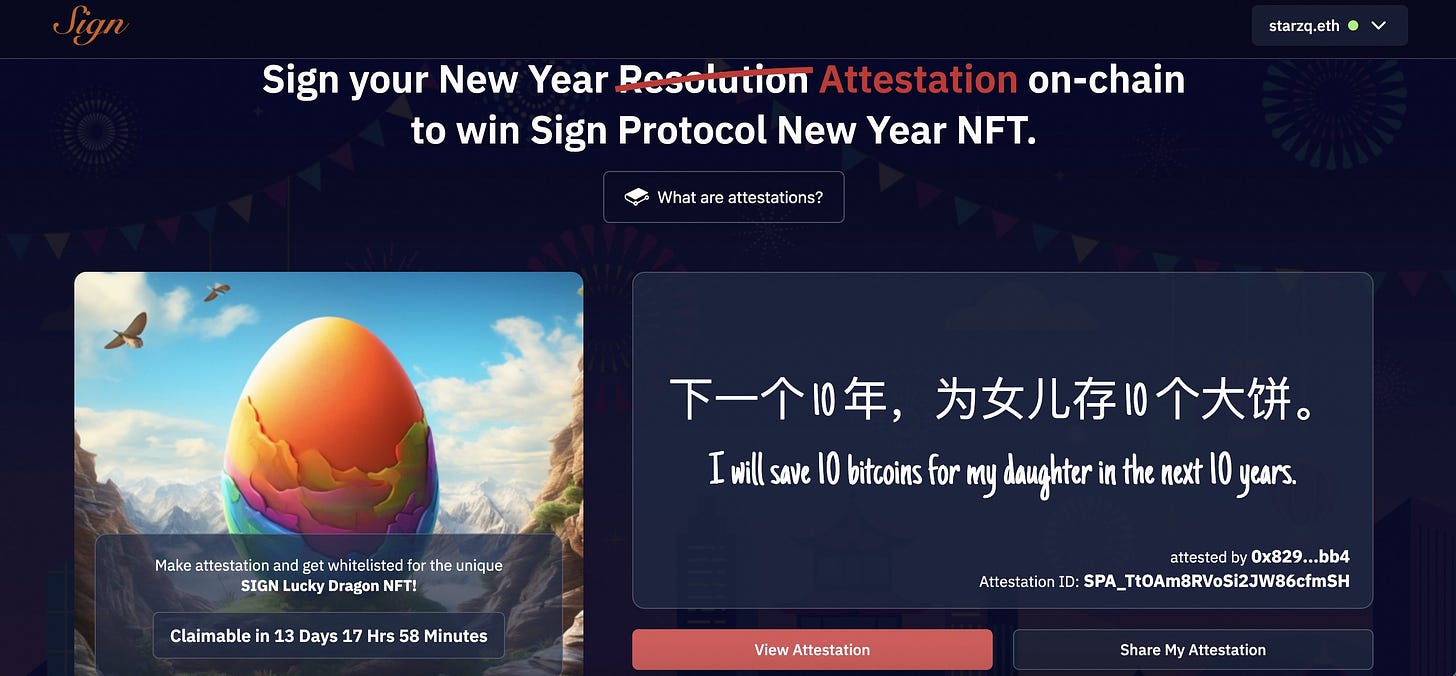
At the beginning of this month, the team launched something fun based on Sign Protocol, turning the "first sign of the new year" into an on-chain proof (Attestation), allowing participants to mint lucky dragon NFTs for a limited time and receive additional benefits in future community plans.
This is the team's first pilot based on Sign Protocol, and this activity generated 316,259 on-chain resolutions within 24 hours, indicating that people are still willing to record some interesting "proofs" on-chain.
My first sign of the new year is "to save 10 bitcoins for my daughter in the next 10 years" :)
Next, I hope to see more individuals and projects contribute various Schemas and create fun things based on Sign Protocol. I also hope that the next time I apply for a XX visa, I can complete it directly through on-chain proof (which country will be the first to support it, or perhaps a certain Network State?).
免责声明:本文章仅代表作者个人观点,不代表本平台的立场和观点。本文章仅供信息分享,不构成对任何人的任何投资建议。用户与作者之间的任何争议,与本平台无关。如网页中刊载的文章或图片涉及侵权,请提供相关的权利证明和身份证明发送邮件到support@aicoin.com,本平台相关工作人员将会进行核查。


