Original Title: "A Deep Dive into Nibiru"
Author: Adopters, CoinList
Translation: Elvin, ChainCatcher
Nibiru is a groundbreaking L1 blockchain that supports DeFi, tokenized real-world assets (RWA), and gas royalties for smart contract centrality. Coinlist recently announced that the Nibiru community sale event is scheduled for February 1, 2024, at 18:00 UTC.
In this article, Coinlist discusses with the Nibiru team the real-world problems they are solving, why they chose Cosmos as the foundation, the future of on-chain derivatives, their growth strategy, and recent gaming partnerships.
1. What is Nibiru? What problems does it solve?
Nibiru Chain is a Layer 1 blockchain and smart contract ecosystem that provides superior throughput and unparalleled security. Nibiru aims to be the most developer-friendly and user-friendly smart contract ecosystem, leading mainstream Web3 adoption through innovation at every layer of the stack: dApp development, infrastructure, consensus, comprehensive developer toolkits, and value accrual.
The on-chain crypto ecosystem suffers from fragmentation, with each application residing in its own unique ecosystem. This fragmentation is a natural result of the diverse global developer communities, bringing rapid innovation but also unnecessary complexity.
Applications and blockchains are often developed in isolation, lacking a central authority to integrate them into a larger ecosystem. This presents challenges for users and developers who want a seamless application or development journey. The key to broader adoption lies in improving the usability and scalability of these systems. Enabling a wider audience to access Web3 is crucial for the next step.
2. Why choose to build with Cosmos SDK?
Choosing Cosmos SDK to build the Nibiru chain was both a practical and strategic decision. Several core contributors to Nibiru have rich experience in projects such as Tendermint and Sommelier, or are innovators and maintainers of the Cosmos SDK itself. In addition to the team's familiarity, building with Cosmos SDK brings several advantages in terms of scalability, interoperability, and low-level flexibility, making it one of the few strong competitors to modern scaling solutions such as Ethereum Layer 2.
Strategic advantages of interchain connectivity: The SDK stands out for its modular design and support for unlimited horizontal scalability through the Inter-Blockchain Communication (IBC) protocol. These factors enable developers to build sovereign chains while defaulting to interoperability with other IBC networks in the ecosystem. This is why projects such as dYdX, Wormhole Gateway (Wormhole bridge on IBC), Composable Finance (Polkadot and Kusama on IBC), Landslide (Avalanche on IBC), Axelar, and Injective choose to build using the Cosmos stack: for the ease of use and unlocking greater emerging capabilities than the sum of their parts.
Improving development efficiency/time to market: The Base Tendermint Core provides a limit of about 10,000 TPS for a single zone/network without any enhancements or optimizations (Buchman, pages 65-70, 2016). In addition, the Cosmos SDK offers out-of-the-box features such as staking, decentralized governance, alternative token standards, and powerful abstractions to avoid dealing directly with the complexity of the consensus layer. It allows teams to focus on core differentiators and product features rather than rebuilding generic blockchain functionality from scratch.
3. There are many incredible L1s out there. What makes Nibiru more developer and user-friendly than other smart contract platforms?
Regarding developer friendliness:
- Security of Wasm VM: Smart contracts in Nibiru's main execution engine (Wasm) are not affected by the vast majority of common attack vectors, such as reentrancy, arithmetic overflow/underflow, ERC20 short address attacks, and many other attacks plaguing the Web3 space. This means highly reliable applications can be deployed and scaled faster to serve the growing cryptocurrency user base.
- Familiarity with EVM: Additionally, Nibiru Chain will offer EVM support in 2024. For developers, being able to build and deploy applications with a lower barrier to entry in a familiar EVM environment is a major advantage. They can continue to use existing tools such as Solidity, Truffle, Remix, and Metamask while enjoying the scalability, faster finality, inter-blockchain composability (IBC), and modularity improvements of Wasm smart contracts. Nibiru Chain will adopt the Ethereum protocol logic of Geth (Go-Ethereum), allowing nodes to run in both the Wasm VM and EVM execution environments simultaneously.
- Multi-language SDK: We have developed high-quality software development kits (SDKs) in various popular languages, such as Python (popular in data science and algorithmic trading), JavaScript/TypeScript (the most widely used programming language in all domains), Golang (common in Web3, especially in the Cosmos stack), and Rust (for CosmWasm smart contract developers).
- GraphQL API for simplifying data processing: The Nibiru team has developed Nibi-Indexer, a service that listens to blockchain events, messages, and transactions, storing the data in structured database tables for easier historical retrieval and search. Initially built as an internal tool, the indexer now supports an open GraphQL API. Nibi-Indexer is conceptually similar to The Graph's protocol-specific API, but it is generic and serves the entire network.
- Low-latency decentralized oracle: On the Nibiru blockchain, validator operator nodes act as oracles by achieving consensus on off-chain data and publishing votes on the network through transactions. This system ensures data integrity, as improper validator behavior or inaccurate data submission may result in imprisonment or slashing. The oracle's speed is limited only by the block completion time (just 1.4 seconds). Smart contracts also provide first-class support for querying Merkleized data from the oracle.
Regarding user friendliness:
Unified Web Application and dApp Registry: Nibiru Chain plans to launch a unified web application that integrates numerous decentralized applications (dApps) to enhance user experience. The platform will also provide a comprehensive registry to make it easier for users to discover and interact with various dApps. This initiative aims to simplify user interactions within the Nibiru ecosystem and provide a central gateway for decentralized services.
Lower Gas Fees: Compared to many other L1 platforms, Nibiru Chain prioritizes affordability by maintaining lower gas fees. This cost efficiency makes it easier for a wider range of users and developers to use it, promoting more transactions and interactions on the network without the burden of high costs.
Performance and Parallelization: Nibiru helps eliminate the trade-offs between decentralization, security, and scalability. Nibiru Chain achieves high throughput and reduces block times, significantly reducing potential network congestion. This makes transaction processing smoother and more reliable.
Another benefit of having a more scalable network that can handle more messages and transactions is that it opens the door for consumer-centric real-time applications. Nibiru Chain's enhanced throughput and parallelization capabilities make it an ideal platform for real-time consumer applications. This technological advantage opens up new possibilities for developers to create innovative, responsive applications similar to what we see in Web2.
4. On-chain derivatives trading volume lags behind spot trading volume, with DeFi exchanges accounting for only about 5% of the total trading volume. Given Nibiru's optimism for on-chain derivatives, what do you think are the main growth catalysts for this industry?
This belief largely stems from an analysis of what has been happening in the centralized exchange (CEX) environment. There has been a new trend in the digital asset space, where over time, the scale and number of DeFi products are becoming comparable to the CeFi space. This has been the case in the spot market, as the overall trading volume on Uniswap often matches or exceeds that of exchanges like Coinbase, Kraken, and Kucoin. The spot order book has been the dominant mode until Uniswap created a new model that can achieve similar capital efficiency and usability in a non-custodial manner.
In the case of Aave and Compound, a similar pattern has emerged for decentralized lending compared to centralized lending. These decentralized exchanges (DEX) were initially much smaller than their CEX counterparts but have now evolved to become the most popular digital asset lending platforms, as they can provide the same utility as Binance Loans and OKX Loans but with higher transparency and decentralization.
So, why is the usage of on-chain DeFi derivatives lower than the DeFi spot market? It's simple: in terms of execution speed, lower maker and taker fees, or liquidity locking, on-chain derivatives have not caught up with CeFi derivatives. It can be said that derivatives are still in the "spot order book" stage.
A quick look at the trading volumes on CoinMarketCap (as of January 29, 2024) shows that the top 5 CEX in the derivatives category are Binance, Bybit, OKX, Bitget, and Kucoin.

The trading volume of derivatives on all these exchanges is significantly higher than the spot trading volume: Binance's difference is over 3 times, Bybit's difference is over 4 times, OKX's difference is over 9 times, and so on. If you compare the same data almost any day, you will see a similar pattern, where the derivatives usage is higher than the spot usage. Or at least, that has been the case for the past few years.
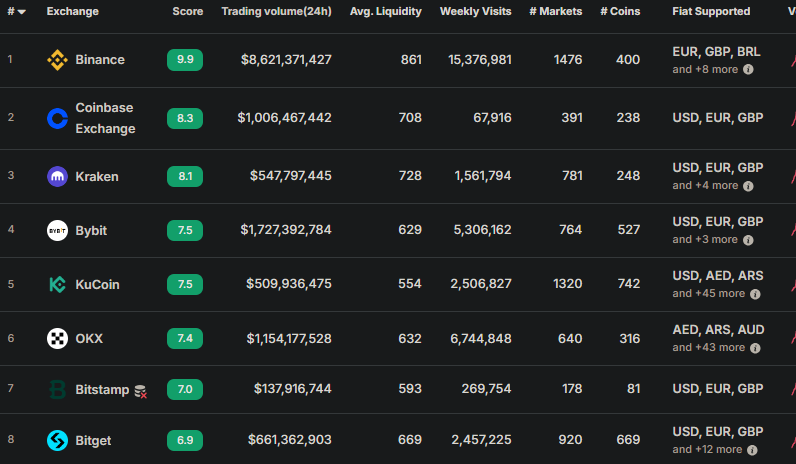
Some top players in the DeFi derivatives space include dYdX (Ethereum L2 + dYdX Chain), Hyperliquid (Arbitrum), GMX (Arbitrum, Avalanche), ApolloX (BSC), and Drift Protocol (Solana). These protocols have different trade-offs in terms of capital efficiency, maker and taker fees, front-running risk, available liquidity, and execution speed. However, they all lag behind what Binance, Bybit, OKX, and others offer in terms of futures. Purely from a trading experience and technical capability perspective, decentralized derivatives are built in a purely smart contract-driven manner, which makes them lower than centralized products in terms of complexity and difficulty.
That being said, the derivatives space is highly competitive and continuously evolving and innovating. One of these decentralized players could still become the "Uniswap of DeFi derivatives," and if this hypothetical exchange mimics the patterns of spot and lending, it should reflect the model of centralized exchanges and surpass spot trading volumes by multiples. This is the key reason why the Nibiru team is optimistic about derivatives.
CeFi derivatives excel in (1) available liquidity, (2) lower trading fees, and (3) order matching and trade execution speed, while DeFi derivatives excel in the following areas:
- Transparency: The collapse of centralized exchanges and platforms like Celsius, Voyager, and FTX has highlighted the inherent risks and lack of transparency in centralized systems. While web3 has potential, there is an urgent need for higher transparency and accountability. Practices like "B-Books" in traditional finance, where brokerage firms act as counterparties, have raised concerns about market manipulation. In contrast, on-chain derivatives provide inherent transparency, promoting fairness in the market.
- Composability/Interoperability: The advantage of on-chain derivatives is the ability to seamlessly integrate with other DeFi products on shared blockchain infrastructure. This enables direct interaction without the need for intermediaries, fostering innovative solutions such as derivative contracts supporting loans, clever use of NFTs for trading-related metadata, or creating entirely new asset classes.
User experience, especially considering the complexity of derivative trading, has been a barrier, keeping the field primarily in the hands of advanced users. Nibiru aims to provide the features needed to bridge this gap, offering the flexibility, usability, and capital efficiency of large centralized exchanges while avoiding the drawbacks of off-chain settlement, full custodial fund custody, or designated market advantages for makers.
5. You recently announced several notable gaming partnerships. How do you view Nibiru's entry into the Web3 gaming space?
The gaming industry has over 3 billion players globally, attracting a diverse population and age range. Web3 enables players to truly own in-game assets and achieve cross-game compatibility. This allows players to own, trade, and sell in-game assets, elevating interaction to a new level and increasing engagement and retention. Traditional Web2 games are flooding into blockchain, and Web3 gaming represents one of the largest vertical industries that has achieved market fit.
It's not just the Nibiru community that sees gaming as a primary pastime. Nibiru not only sees gaming as a core vertical but also provides the toolkit solutions needed to achieve this goal. Game developers choose Nibiru because it can handle 40,000 transactions per second (TPS) and has instant finality.
Game studios and developers can leverage Nibiru Chain's technical stack to:
- Tokenization: In-game assets are tokenized as NFTs for ownership and trading.
- Security: Players can securely access the in-game economy using CosmWasm smart contracts, all verified and proven on Nibiru's blockchain.
- Performance: Provides high transaction throughput and low latency, crucial for a smooth gaming experience.
- Interoperability: In-game assets can serve multiple purposes and use cases; provides a powerful and user-friendly toolkit for developers.
- Royalties: Asset creators can earn rewards and fees each time their creation is traded.
Nibiru has partnered with the Blockchain Gaming Alliance, which will enable Nibiru and its ecosystem partners to further penetrate a wider gaming community.
The games announced by Nibiru currently include mobile role-playing games and prize savings games. These types have the potential to attract a large initial user base through exciting, user-friendly, and familiar gaming experiences. Building on this, Nibiru plans to expand into other verticals, including full-chain games, card games, strategy games, puzzle games, racing games, and more.
6. What mechanisms are in place to ensure the protocol's sustainable growth and decentralization?
A) Foundation Delegation Program
Validators are crucial for maintaining the network's health, performance, and security. Recognizing this, Nibiru Chain has implemented a delegation program aimed at allocating the foundation's tokens to a selected group of active validators who have made significant contributions to the ecosystem.
The program is guided by three main objectives:
- 1. Recognition and Incentives: Aimed at recognizing and rewarding validators actively enhancing the ecosystem. This recognition serves as motivation to continue participation and make greater contributions.
- 2. Enhancing Decentralization and Accessibility: The program aims to provide a fair competitive environment for smaller independent validators. By facilitating their access to voting rights and commission income, it reduces the need for large initial capital, thus increasing decentralization.
- 3. Promoting Equity Distribution: A key focus of the program is to ensure diversified and balanced distribution of stakes. This is achieved through delegation to various validator types, geographical locations, and service providers, mitigating the risk of any single validator accumulating excessive control over the network due to disproportionate voting power.
B) Nibiru Chain Grants Program
To encourage external development, Nibiru offers a grants program to provide financial support, guidance, and other resources to developers committed to enhancing the Nibiru ecosystem. It encourages interested community members to develop resources that make building on Nibiru easier and applications in a wide range of Web3 domains, such as DeFi, gaming, payments, real-world assets (RWA), NFTs, and more.
For more information: [Request for Proposals (RFP) ] [ Nibiru Grants]
C) On-Chain Governance
Nibiru Chain is a community-driven decentralized blockchain utilizing the Tendermint consensus algorithm for proof-of-stake. Within this framework, the NIBI token serves a dual purpose: for paying gas fees and for securing the network. This security is crucial for the generation of new blocks and validation of on-chain transactions.
During the staking process, users lock their NIBI tokens as a form of bonded capital. This action is essential for participating in the network's consensus mechanism, allowing stakeholders to add new blocks to the chain. As a reward for their contributions, stakers receive a proportional return based on the amount of tokens they have staked.
A key aspect of this mechanism is the concept of "slashing." If a validator operator acts maliciously or attempts to disrupt the network, they face the risk of losing their staked tokens as a form of penalty. This slashing serves as a powerful deterrent, preventing validators from engaging in dishonest or harmful activities.
In addition to protecting the network and block production, staking NIBI tokens also empowers users to participate in decentralized governance. This on-chain governance process allows members of the Nibiru ecosystem to collectively make decisions and influence protocol changes. They do so by voting on various "proposals," with their voting power directly proportional to the amount of NIBI they have staked. This mechanism ensures that those with a stake in the network have a voice in its development.
免责声明:本文章仅代表作者个人观点,不代表本平台的立场和观点。本文章仅供信息分享,不构成对任何人的任何投资建议。用户与作者之间的任何争议,与本平台无关。如网页中刊载的文章或图片涉及侵权,请提供相关的权利证明和身份证明发送邮件到support@aicoin.com,本平台相关工作人员将会进行核查。


