This article delves into multiple topics such as the attention value theory, the rise of NFT collector social networks, and the role of stablecoins in remittances in emerging markets.
Authored by: Multicoin Capital
Translated by: TechFlow
Multicoin Capital summarized their expectations and outlook for the upcoming year. This article publicly presents their thoughts for the first time, covering various areas from cryptocurrencies to social networks.
The article delves into multiple topics such as the attention value theory, the rise of NFT collector social networks, and the role of stablecoins in remittances in emerging markets. Additionally, it discusses how cryptocurrencies are transitioning from being products to driving forces for products, as well as the expected growth of on-chain data and new token distribution forms.
These contents not only showcase the latest developments in cryptocurrencies and blockchain technology but also foreshadow new trends and opportunities that may arise in 2024.
Attention Value Theory
Shayon Sengupta (Investment Partner at Multicoin Capital) focuses on the attention value theory.
Exchanges are used to easily price tradable items such as stocks, commodities, and interest rates. There are standard methods to measure these assets (e.g., discounted cash flow function for stocks, the border price of a barrel of oil, willingness to pay $1.05 in the future). This is the significance of price discovery for liquid markets.
However, there is a class of goods where price discovery revolves entirely around attention. Sneakers, art, sports collectibles, vintage furniture—these inherently illiquid items derive their value entirely from social consensus rather than a discounted cash flow model (a valuation model).
In recent years, especially due to the internet, the attention value theory has permeated traditional markets. TSLA, GME, AMC, DOGE, and CryptoKitties have all experienced meaningful price discovery under this model. The primary pricing mechanism for these assets used to be cash flow and settlement prices, but now the main mechanism comes from the attention they receive.
Cryptocurrencies play two important roles in the attention value theory: the ability to rapidly create new assets and the ability to trade new assets.
If attention is the core pricing factor, then cryptocurrencies can issue and trade assets that track attention. The financialization of attention "requires two of the most important attributes of cryptocurrencies to achieve its natural end state: permissionlessness and composability.
Permissionlessness: Anyone can issue any type of asset
Composability: Anyone can trade these assets anywhere
This experimental design space:
Increases the surface area for new asset issuance (e.g., creator tokens in history, prediction market LP positions, meme coins)
Embeds issuance and trading into new venues (e.g., historical communication bots like bonkbot or Bananagun, leaderboards like friend.tech, in-game markets)
Facilitates coordination among asset holders (e.g., historically, collectively funding the purchase of a copy of the constitution)
The near-term implication of this trend is that the next major exchange will not look like an exchange. It will look like a live platform where creators and viewers can bet together, or a group chat where friends and communities can instantly crowdfund, raising millions of dollars to build a network, or a forum like Stack Exchange where top contributors' contributions can earn not only platform-specific rewards but also material economic returns.
In 2024, we will see entrepreneurs experimenting along these three patterns. We will see the emergence of the first "non-exchange" exchange, applicable to both liquid and illiquid assets. These exchanges will climb the rankings in terms of trading volume and take the place of Wall Street Bets.
NFT Collector Social Networks
Vishal Kankani (Investment Partner at Multicoin Capital) focuses on NFT collector social networks.
In 2024, I am excited about collectible NFTs, more people participating in collecting, and the social experience of collectors.
Collecting has a long history, from ancient Egyptian and Chinese rulers amassing unique treasures to the Cabinets of curiosities in Renaissance Europe. Museums actually evolved from these private collections.
From a psychological perspective, aside from speculative opportunities, collecting serves as a means of self-expression. In certain circles, collectibles have become symbols of status, intertwining the act of collecting with personal identity, signifying commitment and expertise. The internet has amplified this behavior, connecting previously isolated enthusiasts and fostering a new sense of belonging within their respective tribes.
Despite this progress, collectors still face some obstacles:
Fraud related to authenticity and provenance
Trading and fungibility
Security, damage, and loss
Space and storage issues
Blockchain fundamentally breaks down these barriers and attracts more people to participate in collecting. Blockchain particularly appeals to the younger generation already passionate about collecting digital items, such as Pokemon Go, virtual sneakers, and in-game skins. These collectibles are the precursors to digital native collectibles existing on public blockchains.
Even as digital collectibles transition from private databases to public blockchains, certain behaviors of collectors will remain unchanged: the desire to show off their collections, easily exchange collectibles, and connect and interact with their tribes. These behaviors will lay the foundation for the rise of social experiences based on ownership graphs.
Stablecoin-Driven Remittances in Emerging Markets
Spencer Applebaum (Investment Partner at Multicoin Capital) focuses on stablecoin-driven remittances in emerging markets.
After interning at Bitspark, I became fascinated by cryptocurrencies. Bitspark was one of the earliest companies to use BTC as a remittance channel, primarily in Southeast Asia and Africa. Cryptocurrency-driven cross-border payments are one of the most exciting use cases I have discovered since finding cryptocurrencies.
In some low-income countries, the remittance industry is one of the biggest drivers of GDP and a way for many economies to sustain themselves:
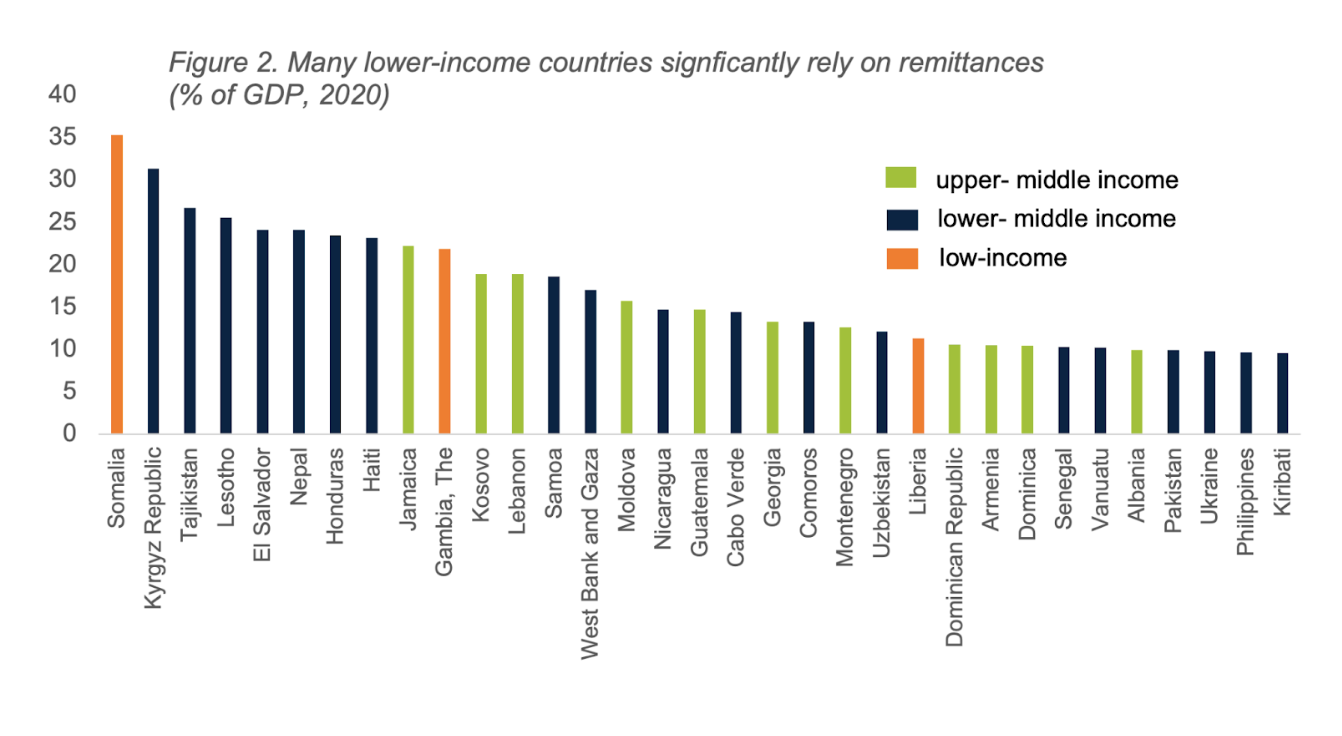
Based on World Bank development indicators
Historically, the challenges of remittances have been high costs and the fact that only a few fiat currencies (such as USD, EUR, JPY, GBP) can be exchanged and traded outside their issuing countries, making many remittance channels slow and difficult to use. According to World Bank data, the average cost of remittances is about 6.2%, but for those using uncommon remittance channels, this proportion significantly increases. For example, the cost of remitting from South Africa to China exceeds 25%.
In this context, I am excited about the emergence of two products in 2024:
Consumer-oriented remittance applications
Opportunities for B2B SaaS companies targeting physical remittance operators (MTOs), especially those using stablecoins in traditionally hard-to-enter or costly remittance channels.
The operation process of these products is:
Exchange local currency for USDC/USDT through local payment methods in a P2P manner (e.g., oRamp or El Dorado)
Send USDC to another country
Either hold USDC or exchange it for local currency through familiar domestic payment methods with another broker or liquidity provider
Over the past 12 years, digital payments have had a profound impact on global remittances:
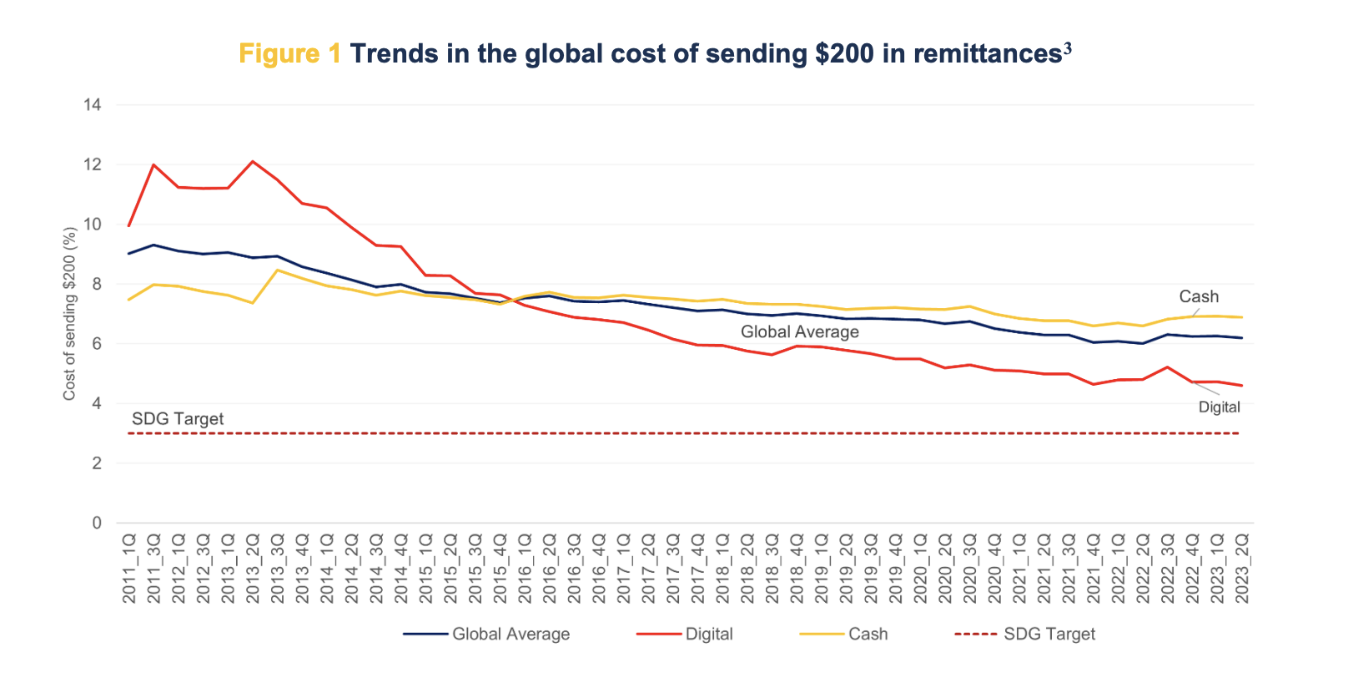
World Bank Global Remittance Prices Quarterly Report
Stablecoins will accelerate this trend and further reduce the cost of remittances. With the rapid adoption of stablecoins in 2023, 2024 will be a year of rapid development for stablecoin remittances.
Cryptocurrencies Transitioning from Products to Driving Forces for Products
Matt Shapiro (Partner at Multicoin Capital) believes that in 2024, cryptocurrencies will transition from being products to driving other products.
By 2024, we will see cryptocurrencies transitioning from being products to driving other products. This trend has already emerged, and I believe new developments are on the horizon.
Last year, cryptocurrencies incubated new markets that were either impossible to achieve or highly inefficient historically. Hivemapper created a brand new map, with viewing frequencies 24 to 100 times higher than Google Street View, and mapped nearly 10% of the Earth's surface in less than a year, using cryptographic mechanisms to incentivize permissionless contributions in a scalable manner. During the global GPU shortage, Render Network created a new GPU supply market, an area we believe will continue to face supply-demand imbalances in the coming years. Helium Mobile is attempting to fundamentally change the cost structure of the telecommunications industry by leveraging user-owned infrastructure and devices supported by cryptographic technology.
Nubank, one of the largest new banks with over 80 million customers, is actively entering the cryptocurrency space by introducing Nucoin as a loyalty reward. Starbucks is also actively entering the cryptocurrency space through its Odyssey program. Blackbird is using cryptocurrency as an entry point into the restaurant industry (which could pioneer a powerful payment business, bringing additional profits to restaurants).
BAXUS is using cryptocurrency to build a market for trading and investing in whiskey and other high-end spirits, opening the market to a new group of participants. oRamp is using cryptocurrency to build a new market for local and regional foreign exchange, reducing spreads and lowering costs for customers.
While these examples are diverse, they share a common core: they all use cryptographic technology to drive products, resulting in meaningful economic outcomes. In some cases, such as Starbucks, Nucoin, and Blackbird, cryptocurrencies are mostly hidden behind the scenes. In other cases, such as Hivemapper and Render, cryptocurrencies are closely integrated with the product, highly visible, and a key part of the product itself. The infrastructure built over the past 5 years paves the way for cryptographic technology to power everyday use cases. By 2024, attempts in this field will erupt.
On-Chain Data
Eli Qian of Multicoin Capital is more focused on on-chain data.
By 2024, he expects the volume of on-chain data to grow by several orders of magnitude. With the addition of new users, use cases and functionalities of decentralized applications (dApps) and protocols will also grow. Data from decentralized social protocols will be particularly rich—people do more on social products and generate more data compared to financial products.
How will we handle such explosive data? Historically, people have viewed on-chain data through the lens of advertising and personalization. However, I am eager to see teams take a more first-principles approach and recognize that placing on-chain data in context when building social products is not only a luxury but a necessity.
Currently, our on-chain social data and identities are built on a unified graph (e.g., Farcaster), making it difficult to build social products for different social environments. People are multifaceted, living in various social contexts. Our behavior and demands vary depending on the specific context. We access Facebook, Twitter, LinkedIn, and Snapchat for different reasons, and the social graph creates specific environments and experiences on each platform.
The launch of Threads provides a case study. Threads did not replace Twitter for many reasons, but one of them is the uncertainty of the social environment. Threads' social graph was imported from Instagram (a social network primarily related to real-life relationships). However, the user interaction in Threads comes from Twitter, an online-first, often anonymous social environment. Due to the mismatch between the product and the environment, Threads users were unsure how to act.
By 2024, the edges and nodes of the social graph will be sliced and categorized into more specific and relevant environments. There are already some in-protocol solutions (such as channels on Farcaster), but I expect that off-protocol solutions will emerge as developers begin to demand data that is more relevant to the products and social experiences they want to build. I am looking forward to the emergence of the next wave of data infrastructure and developer tooling to support the new generation of social applications.
New Token Distribution Methods
Tushar Jain (Managing Partner at Multicoin Capital) focuses on new token distribution methods.
Every cryptocurrency bull market is initiated by a new token distribution method. Examples include:
PoW chain diffusion — 2013/2014
ICO — 2017
IEO — 2019
Liquidity mining — 2020
NFT minting — 2021
In the recent bear market, two new token distribution mechanisms have emerged, which could become the fuel for igniting a new bull market:
DePIN — rewarding tokens to those who help build productive capital assets (e.g., Helium, Hivemapper, Render)
Points — incentivizing people to use products before all token mechanisms are determined. Issuing tokens is a heavy lift, and once a token is live, changing its economic model becomes more difficult. Points have no units, no maximum supply, and lower regulatory risk due to their non-transferability.
New token distribution methods are a powerful way to onboard new users into the cryptographic ecosystem. I believe the next wave of users will come from those who acquire, rather than purchase, cryptographic assets. DePIN and Points both provide novel ways for new users who have never owned a cryptographic wallet to acquire cryptographic assets.
UI Layer Composability and Client-Side Zero-Knowledge Proofs
Kyle Samani (Managing Partner at Multicoin Capital) focuses on UI layer composability and client-side zero-knowledge proofs.
UI Layer Composability
In my speech at the 2021 Multicoin Summit, I explored the concept of composability. At the time, I was more focused on on-chain atomic composability. However, over the past few years, I have started to devalue on-chain atomic composability (hence I changed my name from "Composability Kyle" to "Integrated Kyle"). Recently, I have become more interested in permissionless UI layer composability. In 2023, we witnessed the first major breakthrough in UI layer composability: Unibot. Unibot is an on-chain terminal and DEX bot on Telegram. Previously, people would typically gather information somewhere on the internet (X, Reddit, news, Bloomberg, Telegram chats, etc.) and then navigate to an independent UI to trade (e.g., Drift, Binance, Coinbase, etc.). Unibot brings trading to Telegram, a place where people are already socializing and exchanging information.
By 2024, there is a huge opportunity to bring trading activity into many environments on the network, in addition to Telegram group chats.
Building on this idea, I hope to see more UI layer composability, not only for capital accounts but also for social products, especially Farcaster. Farcaster's vision is bold: a single event subscription source, with each event signed by a person and countless user interfaces to read and write to that event source.
We often discuss X as if it provides a unique product experience for different use cases: Crypto Twitter, Finance Twitter, Sports Twitter, Political Twitter, and so on. Building a Farcaster client from first principles that can achieve this vision is a real opportunity. In 2024, this design space will be open to the public.
Client-Side Zero-Knowledge Proofs
In recent years, discussions about zero-knowledge (zk) have mostly focused on using zk rollups and zk processors to scale asset ledgers. However, I believe the most interesting design space for zk is in client-side privacy. I recently learned about two client-side zk configurations that I find very appealing:
Zk.me, as the name suggests, is a system for generating zk proofs about oneself, especially in the context of KYC and AML compliance. Without stricter on-chain KYC, I find it hard to imagine DeFi growing another 10x. In this assumption, I would prefer users not to disclose their data, and zk proofs will be key to achieving this vision.
Brave Boomerang, traditionally, ad trading runs on centralized servers. Whether it's Google, Facebook, or other online ad trading platforms. Brave is disrupting the ad trading model. Users run ad trading on their local devices and submit proofs of their correct ad trading to the blockchain. This model ensures no personal identity information is leaked while still providing advertisers with the precise targeting they seek (zk proofs can ensure that Honda's ads are shown to 16-year-olds rather than 6-year-old children).
As these two examples show, the biggest opportunity to reshape internet trust and establish new business models using zk lies in the client-side.
免责声明:本文章仅代表作者个人观点,不代表本平台的立场和观点。本文章仅供信息分享,不构成对任何人的任何投资建议。用户与作者之间的任何争议,与本平台无关。如网页中刊载的文章或图片涉及侵权,请提供相关的权利证明和身份证明发送邮件到support@aicoin.com,本平台相关工作人员将会进行核查。


