Author: Peng SUN, Foresight News
In the past two days, at the request of the U.S. Securities and Exchange Commission (SEC), issuers such as BlackRock, ARK 21Shares, VanEck, Fidelity, Grayscale, and Franklin Templeton have successively submitted final amended ETF application documents. Particularly noteworthy is that issuers are competing to lower ETF fees, with some institutions even proposing exemption policies such as a 0% fee for the first 6 months.
At the same time, SEC Chairman Gary Gensler has twice tweeted to remind about the risks of investing in crypto assets. In terms of market trends, since 00:00 on January 9th, Bitcoin has successively broken through $45,000, $46,000, and $47,000. Currently, the price of Bitcoin has remained around $46,842.
Various signs such as the fee reduction trend among institutions, the mixed messages from SEC Chairman, and the rise in Bitcoin prices indicate that the compliant Bitcoin spot ETF seems to be imminent. In this tense moment of tug-of-war between long and short positions, the "Fees War" of ETF rates is astonishing. So, what is this fee, and what is the purpose of institutions competing on fees? How does the fee level of Bitcoin spot ETF compare to traditional ETFs? Behind the low fees, is it really profitable for investors?
I. What is the Sponsor Fee?
In the Bitcoin spot ETF, the Sponsor Fee first appeared in public on November 20, 2023, when ARK Invest added the Sponsor Fee rate to its Bitcoin spot ETF application document, with an initial rate of 0.8%.
The Sponsor Fee is related to the fund's sponsor. The sponsor is responsible for managing and controlling the fund, marketing the fund, and the Sponsor Fee is used to pay for the costs of managing the ETF, including custody costs, management personnel salaries, securities trading costs, legal expenses, etc.
II. Fee War, the General Trend
From January 8th to 9th, 11 institutional issuers applying for Bitcoin spot ETFs continued to lower their fees in the final amended documents, sparking a "fee reduction trend" in the Bitcoin ETF market. As of January 10th, the latest fees for each institution are as follows (arranged in descending order of fees):
- Grayscale: 1.5%
- Hashdex: 0.9%
- Valkyrie: 0.49%
- Franklin Templeton: 0.29%
- Fidelity: 0.25%
- VanEck: 0.25%
- BlackRock: 0.2% for the first 12 months, then increased to 0.3% after 12 months or AUM reaches $5 billion
- Galaxy Invesco: 0 for the first 6 months, then increased to 0.39% after 6 months or AUM reaches $5 billion
- Wisdomtree: 0 for the first 6 months, then increased to 0.3% after 6 months or AUM reaches $1 billion
- Ark/21Shares: 0 for the first 6 months, then increased to 0.25% after 6 months or AUM reaches $1 billion
- Bitwise: 0 for the first 6 months, then increased to 0.2% after 6 months or AUM reaches $1 billion
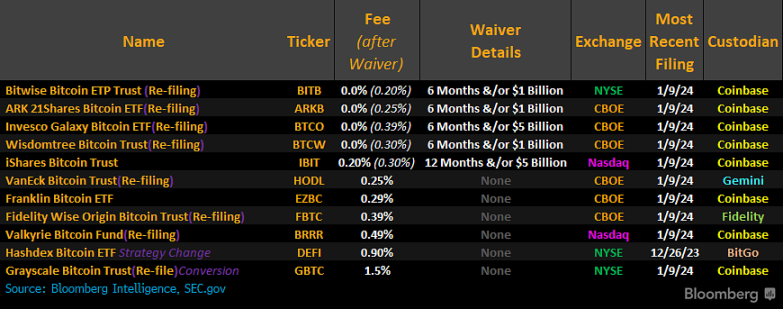
Image source: James Seyffart
Among the 11 institutions, after exemptions, 8 have fees lower than 0.4%, and the average fee for all institutions after exemptions is 0.478%.
In fact, since 1997, the reduction of global ETF fees (both active and passive) has been an irreversible trend. For example, the fees of well-known U.S. fee-cutting kings such as Vanguard, Schwab, and BlackRock's iShares ETFs are even as low as around 0.03%. In addition, according to observations by the Investment Company Institute (ICI), one of the major associations of regulated funds in the United States, the fees for various types of ETFs such as stock ETFs, bond ETFs, and mutual funds have mostly decreased by more than 50% over the past 26 years, with many lower than 0.1%. According to research data from Huobi Research in 2021, the average cost of U.S. ETFs (including management fees) is about 0.44%. Therefore, it can be seen that U.S. issuers are at the average level in terms of fee reduction for Bitcoin spot ETFs, which is due to the U.S. ETF environment.
However, compared with other countries/regions in the world, the fees in the U.S. are significantly lower. For example, the fee for Canadian Bitcoin ETFs represented by BTCC is 1%, and the average fee for the 10 largest Bitcoin ETP/ETN in Europe is 1.047%.
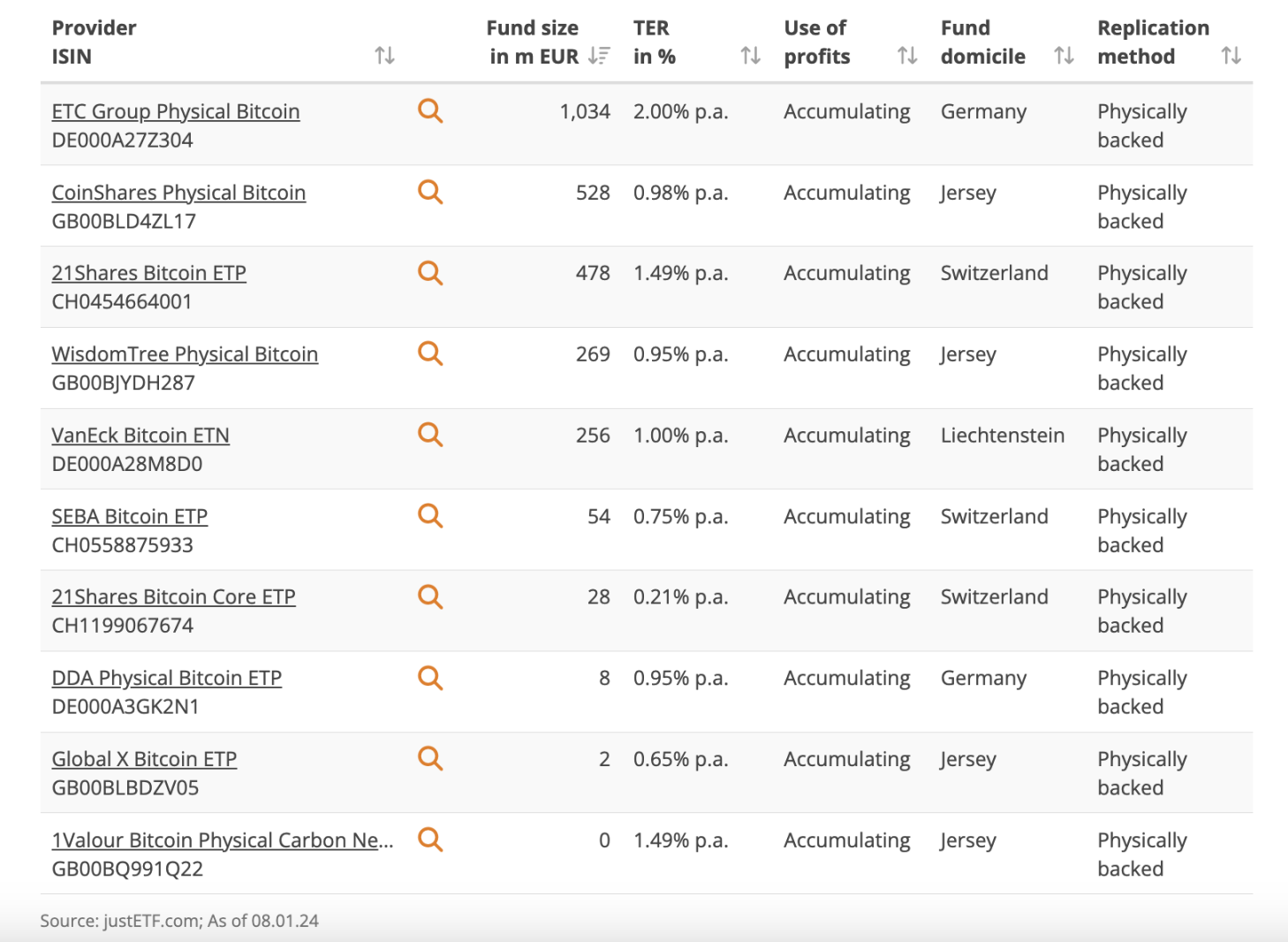
Considering that the user and fund size in Canada and Europe are not comparable to those in the U.S., and under the same circumstances, U.S. users prefer ETFs and tend to favor low-cost ETF products, it is not difficult to understand the fee competition among U.S. institutional issuers for Bitcoin ETFs. After all, as the world's largest ETF market, the United States is on the path of fee reduction under homogenized competition, and Bitcoin is no exception.
III. Fee Reduction Trend, Is Cheap Really Profitable?
Fee reduction is to attract more users, funds, and market share, but is a low fee always cheap?
"How can we make money by managing the fund when the fee is lower than the cost?" This is the question raised by Caitlin Long, Founder and CEO of Custodia Bank, regarding the fee reduction trend for Bitcoin spot ETFs.
Ben Johnson, Global ETF Director at Morningstar, also stated, "There is no free lunch in the world. If you get something for free, you are likely to subsidize it by paying for other things." Generally, zero-fee ETFs make money by lending stocks to customers, selling other products, or providing lower interest rates on money market funds. But will Bitcoin spot ETFs face such problems? What methods will issuers use to earn back that part of the revenue? It is unknown.
Low fees have also raised concerns from Gabor Gurbacs, Strategic Advisor at Tether and VanEck: "I am very afraid when I earn very little or even nothing. Issuers will look for other ways to make money (securities lending, trading, etc.). I personally prefer to charge higher fees in advance and provide clear and sustainable incentives. If possible, thoroughly study the total holding cost. But the ETF fee war is not like this. People like to see low numbers."
Of course, all concerns seem powerless in the face of ETF breakthroughs, as we are witnessing history. Each ETF approved in the U.S. has brought a trillion-dollar blue ocean market, and the market value of Bitcoin has now reached $800 billion, returning to a trillion-dollar market value, providing more users with diversified investment choices beyond U.S. bonds, which is more exciting than anything else.
References:
Guosheng Securities: "What will Bitcoin spot ETF bring?", January 2, 2024;
Gaurav Roy, Bitcoin Spot Vs Futures ETFs: What’s the Difference?, Jan 4, 2024.
Deng Xingcheng, Li Yan, Ge Hui: "Global ETF Development Trends and Future Directions", Shenzhen Stock Exchange, 2009;
Charles Yu, Sizing the Market for a Bitcoin ETF, Galaxy Digital, Oct. 24, 2023.
Keris Lahiff, Why zero-fee ETFs are not risk free, March 9, 2019.
免责声明:本文章仅代表作者个人观点,不代表本平台的立场和观点。本文章仅供信息分享,不构成对任何人的任何投资建议。用户与作者之间的任何争议,与本平台无关。如网页中刊载的文章或图片涉及侵权,请提供相关的权利证明和身份证明发送邮件到support@aicoin.com,本平台相关工作人员将会进行核查。


