Discovering Great Projects: From Zealy to DeGame, Taking Stock of Web3 Game Data Websites.
By DeMan
At the edge of the digital age, the gaming world is not only a haven for fantasy and entertainment, but also a bridge for human emotions and memories. "Cyberpunk 2077" - a game that intertwines the future with reality, witnessed a touching story between a mother and her lost son. This mother, inheriting her son's aspirations, crossed the unfamiliarity of the unknown world and delved deep into the virtual abyss of the game. In this universe constructed by code, she unexpectedly discovered her son's "cyber incarnation," a free spirit no longer bound by the afflictions of the real world.
Her story began with an unexpected change in a 3D printing model shop. Originally just an ordinary shop owner, this mother took over her son's store after his passing. She not only learned the skills of model making, but more importantly, she gradually understood and approached her son's spiritual world. "Cyberpunk 2077" is not only a continuation of her emotional bond with her son, but also a window for her to communicate with this world.
The charm of the game lies in its ability to transcend the limitations of time and space, allowing lost loved ones to be reborn in the virtual world. In this world constructed by code and creativity, every corner is full of possibilities, and every interaction is a cherish of life. This is the true charm of the game - it is not just a tool to escape reality, but also a bridge that connects souls and continues stories.
Just as the Web3 field is full of infinite possibilities, what kind of spark will be ignited when games meet the more creative Web3? This intersection not only heralds the fusion of technology and art, but also symbolizes the combination of personal emotions and global connectivity. Let us explore the popularity of Web3 games globally and reveal the power and potential behind this trend using the following data.
Record-breaking funding but high startup failure rates, is Web3 gaming entering a development bottleneck?
Since 2018, the Web3 gaming industry has experienced a capital storm, with a total investment amounting to a staggering $190 billion. This field reached its investment peak in 2021, but is gradually stabilizing by 2023. Notably, in 2023 alone, the total financing related to blockchain games has reached $150 billion, with $8 billion focused on Web3 game development. The United States, France, Canada, Singapore, and Hong Kong, China have become the centers of this capital frenzy.
However, under this wave of capital frenzy, the success and failure records of Web3 games are quite complex. From 2018 to 2023, a total of 2817 Web3 games have been launched, of which 2127 (accounting for 75.5%) have failed. Up to now in 2023, the number of newly launched Web3 games is 223, showing a significant decline compared to 640 in 2022 and 811 in 2021. According to CoinGecko's report, the average annual failure rate of Web3 games over these five years is as high as 80.8%, highlighting the challenges these games face on blockchain platforms.
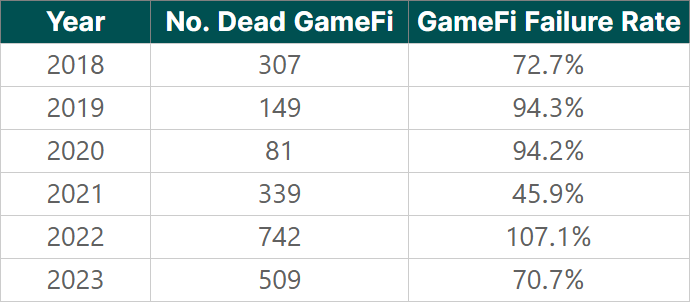
CoinGecko Data: Web3 game failure rate reaches 75.5% in the past 5 years
Of particular note is that after the success of CryptoKitties in 2017, 422 new games emerged in 2018, of which 307 failed. The report also points out that the bear market in 2019-2020 severely hindered the development of GameFi, leading to a surge in the failure rate to 94.3% in 2019. In 2021, with the hot cryptocurrency market, the failure rate of Web3 games dropped to 45.9%, but this trend did not continue into 2022, when the number of game failures reached a record 742 times, and the failure rate soared to 107.1%. In 2023, although the end of the year has not yet arrived, 509 games have already been declared failures, and the current failure rate is stable at 70.7%.
These data reveal the dual nature of the Web3 gaming industry: on one hand, the influx of massive funds proves its enormous potential; on the other hand, the high failure rate exposes its vulnerability. Although the Play to Earn model in the Web3 field is attractive, achieving success among players still requires high-quality gaming experiences. Therefore, for players, finding immersive Web3 games remains a challenge. In this market full of variables, the confrontation between the investment of hundreds of millions of dollars and the high failure rate demonstrates the complexity and challenges of the Web3 gaming industry.
Success experiences of TapTap and Steam are worth learning and replicating for Web3 game developers
In the Web3 gaming field, while the rapid development trend brings new hope and choices for players, such rapid growth is also accompanied by information overload and decision difficulties. This explosive growth of information is like placing players in a maze shrouded in fog, making it difficult for them to find those truly worthwhile games to invest their time in. In this vast digital ocean, the signal of high-quality games is drowned out by endless noise, making the player's selection process exceptionally difficult.
Addressing this issue, it is particularly important to draw on the mature game platform models of the Web2 era. For example, the mobile game platform TapTap and the PC game platform Steam are exemplary in the industry with mature systems and high user satisfaction.
TapTap, founded in 2016, is dedicated to creating a high-quality mobile game sharing community app. Its mission is to "help every player discover great games and help every great game find players who love it." TapTap quickly rose in the game distribution market with its unique business model of "no operation and no revenue sharing," becoming a game exchange and sharing community in the minds of young people. In 2022, the platform had over 573 million active users, with an annual download volume of 801 million, a 32.33% year-on-year increase, and over 1.18 billion game reservations.
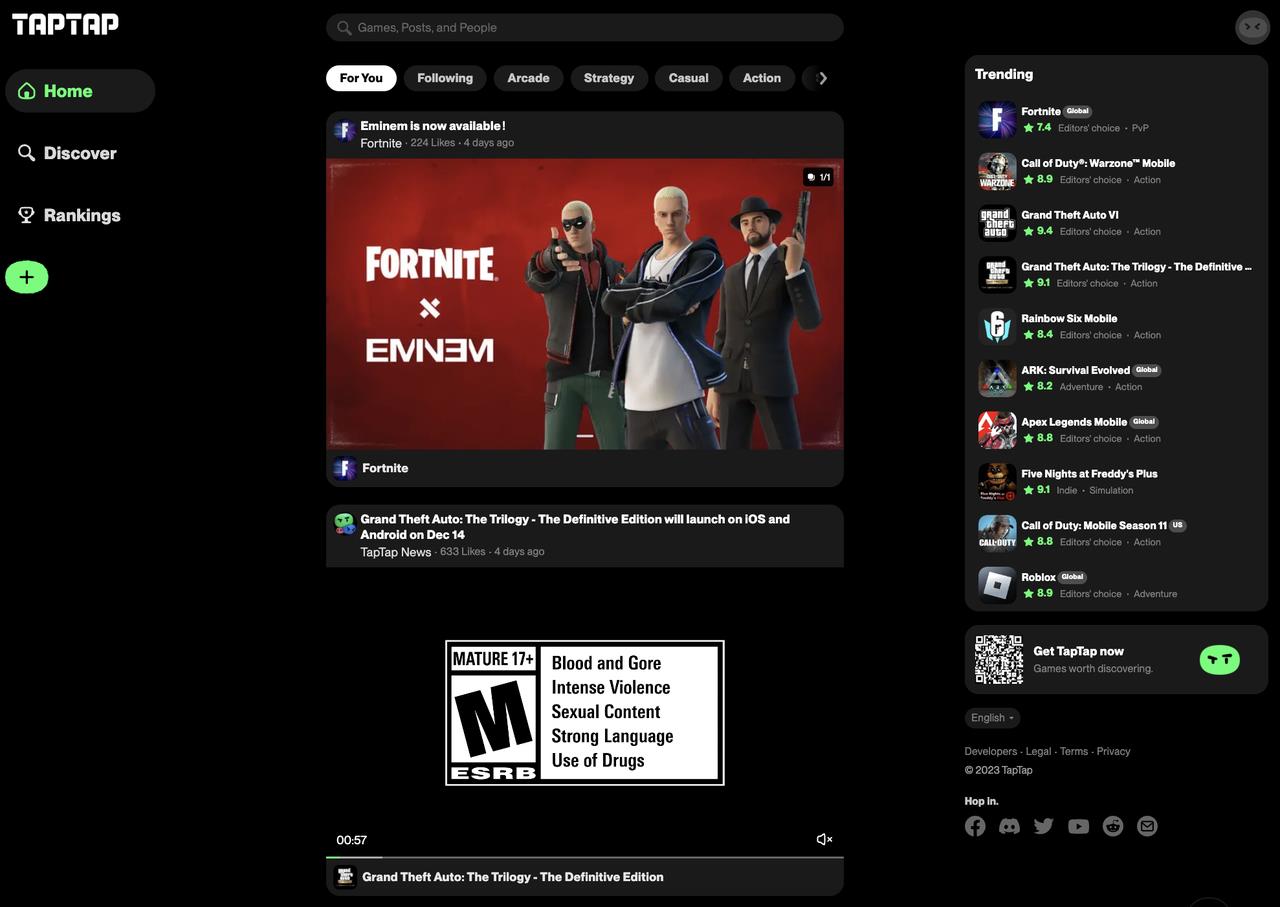
TapTap International Product Page Image
Steam, a comprehensive game trading platform operated by Valve Corporation, provides a space for players to purchase, evaluate, and communicate about digital games. Its greatest advantage lies in providing genuine player reviews and the Steam Workshop, which expands the playability of games, allowing players to download or create their own game mods. In 2021, Steam had 132 million monthly active players, 69 million daily active players, a peak concurrent player count of 27.4 million, and players spent 38 billion hours playing on the platform, a 21% increase from 2020.
Steam Background Poster
The success of these two platforms demonstrates that prioritizing user experience is the key to attracting players. In recent years, several emerging game distribution platforms have also appeared in the Web3 gaming field, all striving to provide better services and experiences for players. The following will provide a detailed introduction to these platforms, helping players find direction in searching for potential and high-quality Web3 games in this age of information overload. Selecting high-quality games for players in this era of information overload will become a new direction and key for industry development.
An Overview of Web3 Game Aggregator Platforms: Allowing Players to Quickly Capture High-Quality Projects from the Opaque Industry
1. Zealy: A Web3 Task Platform Deeply Integrated with Discord
Zealy, formerly known as Crew3, is a Web3 task platform that focuses on the release of digital assets, physical and virtual activities, and tasks. Its uniqueness lies in its integration with Discord, emphasizing social attributes and user engagement. Providing a variety of activity templates, such as daily check-ins, content creation, and invitation tasks, Zealy is committed to providing clear categorization and a points ranking system. It uses a series of authenticity verification measures, such as writing articles, screenshot proof, and invitations, to screen out real users and reduce the impact of automated participants.
2. Galxe: A Platform that Combines Web3 Traffic with Digital Identity
Galxe, formerly known as Project Galaxy, is currently a major Web3 traffic platform that provides opportunities for project owners to issue NFTs, while also offering users the chance to participate in community activities and discover new projects. Galxe achieves the analysis of on-chain data and user behavior tagging through the construction of digital identity credentials Galxe ID and on-chain markers OAT. This approach aims to provide customized services and generate a collection of credentials for third-party applications, such as token distribution.
3. Wemix: A Global Blockchain Game Platform with Multi-Chain Features
Wemix is a global game platform based on blockchain developed by Wemade Tree. It not only provides a game DAPP platform but also includes a wallet and a digital asset market. Wemix aims to build a blockchain game ecosystem with user "experience value" at its core, surpassing the limitations of traditional blockchain game projects that focus solely on digital asset exchange. The platform's core competitiveness lies in its sustainability, benefiting from Wemade's 20 years of experience in the global gaming industry. Wemix addresses scalability and transaction cost issues by adopting a hybrid "multi-chain" infrastructure, striving to set new standards in the blockchain gaming field.
4. DeGame: A Multi-Functional Platform Leading the Innovation of Web3 Games
Since its launch in 2021, DeGame has rapidly risen to become a key gathering place in the blockchain gaming world, serving as a representative one-stop NFT/GameFi aggregation platform. The platform is known for providing diverse blockchain game information, currently featuring over 2500 games and 550 types of tokens, covering 57 different blockchain networks. DeGame has not only attracted the attention of over 200,000 users and more than 50 guilds, but has also integrated the strengths of many platforms such as Galxe and Zealy in terms of functionality and services, providing rich game data, news information, as well as offering project owners a channel for event releases and providing users with opportunities to receive airdrops.
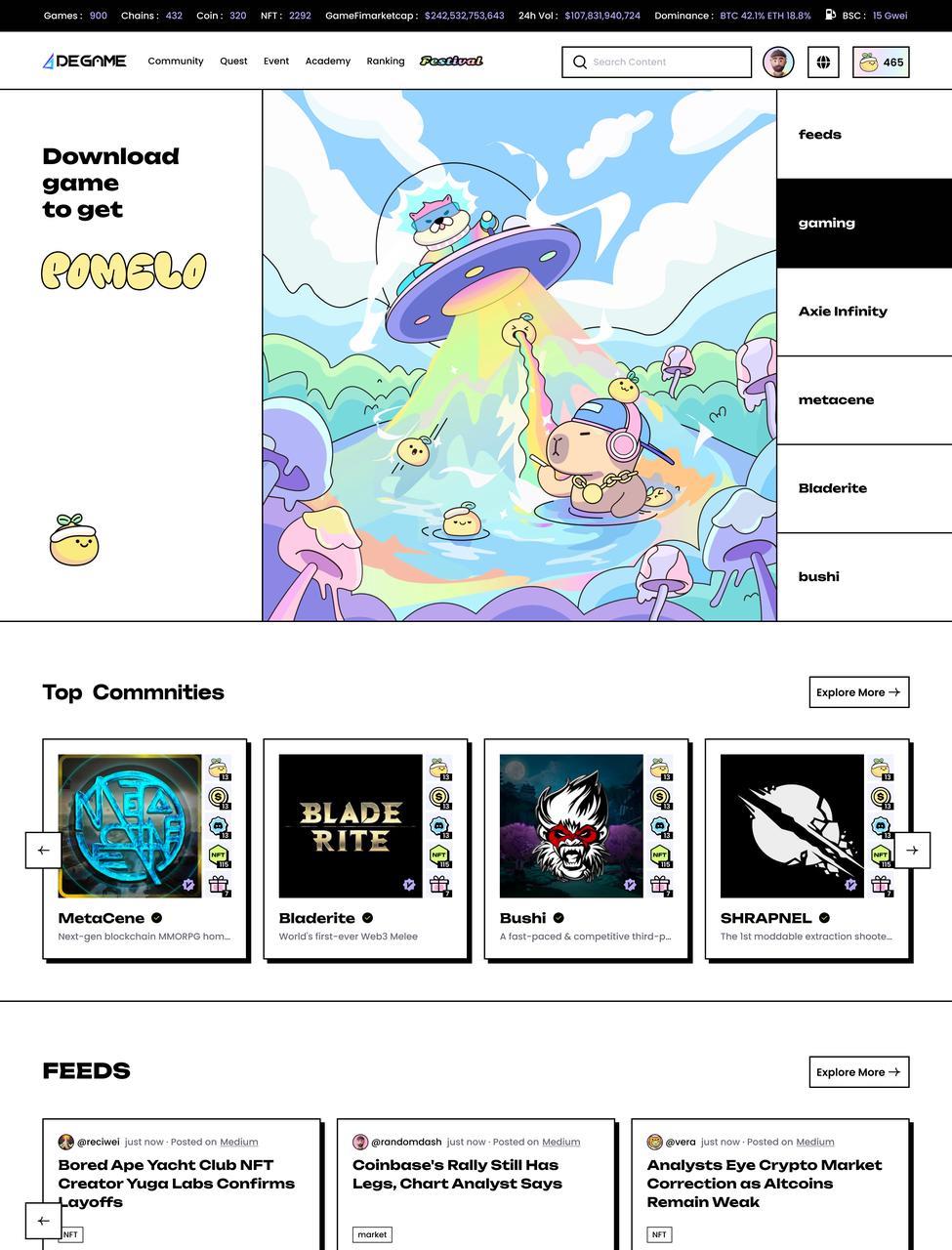
DeGame New Product Page Image
Top Communities: Aggregates over 10,000 global WEB3 game projects' communities, allowing users to easily access the project's official website, official promotions, or official community, to intuitively and comprehensively understand GameFi projects and interact with project owners or community members.
Feeds: Serving as the information gateway in the Web3 ecosystem, this feature centrally displays all news in the Web3 industry, supporting PGC and UGC modes, allowing approved high-quality creators to publish content, delivering valuable information to users.
Quest: A task release window that combines fairness and incentives. Regular users, game project owners, KOLs, and development teams can release customized tasks and set rewards, promoting interaction among Web3 users, increasing traffic, and ecological value.
Leader Board: Provides real-time game data rankings, conducting regular data analysis and rankings of global WEB3 games, KOLs, and game guilds, while also allowing users to rate and evaluate games, achieving truly decentralized game ratings.
Gaming: Real-time display of recent popular WEB3 games and reminders of new game launches, allowing users to easily download and start gaming experiences.
Event: Provides the most comprehensive entrance to Web3 game events, including online and offline activities, allowing users to freely choose to participate. Qualified players can also publish their own events here.
Discover: Aggregates high-quality game videos from across the web, where video creators can upload their own game videos, providing game guides, tutorials, and funny videos to help users easily discover the content they need.
The momentum of Web3 game development may become even more rapid, and the industry calls for high-quality aggregator platforms.
DeGame, as a one-stop NFT/GameFi aggregation platform, has demonstrated its unique comprehensiveness and innovation in the Web3 gaming field. Its wide range of game categories, covering various blockchain technologies, and its ability to attract a broad user base and game guilds, sets it apart from other platforms.
By continuously upgrading and optimizing its features, DeGame has shown a deep understanding of industry trends and user needs. It is not just an information aggregation platform, but also a key force driving the development of the Web3 gaming field.
From the current trend, DeGame has shown strong potential and prospects. Its upcoming new version and feature highlights indicate that the platform will continue to maintain its leading position in the industry and may become a key driver of future development in the Web3 gaming field.
Considering its comprehensiveness, innovation, and market adaptability, there are ample reasons to have positive expectations for the future development of DeGame. This platform is not only an ideal choice for Web3 game enthusiasts but may also become an important force driving further innovation in the entire gaming industry.
免责声明:本文章仅代表作者个人观点,不代表本平台的立场和观点。本文章仅供信息分享,不构成对任何人的任何投资建议。用户与作者之间的任何争议,与本平台无关。如网页中刊载的文章或图片涉及侵权,请提供相关的权利证明和身份证明发送邮件到support@aicoin.com,本平台相关工作人员将会进行核查。


