Author: Inal Tomaev
Compiler: Wu Shuo
This article aims to identify and address the legal issues facing the NFT industry.
Origin
NFTs are encrypted tokens (digital certificates) recorded in a blockchain registry, which can confirm ownership of almost anything in the digital or physical world (such as images and real estate). Each NFT is unique and has its own value due to its connection to the asset.
The concept of using NFTs as a way to represent and manage real-world assets on the blockchain can be traced back to Meni Rosenfeld's article "Overview of Colored Coins," published on December 4, 2012. In the article, Rosenfeld introduced the concept of "colored coins," which are similar to Bitcoin but with an added "token" element that gives them specific uses or utilities, making them unique. The author suggested that these tokens should not only be used on the blockchain but also in real-world applications.
On May 3, 2014, digital artist Kevin McCoy created the first NFT, "Quantum," on the Namecoin blockchain. "Quantum" is a pixelated octagon digital image that changes color and pulsates, similar to an octopus. This early use of NFT technology has become a prototype for the entire digital art field.
From a technical perspective, the available blockchains at the time (mainly Bitcoin) were not designed to serve as databases for tokens representing asset ownership. The positive development of NFTs began with the emergence and popularization of Ethereum.
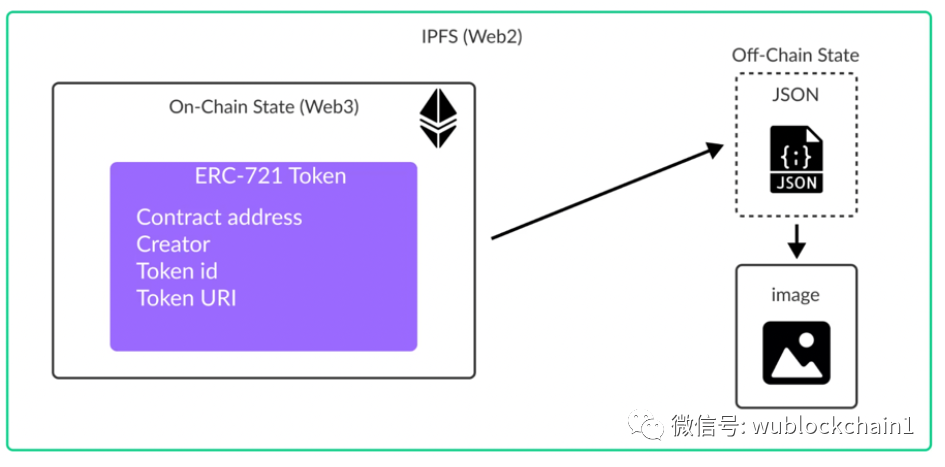
It is also important to distinguish the three choices regarding the relationship between NFTs and the main assets they represent:
On-chain: All transactions involving NFTs are recorded on a single blockchain and can be easily verified using a blockchain explorer. An example of this is real estate recently sold as an NFT.
Off-chain: Transactions are recorded not only on the blockchain but also in a centrally managed database. An unusual example can be found on OpenSea, where NFTs representing a 2000-pound tungsten cube are being sold.
The legal relationship between on-chain and off-chain is called "follow-up rights," where the latter depends on the former and requires a certain degree of rights.
Utility
NFTs are particularly popular in the art world, where the uniqueness of works is highly valued. Therefore, NFT owners are often seen as "chosen ones."
However, many associate NFTs with strange, colorful images selling for millions of dollars. In fact, NFTs can represent a wide range of assets, including digital and physical assets, which have value in both the virtual and real worlds.
NFTs should not be limited to the crypto art field. More precisely, NFTs are a technological tool that can provide new opportunities in both worlds.
Here are some examples of NFT usage.
● Digital Art
One of the main uses of NFTs is in the art and collectibles field. Traditional art pieces, such as paintings, derive their value from being unique—created by hand using unique techniques and materials. Digital files can be easily copied, but NFTs provide a way to prove ownership of unique digital or physical assets. NFTs offer creators a new way to monetize their digital art and provide collectors with a new way to own and trade unique items. NFT platforms may even offer the possibility of automatic royalties for artists' future sales, depending on the platform (platform examples - OpenSea, Rarible).
Representative works: Art Blocks, Murakami Flower Seeds
● PFP (Profile Picture)
NFTs representing PFPs or "profile pictures" are often found on Twitter and are associated with specific accounts. If a PFP is verified on Twitter, the user may receive special badges or emblems for their avatars. PFP ownership can also allow users to join certain communities and access games or other products created by these communities.
Representative examples: BAYC, CryptoPunks
● Virtual Land
These NFTs represent digital land areas owned by users on metaverse platforms and give owners the ability to use the land for various purposes, such as advertising, communication, gaming, work, or renting.
Representative examples: The Sandbox, NFT Worlds
● Gaming
Represent objects in games, such as avatar incarnations, weapons, animals, and land.
● Memberships
NFTs can also be used to address user privacy and data handling issues. They eliminate the need to remember multiple platform passwords and can be resold on secondary markets for profit.
Representative examples: Proof, Premint
● Community NFTs
NFTs can also provide benefits when participating in online and offline social activities.
Representative examples: VeeFriends
● Music
NFTs representing digital content such as music or videos typically differentiate the rights of holders and creators. In most cases, users receive the tokens themselves, giving them the right to sell, transfer, or otherwise dispose of the tokens. However, any intellectual property rights associated with the tokens still belong to the creators, and token holders may only have the right to receive partial royalties as co-investors from streaming.
Representative examples: Royal, Rocki, Sound
● Brands
The popularity of NFTs has led many brands to explore NFTs as potential uses for digital assets and integration with web3.
Representative examples: Adidas, Nike (acquired one of the most famous NFT studios—RTFKT)
● Accounts/Domain Names
In web 2.0, traditional accounts or domain names do not belong entirely to users. For example, Twitter owns all account information and has the right to revoke or delete accounts. NFTs can be used to create decentralized, blockchain-based account systems, with each account verified by a digital certificate.
Representative examples: ENS, Unstoppable
The uniqueness of NFTs can also be useful in other areas:
● Identification tools (e.g., SoulBound Token)
NFTs can serve as universal IDs for various digital services and databases, such as voting systems, attendance tracking, medical records and certificates, and even as a way to identify anonymous individuals in legal proceedings.
● Real Estate
NFTs can be used to represent ownership of real estate assets.
● Logistics
NFTs can be used to track and verify the movement of goods in the supply chain.
Legal Status
From a legal perspective, NFTs can be complex objects with different legal characteristics depending on the specific circumstances. This may subject NFTs to different regulatory requirements in different jurisdictions, including tax, licensing, and other requirements.
Here is an overview of the legal status of NFTs in major jurisdictions.
● United Kingdom
In the UK, there are no specific regulations for NFTs, and NFTs are considered a form of encrypted asset. The Financial Conduct Authority distinguishes three types of tokens:
○ Security tokens: providing rights and obligations specified in investment agreements, including stocks, deposits, insurance, etc. Regulated under the Financial Services and Markets Act 2000.
○ E-money tokens: electronic stored monetary value subject to anti-money laundering regulations.
○ However, most NFTs do not fall into the above categories and are therefore not regulated.
● European Union
Like the UK, the EU does not have specific regulations or legal definitions for NFTs, and there is no agreed regulatory regime among member states.
On October 5, 2022, the European Commission published the Markets in Crypto-Assets Regulation (MiCA), which is expected to become the final version of MiCA, subject to further agreement by the Parliament in 2023, and its scope does not include NFTs.
However, the proposed regulation will explicitly apply to NFTs that confer certain rights to owners, such as rights to financial instruments, profit rights, or other interests. In these cases, NFTs may be considered securities. NFTs may also be subject to legislation in EU member states.
● China
In China, cryptocurrency is prohibited, but individuals can engage in NFT transactions. Currently, there are no specific laws or regulations for NFTs in China. However, on April 13, 2022, the China Internet Finance Association, the China Securities Association, and the China Banking Association jointly initiated the initiative to prevent financial risks associated with NFTs. While this is not a regulatory action under Chinese law, it reflects the government's overall attitude towards NFTs.
According to the initiative, NFTs are not considered cryptocurrencies or virtual currencies. However, the following should be observed:
○ NFTs should not include securities, insurance, credit, precious metals, or other financial assets.
○ The non-fungible nature of NFTs should not be compromised through property division or other means.
○ Centralized trading should not take place.
○ Virtual currencies such as Bitcoin, Ether, USDT, etc., should not be used as pricing and settlement tools for issuing and trading NFTs.
○ Individuals involved in NFT issuance, trading, and purchase should undergo real-name authentication and properly store customer identity information and NFT issuance transaction records.
○ Active cooperation is required in anti-money laundering efforts.
○ Direct or indirect investment in NFTs should not be conducted, and no financial support should be provided for NFT investments.
● United Arab Emirates
Regulation of NFTs and crypto assets in the UAE typically occurs at the level of free economic zones. For example, the Abu Dhabi Global Market (ADGM) recently issued a consultation paper titled "Enhancing Capital Market and Virtual Asset Proposals." ADGM believes that companies need to obtain licenses from the free zone's financial regulatory authority to trade NFTs, and NFTs may be subject to ADGM's anti-money laundering and sanctions regulations. These proposals are still in the consultation stage, but market participants should take them into consideration.
The Dubai Multi Commodities Centre (DMCC) has introduced NFT market licensing. Additionally, NFTs may be subject to the "Crypto Asset Rules," which apply to crypto assets traded as securities or on exchanges. Depending on the nature of the underlying assets, anti-money laundering requirements may be relevant.
● Singapore
The Monetary Authority of Singapore (MAS) has announced that it will not regulate the NFT market, as it considers the market to be in its early stages and does not want to regulate people's investments. However, under Singapore law, if NFTs exhibit characteristics of capital market products as defined in the Securities and Futures Act (SFA), they will be subject to MAS regulatory requirements.
For example, if an NFT represents rights to a portfolio of stocks listed on a stock exchange, it will be subject to requirements related to securities issuance, licensing, and business conduct, similar to other collective investment schemes.
Similarly, if an NFT exhibits characteristics of digital payment tokens under the Payment Services Act (PSA), special restrictions and obligations may be imposed on sellers of such NFTs.
● United States
Currently, there are no specific regulations for NFTs in the United States, but they should be considered as encrypted assets. The Responsible Financial Innovation Act (RFIA) is being considered, which would create the first comprehensive regulatory framework for digital assets in the United States.
The bill classifies most digital currencies as commodities, meaning they will be regulated by the Commodity Futures Trading Commission (CFTC). The RFIA provides clear standards for determining when digital assets are considered commodities and when they are considered securities.
Previously, the nature of NFTs as regulated entities was determined by the U.S. Securities and Exchange Commission (SEC), which typically applies the "Howey test." The current approach to regulating all crypto assets is reflected in comments by SEC Chairman Gary Gensler, who stated that "securities laws should apply to crypto assets."
Overall, the approaches of all analyzed jurisdictions are similar: we are not yet sure what NFTs are, but if they resemble regulated entities (commodities, currencies, securities), we will not hesitate to regulate them.
Furthermore, there is a trend towards strengthening regulation of crypto assets and NFTs (the FTX case provides another reason), and it is expected that the United States will lead this effort in 2023.
Copyright
Note: Spoilers ahead!
Owning an NFT does not automatically grant copyright to the object behind the NFT.
According to Section 102 of the U.S. Copyright Act, protection of "original works of authorship fixed in any tangible medium of expression" is automatic once the original expression is fixed in a tangible form.
This includes eight categories of works: literary works; musical works, including any accompanying words; dramatic works, including any accompanying music; pantomimes and choreographic works; pictorial, graphic, and sculptural works; motion pictures and other audiovisual works; sound recordings; and architectural works.
NFT images fall under the category of pictorial works.
Copyright protection grants the holder the rights to reproduce, distribute, publicly display, perform, and create derivative works based on the original work, as well as the right to prevent others from doing so. When purchasing an NFT, the authenticity of the work can be confirmed through the blockchain.
However, it is important to note that purchasing an NFT does not automatically grant copyright to the object behind it, and the buyer is responsible for ensuring that the work does not infringe on any existing copyrights.
Let me emphasize. One benefit of purchasing an NFT is that the authentication process is conducted on the blockchain. When you purchase an NFT from a well-known artist, the authenticity of the NFT will be verified through the original seller's association with the artist (the marketplace is responsible for verifying this). You can trust that the NFT you purchase is authentic, regardless of how many times it has been resold, as everything can be tracked using a blockchain explorer. However, the blockchain does not provide information on whether the NFT you purchased is a copy of another artist's copyrighted work.
According to Section 504 of the U.S. Copyright Act, selling infringing works, even if unintentional, automatically incurs actual damages and/or statutory damages of $750 to $30,000 per infringement. If the infringement is found to be willful, the damages per infringement increase to $150,000. It is important to note that this is per infringement, meaning the number of NFTs involved in a sale could result in multiple infringements.
Currently, there is some complexity surrounding the transfer of rights through NFTs. While NFTs and copyrights are separate entities, the transfer of one may also involve the transfer of the other. For example, the terms and conditions of the Bored Ape Yacht Club state that "when you purchase an NFT, you fully own the underlying art of the Bored Ape." This indicates that ownership of the NFT includes ownership of the underlying artwork.
An interesting aspect of NFTs is the ability to separate the token from the rights it represents. For example, the owner of a Bored Ape NFT (including the token and the associated artwork) may decide to transfer the image rights used on a T-shirt to A while selling the NFT itself to B.
According to the Bored Ape rules, the transfer of an NFT should include all associated rights. This means that A would be in violation if they did so, as B did not transfer the image rights for the T-shirt to A. However, it can also be understood that B is not involved in the transaction between A and the original owner regarding the image rights, so there is no infringement. If B also uses the image from the Bored Ape NFT to create a T-shirt, the same logic could apply.
This issue may be resolved by treating the rights associated with NFTs as real property rights, where property burdens follow the object. I found only one project that adopts this approach. World of Women operates under this model and is governed by French law. However, this solution may not fully address the issue.
According to Section 204(a) of the U.S. Copyright Act, "a transfer of copyright ownership, other than by operation of law, is not valid unless an instrument of conveyance, or a note or memorandum of the transfer, is in writing and signed by the owner of the rights conveyed or such owner's duly authorized agent." This requirement applies to physical documents and electronic agreements, such as agreements involving "click to agree" options.
This only applies to the initial purchase, i.e., when the owner completes the first transaction. Later on the chain, no one checks any checkboxes or signs any documents. This is a separate issue. If you are interested, there is a good article on the relationship between smart contracts and legal contracts that you can read. That being said, the logic is as follows:
● The owner of the NFT is also the copyright holder of the content behind the NFT.
● The owner of the NFT transfers the NFT through a smart contract, which, unless specifically stated, does not affect the content behind the NFT.
● According to legal requirements, the transfer of rights requires a separate document.
● This document must be signed by the copyright owner.
An important aspect of copyright is understanding the concept of derivative works of original content. In my view, derivative works are sometimes even more valuable than the original. Let me explain: the value of the original is often determined by the number of derivative works, in other words, the uniqueness of the original author's innovation can be "measured" through the network effect of the number of derivative works (viral spread).
Legally, a derivative work is a work based on one or more existing works. This includes translations, musical arrangements, stage adaptations, film adaptations, recordings, art reproductions, abridgments, or any other form of transformation, adaptation, or alteration.
The copyright of a derivative work applies only to the portion introduced by the author of the derivative work that is different from the existing material and does not imply any exclusive rights to the existing material. There are two key criteria for identifying derivative works: originality and legality.
Originality
Derivative works must be original and capable of obtaining copyright on their own. This requirement helps ensure that the author of the derivative work contributes a significant amount of original expression to the final product. If the derivative work is merely a copy of the original work, with little or no original content, it may not be considered a derivative work and therefore does not meet the criteria for copyright protection.
Legality
The legality of creating derivative works is also important. If copyrighted works are used in a derivative work without the permission of the copyright owner, copyright protection does not apply to any part of the derivative work that uses the original content illegally. To create derivative works that can be copyrighted and potentially sold, permission must be obtained from the copyright owner of the original work.
The ability to create derivative works is often considered a key factor in the success of the Bored Apes Yacht Club series. The Rules of Bored Apes grant an unrestricted global license allowing the use, reproduction, and display of acquired artwork, including the creation of derivative works for commercial purposes. However, these same rules also stipulate that when purchasing an NFT, the buyer fully owns the underlying Bored Ape artwork. This creates a contradiction, as it is unclear which rights the buyer is transferring for commercial use if they already own the artwork. Perhaps they are trying to emphasize the independent right to create derivative works, but they have not effectively done so.
It is worth noting that copyright law treats NFTs in the same way as traditional works of art, as in this case, copyright takes precedence over the blockchain. When artists create new works of art, they automatically obtain the copyright to the work and some proprietary rights. These rights include the right of attribution, the right to the author's name, and the right to the integrity of the work, among others, which cannot be transferred. Other rights, such as the right to reproduce, create derivative works, or distribute copies of the work, can be the subject of a contract and transferred to others for commercial purposes. Clearly defining the quantity of rights transferred in an NFT transfer is crucial to avoid any potential conflicts.
To understand how copyright infringement issues are currently being addressed in the context of NFTs, it would be helpful to look at some public cases.
● Benjamin Ahmed and "Weird Whales"
A 12-year-old programmer named Benjamin Ahmed sold 3350 computer-generated "Weird Whales" NFTs for nearly £300,000, only to later discover that the project's graphics were directly copied from another project. The original creator of the graphics has not come forward.
● Quentin Tarantino vs. Miramax
Director Quentin Tarantino announced that he would sell seven NFTs related to the 1994 film "Pulp Fiction." The NFTs would include the "uncut first handwritten script" from the film and the director's "exclusive personal commentary." The film's distributor, Miramax, filed a lawsuit, claiming that he did not have the legal right to create and sell the NFTs and misled consumers about Miramax's involvement in creating the NFTs. The case is currently being litigated.
● Hermès vs. Mason Rothschild
French fashion company Hermès filed a lawsuit against California artist Mason Rothschild over the NFT project "MetaBirkin," which depicts Hermès' Birkin bag and its trademark. Hermès alleges that Rothschild misappropriated the Birkin trademark and profited from the sale of over 100 digital collectibles. The case is currently being litigated.
● Nike vs. StockX
In February 2022, Nike filed a lawsuit against the online sneaker company StockX, accusing it of selling its "Vault" NFT without permission. Nike claims that StockX intentionally used its trademarks to create NFTs without permission and misled consumers about Nike's involvement in creating the NFTs. The case is currently being litigated.
● SpiceDAO
Cryptocurrency project SpiceDAO made headlines after paying $3.5 million to purchase an unpublished manuscript copy of the film "Dune" and intended to create NFTs based on it, only to later discover that the purchase of the manuscript did not include these rights.
● CryptoPunk vs. CryptoPhunk
This case involves two sets of pixelated punk images, where CryptoPunk is original and CryptoPhunk is a bootleg. The original creator of CryptoPunk, Larva Labs, notified the NFT marketplace OpenSea of copyright infringement and had the CryptoPhunk series removed from the website under the Digital Millennium Copyright Act.
● HitPiece
The HitPiece website was accused of selling NFTs featuring the works of many musicians without permission. The website was found to be selling NFTs featuring content from Disney, Nintendo, John Lennon, and many other companies. The original website was shut down, and developers quickly relaunched it. As far as I know, the situation did not escalate into a legal case.
To combat copyright infringement in the NFT space, online gallery DeviantArt and California startup Optic are using image recognition technology and machine learning to analyze smart contracts and identify infringing NFTs in the market. Optic is closely collaborating with NFT marketplace OpenSea. It seems that proving the originality of NFT projects will be a trend in 2023.
Licensing
In the process of creating NFTs, such as PFP collections, there can be several participants:
● Project Owners
The conceptual authors, creators, founders, and visionaries. These are the people who initiated the project and brought everyone together.
● Creators/Artists
The creative individuals who bring the project to life, whether they are the creators or hired experts.
● Investors
Buyers of the NFTs.
● Community
This typically includes anyone involved in the project, from the owners to subscribers on social networks. This can include creators, derivative creators, sponsors, initiators, influencers, and others interested in and potentially contributing to the project.
Market
● NFT trading platforms.
These parties need to address issues related to the transfer of rights, such as the ability to create derivative works, imitate, merchandise, and resell NFTs.
To address these issues, participants in the NFT market have recognized the need for clear rules to regulate intellectual property and have proposed their own NFT licensing schemes.
In 2018, Dapper Labs (known for their work on CryptoKitties and NBA Top Shot) offered the first known NFT license, and in August 2022, a16z VC Fund released their vision for NFT licenses. In the summer of 2022, knowledge-sharing licenses were widely used in NFT sales. a16z wrote a great article explaining why NFT creators choose CC0 tools (Creative Commons has multiple license variants) to transfer rights.
By accepting a CC0 license, the copyright holder agrees to waive their copyright and related rights to the maximum extent allowed by law. Therefore, the work is effectively "dedicated" to the public domain. If for any reason the waiver of these rights cannot be achieved, CC0 serves as a license granting the public unconditional, irrevocable, non-exclusive, and free rights to use the work for any purpose.
This means that NFTs regulated by CC0 have no restrictions on their commercialization or any other use as the owner sees fit. Owners of NFTs regulated by CC0 are on equal footing with the creators in owning the NFT series.
However, since no one owns the artwork under a CC0 license, it also means that anyone (even those who do not own the NFT) can use the artwork for any purpose, including creating NFTs. This creates a paradox: if you cannot prevent others (even non-owners of your NFT) from using the art related to your NFT, why spend resources to create NFTs? The only reason to do so is to promote the ideology of NFTs, rather than for economic gain.
In fact, there are several main options available to determine the scope of rights transferred through NFTs, which can be classified as follows:
● The buyer has no rights other than to display the NFT.
● The buyer has limited commercial rights related to the NFT they own.
● The buyer has full commercial rights related to the NFT they own.
● The copyright holder can waive their exclusive rights to the maximum extent allowed by law.
Another issue with NFT licensing agreements (besides determining the scope of transferred rights) is the asymmetrical control of the copyright holder over the license. If the copyright holder believes the license agreement has been violated, or for any other reason, or even without any reason, the copyright holder can unilaterally modify or revoke the NFT owner's license by updating the terms and conditions, even without any notice. The ability to change the license agreement at any time may be a major concern for the entire NFT industry, as the rights of each NFT owner can be unilaterally restricted or completely revoked.
Considering the various options for determining the limitations of rights transferred through NFTs, I recommend that NFT creators consider the current and potential issues in the industry specific to their projects and discuss these issues with community members in the spirit of web3. After all, it is the community that holds the power in this industry. Only in this way can they formally determine how the license will relate to their NFTs and ensure the possibility of excluding unilateral changes to the terms of the license agreement.
Dispute Resolution
The NFT industry is still too new, and there are not many judicial precedents to analyze. However, the rules of intellectual property law can (and should) apply to disputes about authorship and the use of someone's intellectual property when creating NFTs.
Courts may be interested in several key issues:
● Is there evidence of using someone else's intellectual property?
● Has the claimant of copyright infringement proven authorship?
● Is there any damage?
● What was the intent of the infringer?
● What specific actions did the infringer take, and what were the results?
There may be more questions, but these are enough to understand the logic of the court. The answers to these questions will help the court distinguish between punishable acts carried out for profit and other acts, and the judge may also consider the "fair use doctrine" in their decision. This doctrine was established by English and American law in the 18th to 19th centuries, allowing limited use of copyrighted material without permission.
The doctrine includes four factors that the court needs to consider:
● The nature of the copyrighted material
To prevent private ownership of what should belong to the public domain, the court needs to understand the source of the idea. In this case, known facts and ideas are not protected by copyright, only their specific expression (such as description, method, or scheme) is protected. If known information is reinterpreted in this way, it may be considered an expression of authorship.
● The amount and significance
These two factors should be considered together. The court first determines the quantity of disputed information related to the original work (such as excerpts in text or photos). Generally, the less used relative to the whole, the more likely the use is considered fair. However, the significance of the disputed information also plays a role, and usually this second factor is more important legally.
● The impact of the infringement
If the use impairs the copyright holder's ability to profit from the original work and is used as a substitute demand, it is considered unfair.
The court may also consider additional standards specific to the case to provide greater clarity.
If we apply the fair use doctrine to the situation between CryptoPunk and CryptoPhunk, it will be the basis for the court's ruling. It would be interesting to see how the court rules, but since OpenSea resolved the issue internally, we can only speculate on how the court might handle the case.
The anonymous infringing creator of CryptoPhunk stated in a public letter that the purpose of creating this series was "imitation and satire" (belonging to the "purpose and nature of the use" standard of the doctrine). However, after considering the other standards, it seems that the infringing creator:
● Failed to sufficiently transform the original work (first standard)
● Used material that was already in the public domain (second standard)
● Used a significant amount of original ideas with only minimal changes (third standard)
● Had a significant impact on the reputation and income of the copyright holder (first and fourth standards)
● Knew the original author (additional standard)
Given these factors, OpenSea's solution seems reasonable.
Conclusion
Despite the open principles, the industry needs rules to function properly. Players who take the NFT industry seriously and plan to stay in the industry for the long term will quickly adapt to these rules and understand that these rules are in place to protect everyone. Understanding the legal status of their future digital assets, the method of transfer, and the scope of rights contained within will help create a more reliable industry for NFT creators.
As the industry evolves, controversial situations may increase. Potential areas of dispute in the NFT space include: licensing fees; disputes over the scope of license transfer rights; NFT theft; counterfeiting (confusingly similar) NFTs; taxation; advertising and promotion; hacking; personal data; identifying violators; completing transactions using NFTs as collateral; and liability in the NFT market.
免责声明:本文章仅代表作者个人观点,不代表本平台的立场和观点。本文章仅供信息分享,不构成对任何人的任何投资建议。用户与作者之间的任何争议,与本平台无关。如网页中刊载的文章或图片涉及侵权,请提供相关的权利证明和身份证明发送邮件到support@aicoin.com,本平台相关工作人员将会进行核查。


