Hacker House: A Place for Hackers to Live, Learn, and Build Together
By: Harry Liu
Long-term community living and participation in various hackathons have shown me the powerful catalytic effect of long-term communal living on creativity and collaboration. Compared to short hackathons, Hacker House has its unique significance. It provides participants with a long enough period to communicate, which can lead to more mature ideas, finding partners with compatible abilities and personalities, and enough time to validate their ideas.
My experience at Hacker House has made me feel a special space: a place full of collisions of free thinking, as well as a testing ground for creativity and co-creation. I believe that compared to hackathons, the long-term communal living, learning, and building model of Hacker House is more likely to foster breakthrough ideas and projects.
- ren
The main content of this article is based on a speech given on August 30, 2023 at Shanhaiwu, with some appropriate modifications.
This article also happens to be published on the occasion of our one-year anniversary of hosting Hacker House, serving as a summary of our exploration over the past year.
The community itself is a relatively large category, and I can only elaborate from a very small perspective based on our experience: discussing how to attract developers globally through Hacker House from the perspective of a community organizer. We hope to provide some new ideas for practitioners through our attempts.
For organizers, Hacker House is an activity format that is very suitable in terms of input and output:
- Flexible duration: Can be organized for a few days to a few weeks.
- Appropriate human resource allocation: Can be organized by 1-2 people.
- High combinability: Hacker House can be organized in almost any setting, independently or in conjunction with conferences, or alongside hackathons.
- Appropriate financial investment: Depending on the location, a common range is $5000-15000.
- Community recognition: Developers naturally have a need for in-depth communication and collaboration with each other.
- Gathering attention from people with similar interests for in-depth discussions.
- Good publicity effect: The event itself has its own publicity effect; in addition, organizers hope to have more side events during conferences, which will help with publicity. Furthermore, Hacker House itself is a cool activity format, which will attract more attention.
Given these characteristics of Hacker House, it is currently becoming a favored activity format for various communities and organizations.
What is Hacker House
My definition of Hacker House is "A place for hackers to live, learn, and build together."
In fact, Hacker House has existed for a long time, mostly as a fixed living space where hackers need to pay rent to stay, and members organize technical activities and do project development. The focus here is on the "living space" and the activities that take place within it.
The Hacker House we are discussing here is centered around "activities," which include living together, learning together, and building together, with the living space being temporary, serving as a carrier to meet the needs of the activities. The main source of funding is sponsorship.
Some people are not very clear about the differences between Hacker House, hackathons, and Pop-up cities. Here is a comparison I have made.
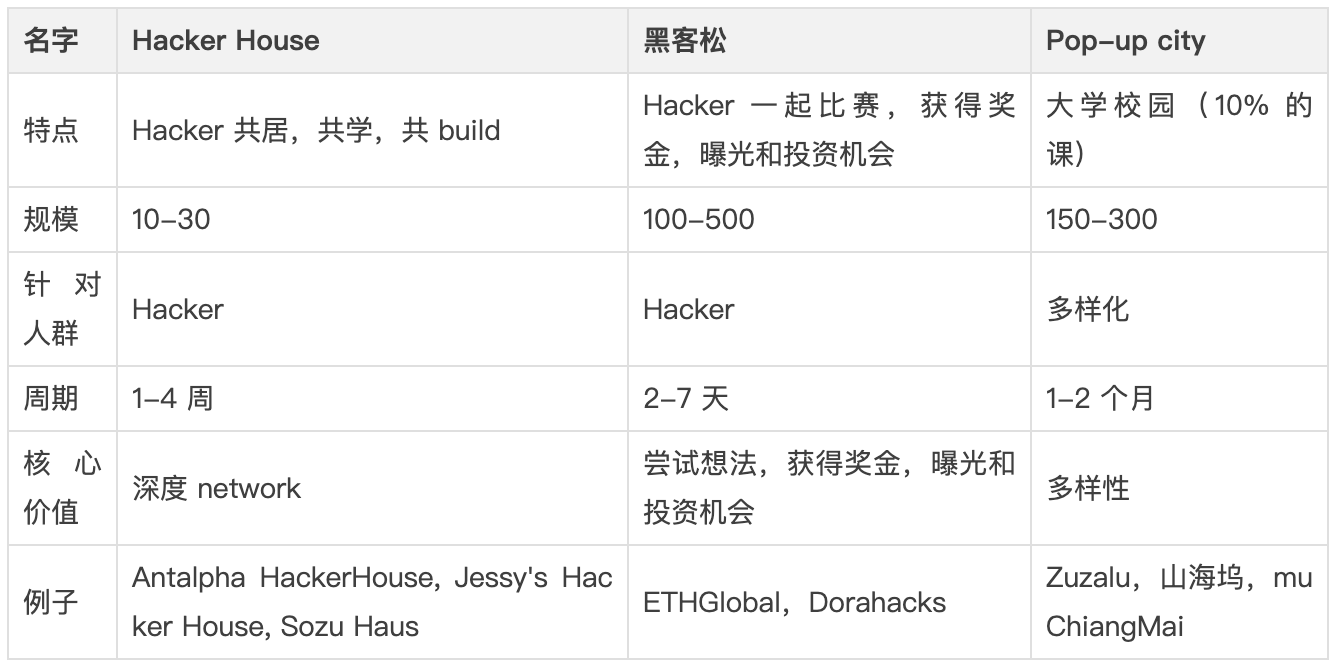
Both Hacker House and hackathons produce projects, but because Hacker House has a longer duration, the projects produced are more complete, although there is still a certain distance from commercialization.
Our Attempts
We started organizing Hacker House in Dali in October 2022, and have held 9 sessions in total, including 6 overseas sessions, producing over 50 projects. Several projects have won awards at hackathons and received grants.
Initially, our plan was to organize 3 sessions and then expand overseas in April 2023. At that time, we had no experience in how to build a developer community overseas, and we didn't know if the format of Hacker House was suitable. We just randomly decided to start with Southeast Asia, which is relatively close to us.
After completing the second session in China, we gained some organizing experience. By chance, we discovered ETHDenver, and we thought it might be a good opportunity to solve the problem of sourcing developers. So, we changed our plan and decided to hold our Hacker House around the ETHDenver conference in February 2023. The result proved to be very successful. We received over 50 applications, and even after closing the registration form, people continued to email us asking if we were still recruiting. During this period, we also met some very nice people, which provided great help for us to continue organizing Hacker House in the future. After that, we successively held Hacker House in Chiang Mai, Japan, Montenegro, South Korea, and France.
After ETHDenver, we gained recognition from the community, and it became relatively easier to talk to sponsors for the subsequent Hacker House sessions. Hackers also liked us and wanted to continue joining us to help us.
Later, we found that the domestic community was also paying attention to Hacker House, so we launched the Global Hacker House, joining forces with 6 communities to organize Hacker House in multiple cities and on multiple themes. As of the writing of this article (September 3, 2023), the event is still ongoing. The biggest gain from this was that several hackers mentioned that they hoped to organize Hacker House in their own cities. This is also what we hope to achieve - to support more people in organizing Hacker House, and even open up their own houses. With 3-5 people, they can become a Hacker House. If people in various regions organize these, it would be a very meaningful thing.
Additionally, we are also trying to gradually decentralize and support community members in organizing Hacker House. We have introduced the role of "Hacker House host," mainly responsible for the operation of Hacker House. We hope to support more "Hacker House hosts" in the future.
Next, let's discuss how to organize a Hacker House overseas.
How to Organize a Hacker House Overseas
Here, I will not provide a comprehensive introduction to organizing a Hacker House, but I hope to give everyone a general understanding of how to organize a Hacker House through a simple introduction.
Early Stage
1. Determine the theme
The theme should be as focused as possible, preferably in an area that the organizers themselves are interested in and have a certain level of understanding. For example, we have organized several themes around zero-knowledge proofs (zkp) because our community itself is more focused on this area.
Good themes:
- zkp
- zkml
- Account abstraction
Bad themes:
- Infra
- Layer2
- Web3
Focused themes are conducive to in-depth discussions among participants, while broad themes are not conducive to discussions and also increase the difficulty of recruitment.
2. Location
The choice of location generally needs to consider transportation, visas, local prices, and the level of infrastructure.
If you also have the same cold start problem as us and don't know where to attract developers, you can choose to hold the event around conferences and hackathons, using existing resources to help you get started.
However, the disadvantage of holding the event around conferences is that hackers' attention will be drawn away by the conference, leaving relatively little time in your house.
If you don't want to follow the conference, you can choose your own venue. Our Hacker House in Chiang Mai in April did not rely on any conference. Although there was some pressure in recruitment, this format allowed developers to focus more on our activities, facilitating more interaction and output.
3. Promotion
In addition to having your own promotional channels, you can also use official websites and websites of surrounding events for promotion, especially in the early stages when your own promotional channels are relatively weak. The latter is more important. Additionally, some partners can also help with promotion and recruitment. If the community already has a certain level of attention, developers will naturally pay attention to your event.
4. Interviews and finalizing the list
For different themes, there are certain requirements for applicants. After applying, they need to have a one-on-one video interview with us to ensure that both parties meet each other's expectations. The specific requirements depend on the theme. For example, for the zkp theme, applicants may need to have a certain understanding of zkp protocols, while for application development, they may need programming experience and knowledge of web3.
It is important to recruit as early as possible, for example, starting two months in advance. After finalizing the list, participants should be given 2-4 weeks to prepare for visas and book flights.
5. Finding sponsors and partners
Partners are relatively easy to find and generally include developer communities, media, and projects in related fields. The main task is to assist in promoting the event within their communities.
Sponsors come from different organizations, usually investment institutions, public chains, and projects related to the current theme willing to sponsor.
6. Finding accommodation
Our main channels for finding accommodation are Airbnb and friends. We usually look for two types of accommodation: whole properties and separate properties. Whole properties involve renting out an entire hotel or guesthouse, where work and living are in the same place, allowing more opportunities for interaction. Separate properties involve accommodation and activity locations being separate, but generally not more than one kilometer apart. We tend to prefer whole properties, as they provide more opportunities for interaction. However, the separate approach has also yielded good results, so the decision can be made based on the specific situation.
Finding accommodation can be done in parallel with interviews. It only needs to be finalized before the final list is confirmed, as the number of participants needs to be determined based on the accommodation situation.
During the Event
Here, I will use a three-week Hacker House as an example to illustrate how we generally arrange activities during these three weeks.
0. Opening
The general process for the opening includes:
- Introduction by the organizers
- Personal introductions by everyone
- Introduction of everyone's ideas
1. First week
The goal of the first week is to promote interaction among participants, so different sharing sessions are usually organized with the aim of forming project ideas by the end of the first week.
There is a weekly progress synchronization for all participants, usually held on weekends. The first weekend is mainly to synchronize everyone's project ideas, and the presentation format is decided by the participants, which can be slides or a whiteboard.
2. Second week
After the first week, with project ideas in place and participants familiar with each other, the second week can start team formation and development. There are also a few sharing sessions. A progress synchronization session is held on the weekend to synchronize everyone's development progress.
3. Third week
The third week is mainly for development sprint and preparation for the final demo day. There are usually no sharing sessions this week, as everyone is busy preparing for the final demo day.
The final demo day requires everyone to present their projects and do project demonstrations.
"Anything that has competition in it will strangle the exploration of knowledge."
— Antifragile: Things That Gain from Disorder by Nassim Nicholas Taleb
Unlike hackathons, we do not award projects. Our goal is to guide more discussions and gather ideas to improve projects.
Post-Event
A summary article and video will be released later, both of which are important and should be done if possible. These contents serve as good summaries and also help to garner more support for the next event.
Additionally, we will conduct a retrospective to discuss how various organizational aspects can be improved. In fact, our retrospective has been ongoing throughout the organization process, discussing how each aspect can be improved and which processes can be enhanced next time.
Conclusion
We organize Hacker House partly to meet our own needs, hoping to have in-depth discussions and collaborations with like-minded people. Attending conferences and hackathons cannot meet this need. Now we have found that this need is universal and exists worldwide. Positive and lasting interactions between people can have a positive impact, and we hope that this impact can continue to be passed on through new Hacker House events.
免责声明:本文章仅代表作者个人观点,不代表本平台的立场和观点。本文章仅供信息分享,不构成对任何人的任何投资建议。用户与作者之间的任何争议,与本平台无关。如网页中刊载的文章或图片涉及侵权,请提供相关的权利证明和身份证明发送邮件到support@aicoin.com,本平台相关工作人员将会进行核查。


