Author: Kyle
Editor: Wendao
In the 8 years since the birth of the open-source blockchain network Ethereum, countless competitive chains have emerged, laying the underlying foundation for the development of on-chain applications in finance, gaming, and other scenarios. The only regret is that, after 8 years, the vast majority of Internet users still cannot access the Web3 gateway based on blockchain.
Data shows that out of the total of 5.16 billion Internet users, less than 100 million users have blockchain wallets (the main entry point for Web3 networks and applications). Why is it so difficult for Web3 to break into the mainstream?
On the one hand, there has been no breakout application familiar to Web2 users, such as in social media, e-commerce, and more importantly, the complex nature of the operations: every action on the chain requires careful consideration of "network fees" (GAS fees, one of the network usage costs), and every interaction requires a wallet signature (similar to providing authorization and verifying transactions).
Recently, a new concept aimed at revolutionizing the Web3 user experience has emerged—investment firm Paradigm proposed "intent-centric," outlining a new approach to establishing Web3 interaction experience centered around "intent": ideally, users only need to issue an intent command, and all operations can be automatically executed in the background, requiring the user to sign only once to achieve the intent.
The intent-centric approach, which focuses solely on the result and not the process, seems very user-experience-oriented. Does this simplified style resemble what AI chatbots do? In fact, artificial intelligence can indeed be used here.
1. New Focus of Web3
A recent research article by the well-known crypto investment firm Paradigm has made the concept of intent-centric the new focus of the Web3 track. The firm listed intent-centric as the first of "ten Web3 directions worth paying attention to," and this unfamiliar term has since spread in the crypto community, sparking excitement.
Intent-centric, translated as "centered around intent," directly refers to "what you want to do." It focuses on the result rather than the process. Intent-centric aims to optimize the cumbersome on-chain operations "in one go" through protocol and infrastructure optimization. More precisely, it hides the complex operational processes, allowing users to achieve their goals seamlessly and directly.
For example, a user wants to exchange the Ethereum blockchain version of the stablecoin USDT for the ARB coin on the Arbitrum blockchain. This process is somewhat similar to an international interbank transfer, usually requiring a series of operations, including opening a cross-chain bridge (a cross-system trust solution), connecting a wallet (account), transferring USDT and the Gas fee ETH (transaction fee) from the Ethereum network to Arbitrum, waiting for the cross-chain asset transfer to complete, and then finding a liquid exchange on Arbitrum (currency exchange) to execute the exchange.
The above is a very familiar and routine operation for a "veteran" on the chain. Every day, a large number of users transfer assets between various blockchains, conduct transactions, and stake assets, and the complex operational process is extremely unfriendly, especially for newcomers. Intent-centric aims to solve these problems, turning the long chain of operations into a short one, or more accurately, making this chain "seamless" on the user experience end.
Ideally, users only need to express their intent: "Help me exchange the USDT in my wallet for ARB on Arbitrum," and the intent-centric related protocols can automatically operate in the background, including cross-chain transactions, finding the optimal exchange path, and paying Gas fees until the exchange is completed. Throughout all these processes, the user remains unaware, and only receives a clear result: the USDT in the wallet has been exchanged for ARB.
This is very close to the experience of Web2 applications. For example, when we buy something on Taobao using Alipay, we just need to pay and wait for the delivery, without needing to know how the money reaches the merchant.
From the simple example of a cross-chain transaction from USDT to ARB, theoretically, with the maturity and perfection of the intent-centric concept at the protocol level, any on-chain operation can be completed with a single click. For example, a one-click purchase of a specific NFT, or a one-click search for the highest annualized return investment product, and so on.
In short, the core idea of intent-centric is to optimize the user experience, allowing even novices to quickly navigate the on-chain world.
So, how is the vision of intent-centric technically realized? In fact, its principle is not difficult to understand—it is to break down the intent and assign each step of the process to professional protocols to complete.
Taking the recent standout performance at the ETHGlobal Paris hackathon, Bob the Solver, as an example, it is an infrastructure based on intent-based transactions, consisting of two parts: the Solver and the Account Abstract Wallet (AA Wallet).
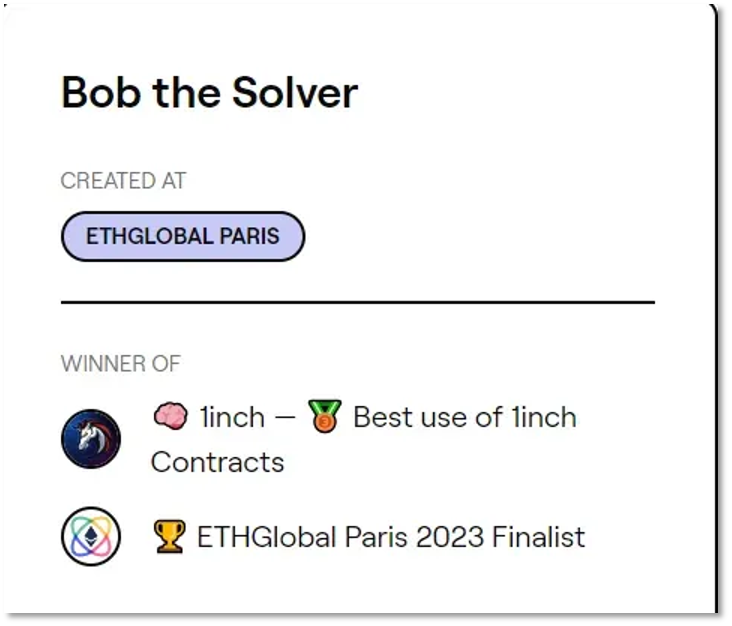
Bob the Solver brings an intent-centric template
The Solver acts as a coordinator, responsible for identifying user intent, categorizing intent, and planning the optimal path to achieve the intent. Once the path is determined, the Solver will construct the necessary transactions to fulfill the user's intent, similar to outlining a "process outline," and then forward it to the programmable Account Abstract Wallet.
The Account Abstract Wallet is responsible for execution. It consists of a "bundler" and a "paymaster," with the former responsible for planning the transactions sent by the Solver, and the latter managing and disbursing the related Gas fees.
Bob the Solver provides a simple template for intent-centric. Following this approach, as long as there are professional Solver solutions and wallet programming solutions, it is possible to achieve one-click direct access to the intent in multiple scenarios.
2. Potential Integration with AI
The on-chain application ecosystem has undergone 8 years of development, and a large number of trading, lending, financial, gaming, and NFT applications and other new assets have emerged. In the context of the nascent on-chain ecosystem, the emergence of intent-centric is timely. Only with a breakthrough upgrade in user experience can the on-chain world achieve exponential user growth.
Currently, there are relatively few new protocols under the narrative of intent-centric, but in fact, applications similar to its vision have already appeared.
The decentralized crypto asset trading application 1inch is a typical example. Compared to the well-known Uniswap, the feature of 1inch lies in allowing users to trade encrypted assets across multiple DEXs in a single transaction. By simultaneously scanning multiple DEXs, 1inch can find the best price for a specific trading pair and execute the trade at the most favorable price for the user.
Before the emergence of 1inch, users who wanted to complete a transaction in a way that maximized value typically had to visit multiple DEXs for comparison, while also considering factors such as trade slippage and Gas fees. However, 1inch, through specific algorithms and aggregating dozens of DEXs, can efficiently find the optimal exchange path, allowing users to complete the best trade in real time at the best price.
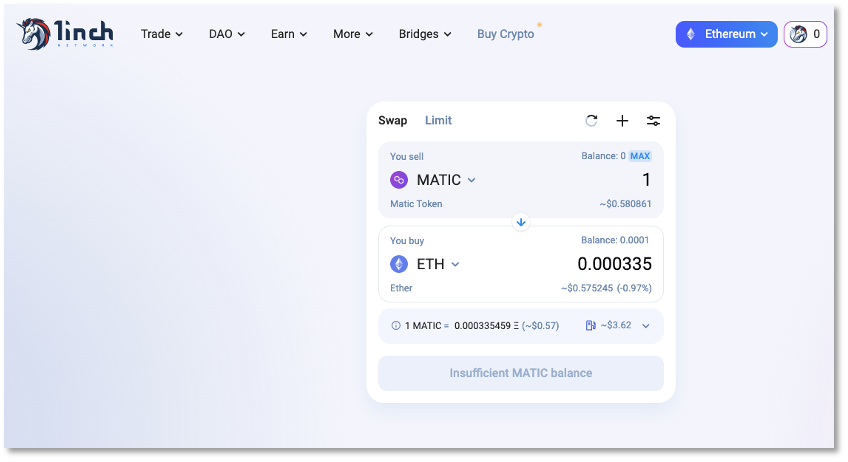
1inch trading page
Aggregation is a simple and effective way to simplify user operations. However, the on-chain world is not just about simple A-to-B exchanges. There are hundreds of independent public chains, each supporting a variety of on-chain applications and digital assets. Aggregation alone is not enough to solve the complexity of most operations.
Therefore, the realization of the intent-centric vision still has a long way to go, and in this process, highly intelligent AI may become a powerful assistant.
Whether it is natural language input of intent, breaking down goals, calculating the optimal path, or executing operations, AI can play to its strengths.
In many cases, user intent is complex, and the expression of intent may not be accurate, which can make it difficult for the solver to accurately understand the user's intent and therefore plan the optimal solution. However, AI trained with specific models can more accurately identify user intent and infer potential purposes and needs based on the source of the user's transaction requests, transaction data, and more.
In terms of breaking down goals and execution, AutoGPT, based on the GPT-4 large language model developed by OpenAI, has already proven its power. With just one task, AutoGPT can plan and execute automatically. Its characteristics happen to align with the requirements of intent-centric.
In the eyes of many professionals, the realization of intent-centric cannot be achieved without the boost of AI. After all, the efficiency of AI retrieval and execution far exceeds that of humans, and AI's involvement will accelerate the arrival of a user-friendly era for blockchain.
Of course, when developers hand over the "intermediate layer" operations from intent to result to AI and other third-party execution layers, it means that there are multiple parties involved behind the "one-click intent realization," and security issues must be taken seriously. On the one hand, intent-centric protocol parties need to establish a mechanism for punishing malicious behavior and provide a secure and stable third-party execution layer. On the other hand, they also need to enhance technical security capabilities to prevent algorithm breaches or AI being "tricked." If any link in the chain encounters a problem, user rights will not be guaranteed.
Intent-centric presents an exciting future for the Web3 industry, and it is hoped that more secure and user-friendly "intent" applications will emerge, revolutionizing the user experience from the user's end.
免责声明:本文章仅代表作者个人观点,不代表本平台的立场和观点。本文章仅供信息分享,不构成对任何人的任何投资建议。用户与作者之间的任何争议,与本平台无关。如网页中刊载的文章或图片涉及侵权,请提供相关的权利证明和身份证明发送邮件到support@aicoin.com,本平台相关工作人员将会进行核查。


