Author: duoduo, LD Capital
GMX V2 was officially launched on August 4, 2023. This article reviews the development of GMX V1 and its existing issues, compares the modifications in V2, and analyzes the potential impacts.
I. GMX V1: A Valid Model for Derivative DEX Protocols
GMX V1 was launched at the end of 2021, using the GLP model, providing a simple and effective trading model, and creating the concept of "realized yield," which holds an important position in derivative DEX protocols. Many projects have forked the GMX V1 model.
The GMX V1 protocol captured a large amount of fees. Since 2023, the income of the GMX V1 protocol has been $98.1 million, ranking eighth among all projects and first in the derivative DEX track.
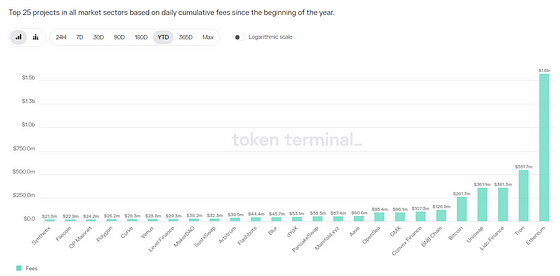
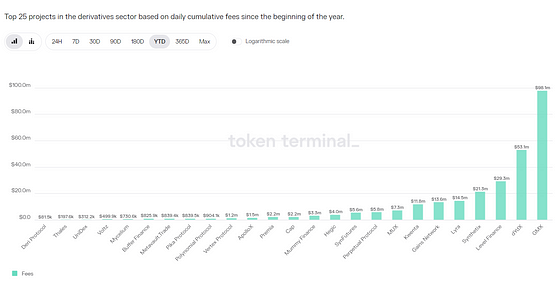
Source: token terminal
However, GMX V1 also has limitations, mainly including:
1. Imbalance of Open Interest (OI) Leading to High Risks for LP Providers
The fees of GMX V1 are for opening/closing positions and borrowing costs, without funding rates. Borrowing costs result in holding costs, preventing liquidity from being indefinitely occupied. In addition, the dominant party needs to pay more fees. However, since fees are charged to both long and short sides, there is no arbitrage space, and open interest contracts cannot be balanced quickly through arbitrage behavior.
If this imbalance is not addressed, in extreme cases, the GLP pool will face huge losses, and LP providers will suffer losses, leading to the collapse of the protocol.
2. Limited Tradable Assets
GMX V1 only offers 5 tradable assets: BTC/ETH/UNI/LINK and AVAX. In contrast, DYDX and Synthetix can provide dozens of trading assets. Gains provides foreign exchange trading assets. The new platform HMX provides commodities and US stock assets.
3. High Fees for Small and Medium Traders
The opening and closing fees of GMX V1 are both 0.1%, which is relatively high. In the context of the intense competition in the derivative DEX track, the fees of many protocols are below 0.05%.
II. GMX V2: Ensuring Protocol Security and Balance
1. Core
The core of GMX V2 is to ensure the security and balance of the protocol by modifying the fee mechanism to maintain the balance of long and short positions, in order to reduce the probability of systemic risk occurring in GMX when facing severe market fluctuations. By setting up isolated pools, it increases high-risk trading assets while controlling overall risk. Through cooperation with Chainlink, it provides more timely and effective oracle services, reducing the probability of price attacks. The project also considers the relationship between traders, liquidity providers, GMX holders, and the continuous development of the project, and ultimately adjusts and balances the distribution of protocol income.
2. Fee Model Adjustment: Adding Funding Rates and Price Impact Fees
GMX V2's fee model has been significantly adjusted, focusing on how to promote the balance of long and short positions and improve the efficiency of fund utilization. The specific fee model is as follows:
- Reduce opening/closing fees.
Reduced from the previous 0.1% to 0.05% or 0.07%, depending on whether the opening is favorable to the balance of long and short positions, lower fees are charged if favorable.
- Increase funding rates, with the stronger side paying the funding rate to the weaker side.
The funding rate will be adjusted in segments. When the dominant side's position/full position is between 0.5–0.7, the funding rate is at a lower level; when it reaches 0.7, it will be raised to a higher level, increasing arbitrage space and encouraging arbitrage funds to enter, thereby restoring the balance of long and short positions.
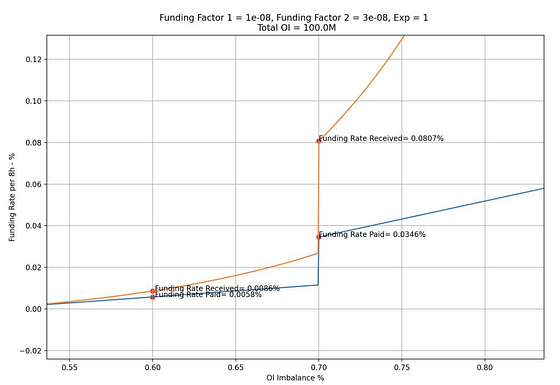
Source: chaos labs
Retain borrowing costs to prevent indefinite occupation of liquidity.
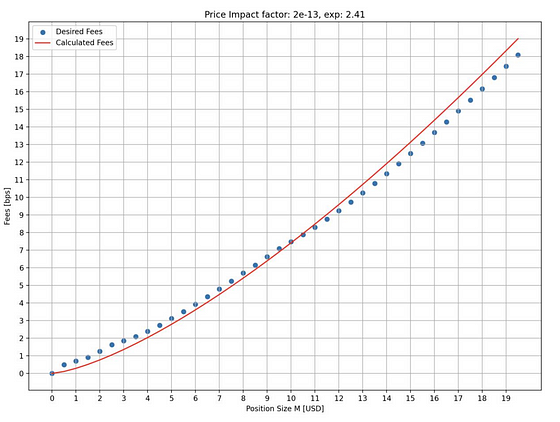
Increase price impact fees, with larger positions and less favorable balance of long and short positions incurring higher fees.
The price impact fee simulates the dynamic process of price changes in the order book trading market, meaning the larger the position, the greater the impact on the price. This design can increase the cost of price manipulation, reduce price manipulation attacks, prevent price crashes or spikes, and maintain a balanced long and short position, maintaining good liquidity.
The following figure shows the fee rates faced by different opening scales in a simulated state. It can be seen that the larger the position, the higher the fee rate. The horizontal axis represents the opening scale (in millions of US dollars), and the vertical axis represents the fee rate (bps).
Source: chaos labs
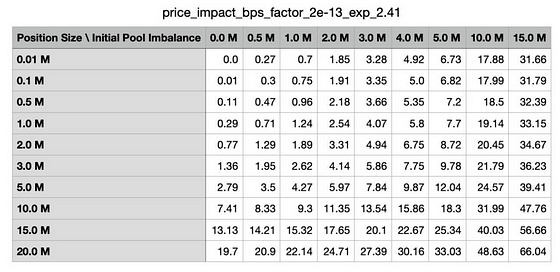
In addition, if the opening is less favorable to the balance of long and short positions, the fees will also be higher. The table below shows the fees charged under different long and short balance states in a simulated state. The first column is the opening scale, and the first row is the initial pool's unbalanced position scale.
Source: chaos labs
A brief comparison of the fees of several major derivative DEX protocols:
- DYDX: maker 0.02%, taker 0.05%, with larger trading volume, larger discounts;
- Kwenta: maker 0.02%, taker 0.06%-0.1%;
- Gains Network: 0.08% opening/closing fees + 0.04% spread + price impact fees.
It can be seen that the fees of GMX V2 are still relatively high, but have decreased from a high level to a moderate level, with opening/closing fees reduced by nearly 50%. For small and medium traders, the fees of V2 are more friendly.
3. Liquidity Provision: Adding Isolated Pool Mode, Adding Synthetic Assets
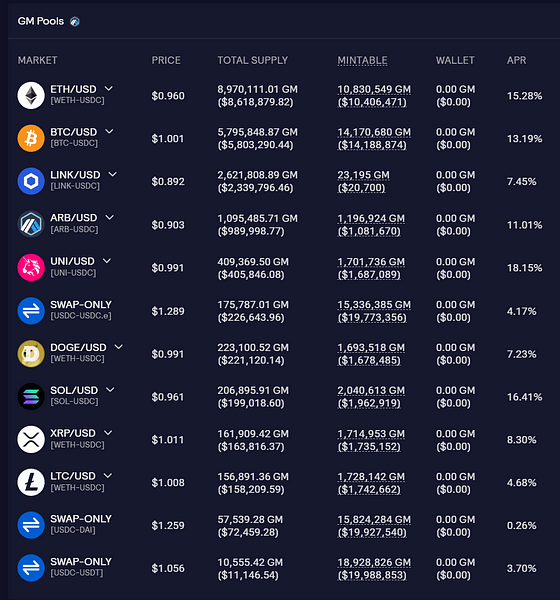
The liquidity pool of GMX V2 is called the GM pool, and each pool is independent of each other. The amount of funds, funding rates, and fund utilization of each pool can be viewed on the official website.
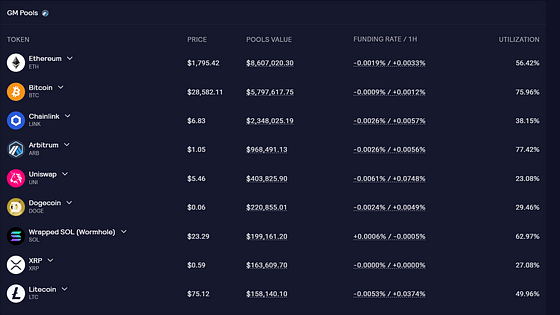
Source: GMX
The advantage of isolated pools is that different token markets can have different underlying support and different parameter settings, achieving their own risk control with high flexibility, thereby expanding trading assets while keeping risk under control. For liquidity providers, they can also choose risk exposure based on risk preferences/return expectations. The issue with isolated pools is the fragmentation of liquidity. Some pools may not attract enough liquidity.
Currently, GMX V2 has divided markets into 3 different types:
- Blue Chips: BTC and ETH. The possibility of price manipulation for these two tokens is relatively low, so the price impact fees can be set at a lower rate, making them more competitive than CEX. Both are supported by native tokens.
- Mid-cap assets: With a market value between $1 billion and $10 billion, they have high liquidity and trading volume on CEX, but are easily affected by external factors causing significant price fluctuations. For these assets, the price impact fee will be set at a higher rate, with liquidity not exceeding that of other external markets, increasing the cost of attacks. LINK/UNI/AVAX/ARB/SOL belong to this type. They are supported by native tokens.
- Mid-cap synthetic assets: They do not use native tokens, but use ETH as the underlying liquidity support. DOGE and LTC belong to this type.
The problem with these assets is that if the related tokens experience a significant short-term increase, the ETH in the pool may be insufficient to pay all the profits.
If there are 1000 ETH and 1 million USDC in the pool, and the maximum long DOGE position is limited to 300 ETH, but the price of DOGE has increased by 10 times while the price of ETH has only doubled, in this case, the profit will exceed the value of the ETH in the pool.
To avoid this situation, the function of automatic deleveraging (ADL) has been introduced. When the pending profit exceeds the threshold set by the market configuration, the profitable position may be partially or fully closed. This helps ensure that the market always has the ability to pay, and all profits at the close can be fully paid. However, for traders, automatic deleveraging may lead to the loss of advantageous positions, thus missing out on subsequent profits.
According to the report issued by chaos labs, it is recommended that during the initial operation period of V2, the upper limit of open interest contracts for BTC and ETH is $256 million each, and for AVAX/LINK, it is $4 million each, while for other tokens, it is $1 million each. Adjustments can be made based on actual operations in the future. However, the total TVL of the GM pool is currently about $20 million, still far from the upper limit.
4. Improving User Experience: Adding Coin-based Contracts, Faster Execution Speed, and Lower Slippage
In GMX V1, traders could only open USD-based contracts. Regardless of the asset used by the trader to open a position, the position value was calculated in USD based on the opening price, and the profit was equal to the USD value at closing minus the USD value at opening.
In GMX V2, coin-based contracts have been added. Traders can deposit relevant trading assets as collateral without converting them to USD. This will meet more needs of traders and provide a more diverse investment portfolio.
Additionally, the oracle system of GMX V2 will price each block, and orders will be executed as close to the latest price as possible, with faster execution speed and lower slippage.
5. Distribution Model
To maintain the long-term development of the project, the protocol income of GMX V2 has also been adjusted. 8.2% will be allocated to the protocol treasury for project operations and other matters.
- GMX V1: 30% allocated to GMX stakers, 70% allocated to GLP providers.
- GMX V2: 27% allocated to GMX stakers, 63% allocated to GLP providers, 8.2% allocated to the protocol treasury, 1.2% allocated to Chainlink. This allocation has been approved by community vote.
III. Operation of GMX V2
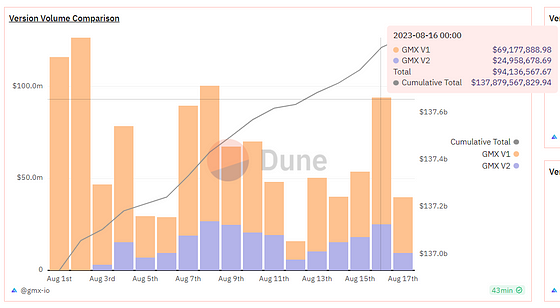
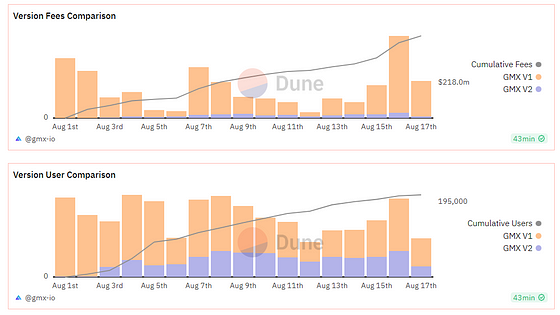
GMX V2 has been operational for about 2 weeks, with a TVL of approximately $20 million, daily average trading volume of $23 million, daily average protocol income of $15,000, open interest of $10.38 million, and approximately 300–500 daily active users. As a starting point, the performance is acceptable without using trading incentives.
Some V1 users have migrated to V2. The trading volume and daily active users of V2 are roughly equivalent to 40%-50% of the trading volume of V1. The comparison of trading volume, protocol income, and users between V1 and V2 is shown in the following figures:
Source: dune
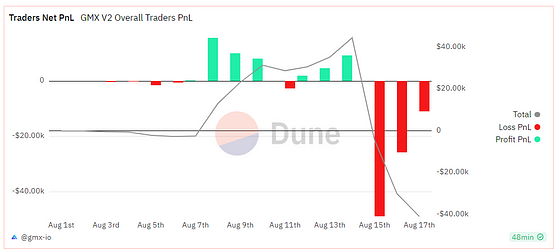
Traders on GMX V2 are currently in a net loss state, with a cumulative net loss of $40,000.
Source: dune
In terms of yield, the recent yield of GMX V1 has been consistently low, with a GMX staking yield of 1.44% this week, GLP (arbitrum) at 3.18%, and GLP (Avalanche) at 8.09%. In comparison, the yield of GMX V2 is higher, as listed below:
Source: GMX
After the launch of GMX V2, the market response has been lukewarm, with average funding. The main reason is that the recent market volatility has decreased to historically low levels, overall trading volume has shrunk, and the competition in the track has intensified, leading to weak growth in protocol income.
IV. Conclusion
GMX V1 is a successful model in the derivative DEX track, with many followers. The delivery of GMX V2 also meets market expectations, demonstrating the strong protocol design capabilities of the GMX team. Mechanism-wise, V2 has improved the balance of liquidity pools, expanded the types of trading assets, and provided multiple collateral position options. For liquidity providers and traders, investment options are more diverse, risk balance is better, and fees are lower.
However, from the initial stage, due to the use of isolated pools, there is a problem of fragmented liquidity, and some assets may have insufficient liquidity. Additionally, the GMX team has not implemented marketing activities and trading incentives, and in the short term, there has been no significant impact on the addition of new users and trading volume to the protocol.
Fundamentally, GMX V2 focuses more on protocol infrastructure, protocol security, and balance. In the current bear market environment, focusing on building the underlying architecture, ensuring protocol security, and using accumulated data for better risk parameter design may be more helpful for the project's future development in a bull market. At that time, it can provide higher open interest contract capacity, a more diverse trading market, and can also launch more marketing measures to attract more new users.
免责声明:本文章仅代表作者个人观点,不代表本平台的立场和观点。本文章仅供信息分享,不构成对任何人的任何投资建议。用户与作者之间的任何争议,与本平台无关。如网页中刊载的文章或图片涉及侵权,请提供相关的权利证明和身份证明发送邮件到support@aicoin.com,本平台相关工作人员将会进行核查。


