Compiled and Translated by: Deep Tide TechFlow
In a recent Lightspeed podcast, Kyle Samani, co-founder of Multicoin Capital and one of the most independent thinkers in the cryptocurrency field, shared his insights on the development of various tracks in the current crypto market. The content includes "integrated L1," the value of a global ledger, how protocols establish moats, and why DePIN is seeking the intersection of product and market.
Following the thoughts of top industry minds often helps us discover new directions and opportunities.
A 5-minute read of podcast notes can save you 80 minutes of time.
The following is the main content of the conversation, interpreted and summarized by Deep Tide, and the main points are presented:
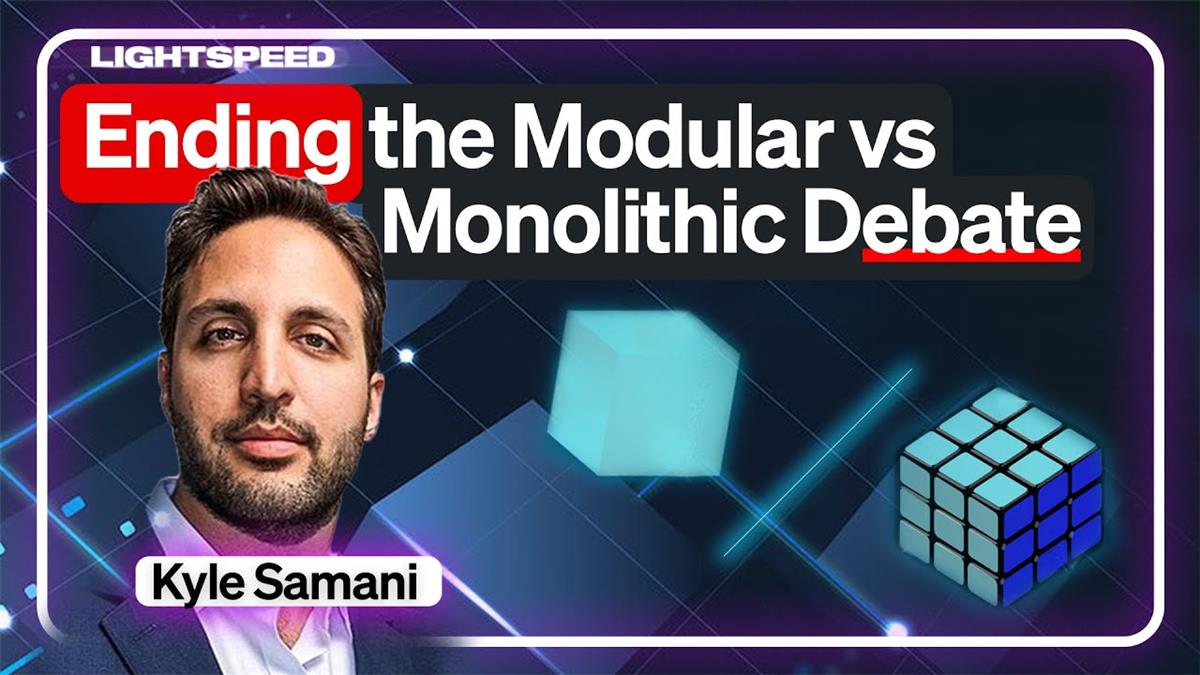
Hosts: Mert & Garrett, Lightspeed (Twitter: @0xMert_ and @GarrettHarper_)
Speaker: Kyle Samani, Co-founder of Multicoin (@KyleSamani)
Video Source: Lightspeed Podcast
Program: Link
Release Date: August 3rd
Learning from History: Blockchain Modularization or Integration?
The hosts mentioned a major point of contention in the crypto field, which is modularization versus integration.
Kyle believes that the term "integration" is more accurate than "monolithic." He further explained that this debate has existed in history, citing the example of IBM mainframes:
In the early history of computing, IBM mainframes were monolithic systems where all components were designed and manufactured by IBM, including hardware, operating systems, and applications. This integrated design made the system more stable and efficient but also limited the entry of other vendors into the market and innovation space.
Over time, computer technology shifted towards more modular design, allowing different vendors to provide different components for the same system. This modular design increased the flexibility and innovation of the system but also brought more complexity and compatibility issues.
Kyle Samani emphasized that the debate between modularization and integration in technical history is not new. He believes that the key is not to decide which configuration (modular or integrated) is correct, but to recognize that both configurations can usually coexist and be chosen based on specific applications and needs.
At the same time, he pointed out the complexity of current modularization solutions. For example, if a user's assets are on another chain, how do they transfer? Or how do address formats change between different EVM L2s? This complexity is often underestimated by most developers.
Community and financial incentives: Kyle mentioned that a major difference in the cryptocurrency field compared to other technology markets is the large number of public holders. Many people make decisions based on their investment choices, and this "holder effect" has not been clearly defined in determining the winners and losers in traditional directions.
He also mentioned the importance of financial incentives and how the term "community" is often used as an excuse for lack of thought.
Rollup and Application Chains
When asked about his views on Roll-Ups, Kyle expressed that he does not oppose their concept. He believes that the Ethereum community is overly convinced that Roll-Ups are the right solution, when in reality, very few applications truly need them.
He mentioned that while Roll-Ups may be useful in some cases, they are not a one-size-fits-all solution. Kyle's view is that the most suitable scaling strategy should be chosen based on specific applications and needs, rather than relying solely on Roll-Ups.
Kyle mentioned that the concept of App Chains is not new, and Cosmos and Polkadot were the first platforms to promote it. He often communicates with the teams of Cosmos and Polkadot, inquiring about the App Chains they are customizing.
Regarding App Chains, he believes that derivative exchanges may be the only meaningful application because they have unique attributes such as high-frequency trading and latency issues. However, apart from this, he has not seen any other compelling applications.
Different scaling strategies (such as Roll-Ups and App Chains) have their own advantages and applicable scenarios. The choice of strategy should be based on specific applications and needs.
Composability and Global Shared State of Blockchain Ledgers
Kyle explained the concept of Composability. He believes that Composability is not just about atomic transactions and flash loans. For him, Composability is more about how to make all different systems and applications work seamlessly together.
Kyle distinguished between two types of software: rich software (such as infinite video streams, tweets, etc.) and scarce software (mainly related to money and finance). The purpose of these two concepts is to emphasize the uniqueness of cryptocurrency and blockchain technology. Traditional software development mainly focuses on rich software, while blockchain technology provides a unique platform for developing scarce software.
He believes that blockchains are asset ledgers, simply tracking who owns which coins. Ideally, there should be a single asset ledger in the world, tracking ownership for everyone. This would be a clear and simple construct.
Advantages of a single asset ledger: Kyle believes that a single asset ledger can provide more scalability than people expect, while still enforcing the social properties of a blockchain.
For blockchains, there is no need to have 200 computers in a house to verify these systems and data. He compared the physical rules of the real world to the asset ledger of the digital world, emphasizing the advantages of a unified asset ledger in enforcing asset ownership globally.
Moats in the Crypto World, Path to the Traditional World, Solana's Phone
Kyle discussed how crypto projects establish moats. He believes that unlike traditional enterprises, crypto projects cannot rely on traditional moats such as network effects or economies of scale.
Instead, they need to find new ways to protect themselves from competitors. A major moat for crypto projects is their community. A strong, active community can provide continuous support and innovation for a project.
Kyle mentioned the concept of "Meat Space," a term used to describe the real world (as opposed to the digital world). He discussed how to integrate crypto technology with the real world to create new value and opportunities. He believes that while crypto technology has enormous potential in the digital world, its application in the real world is still limited.
He sees Saga Phone as a good example of how to integrate crypto technology with real-world products and services. This phone has unique crypto features such as built-in hardware wallets and encrypted communication tools.
Kyle is interested in Solana Mobile and mentioned that he owns a Saga phone. He believes that Saga phones may not sell in large numbers, but the Solana Mobile Stack (SMS) behind it is free and available for any Android OEM to use. He hopes that other phone manufacturers will implement SMS, bringing more distribution opportunities.
About DePIN (Decentralized Public Infrastructure Network)
Kyle explained the concept of DePIN, emphasizing its importance, especially for projects that can leverage existing behaviors (such as driving). He believes that to make these DPIN systems work, you need to have some structural cost advantage compared to large companies like Google or Amazon.
Kyle emphasized that if consumers purchase hardware for personal consumption and can repurpose that hardware to become an income-generating asset, this is the simplest way to gain a structural cost advantage.
He mentioned two types of DePIN networks: GPS-dependent and server networks. He compared Filecoin and Hive mapper as examples, explaining the differences between these two networks.
Kyle mentioned the examples of Hive mapper and Helium, explaining why micro-payments are crucial for the operation of these systems. He emphasized that if you expect the suppliers of these networks to come from hundreds of thousands or millions of people worldwide, involving small amounts of money, multiple currencies, countries, and geographical locations, then the only answer is blockchain.
Kyle explained why early participants in the network need to be rewarded. He believes that early participants take on greater risks because they are unsure if the network will reach a sufficient scale to attract users. Therefore, they should be rewarded with more tokens.
Kyle expressed skepticism about the indispensability of GPUs and edge computing. He believes that when the demand for a certain service increases by 100 or 1000 times in a short period, it is obvious that all available software will reconfigure itself to adapt to all available hardware.
About Spatial Computing
Kyle Samani discussed spatial computing as a new computing paradigm, especially in the context of augmented reality (AR) and virtual reality (VR). He mentioned the Apple Vision Pro and its impact on this new paradigm.
Kyle believes that if people spend more time in 3D virtual spaces interacting with others and non-player characters (NPCs), these systems will have their own economies. These economies may operate on the track of cryptocurrencies as they provide a more elegant and acceptable solution.
Kyle mentioned the two major VR competitors in the current market: Apple and Facebook (now called Meta). Apple Vision Pro focuses more on personal computing experiences such as productivity and home entertainment, while Quest focuses more on social and gaming.
Adoption of new technologies: Looking back at history, desktop computers in the 1980s. He mentioned how the adoption of desktop form factors was guided by identifying key use cases (such as documents and Excel); for mobile phones, the most important applications were making calls and sending messages. For the Apple Watch, the initial focus was on third-party apps, but over time, the focus shifted to health and fitness.
Kyle's Personal Work Philosophy
Kyle emphasized the importance of first principles thinking. He believes that rather than being called "different," it is more meaningful to think from first principles: starting from basic facts and truths, rather than relying on existing viewpoints or traditions. This way of thinking encourages rethinking problems fundamentally, rather than based on existing solutions or common practices.
He refines and improves his thinking through writing. He sees writing as a great way to express his views clearly and refine his articles through continuous revision and editing.
He advises those who want to improve the quality of their thinking to write regularly and suggests writing at least one article per week, whether for public release or for personal reference.
How to cultivate your communication style: Kyle's communication style is direct and authentic. He encourages Multicoin team members to adopt this style as well. Through writing, especially regular writing and self-editing, people can express their views more clearly and concisely.
Advice for founders: Instead of listening to opinions on crypto Twitter, do what you believe is best. He emphasizes the importance of regular writing, not only to improve the quality of one's thinking but also to notice events or viewpoints in daily life that may be worth writing about.
免责声明:本文章仅代表作者个人观点,不代表本平台的立场和观点。本文章仅供信息分享,不构成对任何人的任何投资建议。用户与作者之间的任何争议,与本平台无关。如网页中刊载的文章或图片涉及侵权,请提供相关的权利证明和身份证明发送邮件到support@aicoin.com,本平台相关工作人员将会进行核查。


