Author: Claude, Deep Tide TechFlow
Deep Tide Overview: On July 2, Ondo Finance announced the tokenization of BlackRock’s S&P 500 ETF (IVV) and Micron stock, becoming the first practical implementation of the “third-party custody model” proposed by the SEC in January this year. The underlying stocks remain within the traditional custody system, and token holders can exercise voting rights through Broadridge. However, the product is not currently open to U.S. investors, and the SEC staff statement does not equate to formal rules.
Tokenized stocks in the U.S. finally have a version that has received regulatory approval.
According to CoinDesk, Ondo Finance announced on July 2 that it will issue tokenized versions of BlackRock's S&P 500 Index ETF (IVV) and Micron Technology (MU) stock on Ethereum. This marks the first production environment deployment of the "third-party custody model" since the SEC issued its staff statement on tokenized securities in January, and it is also the first time U.S. listed securities have been tokenized by a third party without crossing borders or circumventing offshore structures.
Ondo CEO Ian De Bode stated in a statement, “Today's milestone shows that we can tokenize securities in a way that meets both market and regulatory requirements, serve U.S. and global investors, and lay the groundwork for more U.S. investors to enter on-chain investments.”
The first batch of targets selected two of the most mainstream assets
The two tokenized targets this time are not obscure assets. IVV is the flagship ETF of BlackRock that tracks the S&P 500, while Micron is a star stock in the current memory chip cycle. By using a broad-based ETF and a popular tech stock to validate the new model, Ondo's intention is clear: first prove that “mainstream assets can also be compliantly on-chain.”
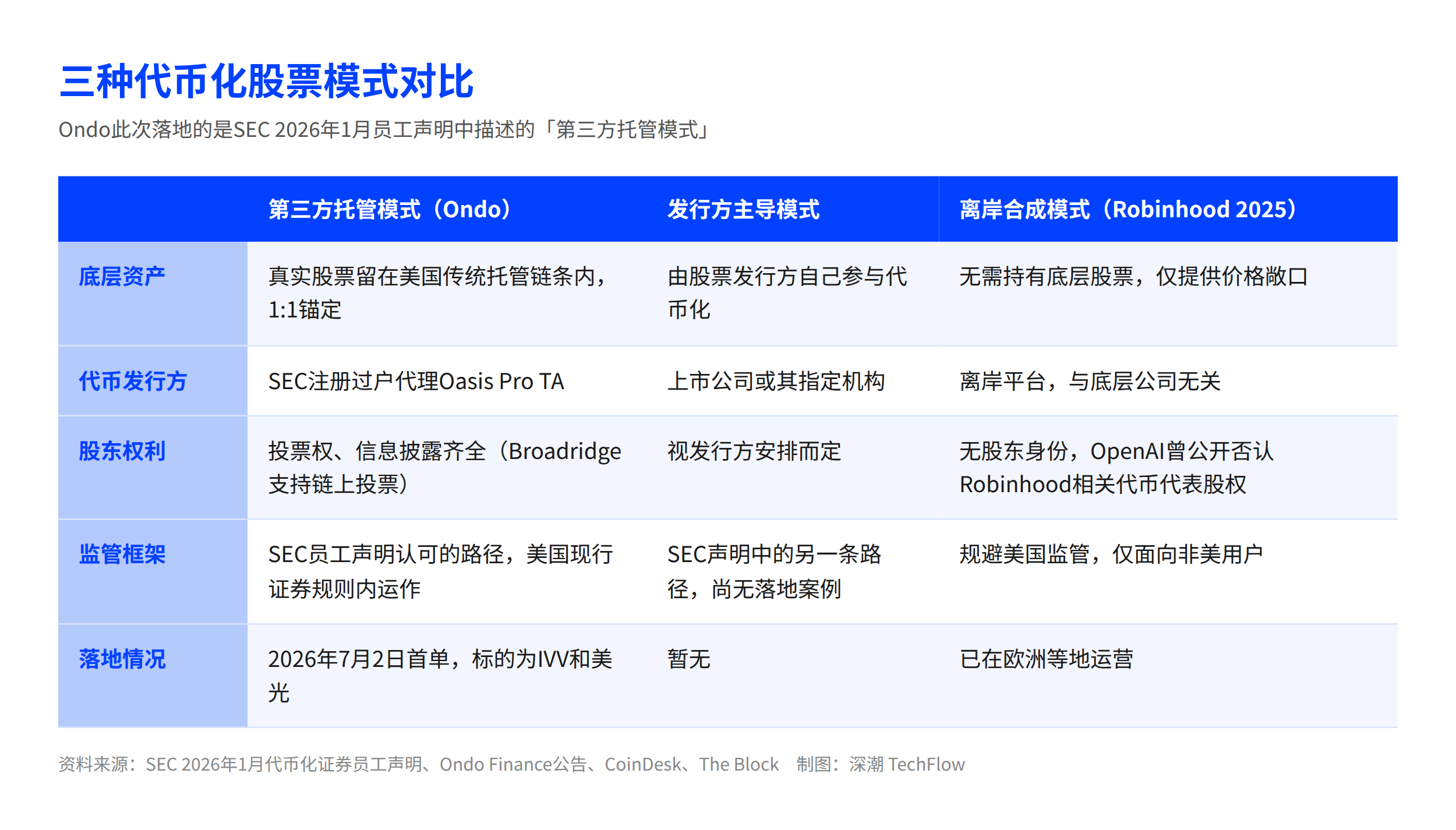
In terms of specific structure, the underlying IVV and Micron stocks remain within the U.S. traditional custody chain, held by a regulated custodian. The SEC-registered transfer agent Oasis Pro TA, which Ondo acquired last year, mints corresponding tokens on Ethereum at a 1:1 ratio, and transfer restrictions are enforced by participating brokers, transfer agents, and custodians.
According to Ondo, its overseas Global Markets platform has currently tokenized over $1 billion in stocks and ETFs, covering more than 430 securities, making it the industry leader by total value of tokenized securities. This is the first time the company has extended its business into the U.S. domestic framework.
Fundamentally different from the model that Robinhood was slapped by OpenAI
For ordinary investors, the real concern about this release is whether the tokenized stocks they buy actually count as equity.
This issue caused a stir last year. After Robinhood launched tokenized products linked to OpenAI shares in Europe, OpenAI publicly stated that it had not authorized the product and warned that these tokens do not represent company equity. Those products belonged to a “synthetic model,” where the issuer had no relationship with the underlying company, and investors received only price exposure, without shareholder identity.
The SEC's staff statement in January provided an alternative path. In the third-party custody model, regulated intermediaries hold real stocks and reissue on-chain tokens representing the rights of holders. According to The Block, the products from Ondo are structured around this framework, allowing token holders to obtain the same shareholder rights and protections as investors in traditional brokerage accounts, including issuer notices and on-chain proxy voting.
From a holding perspective, this distinction means that tokens in the custody model have real stocks behind them, along with voting rights and information disclosures, while the synthetic model only has a price shadow.
Wall Street's traditional infrastructure Broadridge involved in overseeing votes
Another signal from this release is the deep participation of traditional financial infrastructure.
Broadridge (NYSE symbol BR) is a giant in the field of shareholder communications and proxy voting in the U.S., with a large number of U.S. listed companies conducting shareholder votes on its ProxyVote.com platform. In this collaboration, Broadridge is responsible for providing proxy voting, regulatory disclosures, and shareholder communication services for Ondo’s token holders, allowing them to participate directly in voting on-chain.
Doug DeSchutter, President of Broadridge’s Investor Communications Solutions business, stated in a statement, “By providing Ondo’s token holders with proxy voting, issuer communications, and regulatory disclosures, we fulfill our commitment to provide complete and credible governance capabilities for investors and issuers, regardless of the structure in which the asset exists.”
The tokenization sector has seen considerable activity recently. Robinhood launched its own public chain on July 1 and expanded its tokenized stocks beyond Europe, while DTCC (Depository Trust & Clearing Corporation) announced in May that it would introduce tokenized assets to the Stellar chain. Nasdaq received SEC approval in March to initiate tokenized securities trading, and the New York Stock Exchange has also announced related plans. According to a report from Citigroup in June cited by CoinDesk, the market size of tokenized securities could reach $5.5 trillion by 2030.
Not open to U.S. investors for now, two risk points to note
For readers wanting to participate, there are two things that need to temper expectations.
First, according to CoinDesk, this product is currently not open to U.S. investors. Ondo is more focused on validating the feasibility of the structure, and the timing for opening to U.S. retail investors is still undecided.
Second, the SEC’s January statement is classified as a staff statement and only represents the thoughts and directions of regulators, without the formal rule-making authority of the committee. In other words, the compliance status of this model still carries the possibility of being modified by subsequent formal rules.
For ONDO token holders, as of the time of writing, ONDO is priced at approximately $0.33, up about 4% in 24 hours. The news has limited direct impact on the token price, and the mid-term logic depends on when U.S. investors can actually purchase these products, and whether the custody model can expand from the two tokens to the more than 430 securities on Ondo's overseas platform. Until these two milestones are achieved, the significance of this release primarily lies in the regulatory aspect rather than the revenue aspect.
免责声明:本文章仅代表作者个人观点,不代表本平台的立场和观点。本文章仅供信息分享,不构成对任何人的任何投资建议。用户与作者之间的任何争议,与本平台无关。如网页中刊载的文章或图片涉及侵权,请提供相关的权利证明和身份证明发送邮件到support@aicoin.com,本平台相关工作人员将会进行核查。


