Author: Xia Luo, Deep Tide TechFlow
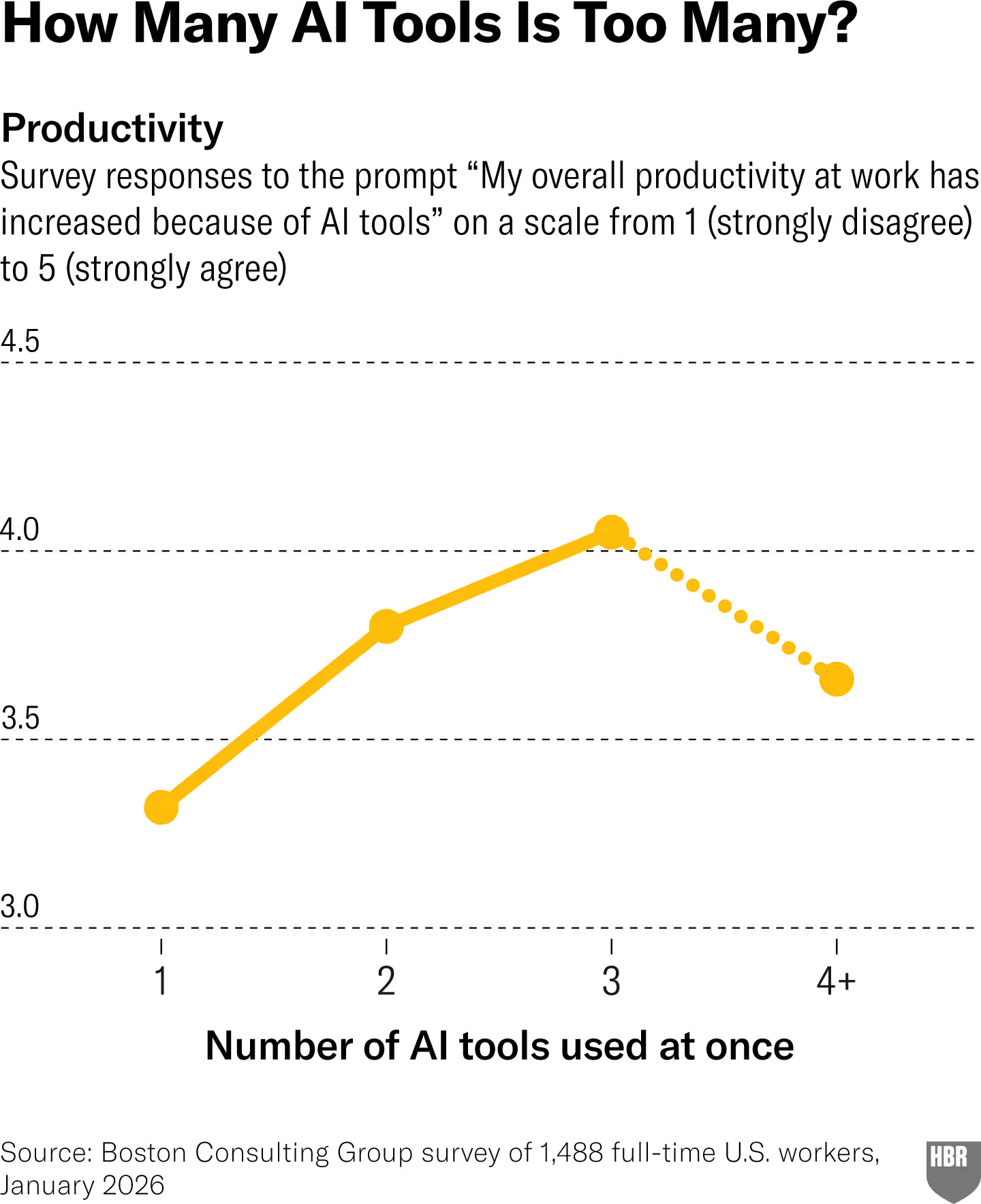
Boston Consulting Group (BCG) in collaboration with Harvard Business Review released a recent study showing that 14% of employees in large American companies are experiencing a form of cognitive overload called "AI brain fry," manifested as brain fog, headaches, and slowed decision-making. The study found that productivity significantly increases when using 1 to 3 AI tools, but drops sharply when exceeding 4 tools. 34% of employees reporting "brain fry" are actively considering leaving their jobs. BCG Research Director Julie Bedard candidly stated on the podcast Hard Fork that she is "quite pessimistic" about humanity overcoming this issue in the short term.
AI should make things easier, but more and more heavy users are finding themselves dragged into an unprecedented mental fatigue by these "productivity tools."
In a study published in Harvard Business Review in March this year, BCG named this phenomenon "AI brain fry," defining it as cognitive exhaustion resulting from excessive use or oversight of AI tools. Among the 1,488 full-time employees surveyed in the U.S., many described a persistent "buzzing sensation" or brain fog after prolonged use of AI, forcing them to take breaks from screens; some even carried this feeling home.
Increase efficiency with 3 tools, collapse with 4 tools
The BCG research team surveyed 1,488 full-time employees in large U.S. companies across various industries and found a clear threshold: when using 1 to 2 AI tools, productivity showed a significant jump; the increase diminished with the addition of the 3rd tool; beyond the 4th tool, self-reported productivity began to decline. The issue is not that the tools themselves have malfunctioned, but that the cognitive load of managing these tools has consumed their value.
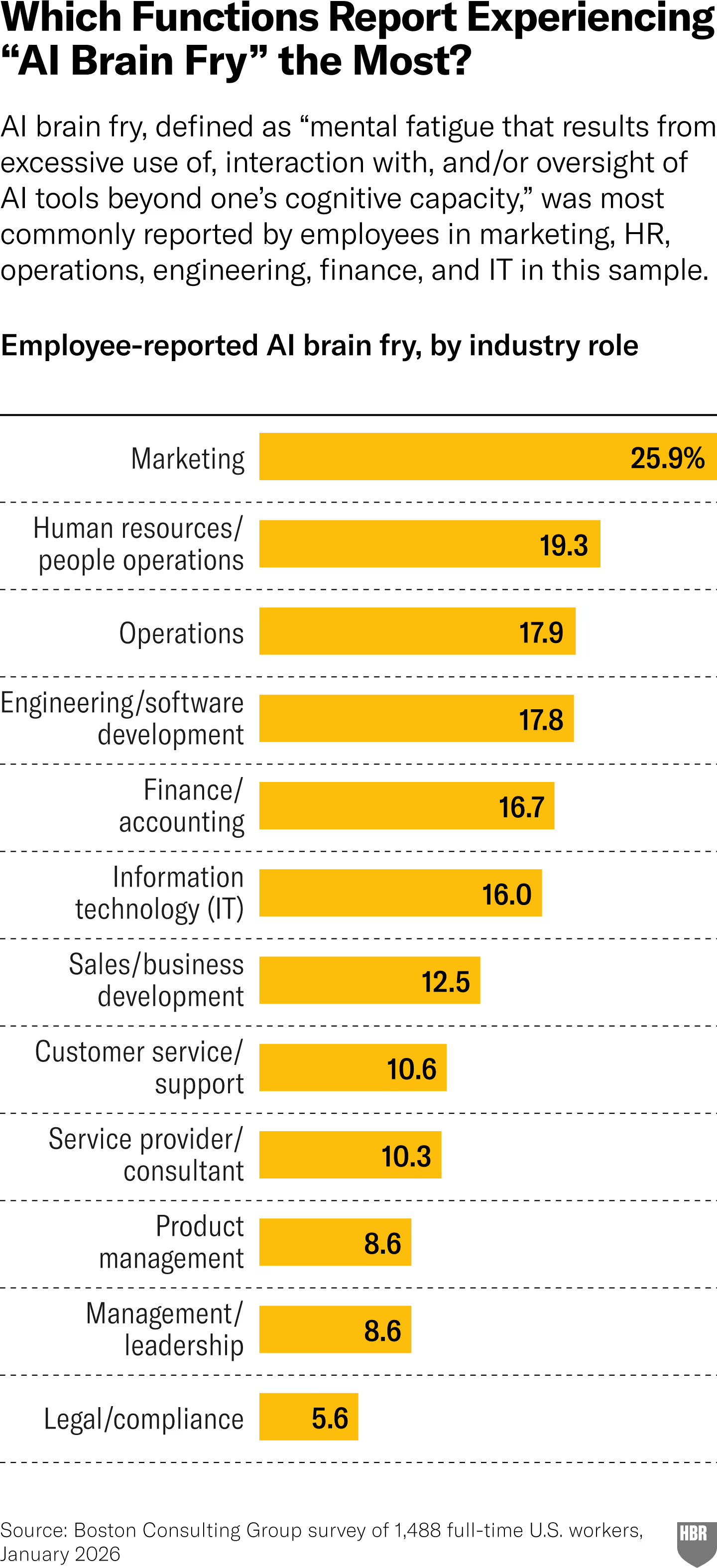
14% of respondents reported symptoms of "AI brain fry," including brain fog, headaches, and slowed decision-making speed. The incidence is higher in marketing, human resources, operations, and software engineering than in legal and compliance departments.
The downstream effects revealed by the data are equally concerning: when AI-related work requires high-intensity supervision (such as line-by-line reviewing of text generated by large models), employees exert 14% more cognitive effort, experience 12% more mental fatigue, and feel 19% more information overload. Among the employees reporting "brain fry," 34% showed clear intent to leave, compared to 25% among those who did not report such symptoms. BCG cited an estimate from Gartner suggesting that a company with $5 billion in revenue could lose about $150 million annually due to decreased decision quality.
Julie Bedard of BCG told Fortune Magazine that while people are indeed doing more work with AI, they also feel their cognitive capacity is at its limit, overwhelmed by too many decisions and unable to process information quickly enough to keep pace with the tools. She subsequently stated more bluntly on the tech podcast Hard Fork that she is "quite pessimistic" about humanity overcoming the "brain fry" problem in the short term.
Programmers are most affected, "AI vampire" becomes a popular concept
The hardest-hit group currently is software developers. The capabilities of AI programming agents have advanced rapidly, writing code much faster than humans, but reviewing AI-written code is more exhausting than reviewing code written by humans. Software engineer Siddhant Khare wrote in his blog that AI-generated code requires even more careful scrutiny. Canadian programmer Adam Mackintosh expressed that having to sign off on hundreds of lines of AI-written code, worrying about potential security vulnerabilities or not being able to understand the entire codebase, is "very scary."
Senior programmer Steve Yegge launched Gas Town in January (a multi-agent coordination system allowing developers to schedule 20 to 30 AI programming agents simultaneously) but later issued a contrary warning in a Medium article in February titled "AI Vampire." He compared AI's consumption of human energy to the "energy vampire" Colin Robinson from the TV show What We Do in the Shadows, where production surges while human energy is continuously drained.
Yegge described a common phenomenon in his article: programming with agents is addictive, with each prompt acting like pulling a slot machine lever, randomly producing rewards and "jackpots." People boast on social media about their 40-hour marathon with Claude Code, inspiring others to follow suit, while entrepreneurs are consuming themselves and their teams at an unprecedented rate, chasing a batch of highly homogenous ideas. He wrote that this is a gold rush where everyone is running until exhaustion, yet no one is truly winning the race.
Ben Wigler, co-founder of LoveMind AI, termed this a "brand new type of cognitive load," stating that users must "watch these models like babysitters." Tim Norton, founder of AI integration consulting firm nouvreLabs, pointed out on the X platform that the real cause of burnout is not those who casually try AI, but rather the heavy users who create numerous agents and require ongoing management.
Francesco Bonacci, founder of Cua AI, described a paradox he called "atmosphere programming paralysis" in an X post: the stronger the AI capability, the more you feel the need to use it; the more you use it, the more fragmented your attention becomes; and the more fragmented your attention is, the less you actually deliver. The result is not a empowered, high-output employee, but a mountain of unfinished projects and a bewildered human.
Does AI truly enhance productivity? Conflicting data
Amid the promises of productivity surrounding AI, the market is sending entirely opposite signals.
Positive evidence: An estimate from the Federal Reserve Bank of St. Louis in February this year suggested that generative AI contributed about 1.1% growth in overall productivity, which translates to a productivity increase of approximately 33% for employees using AI each hour. Former Meta senior engineering leader Erik Meijer lamented that Anthropic's Claude Code has "pushed the technological frontier of software engineering beyond the level of 75 years of academic research" in just months.
Negative evidence: A March analysis report from Goldman Sachs pointed out that no meaningful correlation could be found between "AI adoption and productivity" at the overall economic level, noting that AI is only effective in two specific scenarios: customer service and software development tasks. A survey covering 6,000 C-level executives was even more sobering: 90% of respondents reported no substantial impact of AI on their company's productivity or employment over the past three years, predicting only a 1.4% productivity increase from AI over the next three years.
A research team from the University of California, Berkeley, conducted an 8-month tracking study of a 200-person technology company in America, concluding that while AI did indeed increase employee workload, it also led to more burnout, ultimately dragging down work efficiency in the long run. The researchers judged that AI did not lighten the workload; rather, it intensified it, requiring employees to handle more information and blurring the boundaries between work and non-work.
BCG's "prescription": not to give up AI, but to redesign work
BCG's research also found a positive signal: when AI merely replaced repetitive tasks, traditional feelings of burnout among employees actually decreased. Bedard emphasized that "brain fry" is different from traditional occupational burnout; the former is acute cognitive overload, while the latter is chronic emotional exhaustion, with both operating through different neural mechanisms.
BCG's suggestion is that the problem lies not in whether to use AI, but in how to deploy it. Too many companies simply stack AI onto existing job responsibilities without redesigning roles. When management provides training and support for using AI, symptoms of "brain fry" significantly diminish. The Berkeley research team recommends concentrating tasks requiring AI tools in specific periods of the workday for batch processing, and deliberately scheduling breaks away from screens before making high-difficulty decisions.
However, Wigler from LoveMind AI is not optimistic about this. He pointed out that self-care has never been a core value in the American workplace, and he is skeptical about whether this issue can be resolved in a healthy or high-quality manner.
免责声明:本文章仅代表作者个人观点,不代表本平台的立场和观点。本文章仅供信息分享,不构成对任何人的任何投资建议。用户与作者之间的任何争议,与本平台无关。如网页中刊载的文章或图片涉及侵权,请提供相关的权利证明和身份证明发送邮件到support@aicoin.com,本平台相关工作人员将会进行核查。


