Author: ethn, a16z
Compiled by: 深潮 TechFlow
Deep Tide Intro: a16z released the sixth edition of the generative AI consumer application list. ChatGPT's weekly active users reached 900 million, but Gemini and Claude's paid growth is even more rapid, and the battle for "default AI assistant" has officially begun.
The biggest change in this edition is the inclusion of established products like CapCut, Canva, and Notion, which "have made AI features core," into the rankings, and for the first time, it covers agents, AI browsers, and desktop tools.
The author Olivia Moore is a partner in the a16z consumer team, and this report is one of the most systematic public data sets tracking the landscape of AI consumer applications currently available.
The full text is as follows:
Three years ago, we released the first edition of this list, with a simple goal: to understand which generative AI products are genuinely used by mainstream consumers. At that time, the boundary between "AI-native" companies and others was clear. ChatGPT, Midjourney, and Character.AI were products built from scratch around foundational models, while the rest of the software world was still exploring how to use this technology.
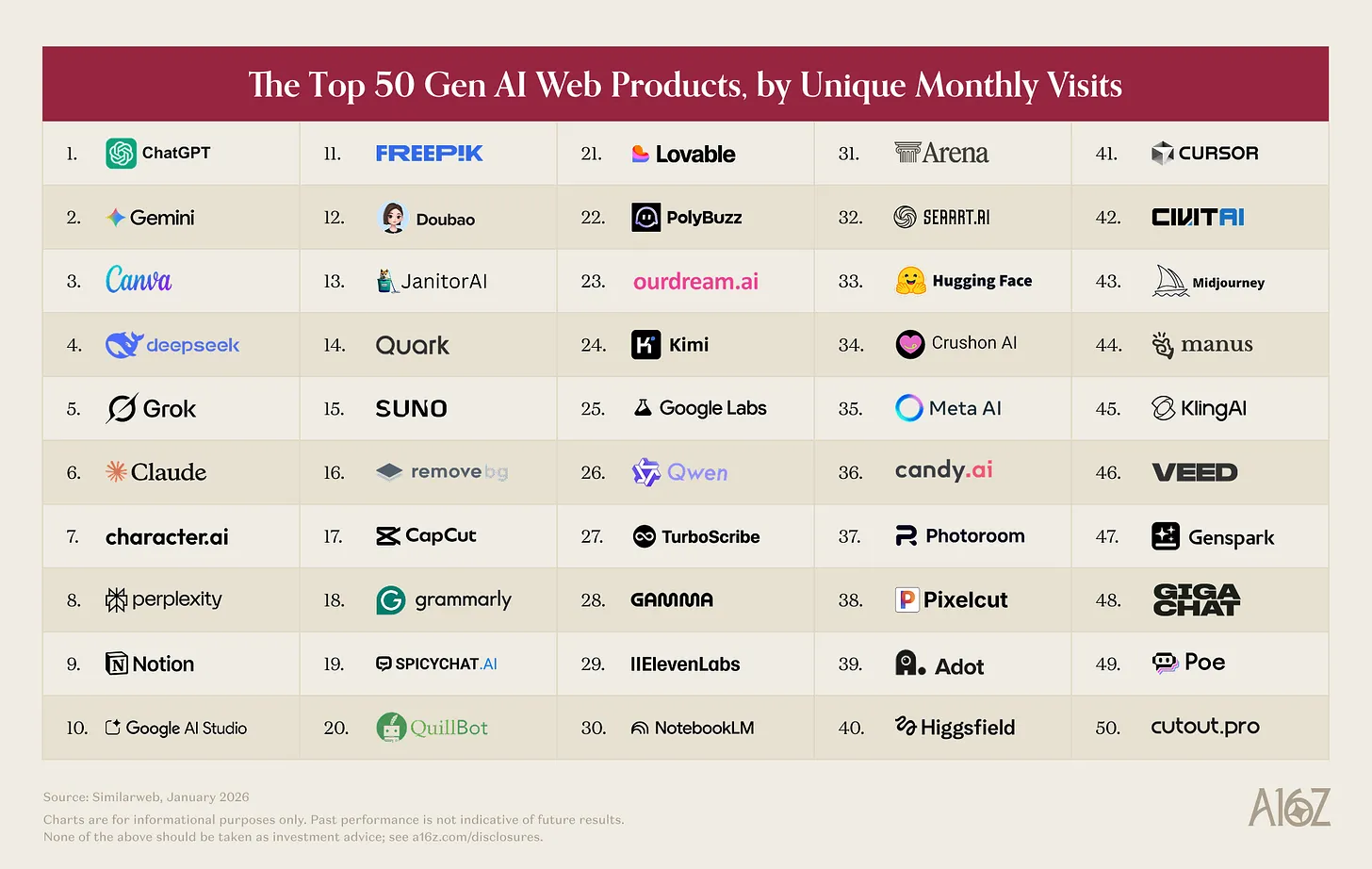
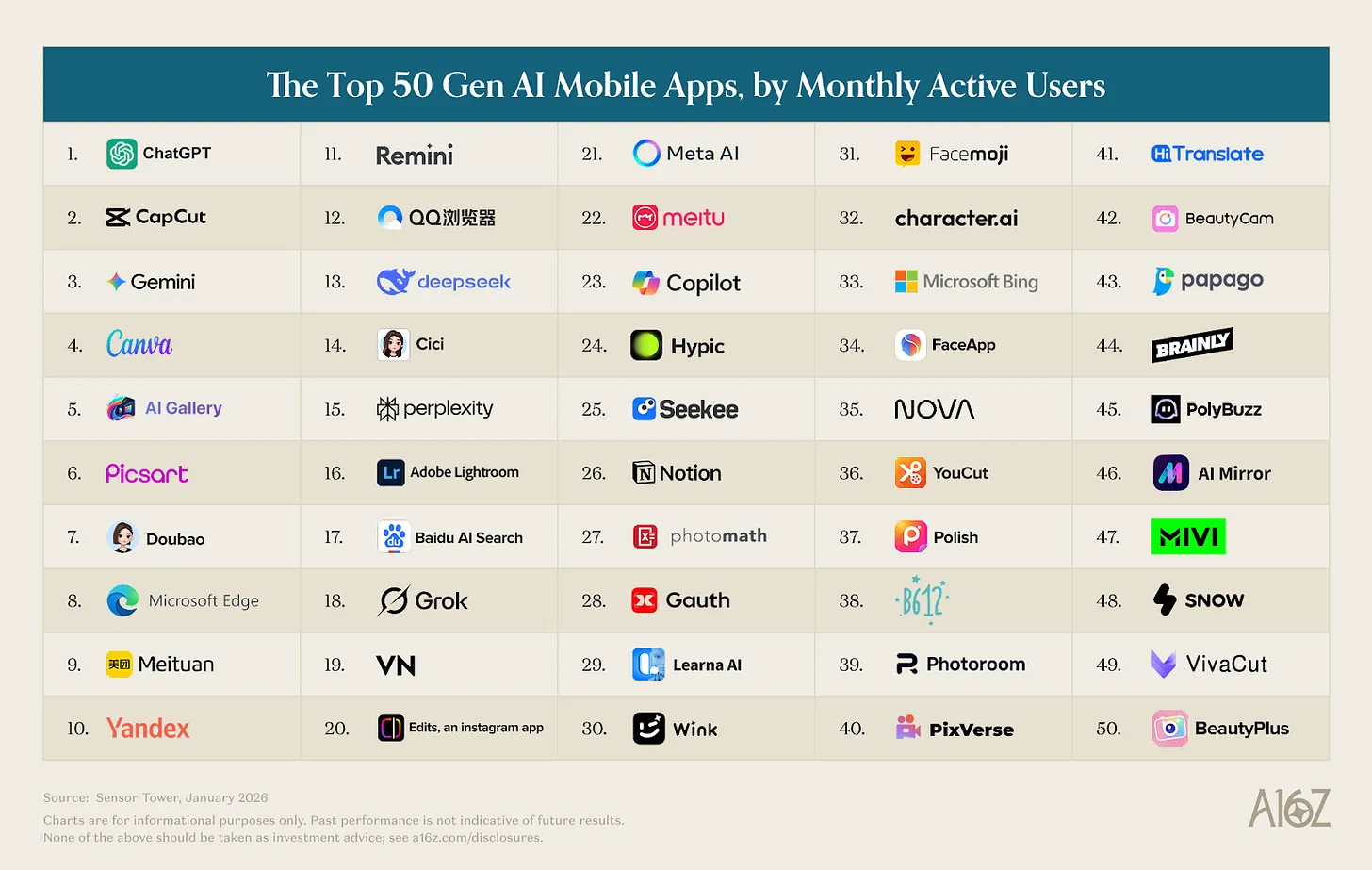
This boundary is no longer valid. CapCut is a video editor with 736 million monthly active mobile users, and its most popular features are entirely powered by AI—background removal, AI effects, automatic subtitles, and text-to-video. Canva's growth engine is completely built on Magic Suite AI tools. Notion’s paid AI attachment rate surged from 20% to over 50% in one year, with AI features currently contributing about half of the ARR.
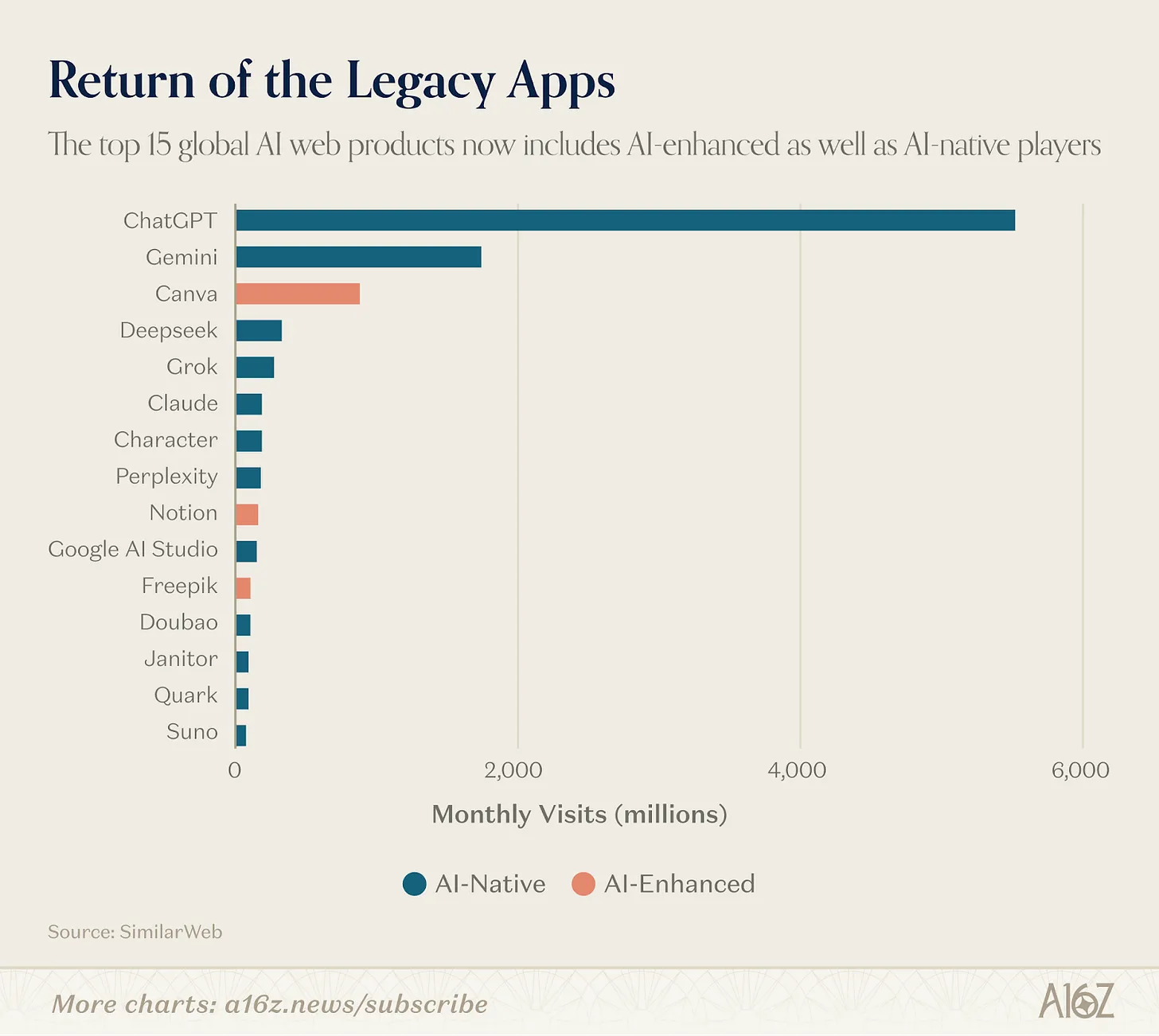
Starting from this edition, we expanded the scope to include all consumer products that have made generative AI the core experience, including CapCut, Canva, Notion, Picsart, Freepik, and Grammarly. We believe this can more accurately reflect how people actually use AI, though the top-ranked products are mostly still AI-native.
Caption: Complete list of the Top 100 generative AI consumer applications as of March 2026
As before, the web rankings are based on monthly unique visitors (data from SimilarWeb as of January 2026), and the mobile rankings are based on monthly active users (data from Sensor Tower as of January 2026). Here are our core findings:
1. ChatGPT leads, but the "default AI" battle has begun
ChatGPT remains the largest consumer-grade AI product, significantly ahead. Its web traffic is 2.7 times that of second place Gemini, and monthly active users on mobile are 2.5 times Gemini’s. ChatGPT's weekly active users grew by 500 million in the past year, currently reaching 900 million. Given that the larger the scale, the harder it is to grow, this number is astounding—over 10% of the global population uses ChatGPT weekly.
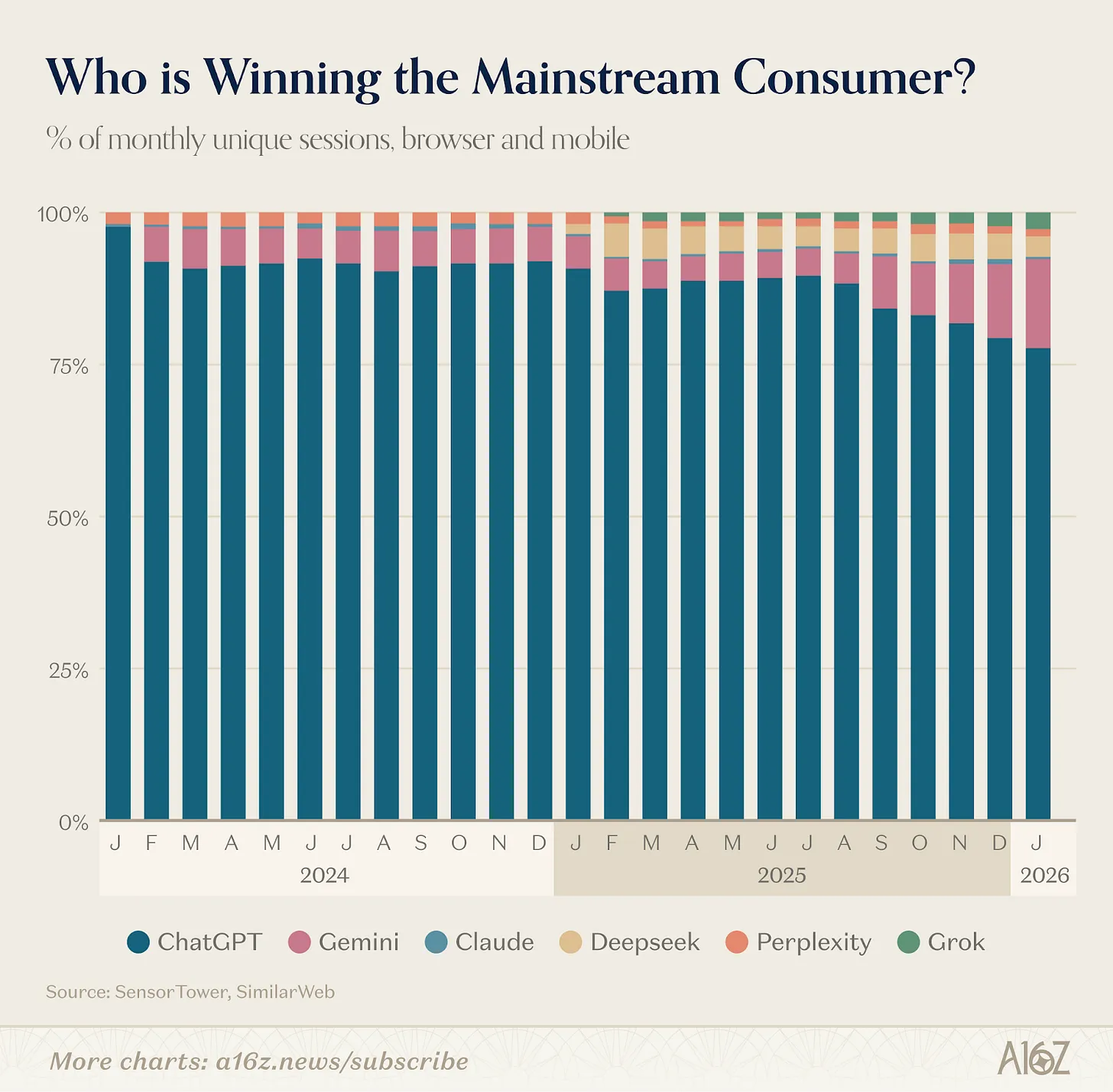
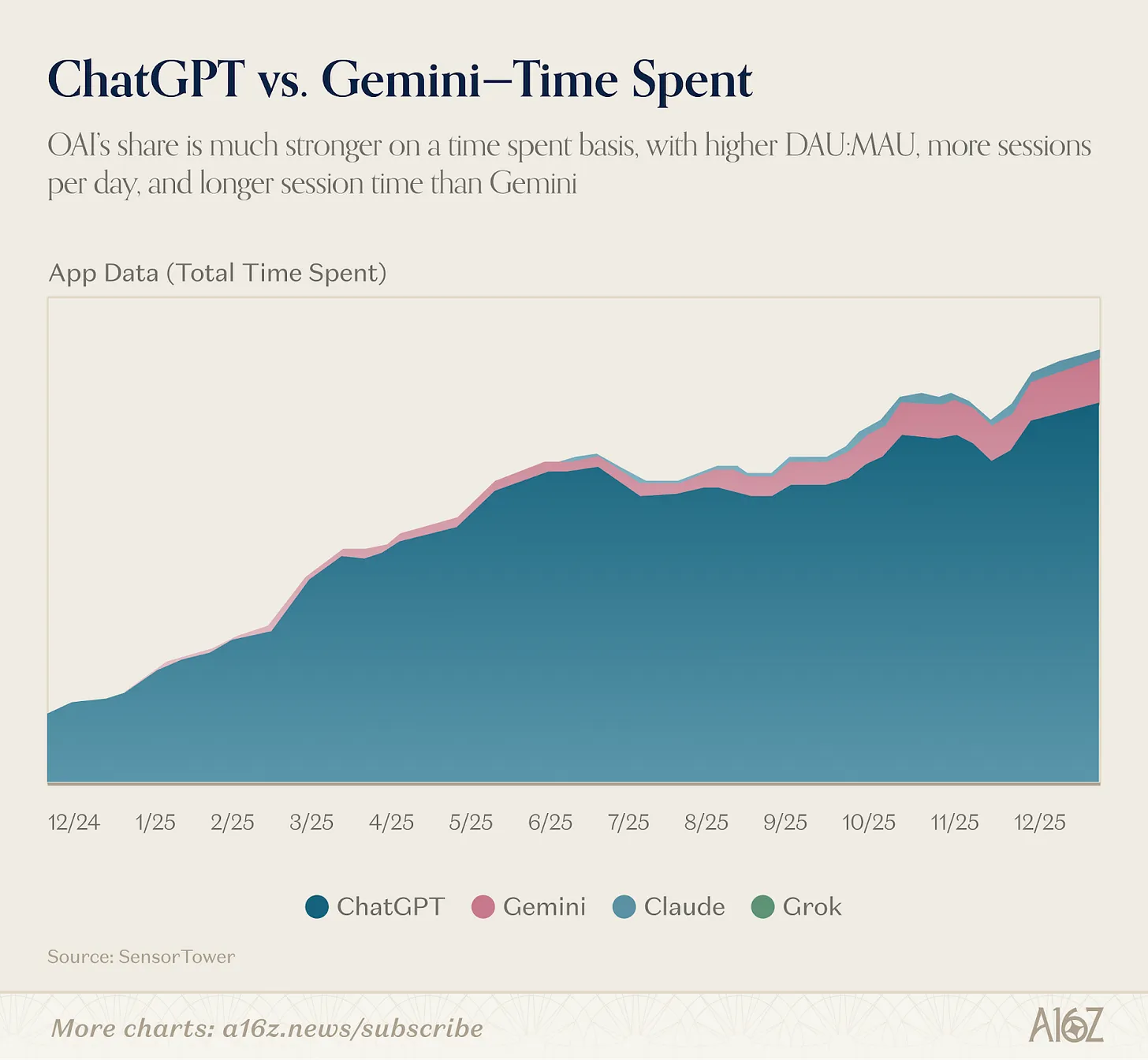
However, we are starting to see the field widen, with other general platforms making moves in specific scenarios. Both Gemini and Claude accelerated in paid subscriptions in the U.S. over the past year (though still far behind ChatGPT—ChatGPT's paid users are 8 times that of Claude and 4 times that of Gemini). According to Yipit Data, as of January 2026, Claude's paid user growth year-over-year exceeded 200%, while Gemini's was 258%. At the same time, we are seeing more "multi-platform usage"—about 20% of ChatGPT's web weekly active users also used Gemini in the same week.
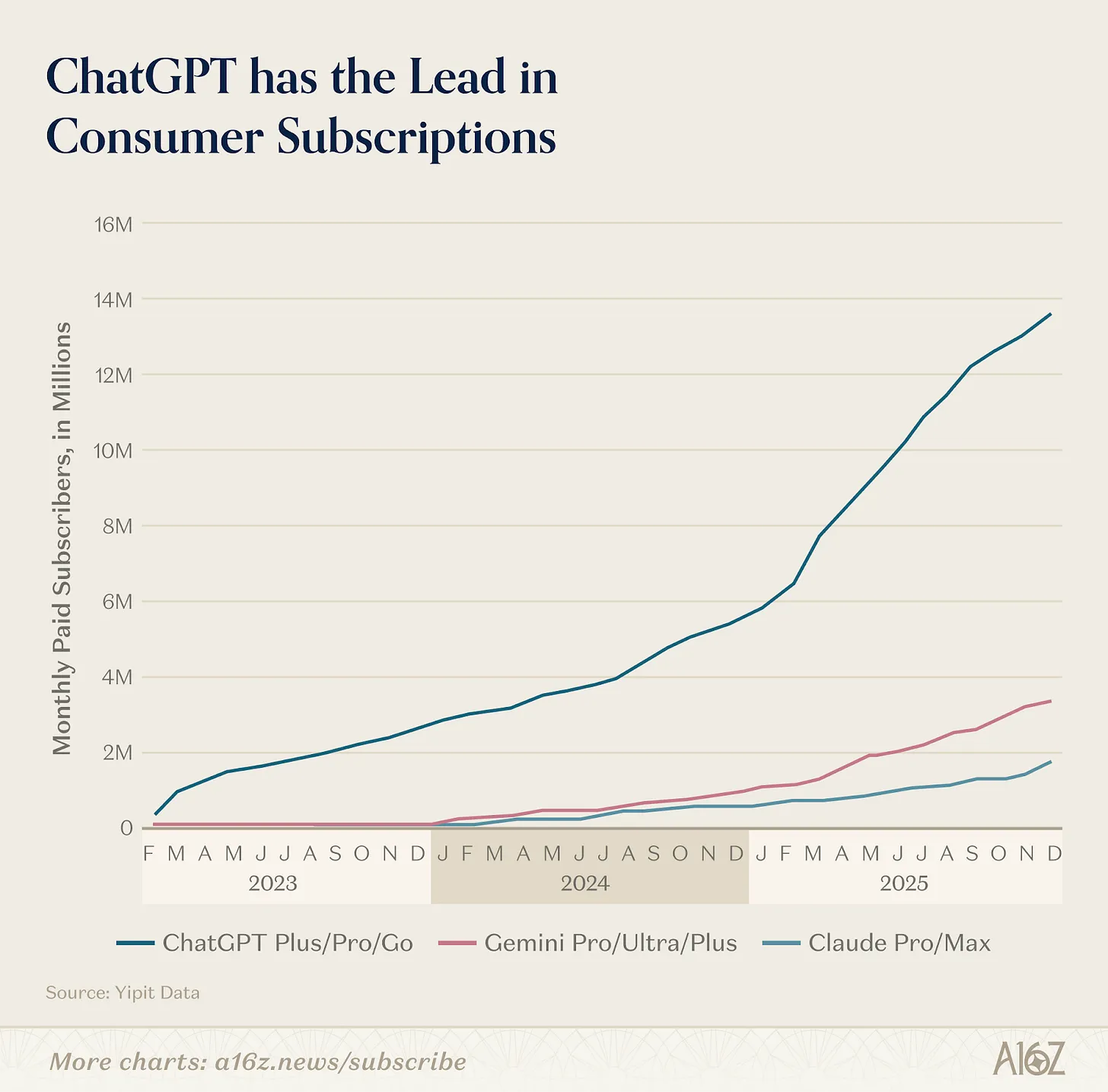
What happened? Competitors are stepping up. Google has excelled with creative models—Nano Banana produced 200 million images in its first week, bringing 10 million new users to Gemini; Veo 3 is recognized as a breakthrough moment for AI video. Anthropic is focusing on professional users, launching Cowork, Claude in Chrome, Excel and PowerPoint plugins, as well as the crucial Claude Code.
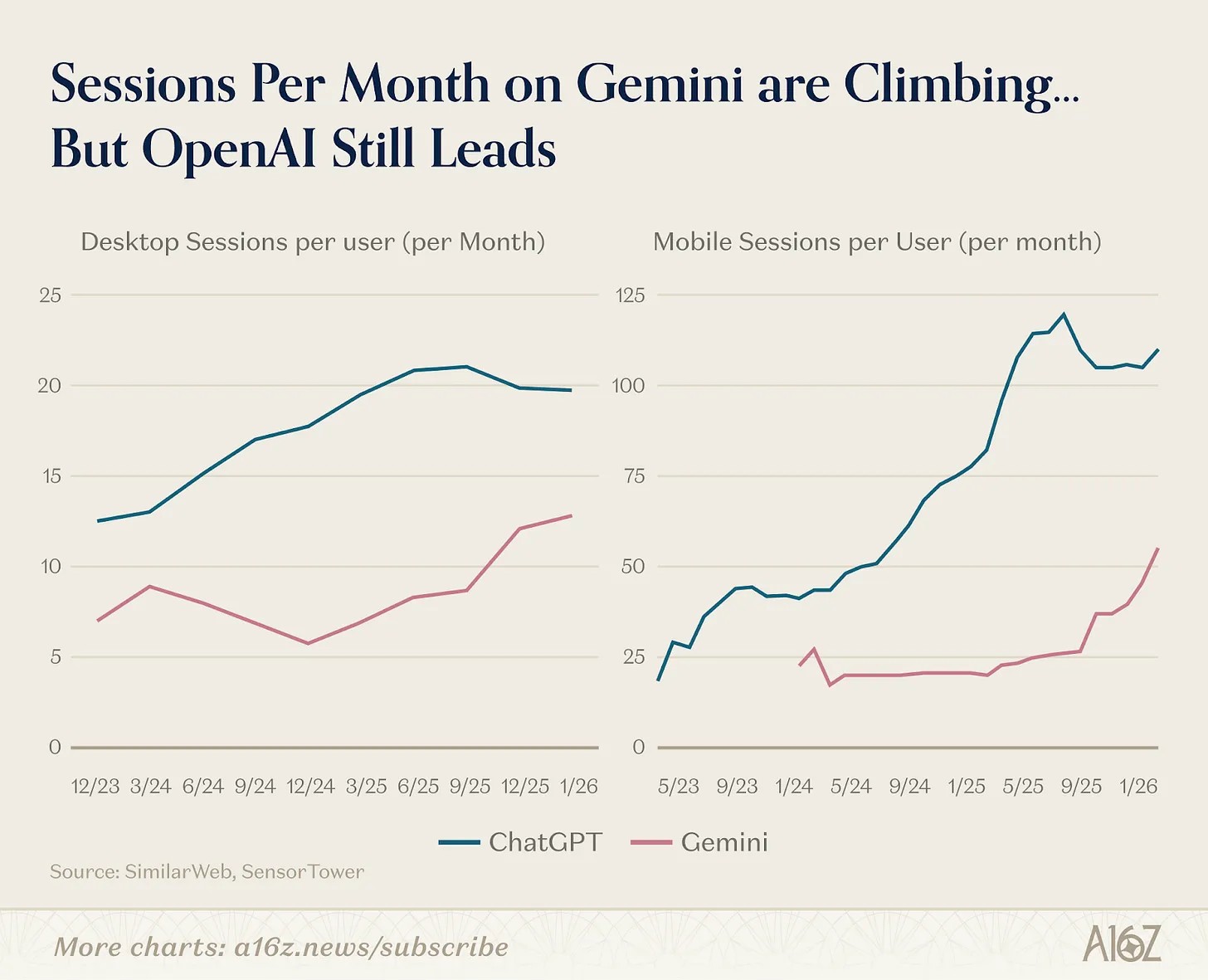
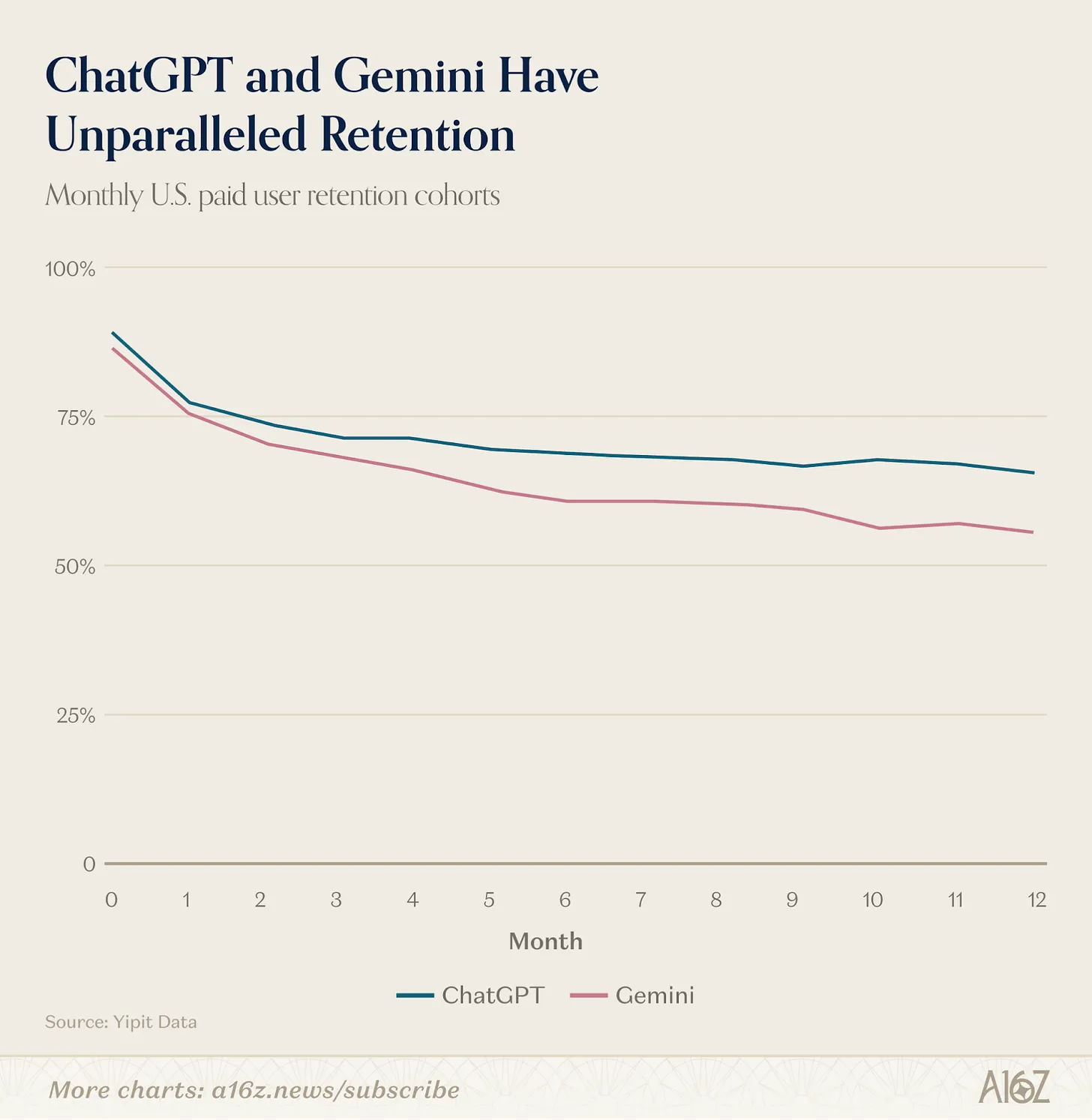
This competition is not just about who leads today but about who can establish structural barriers. Context accumulates: the more a large language model knows about you, the better the results it provides, making you more reliant on it. Early data shows that the monthly average number of sessions per user on Gemini’s web platform is rising, although ChatGPT still surpasses it by 1.3 times. On mobile, ChatGPT has an even greater advantage, with a monthly average session count per user 2.2 times that of Gemini. According to Yipit Data, both companies have top-tier user retention rates among U.S. consumer-level paid users.
The next layer of lock-in comes from app stores. ChatGPT and Claude have both launched connector ecosystems—ChatGPT has GPTs and Apps, while Claude offers MCP integrations and Connectors, allowing users to build workflows on top of assistants. Once users configure AI to connect with calendars, emails, and CRMs, the switching costs will rise sharply. Developers might focus their efforts on the platforms with the most users, creating a flywheel effect similar to early platform battles.
We are already seeing differentiation in the routes of various platforms. Sam Altman previously stated that OpenAI aims to "bring AI to the billions who cannot afford subscription fees," which is also why they started to advertise. He also mentioned that OpenAI would introduce a "Sign in with ChatGPT" identity layer, positioning the AI assistant as the default interface between consumers and the internet. The ambition is to make ChatGPT the starting point for everything: shopping, booking hotels, browsing the web, health management, and daily life.
The application directory already reflects this difference. As of the end of February, ChatGPT's app store covers 13 categories and 220 applications. Claude has about 160 selected connectors plus around 50 community MCP servers. However, there are only 41 overlapping applications between the two—approximately 11% of the combined directory, and these 41 are almost all universally needed productivity tools: Slack, Notion, Figma, Gmail, Google Calendar, HubSpot, Stripe.
Beyond core tools, the two platforms are moving in almost completely different directions. ChatGPT has over 85 exclusive applications in categories like travel, shopping, food, health, lifestyle, and entertainment, while Claude has almost none in these categories. These are all consumer transaction scenarios: booking flights on Expedia, buying groceries through Instacart, browsing listings on Zillow, tracking nutrition on MyFitnessPal. This is the most aggressive super-app approach among all AI companies. Claude's exclusive integrations lean toward professional ends: financial data terminals (PitchBook, FactSet, Moody's, MSCI), developer infrastructure (Sentry, Supabase, Snowflake, Databricks), scientific and medical tools (PubMed, Clinical Trials, Benchling), and an open-source MCP community that ChatGPT has no equivalent for.
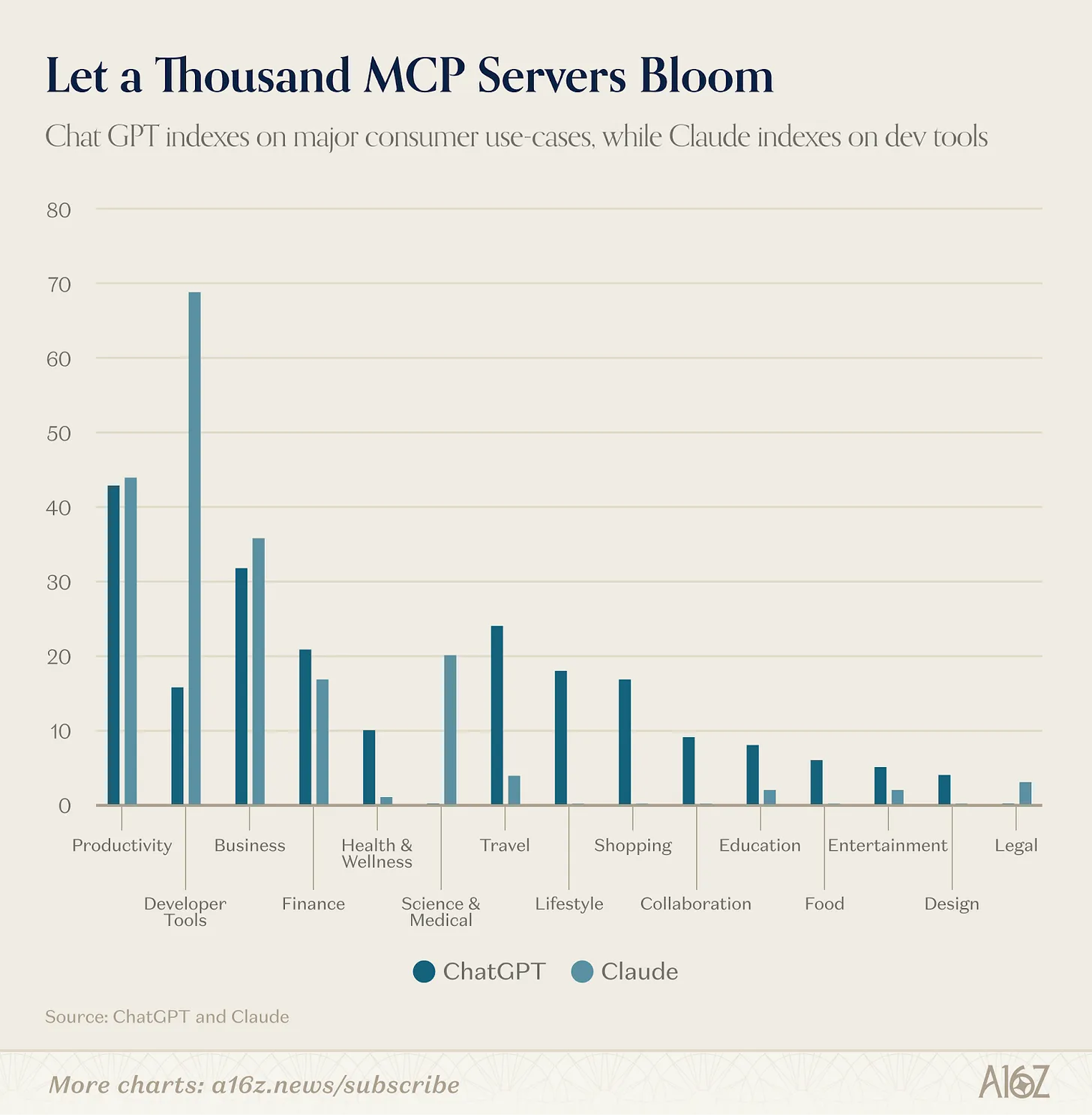
Anthropic seems focused on advanced AI users (developers, knowledge workers, etc.). These users are more willing and able to pay for high-priced direct subscriptions. While ChatGPT also has products aimed at similar audiences (like Codex, Frontier), they simultaneously express the goal of being a platform for true mass users—which may open up more monetization pathways as the user base grows. They have already been testing ads, and taking a cut from transactions is also a natural expansion direction.
If AI assistants are not just a chat window but an operating system-level environment, this competition may end up being less like the search wars—where one captures 90% of the market—and more like the mobile OS wars, where two radically different platforms each build trillion-dollar ecosystems.
2. Global usage is splitting by product
Geographically, the AI market is splitting into three distinctly different ecosystems, with widening gaps between them.
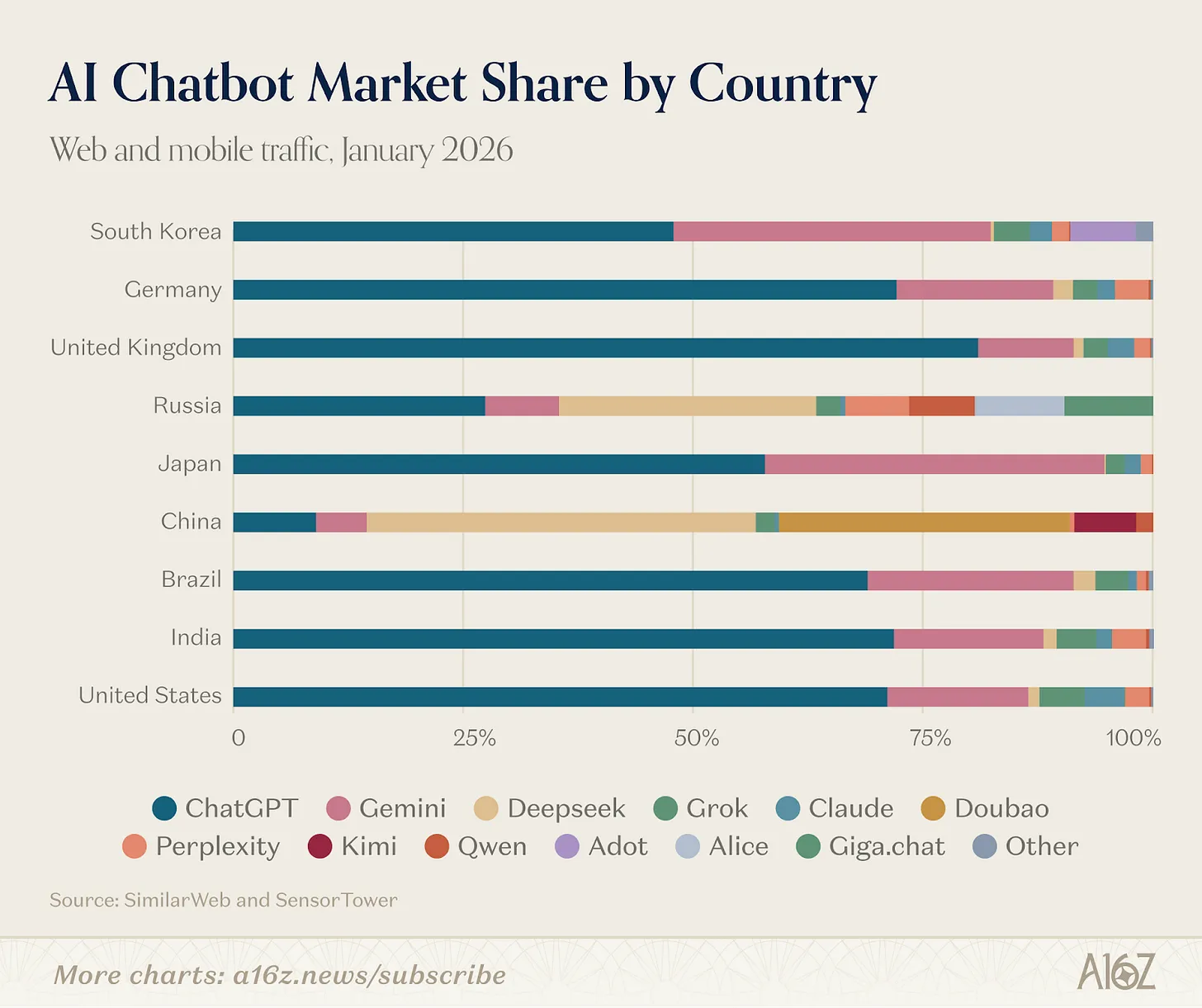
Western AI tools share a highly similar user base. The core markets of ChatGPT, Claude, Gemini, and Perplexity all originate from the same pool: the United States, India, Brazil, the United Kingdom, and Indonesia, just in different orders. None have significant usage in China or Russia. The reason is policy: since 2022, Western tech sanctions have restricted Russia's access to American AI tools; China, on the other hand, requires AI providers to register and store data locally while following censorship rules.
DeepSeek is the only product spanning multiple camps. Its web traffic is distributed across China (33.5%), Russia (7.1%), and the United States (6.6%), with a similar pattern on mobile. Chinese users also heavily use ByteDance's Doubao and local product Kimi.
Russia, which barely constituted an independent market in our earlier versions, has now become a third pole, with DeepSeek penetration ranking second. The Yandex browser integrated with the Alice AI assistant has reached 71 million monthly active users, making it one of the top ten mobile AI products globally. Sber's GigaChat also made its first appearance in our web rankings. This model mirrors China, just with a compressed timeline: sanctions created a gap, and local products filled it within two years.
To measure AI adoption per capita, we constructed a simple index combining web per capita visits and mobile per capita monthly activity, scoring between 0 and 100. The results redefine the geographic landscape. Singapore ranks first, followed by the UAE, Hong Kong, and South Korea. The U.S.—the origin of most AI products—ranks 20th.
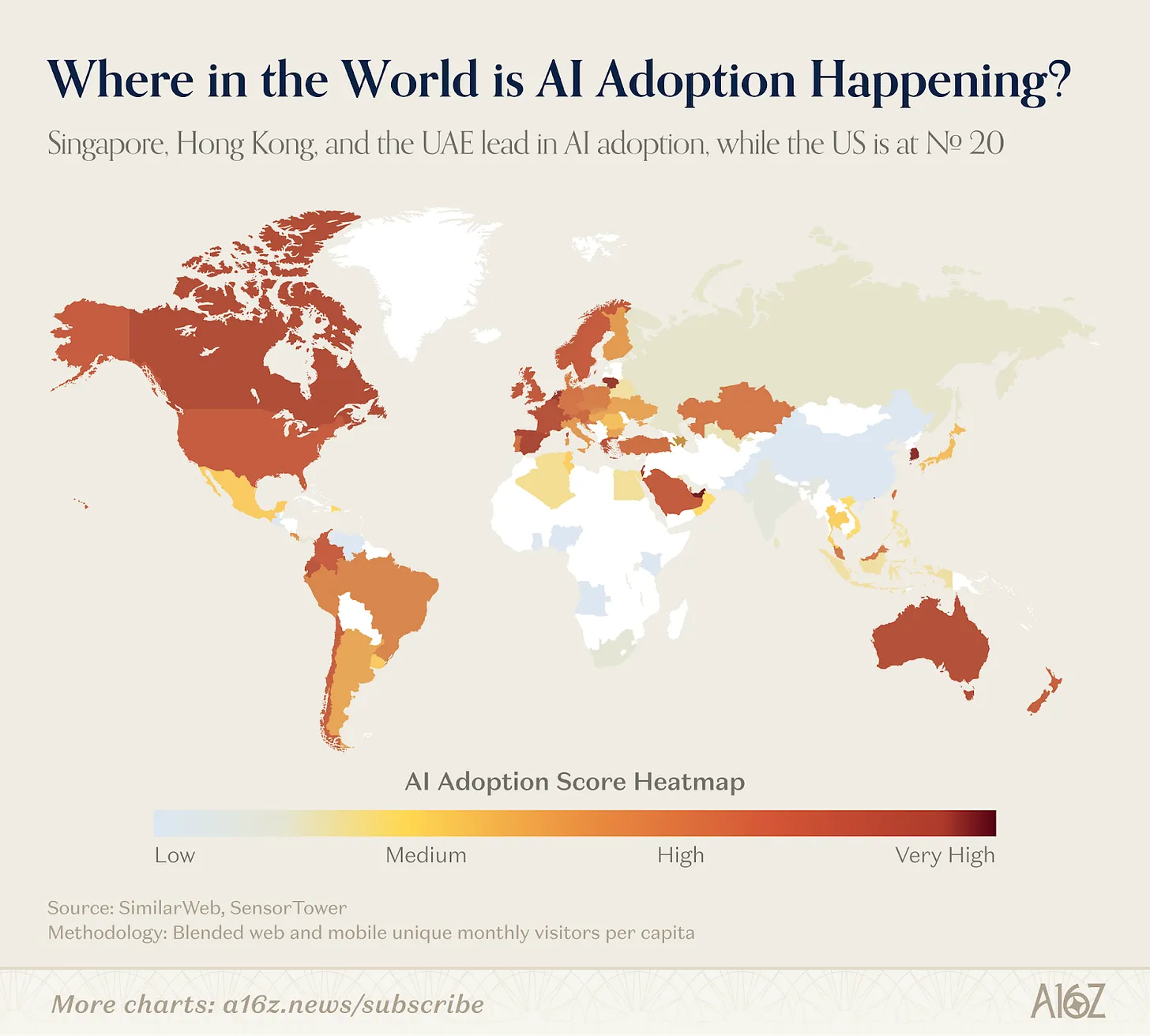
Caption: Generative AI per capita adoption index (0-100), with Singapore ranking first and the U.S. at 20th
3. Major reshuffle in creative tools
Midjourney, DALL-E, and Stable Diffusion are the products that brought most early users into the generative AI world—all three launched before ChatGPT. Image generation tools not only dominated creative categories (video and audio generation came later) but also consistently ranked high in our first three editions.
In the first edition list of September 2023, seven out of nine creative tools on the web were image generators. Three years later, only three image generators remained on the list, yet the creative tools still total seven. The difference lies in what filled the vacancies: video, music, and voice products took the spots vacated by image generation.
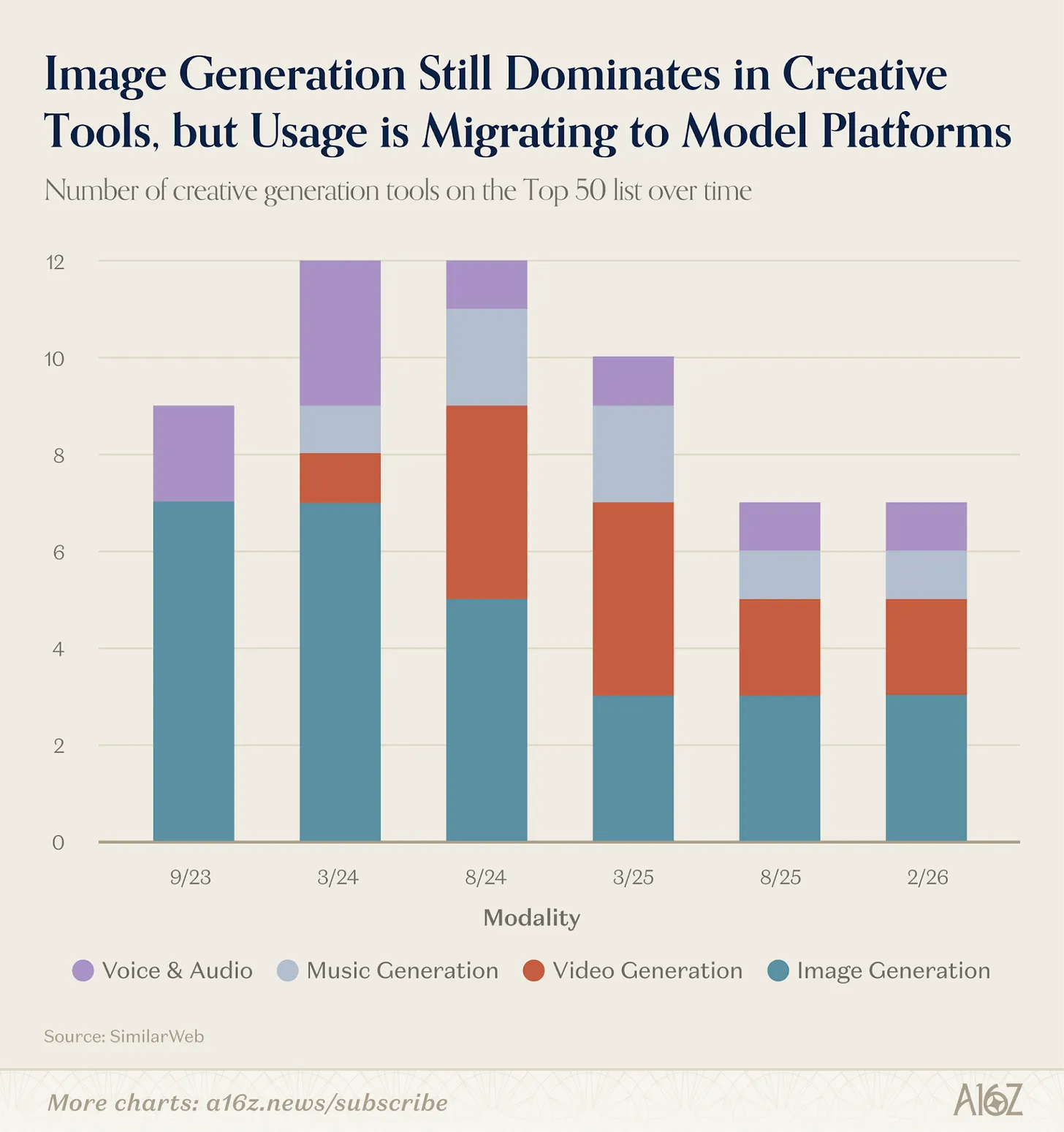
The story of image generation is one of being consumed by bundling. As the quality of integrated image models from ChatGPT (GPT Image 1.5) and Gemini (Nano Banana) has risen, the bar for independent image products has been significantly raised. Midjourney ranked in the top 10 on our first list but has now dropped to 46th place. The surviving products—Leonardo, Ideogram, CivitAI—tend to serve specific creative communities, differentiating with attitude-driven features rather than competing head-on with general generators.
Video generation is the area with the most changes in this edition. Kling AI, Hailuo, and Pixverse have all built solid user bases, with models developed in China consistently leading in output quality. Applications based on Seedance 2.0 showing up in the next edition of the list would not surprise us. Veo 3 is the first American model to close the gap, boosting Google Labs' traffic (ranking up from 36th to 25th).
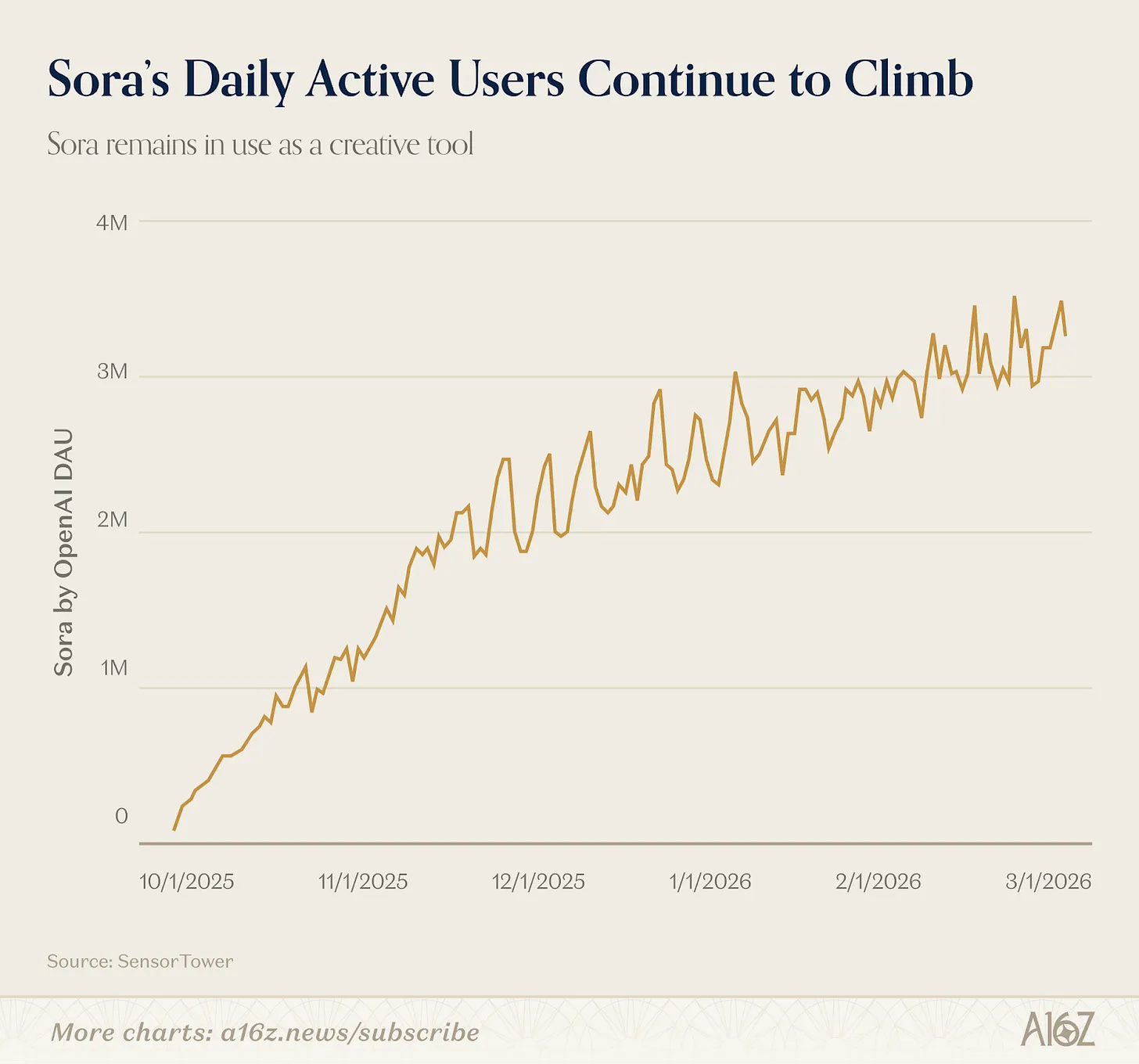
Who is missing? Sora. OpenAI launched Sora 2.0 in September 2025 as an independent application, allowing users to upload their digital avatars as Cameo, generating videos that include real people. Sora dominated the U.S. App Store for 20 consecutive days, achieving 1 million downloads faster than ChatGPT. Afterward, downloads declined because Sora failed to maintain viral growth as a social application (no one has successfully navigated the AI × social road yet), so it didn’t make it onto the mobile list this edition. However, SensorTower data shows that Sora’s mobile daily active users still exceed 3 million, and AI video creators continue to use this model even if they post their works on other platforms.
Music and voice are more defensively positioned. Suno maintained its ranking from the last edition (15th). ElevenLabs has been on the list in every edition since September 2023; its core capabilities—voice cloning, dubbing, audio production—are specialized enough that they haven’t become a checkbox feature in mega products.
To summarize the patterns: When model giants and large players like Google and OpenAI make strides in creative directions (image, and increasingly video), the traffic for independent products will get compressed—although there may still be space for products aimed outside the mainstream with more attitude and potentially higher price points. In directions where giants are not making strides (music, voice), the space for independent products is even larger.
4. The rise of Agents
The shift toward agent-based AI did not begin in this edition—it started in the previous one, with vibe coding. When Lovable, Cursor, and Bolt appeared on our March 2025 list, they represented a new thing: AI products not just answering questions or generating media, but building things for users. This is agent behavior, albeit confined to a vertical domain.
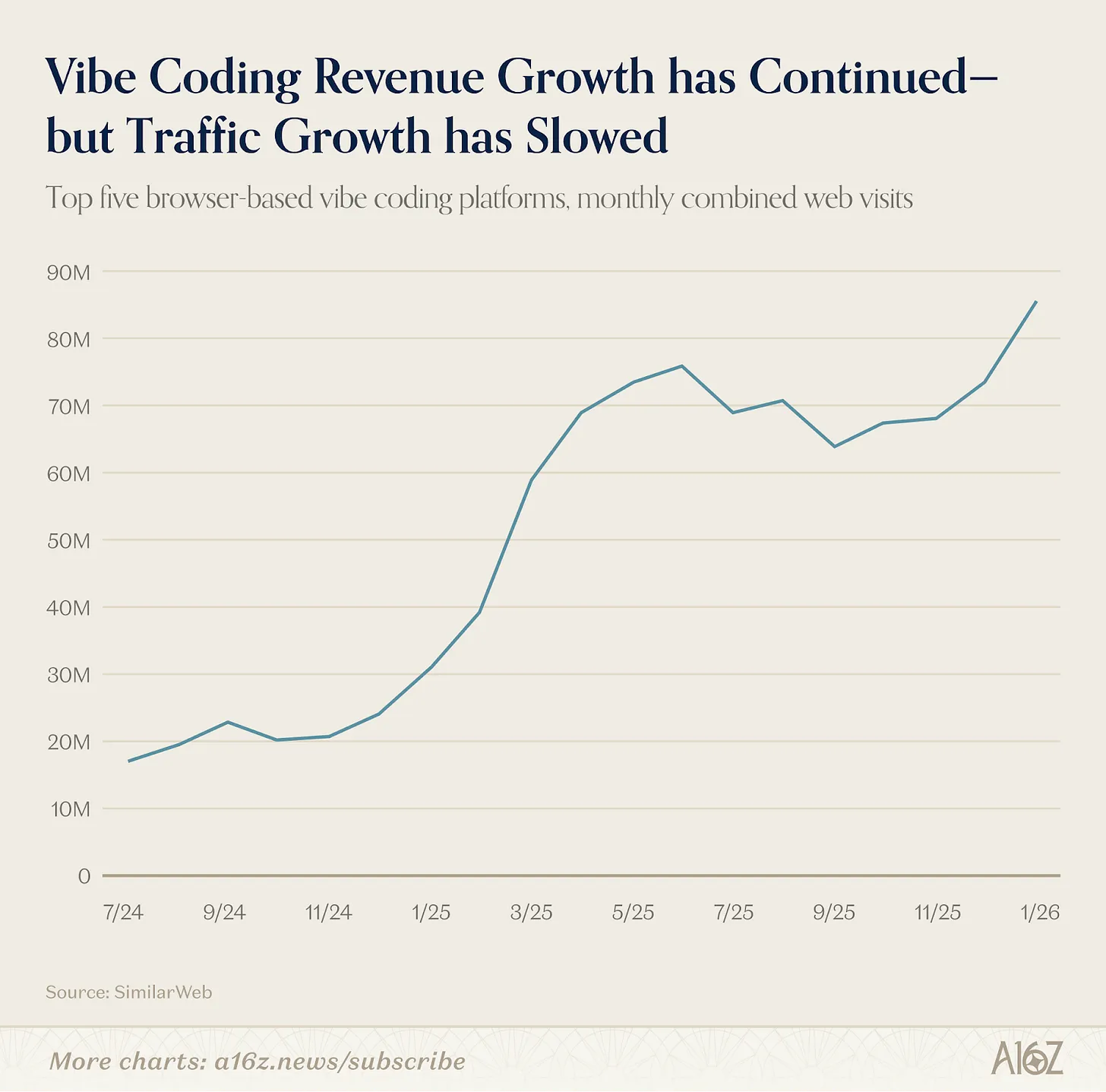
Vibe coding has proven to retain users among technical (and semi-technical) users. Both Replit and Lovable remain on the list this edition, and Claude Code (via Claude) is also included. There’s still much growth potential, as this trend has not yet truly penetrated the mass market. The traffic for the five largest vibe coding platforms is still growing, although the growth rate has slowed since the initial burst. Still, revenue for many products is rising as developers and teams deepen their usage.
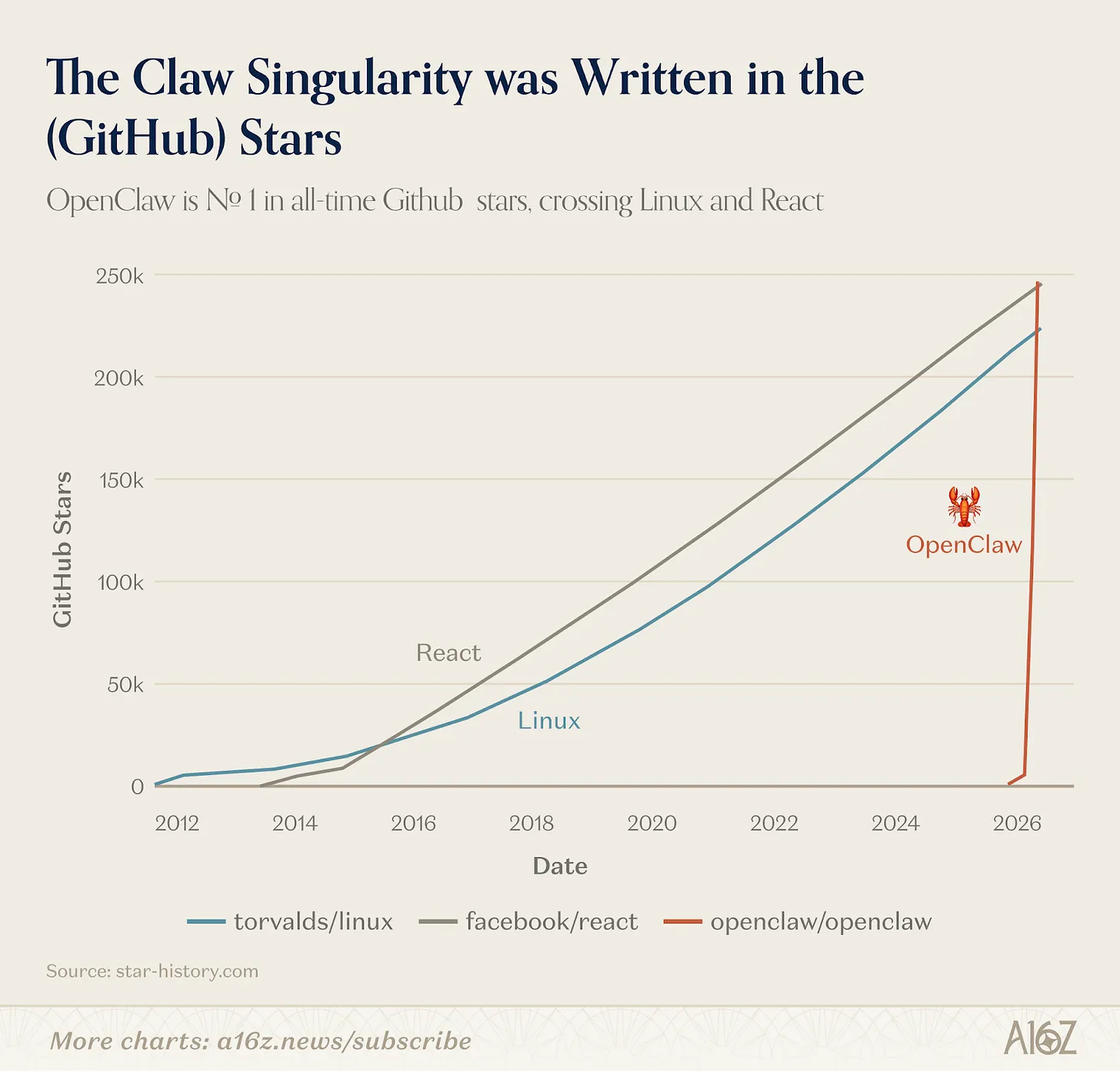
More recently, general-purpose agents have begun to emerge. In January 2026, an open-source project called OpenClaw transformed from a side project of an independent developer to a mainstream media headline with 68,000 stars on GitHub, all in just a few weeks. OpenClaw was created by Austrian developer Peter Steinberger; it's a locally running AI agent that can connect your messaging applications to carry out multi-step tasks on your behalf.
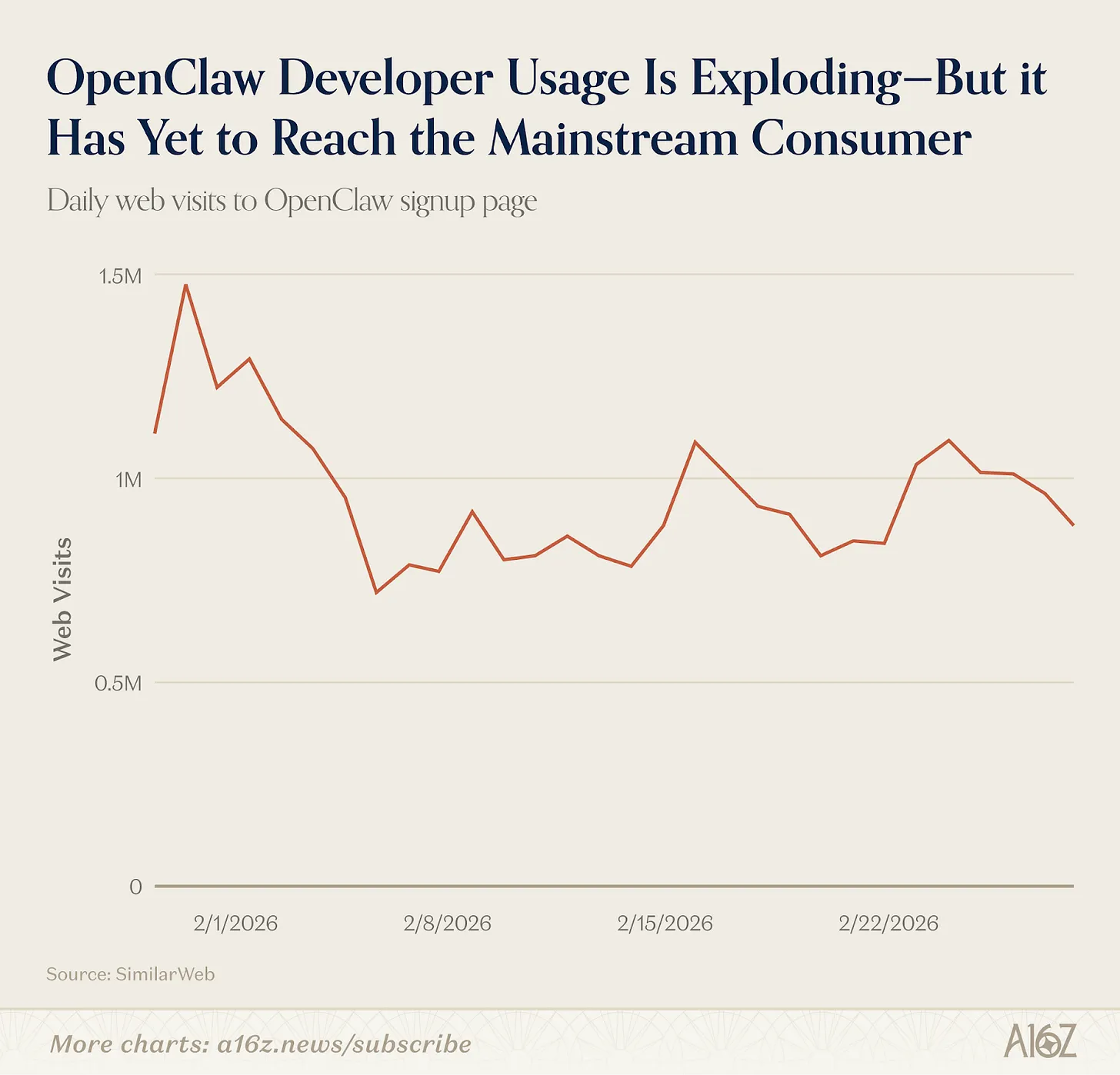
If ChatGPT was the moment consumers discovered that AI could converse, OpenClaw may be the moment consumers discover that AI can act. This product exploded in the developer community—if we push the analysis time window to February instead of January, OpenClaw could rank in the top 30 on the web.
However, OpenClaw is still not a consumer-grade product—it requires terminal knowledge for installation and maintenance. OpenClaw has continued gaining momentum among technical users, becoming the most starred project on GitHub in early March, surpassing React and Linux. But this product has yet to "graduate" to true mainstream users—at least based on new visitor data from the OpenClaw installation page, growth looks quite flat. The project was acquired by OpenAI in February 2026, which may suggest a more user-friendly version of OpenClaw is on the way.
OpenClaw is not the only general-purpose agent on the list. Manus and Genspark have also made it—both platforms allow consumers to delegate open-ended tasks (research, spreadsheet analysis, slide creation) to AI, with AI completing the entire workflow end-to-end. Manus is on the list for the second time; it was acquired by Meta for around $2 billion after previously being listed in December 2025. Genspark is a new face in this edition—the company completed a $300 million Series B funding earlier this year and announced reaching an annual recurring revenue of $100 million .
On mobile, consumers typically interact with agents through text, rather than through mobile applications. During installation, users connect OpenClaw to platforms like WhatsApp, Telegram, and Signal, sending it instructions just like they would to a friend, while it executes tasks in the background. Other products like Poke also offer similar agent experiences via SMS.
These products will compete directly with the generic LLM assistants that consumers use daily—ChatGPT, Claude, and Gemini’s agent capabilities. As these giants build their own connectors and application ecosystems, will consumers choose one as their main agent? The next six months will give us the answer.
5. AI is emerging beyond browsers and applications
Every previous edition of this list ranked AI products using two metrics: web traffic and mobile monthly activity. However, a new class of AI products is emerging that cannot be captured by either metric. Some of the most significant consumer-side AI growth in the past year has occurred in products that are completely invisible in these two dimensions.
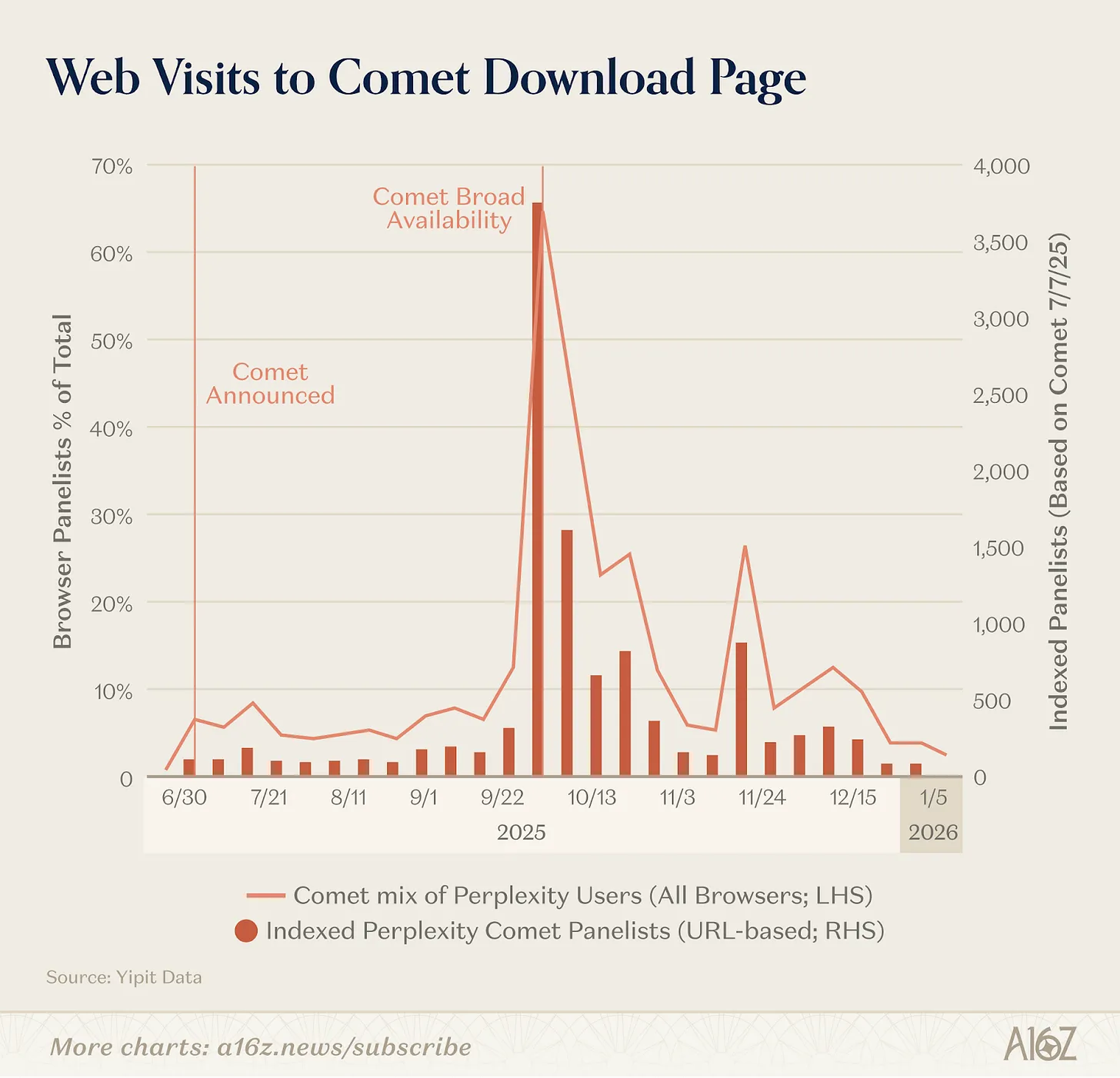
The most obvious change is that the browser itself is becoming an AI product. In the past nine months, OpenAI released Atlas (a browser with ChatGPT built into every page); Perplexity launched Comet, and Browser Company (which was later acquired by Atlassian) launched Dia. Yipit data shows that Perplexity's Comet had the most significant market impact (measured by download page visits), but no AI browser has yet achieved accelerated growth.
Other AI giants have chosen the path of adding AI to existing browsers rather than launching a separate AI browser. Google integrated Gemini into Chrome and released a beta version of Disco, which can dynamically generate web applications based on users' browser tabs. Anthropic released Claude in Chrome, which can connect to users' Claude or Claude Code sessions to drive operations on webpages.
The growth of native desktop AI tools has been even more intense, especially developer tools. Claude Code—a command-line developer agent—reached $1 billion in annual revenue in just six months. OpenAI launched a standalone Codex application for Mac, and the company claims that Codex had 2 million weekly active users by early March, with a 25% week-over-week growth. Cursor maintained its position in the top 50 on the web.
For pure consumers, the most common standalone desktop AI applications are related to voice. Note-taking tools like Fireflies, Fathom, Otter, TL;DV, and Granola reach users through a product-led growth model, gradually penetrating enterprises—together, the top five players attract over 20 million visitors. Workspace applications like Notion (making its debut on the list this edition) are increasingly integrating AI through note-taking, research agents, and even task automation.
Finally, AI is becoming increasingly deeply embedded in the tools people are already using. Anthropic launched Claude in Excel and Claude in PowerPoint. OpenAI released ChatGPT for Excel. Google deepened Gemini's integration across its entire Workspace lineup—Docs, Sheets, Gmail, and Meet now feature native AI capabilities. Google also launched Personal Intelligence in January 2026, connecting Gemini to Gmail, Google Photos, YouTube, and Search, allowing the assistant to reference your hotel bookings, purchase history, albums, and viewing history without you needing to inform it.
The insight from this list is that our rankings are increasingly underestimating the AI products people actually use the most. A developer who spends eight hours daily immersed in Claude Code, or a knowledge worker dictating every email through Wispr, are heavy AI users, but they are nearly invisible in web traffic data. As AI transitions from a destination to a functionality, our methodology needs to adapt accordingly.
免责声明:本文章仅代表作者个人观点,不代表本平台的立场和观点。本文章仅供信息分享,不构成对任何人的任何投资建议。用户与作者之间的任何争议,与本平台无关。如网页中刊载的文章或图片涉及侵权,请提供相关的权利证明和身份证明发送邮件到support@aicoin.com,本平台相关工作人员将会进行核查。


