Compiled by: Jerry, ChainCatcher
Last Week's Cryptocurrency Spot ETF Performance
U.S. Bitcoin Spot ETF Net Inflows of $787 Million
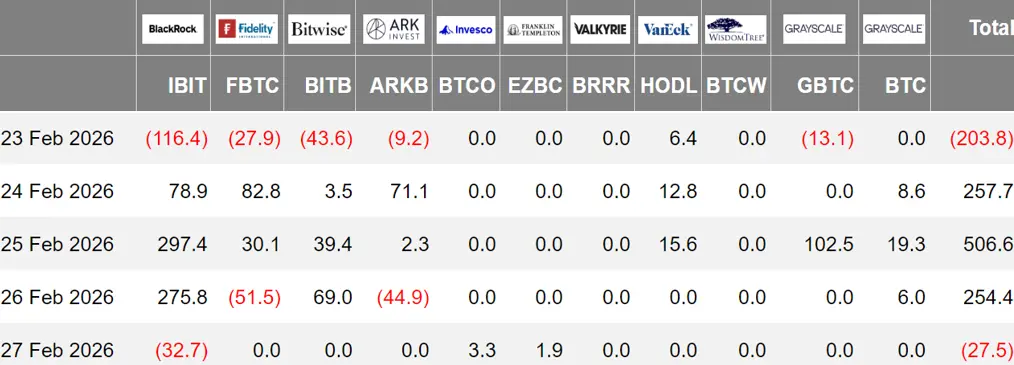
Last week, the U.S. Bitcoin spot ETF saw a net inflow over three days, totaling $787 million, with total assets under management reaching $83.4 billion.
Last week, 9 ETFs were in a net inflow state, with inflows primarily coming from IBIT, GBTC, and BITB, which had inflows of $503 million, $89.4 million, and $68.3 million respectively.
Data Source: Farside Investors
U.S. Ethereum Spot ETF Net Inflows of $80.2 Million
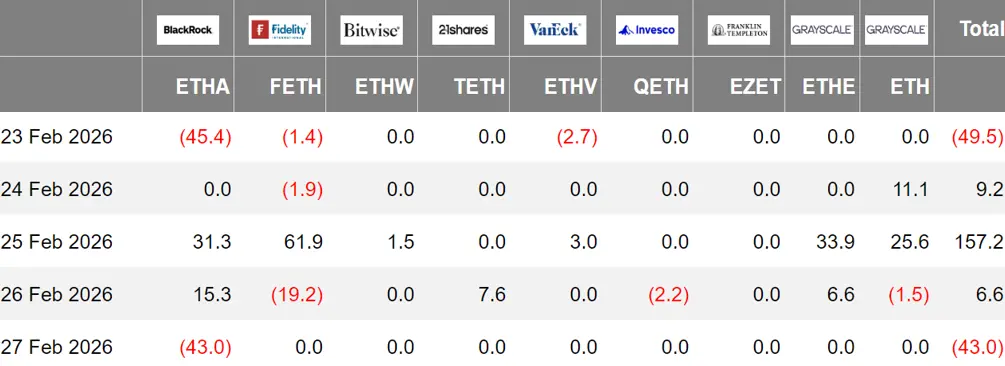
Last week, the U.S. Ethereum spot ETF saw a net inflow over three days, totaling $80.2 million, with total assets under management reaching $10.96 billion.
Last week’s inflow primarily came from Grayscale ETHE, with a net inflow of $40.5 million. Six Ethereum spot ETFs were in a net inflow state.
Data Source: Farside Investors
Hong Kong Bitcoin Spot ETF Net Inflows of 12.73 Bitcoins
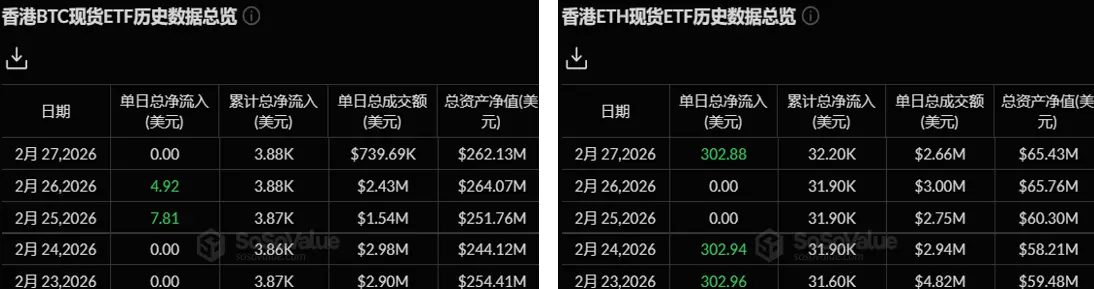
Last week, the Hong Kong Bitcoin spot ETF saw a net inflow of 12.73 bitcoins, with total assets under management reaching $26.2 million. The issuer, Harvest, reduced its holdings to 219.69 bitcoins, while Huaxia increased to 2,510 bitcoins.
The Hong Kong Ethereum spot ETF recorded net inflows of 908.78 ethers, with total assets under management at $6.543 million.
Data Source: SoSoValue
Cryptocurrency Spot ETF Options Performance
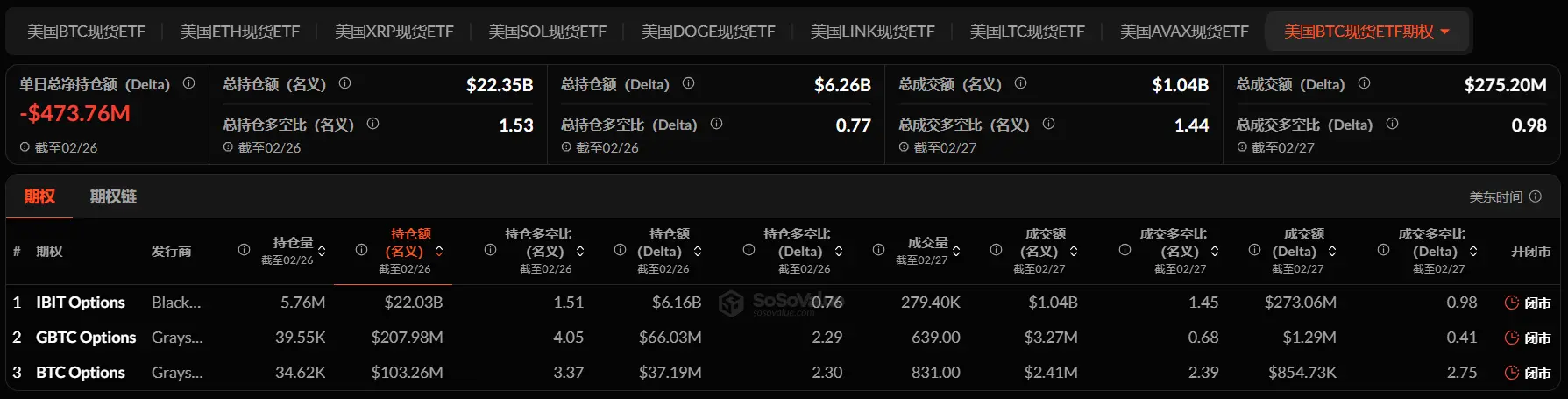
As of February 27, the total notional trading volume of U.S. Bitcoin spot ETF options was $1.04 billion, with a bullish-bearish ratio of 1.44.
As of February 26, the total notional open interest of U.S. Bitcoin spot ETF options reached $22.35 billion, with a bullish-bearish ratio of 1.53.
The market's short-term trading activity for Bitcoin spot ETF options has decreased, with overall sentiment leaning bearish.
Moreover, the implied volatility is at 50.36%.
Data Source: SoSoValue
Overview of Cryptocurrency ETF Dynamics Last Week
Bitcoin ETF and Treasury Department Buy Large Amounts of $60k Protective Put Options
According to market news, large Bitcoin ETF holders and the Treasury Department have recently concentrated on buying BTC put options with a strike price of $60,000 or below, with expirations of 6 months and 1 year, as a hedge against a price drop below $60,000.
Deribit stated that the open interest for BTC put options with a strike price of $60,000 has risen to around $1.5 billion, the highest among all strike prices and expiration dates on the platform, indicating a significant increase in demand for hedging against medium to long-term declines. Currently, Bitcoin spot is fluctuating around $67,000, but the implied volatility for 30-day put options is about 7% higher than for calls, and options trading shows that the market still prefers downside protection.
According to Bloomberg ETF analyst James Seyffart, institutions submitting 13F reports have overall reduced their positions in Ethereum spot ETFs, with hedge funds concentrating on selling due to collapsed returns from basis trading; traditional/long-term funds are increasing their positions against the trend, with Harvard endowment being the largest new buyer this quarter.
Nasdaq Applies to List VanEck JitoSOL ETF
According to Cointelegraph, Nasdaq has submitted a proposed rule change application to list the VanEck JitoSOL ETF. This ETF will hold liquid staking tokens JitoSOL based on Solana directly.
Jito Foundation Chairman Brian Smith stated that if approved, staking rewards will not be distributed separately but reflected in the fund's net asset value. Due to JitoSOL's auto-compounding rewards, each token held by the trust will represent the underlying SOL deposited and the staking rewards accumulated on the Solana network.
Harvard and Other Top University Endowments Start Allocating Bitcoin ETFs
According to CoinDesk, in light of declining expectations for traditional asset returns, several university endowments are adjusting their investment strategies and starting to allocate cryptocurrency ETFs. Harvard University and Brown University have disclosed their holdings in Bitcoin and Ethereum ETF positions in the latest 13F filings.
Columbia Investment Management Company CEO Kim Lew stated that expectations for returns and Alpha in traditional asset classes will compress, forcing institutions to explore new strategies further along the risk curve. Carlos Rangel of the W.K. Kellogg Foundation noted that without obtaining an 8% return, the traditional foundation model will be difficult to sustain.
21Shares Spot SUI ETF Begins Trading on Nasdaq
According to official news from the Sui Foundation, the 21Shares issued spot SUI ETF (Nasdaq code: TSUI) has begun trading on Nasdaq, providing U.S. investors with a regulated, high-liquidity direct exposure to SUI through existing brokerage accounts.
This ETF recently received approval from the U.S. Securities and Exchange Commission.
iShares Applies to Launch Staked Ethereum Spot ETF ETHB, Intended for Trading on Nasdaq
U.S. SEC documents show that BlackRock's iShares has submitted a revised S-1 to launch the "iShares Staked Ethereum Trust ETF" (code ETHB) and intends to list on Nasdaq.
The trust is a state trust of Texas, primarily holding ETH, and will participate in Ethereum staking with about 70%-95% of assets through third-party nodes such as Coinbase, without affecting its status as a grantor trust for tax purposes, in order to earn staking rewards.
The product uses a redemption mechanism of 40,000 shares in a basket, supporting cash or physical ETH redemptions, and only authorized participants can directly redeem with the trust. The base fee rate is 0.25% annually, reduced to 0.12% for the first $2.5 billion in assets for the first 12 months after listing. The trust is expected to continue issuing shares under manageable risk conditions.
Opinions and Analysis on Cryptocurrency ETFs
ETF Store President: 50% Drawdowns Not Uncommon for Bitcoin, ETF Investors Still Bottom Fishing
ETF Store President Nate Geraci stated that for long-term Bitcoin investors, a 50% drawdown is not uncommon and may not be the last occurrence. He pointed out that despite the market experiencing significant declines, there are no clear signs of panic among spot Bitcoin ETF investors, with cash flow data indicating that investor attitudes remain steady.
Geraci believes that based on recent cash flow trends, some ETF investors are more inclined to make low buy-ins during pullbacks.
Bloomberg senior ETF analyst Eric Balchunas stated on platform X that yesterday, Bitcoin ETFs attracted approximately $500 million in inflows, the largest single-day increase in recent times, with cumulative inflows of about $750 million over the past two days, occurring at a time of strong pessimism in the market. He described this inflow as "like hitting a home run during a slump," bringing a boost to the market.
Since the beginning of the year, Bitcoin ETFs have seen a cumulative net outflow of less than $2 billion, but it is still unclear whether this marks the beginning of a genuine rebound or a temporary "dead cat bounce."
Discussions around market manipulation speculations about Jane Street have intensified discussions about Bitcoin ETF mechanisms, with Bitwise advisor Jeff Park stating that whether Bitcoin prices are suppressed by Jane Street is not aimed at a single institution but is determined by structural features in the Bitcoin ETF framework.
Each authorized participant (AP), including Jane Street Capital, JPMorgan, Goldman Sachs, etc., has an exemption for creating and redeeming ETF shares. This allows them to operate flexibly in the market, including using futures or derivatives for hedging, without having to purchase spot Bitcoin, which may influence the price discovery mechanism.
This gray area stems from regulatory exemptions and the SEC’s approval of physical delivery. Although there is no evidence showing that any AP explicitly suppresses Bitcoin prices, the existing structure may alter the natural mechanisms of price formation, which deserves attention from regulators and investors.
Bloomberg ETF analyst Eric Balchunas responded by stating that this mechanism is indeed difficult to understand, and he is curious about who or what forces are operating behind the "pattern-type sell-offs" that appear daily and then suddenly disappear. Samson Mow, CEO of Bitcoin technology company Jan3, stated that becoming an AP is not the only factor in price suppression strategies; the key lies in how "extensive" their undisclosed trading and hedging activities are. This is a channel that brings capital costs close to zero.
Bitfinex: ETF Outflows and Whale Sell-offs Weigh on Bitcoin, $53,000 May Be Key Support
According to the Bitfinex Alpha report, due to weak inflows into Bitcoin spot ETFs and continuous sell-offs by whales, the Bitcoin market remains in a long-term downtrend.
The report indicated that although Bitcoin has rebounded 20% from its low on February 5, it has not yet confirmed a bottom. Since the beginning of the year, U.S. Bitcoin spot ETFs have seen a cumulative net outflow of $2.6 billion, with "ETF fatigue" among institutional investors exacerbating selling pressure. On-chain data shows that currently, about 64% of inflow funds to exchanges are from large holders (whales), marking a new high since October 2015.
Moreover, influenced by U.S. tariff policies and macro uncertainties, options traders are once again paying premiums for downside risks, and market sentiment is leaning cautious. Currently, the realized price of $53,000 is viewed as a key support level for the mid-term market.
Bloomberg analyst James Seyffart stated on platform X that institutions submitting 13F reports in Q4 2025 have collectively reduced their positions in Bitcoin ETFs, with investment advisors and hedge funds being the two largest types of institutions in terms of position size, making them the main sellers in the market.
Overall, the institutions submitting 13F reports collectively sold ETF shares equivalent to approximately 25,000 bitcoins in Q4 2025.
According to Bloomberg, hedge funds that once fueled the Bitcoin ETF boom in the U.S. are quickly exiting.
Based on data compiled by CF Benchmarks, a wholly owned subsidiary of the cryptocurrency trading platform Kraken, the total allocation of Bitcoin ETFs held by the largest hedge funds has decreased by 28%. CF Benchmarks research director Gabe Selby wrote in a research report on February 19: "The dominant theme over the past two quarters has been the deleveraging actions of hedge funds. The spike in October seems to have triggered systematic reductions." Brevan Howard significantly adjusted its holdings in BlackRock's iShares Bitcoin Trust, becoming the largest seller of this spot ETF in the fourth quarter. Its holdings decreased by approximately 86% to 5.5 million shares, resulting in its spot position value dropping from around $2.4 billion to $275 million. Bitcoin prices fell along with macro risks, and in certain phases, the declines were even greater, undermining the earlier rationale presented to institutional investors that Bitcoin could hedge against inflation, currency depreciation, or stock market pressure.
免责声明:本文章仅代表作者个人观点,不代表本平台的立场和观点。本文章仅供信息分享,不构成对任何人的任何投资建议。用户与作者之间的任何争议,与本平台无关。如网页中刊载的文章或图片涉及侵权,请提供相关的权利证明和身份证明发送邮件到support@aicoin.com,本平台相关工作人员将会进行核查。


