Original Title: : : [Issue] No Free Lunch: Reflections on Arbitrum and Optimism
Original Author: Four Pillars
Original Translation: Ken, ChainCatcher
Key Summary
Base announced its transformation from Optimism's OP stack to a proprietary unified architecture, bringing a strong shock to the market and severely impacting the $OP price.
Optimism fully open-sourced its code under the MIT license and implemented a revenue-sharing model for chains joining the "Superchain." Arbitrum adopted a "community source code" model, requiring chains built on Orbit that settle outside the Arbitrum ecosystem to contribute 10% of protocol revenue.
The open-source monetization debate in blockchain infrastructure is an extension of the recurring issues in traditional software fields (e.g., Linux, MySQL, MongoDB, WordPress). However, the introduction of tokens as variables adds a layer of dynamic relationships among stakeholders.
It is difficult to assert that one party is absolutely correct. It is important to soberly understand the trade-offs involved in each model and to think collectively about the long-term sustainability of L2 infrastructure as an ecosystem.
1. The Departure of Base and the Rift in the Superchain
On February 18, Coinbase's Ethereum L2 network Base announced that it would cut its dependence on the Optimism OP stack and transform into a proprietary unified codebase. The core idea is to integrate key components, including sequencers, into a single repository while reducing reliance on external entities like Optimism, Flashbots, and Paradigm. The Base engineering team stated on the official blog that this transition would increase the annual hard fork frequency from three to six, effectively speeding up upgrades.
The market reacted swiftly: $OP fell by more than 20% within 24 hours. Given that the largest chain in the Optimism superchain ecosystem had just announced its independence, this was not surprising.
 Source: @sgoldfed
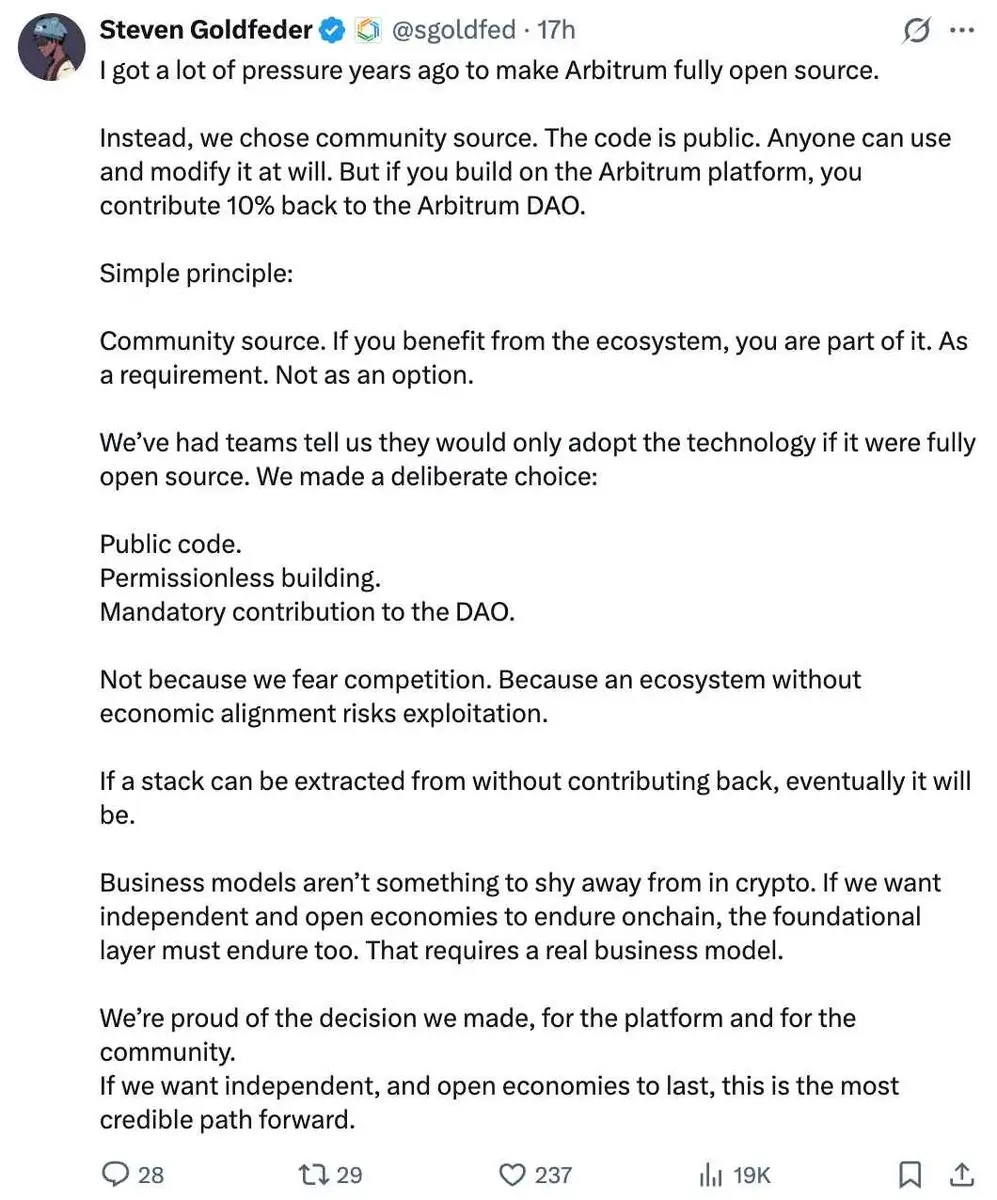
Around the same time, Arbitrum co-founder and Offchain Labs CEO Steven Goldfeder posted on the X platform, reminding everyone that his team had deliberately chosen a different path years ago. His core point was that despite pressures to release Arbitrum code as fully open-source, the team insisted on what they referred to as a "community source code" model.
In this model, the code itself is public, but any chain built on the Arbitrum Orbit stack that operates outside the Arbitrum ecosystem must contribute a fixed percentage of protocol revenue to the Arbitrum decentralized autonomous organization. Goldfeder issued a sharp warning: "If a stack allows taking benefits without contributing, this will eventually happen."
The departure of Base is not merely a technical migration. This event brings a fundamental question to the fore: What kind of economic structure should blockchain infrastructure be built upon? This article will examine the economic frameworks adopted by Optimism and Arbitrum, explore their differences, and discuss the future direction of the industry.
2. Two Models
Optimism and Arbitrum handle software in drastically different ways. Both are leading projects in the Ethereum L2 scalability space but have significant divergences in their approaches to achieving ecosystem economic sustainability.
2.1 Optimism: Openness and Network Effects
The OP stack of Optimism is completely open-sourced under the MIT license. Anyone can access the code, modify it freely, and build their own L2 chain. There are no royalties or revenue-sharing obligations.
Revenue sharing is only triggered when a chain joins the official Optimism ecosystem "Superchain." Members are required to contribute either 2.5% of chain revenue or 15% of on-chain net revenue (fees minus Layer 1 network gas costs), whichever is greater. In return, they receive shared governance over the Superchain, shared security, interoperability, and branding resources.
The logic behind this approach is simple. If countless L2 chains are built on the OP stack, these chains will form an interoperable network, and the value of both the OP token and the entire Optimism ecosystem will rise through network effects. In practice, this strategy has achieved significant results. Major projects such as Coinbase's Base, Sony's Soneium, Worldcoin's World Chain, and Uniswap's Unichain have adopted the OP stack.
The reasons large enterprises favor the OP stack are not limited to its permissive model. In addition to the freedom offered by the MIT license, the modular architecture of the OP stack is a core competitive advantage. Since the execution layer, consensus layer, and data availability layer can be independently replaced, projects like Mantle and Celo can adopt zero-knowledge proof modules such as OP Succinct and customize freely. For enterprise sovereignty, the ability to access code without external permission and freely replace internal components is extremely attractive.
However, the structural weaknesses of this model are equally evident: a low entry threshold also means a low exit threshold. Chains using the OP stack have limited economic obligations to the Optimism ecosystem, and the higher the profits of the chain, the more economically rational it becomes to operate independently. The departure of Base is a textbook case of this dynamic.
2.2 Arbitrum: Forced Synergy
Arbitrum takes a more complex approach. For L3 chains built on Arbitrum Orbit that settle on Arbitrum One or Nova, there are no revenue-sharing obligations. However, according to the Arbitrum expansion plan, chains settling on networks outside Arbitrum One or Nova (whether Layer 2 or Layer 3) must contribute 10% of net protocol revenue to Arbitrum. Of this 10%, 8% goes to the Arbitrum decentralized autonomous organization treasury, and 2% goes to the Arbitrum Developer Alliance.
In other words, chains remaining within the Arbitrum ecosystem enjoy freedom, while chains that utilize Arbitrum technology and deploy in external ecosystems must contribute. This creates a dual structure.
In the early days, building Arbitrum Orbit L2 that settled directly on Ethereum required approval via blockchain governance voting of the Arbitrum decentralized autonomous organization. When the Arbitrum expansion plan launches in January 2024, this process will shift to a self-service model. Nevertheless, the early "permission" process and the emphasis on encouraging L3 may have posed obstacles for large enterprises seeking sovereign L2 chains. For companies wishing to connect directly with Ethereum, the L3 structure built on Arbitrum One introduces additional business risks in terms of governance and technical dependencies.
Goldfeder's decision to label this model as "community source code" is intentional. It positions itself as a third way between traditional open-source and proprietary licensing. Code transparency is preserved, but commercial use outside the Arbitrum ecosystem must contribute to the ecosystem.
The advantage of this model lies in coordinating the economic interests of ecosystem participants. There are tangible exit costs for chains settling externally, ensuring a sustainable revenue stream. It has been reported that the Arbitrum decentralized autonomous organization has accumulated revenue of approximately 20,000 Ether, and Robinhood recently announced it will build its own L2 chain on Orbit, further validating the model's potential for institutional adoption. The Robinhood chain test net recorded 4 million transactions in its first week, indicating that Arbitrum's technological maturity and regulatory-friendly customization capabilities provide meaningful value for specific types of institutional clients.
2.3 Trade-offs of Each Model
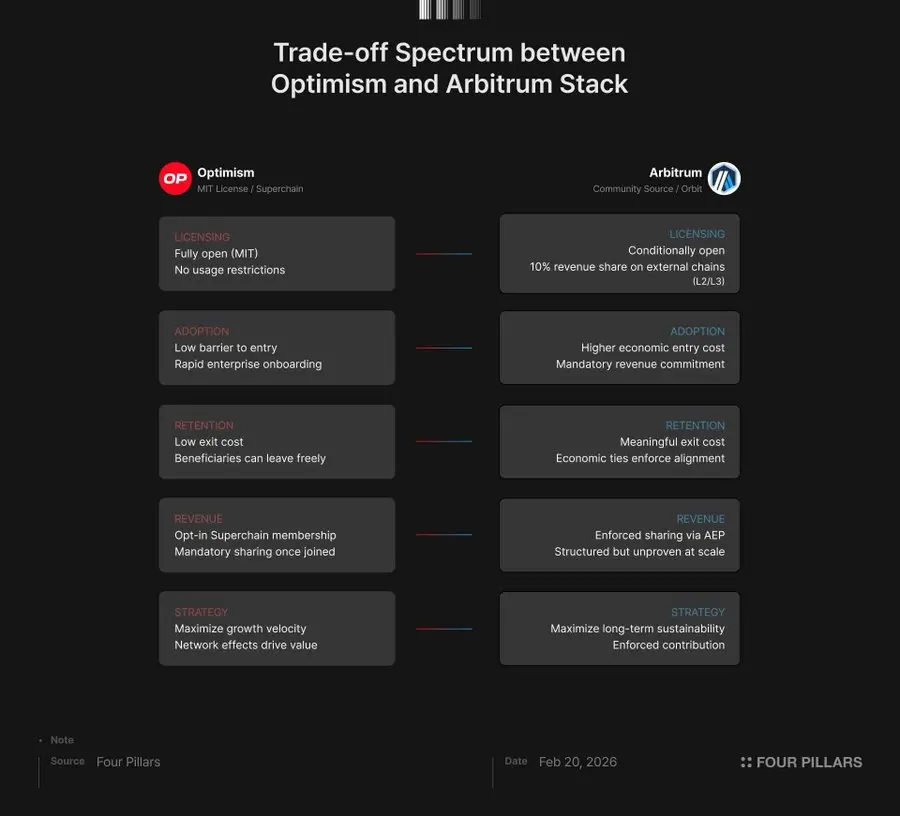
Both models optimize for different values. Optimism's model maximizes the speed of early enterprise adoption through unconditional openness under the MIT license, a modular architecture, and the powerful proof of concept represented by Base. An environment where code can be accessed without permission, components can be freely replaced, and mature reference cases exist presents the lowest entry barriers for business decision-makers.
On the other hand, Arbitrum's model emphasizes the long-term sustainability of the ecosystem. In addition to superior technology, its economic coordination mechanism requires external users to contribute revenue, ensuring a stable funding base for infrastructure maintenance. The speed of early adoption may be slightly slower, but for projects built utilizing the unique functions of the Arbitrum stack (such as Arbitrum Stylus), the exit costs could be quite high.
That said, the differences between these two models are not as extreme as often described. Arbitrum also offers free and permissionless licenses within its ecosystem, while Optimism requires revenue sharing from Superchain members. Both lie on a spectrum between "fully open" and "fully enforced," differing in degree and scope rather than essence.
Ultimately, this difference is a blockchain version of the classic trade-off between growth speed and sustainability.
3. Lessons from Open-source History
This tension is not unique to blockchain. The monetization models for open-source software have undergone extremely similar debates over the past few decades.
3.1 Linux and Red Hat
Linux is the most successful open-source project in history. The Linux kernel is fully open under the GPL license and has penetrated nearly every field of computing: servers, cloud, embedded systems, Android, etc.
However, the most successful commercial enterprise built on this ecosystem, Red Hat, does not profit from the code itself. It profits from services built on top of the code. Red Hat sells technical support, security patches, and stability guarantees to enterprise clients and was acquired by IBM for $34 billion in 2019. The code is free, but professional operational support is not. This logic bears a striking resemblance to Optimism's recent introduction of OP Enterprise.
3.2 MySQL and MongoDB
MySQL introduced a dual-licensing model: an open-source version under the GPL license and a separate commercial license sold to enterprises wishing to use MySQL for commercial purposes. The code is visible and free for non-commercial use, but generating income from it requires payment. This concept is similar to Arbitrum's community source code model.
MySQL achieved success through this approach, but it was not without side effects. When Oracle acquired Sun Microsystems in 2010, subsequently gaining ownership of MySQL, concerns over MySQL's future led its original creator, Monty Widenius, and community developers to create a fork, MariaDB. Although the direct catalyst was the change in ownership structure rather than licensing policy, the possibility of forks is a risk that always exists in open-source software. This bears a clear resemblance to Optimism's current situation.
MongoDB provides a more direct example. In 2018, MongoDB adopted a server-side public license. Its motivation was to address a growing problem: cloud service giants like Amazon Web Services and Google Cloud were using MongoDB's code to offer hosted services without paying MongoDB any fees. The pattern of actors reaping the value of open code without any reciprocity is a recurring theme throughout open-source history.
3.3 WordPress
WordPress is fully open-sourced under the GPL license and powers approximately 40% of the world's websites. The company behind WordPress, Automattic, generates revenue through WordPress.com hosting services and various plugins but does not charge for the use of WordPress core itself. The platform is completely open, with the logic that the growth of the ecosystem itself will enhance the value of the platform. This structurally resembles Optimism's Superchain vision.
The WordPress model has clearly been successful. However, the "free-rider" problem has never been fundamentally resolved. In recent years, a dispute erupted between WordPress founder Matt Mullenweg and major hosting company WP Engine. Mullenweg publicly criticized WP Engine for reaping significant profits from the WordPress ecosystem but contributing insufficiently in return. The paradox of the biggest beneficiaries of an open ecosystem contributing the least: this is the same dynamic occurring between Optimism and Base.
4. Why the Crypto Space is Different
These debates have frequently occurred in traditional software. So why does this issue become particularly acute in blockchain infrastructure?
4.1 Tokens as Amplifiers
In traditional open-source projects, value is relatively dispersed. When Linux succeeds, there is no specific asset's price that directly rises or falls as a result. But in the blockchain ecosystem, tokens exist and reflect the incentives and political dynamics of ecosystem participants in real-time through their prices.
In traditional open-source software, while free-riding leads to a shortage of development resources, the consequences are gradual. In the blockchain space, the exit of major players triggers immediate and highly visible results: token prices plummet. The drop of over 20% in $OP following Base's announcement clearly illustrates this. Tokens act as both a barometer of ecosystem health and a mechanism that amplifies crises.
4.2 Financial Infrastructure Responsibilities
L2 chains are not just software. They are financial infrastructure. Billions of dollars in assets are managed on these chains, and maintaining their stability and security requires enormous ongoing costs. In successful open-source projects, maintenance costs are typically covered by corporate sponsorship or foundation support, but today most L2 chains are already struggling to keep their ecosystems operational. Without external contributions through fee-sharing mechanisms, it is challenging to ensure the resources needed for infrastructure development and maintenance.
4.3 Ideological Tensions
The crypto community has a strong ideological tradition of "code should be free." Decentralization and freedom are core values closely intertwined with the industry's identity. In this context, Arbitrum's fee-sharing model may cause discomfort among some community members, while Optimism's open model is ideologically appealing but faces the reality of economic sustainability challenges.
5. Conclusion: There is No Free Infrastructure
Indeed, Base's departure has dealt a blow to Optimism, but it's premature to conclude that the Superchain model itself has failed.
First, Optimism has not been idle. On January 29, 2026, Optimism will officially launch OP Enterprise, an enterprise-grade service for fintech companies and financial institutions that supports the deployment of production-grade chains within 8 to 12 weeks. Although the original OP stack is licensed under MIT and can always be transitioned to a self-managed model, Optimism's assessment is that for most teams that are not blockchain infrastructure experts, collaborating with OP Enterprise is a more rational choice.
Base will not sever ties with the OP stack overnight. Base itself has stated that during the transition period it will remain a core support service client of OP Enterprise and plans to maintain compatibility with OP stack specifications throughout the process. This separation is technical rather than relational. This is the official position of both parties. On the other hand, Arbitrum's community source code model also reveals gaps between ideals and reality.
In fact, the approximately 19,400 Ether net fee income accumulated in the treasury of the Arbitrum decentralized autonomous organization comes almost entirely from sequencer fees and Timeboost maximum extractable value auctions on Arbitrum One and Nova themselves. The fee-sharing revenue contributed by ecosystem chains through the Arbitrum expansion plan has not yet received any significant public acknowledgment. This has structural reasons. The Arbitrum expansion plan itself will only launch in January 2024, and the majority of existing Orbit chains are built on Arbitrum One, thus exempting them from revenue-sharing obligations, while even the most well-known independent L2 eligible for the Arbitrum expansion plan—the Robinhood chain—remains in the testnet stage.
To give the community source code model of Arbitrum real weight as a "sustainable revenue structure," the ecosystem needs to wait for major L2s like Robinhood to launch their mainnets and for fee-sharing revenues from the Arbitrum expansion plan to genuinely begin flowing in. It is not easy for large enterprises to agree to hand over 10% of protocol revenues to an external decentralized autonomous organization. The fact that institutions like Robinhood still choose Orbit highlights the value proposition in other dimensions, such as customization potential and technological maturity. However, the economic rationality of this model has yet to be proven. The gap between theoretical design and actual cash flows remains a challenge that Arbitrum must address.
Ultimately, the two models provided by Arbitrum and Optimism are different answers to the same question: How to ensure the sustainability of public infrastructure?
What is important is not which model is correct, but understanding the trade-offs each model brings. Optimism's open model enables rapid expansion of the ecosystem, but also comes with the inherent risk that its biggest beneficiaries may leave. Arbitrum's forced contribution model establishes a sustainable revenue structure, but raises the threshold for early adoption.
Whether discussing Optimism or Arbitrum, OP Labs, Sunnyside Labs, and Offchain Labs have employed world-class research talent dedicated to scaling Ethereum while maintaining decentralization. Without their ongoing development investment, the technological advancements in L2 scaling would be impossible, and the resources to fund this work must come from somewhere.
There is no free infrastructure. As a community, what we should do is not to blind allegiance or subconscious resentment, but to begin an honest dialogue about who will bear the costs of this infrastructure. The departure of Base can be a starting point for this dialogue.
免责声明:本文章仅代表作者个人观点,不代表本平台的立场和观点。本文章仅供信息分享,不构成对任何人的任何投资建议。用户与作者之间的任何争议,与本平台无关。如网页中刊载的文章或图片涉及侵权,请提供相关的权利证明和身份证明发送邮件到support@aicoin.com,本平台相关工作人员将会进行核查。


