The value of ETH is no longer limited to Gas or Blob revenue, but lies in its institutional premium as the world's most secure EVM settlement layer and native currency asset.
Authors: Jacob Zhao, Jiawei, Turbo
On February 3, 2026, Vitalik published important reflections on Ethereum's scaling roadmap on X. As the reality of Layer 2 evolving towards a fully decentralized form is re-evaluated, and with the mainnet's throughput capacity expected to significantly increase in the coming years, the original assumption of solely relying on L2 for throughput expansion is being revised. L1 and L2 are forming a new 'settlement-service' collaborative paradigm: L1 focuses on providing the highest level of security, censorship resistance, and settlement sovereignty, while L2 evolves into 'differentiated service providers' (such as privacy, AI, high-frequency trading). Ethereum's strategic focus is returning to the mainnet itself, reinforcing its position as the world's most trusted settlement layer. Scaling is no longer the only goal; security, neutrality, and predictability are once again becoming Ethereum's core assets.
Core Changes:
- Ethereum is entering an "L1 priority paradigm": As the mainnet directly expands and fees continue to decline, the original assumption of relying on L2 to play a scaled core role is no longer valid.
- L2 is no longer "branded sharding," but a spectrum of trust: The decentralization of L2 is progressing much slower than expected, making it difficult to uniformly inherit Ethereum's security, and its role is being redefined as a network spectrum of different trust levels.
- Ethereum's core value is shifting from "traffic" to "settlement sovereignty": The value of ETH is no longer limited to Gas or Blob revenue, but lies in its institutional premium as the world's most secure EVM settlement layer and native currency asset.
- Expansion strategies are adjusting towards protocol endogenization: Based on the continuous direct expansion of L1, the exploration of native verification and security mechanisms at the protocol layer may reshape the security boundaries and value capture structure between L1 and L2.
- The valuation framework is undergoing a structural shift: The weight of security and institutional credibility is significantly increasing, while the weight of transaction fees and platform effects is decreasing. The pricing of ETH is shifting from a cash flow model to an asset premium model.
This article will analyze the paradigm shift and valuation reconstruction of Ethereum's pricing model based on facts (technological and institutional changes that have occurred), mechanisms (impact on value capture and pricing logic), and deductions (implications for allocation and risk-return).
I. Return to the Origin: Ethereum's Value Perspective
Understanding Ethereum's long-term value is not about short-term price fluctuations, but about its consistent design philosophy and value orientation.
- Trustworthy neutrality: Ethereum's core goal is not efficiency or profit maximization, but to become a trustworthy and neutral infrastructure—rules are public, predictable, not favoring any participant, and not controlled by any single entity, allowing anyone to participate without permission. The security of ETH and its on-chain assets ultimately relies on the protocol itself, not on any institutional credit.
- Ecological priority over revenue priority: Ethereum's multiple key upgrades reflect a consistent decision-making logic—actively sacrificing short-term protocol revenue in exchange for lower usage costs, larger ecological scale, and greater system resilience. Its goal is not to "charge tolls," but to become an irreplaceable neutral settlement and trust foundation in the digital economy.
- Decentralization as a means: The mainnet focuses on the highest level of security and finality, while Layer 2 networks exist on a spectrum of varying degrees of connection to the mainnet: some inherit the mainnet's security and pursue efficiency, while others position themselves with differentiated functions. This allows the system to serve both global settlement and high-performance applications simultaneously, rather than L2 "branded sharding."
- Long-term technological route: Ethereum adheres to a slow but certain evolutionary path, prioritizing system security and credibility. From the transition to PoS to subsequent scaling and confirmation mechanism optimizations, its roadmap seeks sustainable, verifiable, and irreversible correctness.
Security Settlement Layer: Refers to the Ethereum mainnet providing irreversible finality services for Layer 2 and on-chain assets through decentralized verification nodes and consensus mechanisms.
This positioning of the security settlement layer marks the establishment of "settlement sovereignty," representing Ethereum's shift from a "confederation" to a "federation," a "constitutional moment" in the establishment of Ethereum as a digital nation, and a significant upgrade of Ethereum's architecture and core.
After the American Revolutionary War, under the terms of the confederation, the 13 states resembled a loose alliance, each printing its own currency and imposing tariffs on one another, with each state free-riding: enjoying common defense while refusing to pay; benefiting from the alliance's brand while governing independently. This structural issue led to a decline in national credit and an inability to unify foreign trade, severely hindering the economy.
1787 was America's "constitutional moment," when the new constitution granted the federal government three key powers: the power to levy taxes directly, regulate interstate trade, and unify currency. But what truly brought the federal government to life was Hamilton's 1790 economic plan, which involved the federal government assuming state debts, redeeming them at face value to rebuild national credit, and establishing a national bank as a financial hub. A unified market released economies of scale, and national credit attracted more capital, enabling infrastructure development to gain financing capabilities. America transitioned from 13 mutually defensive small states to the world's largest economy.
Today's structural dilemma in the Ethereum ecosystem is entirely consistent.
Each L2 is like a "sovereign state," each with its own user base, liquidity pool, and governance token. Liquidity is fragmented, cross-L2 interactions are cumbersome, and L2s enjoy Ethereum's security layer and brand but cannot reciprocate value back to L1. Each L2 locking liquidity on its own chain is rational in the short term, but if all L2s do this, it leads to the loss of the core competitive advantage of the entire Ethereum ecosystem.
The roadmap Ethereum is currently advancing is essentially its constitution and the establishment of a central economic system, which is to establish "settlement sovereignty":
- Native Rollup Precompile = Federal Constitution. L2s can freely build differentiated functions outside of the EVM, while the EVM part can obtain Ethereum-level security verification through native precompiles. Not connecting is certainly possible, but the cost is losing trustless interoperability with the Ethereum ecosystem.
- Synchronous Composability = Unified Market. Through mechanisms like native Rollup precompiles, trustless interoperability and synchronous composability between L2s and between L2 and L1 are becoming possible, directly eliminating "interstate trade barriers," and liquidity is no longer trapped on individual islands.
- L1 Value Capture Reconstruction = Federal Taxation Power. When all key cross-L2 interactions revert to L1 settlement, ETH re-establishes itself as the settlement hub and trust anchor of the entire ecosystem. Whoever controls the settlement layer captures the value.
Ethereum is transforming the fragmented L2 ecosystem into an irreplaceable "digital nation" with a unified settlement and verification system, which is a historical inevitability. Of course, the process of transformation may be slow, but history tells us that once this transformation is complete, the released network effects will far exceed the linear growth of the fragmented era. The United States turned 13 small states into the world's largest economy with a unified economic system. Ethereum will also transform the loose L2 ecosystem into the largest security settlement layer and even a global financial vehicle.
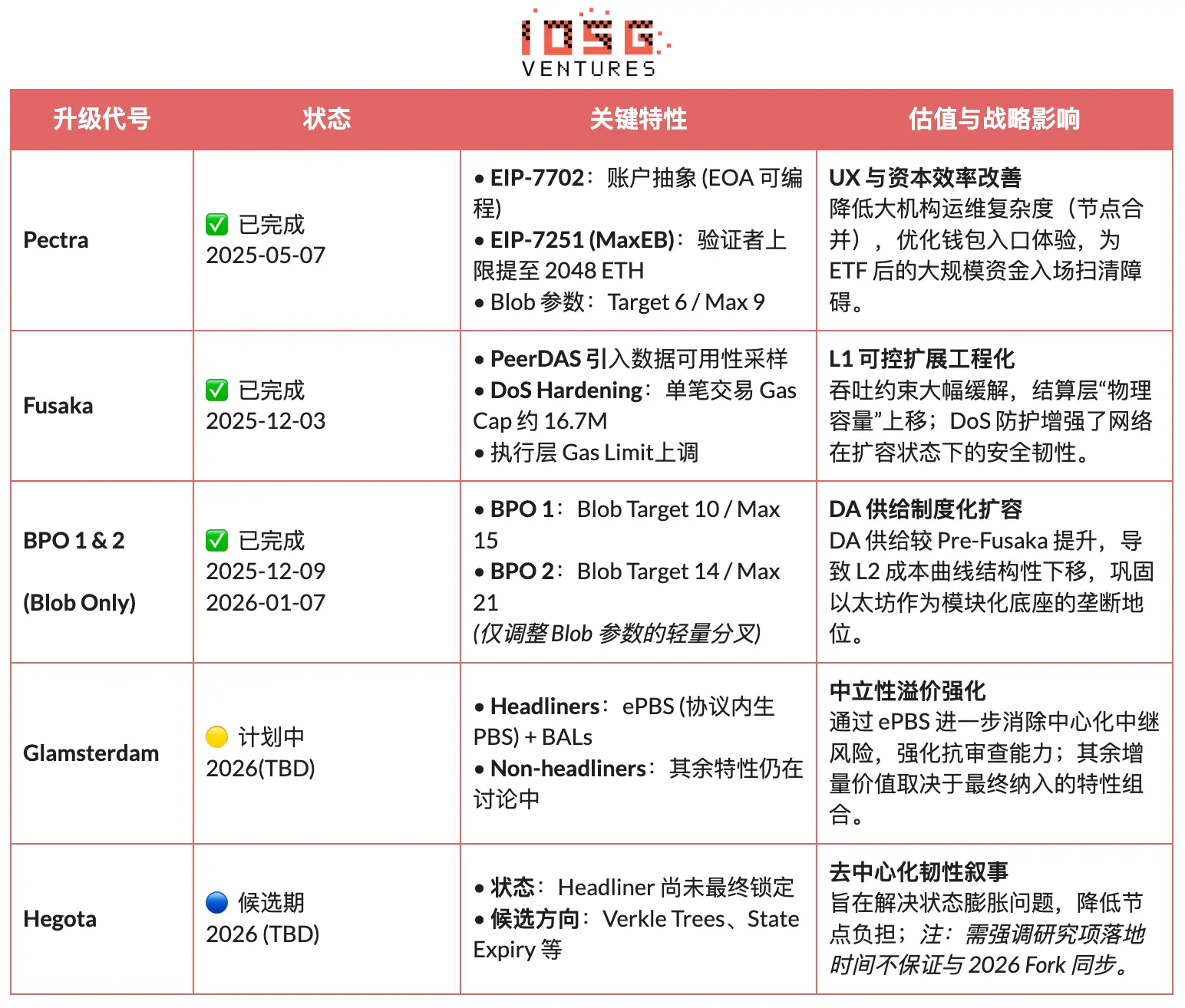
Ethereum's Core Upgrade Roadmap and Valuation Impact (2025-2026)
II. Valuation Misconception: Why Ethereum Should Not Be Viewed as a "Tech Company"
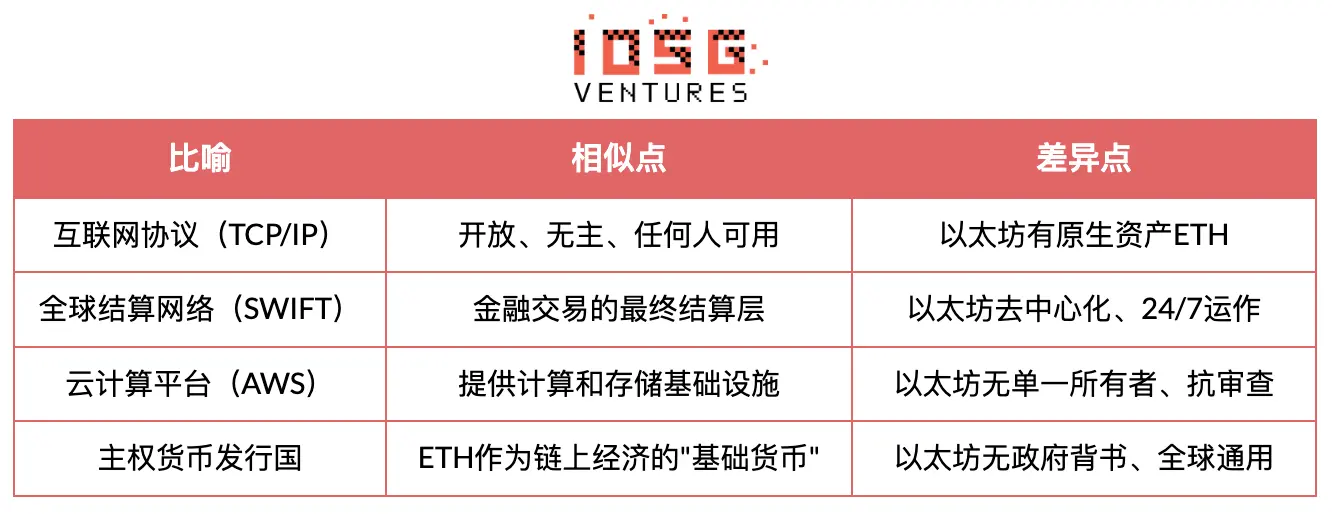
Applying traditional corporate valuation models (P/E, DCF, EV/EBITDA) to Ethereum is essentially a category error. Ethereum is not a company aimed at profit maximization, but an open digital economic infrastructure. Corporations pursue shareholder value maximization, while Ethereum seeks to maximize ecological scale, security, and censorship resistance. To achieve this goal, Ethereum has repeatedly actively lowered protocol revenue (such as through EIP-4844 by introducing Blob DA, structurally reducing L2 data publishing costs, and lowering L1 fees from rollup data)—which may seem like "self-destructive revenue" from a corporate perspective, but from an infrastructure perspective, it is sacrificing short-term fees for long-term neutrality premiums and network effects.
A more reasonable understanding framework is to view Ethereum as a global neutral settlement and consensus layer: providing security, finality, and trustworthy coordination for the digital economy. The value of ETH is reflected in multiple structural demands—rigid demand for final settlement, the scale of on-chain finance and stablecoins, the impact of staking and burning mechanisms on supply, and the long-term, sticky capital brought by institutional-level adoption such as ETFs, corporate treasuries, and RWAs.
III. Paradigm Reconstruction: Finding Pricing Anchors Beyond Cash Flow
At the end of 2025, the ethval.com launched by the Hashed team provided a detailed and reproducible quantitative model set for Ethereum, but traditional static models struggle to capture the dramatic shifts in Ethereum's narrative in 2026. Therefore, we reused its systematic, transparent, and reproducible underlying models (covering revenue, currency, network effects, and supply structure) and reshaped the valuation architecture and weighting logic:
- Structural Reconstruction: Mapping the model to the four major value quadrants of "security, currency, platform, revenue" and categorizing and summing pricing.
- Weight Rebalancing: Significantly increasing the weight of security and settlement premiums while weakening the marginal contributions of protocol revenue and L2 expansion.
- Risk Control Overlay: Introducing a circuit breaker mechanism for macro and on-chain risk perception, making the valuation framework adaptable across cycles.
- Eliminating "Circular Reasoning": Models that include current price inputs (such as Staking Scarcity, Liquidity Premium) are no longer used as fair value anchors, retaining only their role as indicators for position and risk preference adjustments.
Note: The following models are not used for precise point predictions but to characterize the relative pricing direction of different value sources in different cycles.
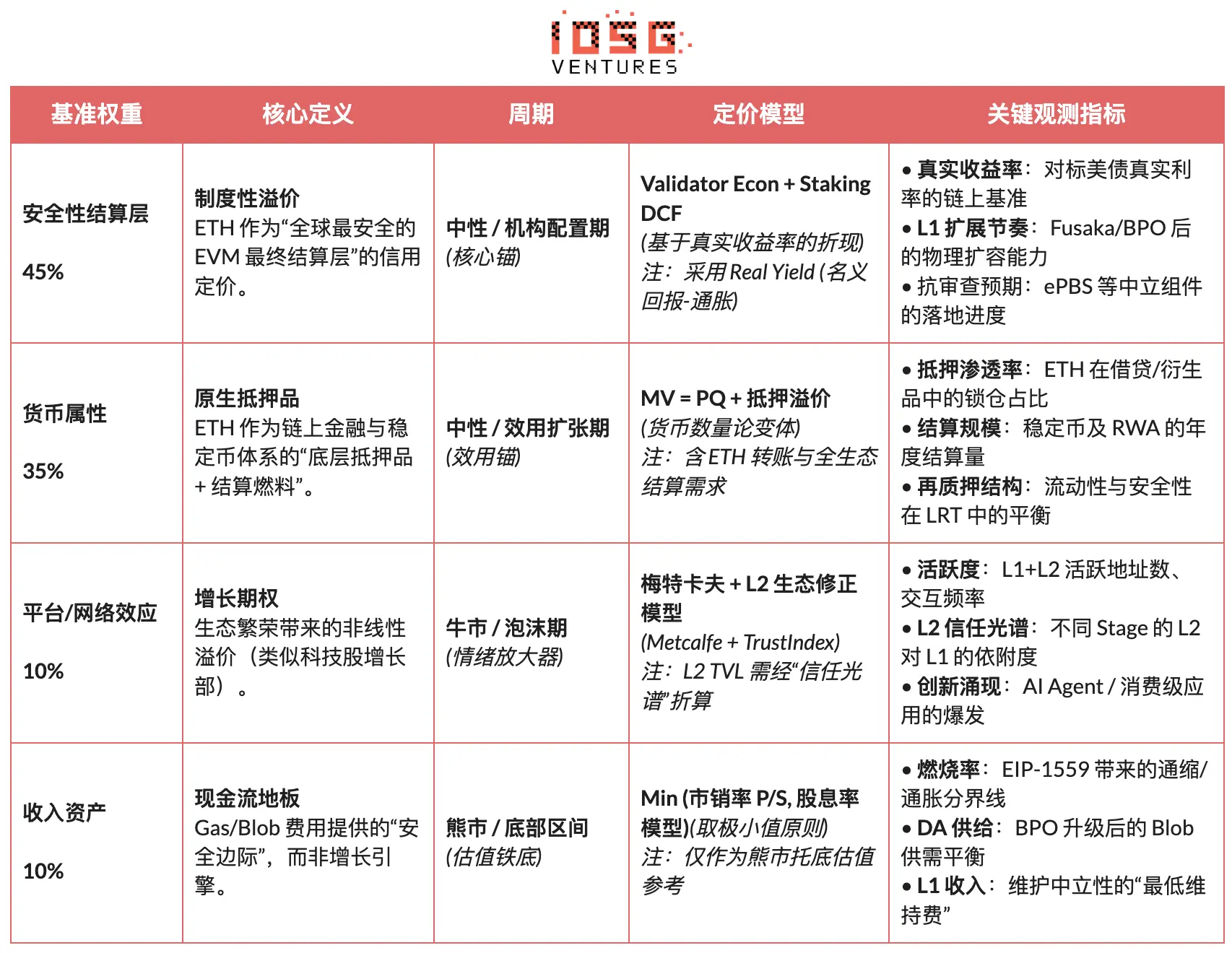
1. Security Settlement Layer: Core Value Anchor (45%, Risk Aversion Period Adjustment)
We view the security settlement layer as the most core source of value for Ethereum and assign it a baseline weight of 45%; during periods of rising macro uncertainty or declining risk appetite, this weight is further increased. This judgment stems from Vitalik's latest definition of "truly scaling Ethereum": the essence of scaling is not to increase TPS, but to create block space fully backed by Ethereum itself. Any high-performance execution environment relying on external trust assumptions does not constitute an expansion of Ethereum itself.
Under this framework, the value of ETH primarily reflects the credit premium of a global non-sovereign settlement layer, rather than protocol revenue. This premium is supported by structural factors such as the scale and decentralization of validators, long-term security records, institutional adoption, clarity of compliance pathways, and the protocol's endogenous Rollup verification mechanisms.
In terms of specific pricing, we mainly adopt two complementary methods: Validator Economics (yield equilibrium mapping) and Staking DCF (perpetual staking discounting), together depicting ETH as the "global secure settlement layer" with an institutional premium.
- Validator Economics (yield equilibrium pricing): Based on the ratio of annual staking cash flow per ETH to the target real yield, we derive the theoretical fair price:
Fair Price = (Annual Staking Cash Flow per ETH) / Target Real Yield
This expression is used to characterize the equilibrium relationship between yield and price, serving as a directional relative valuation tool rather than an independent pricing model.
- Staking DCF (perpetual staking discounting): Treating ETH as a long-term asset that sustainably generates real staking yields, we perpetually discount its cash flows:
M_staking = Total Real Staking Cash Flow / (Discount Rate − Long-term Growth Rate)
ETH Price (staking) = M_staking / Circulating Supply
Essentially, this value layer does not benchmark against the revenue-generating capacity of platform companies, but rather resembles the settlement credit of a global clearing network.
2. Currency Attributes: Settlement and Collateral (35%, Dominated by Utility Expansion Phase)
We view currency attributes as the second core source of value for Ethereum, assigning it a baseline weight of 35%, becoming the main utility anchor during neutral markets or phases of on-chain economic expansion. This judgment is not based on the narrative of "ETH equals USD," but on its structural role as the native settlement fuel and ultimate collateral asset within the on-chain financial system. The security of stablecoin circulation, DeFi settlements, and RWA settlements all rely on the settlement layer supported by ETH.
For pricing, we adopt an extended form of the quantity theory of money (MV = PQ), but layer the usage scenarios of ETH to model the demand for money in response to the magnitude differences in circulation speed across different scenarios:
- High-frequency settlement layer (Gas payments, stablecoin transfers)
- Mtransaction = Annual Transaction Settlement Volume / Vhigh
- V_high ≈ 15-25 (based on historical on-chain data)
- Medium-frequency financial layer (DeFi interactions, lending settlements)
- Mdefi = Annual DeFi Settlement Volume / Vmedium
- V_medium ≈ 3-8 (based on mainstream DeFi protocol capital turnover rates)
- Low-frequency collateral layer (staking, re-staking, long-term locking)
- M_collateral = Total ETH Collateral Value × (1 + Liquidity Premium)
- Liquidity Premium = 10-30% (reflecting compensation for liquidity sacrifice)
3. Platform / Network Effects: Growth Options (10%, Bull Market Amplifier)
Platform and network effects are viewed as growth options in Ethereum's valuation, assigned only a 10% weight to explain the nonlinear premium brought about by ecosystem expansion during bull markets. We use a trust-adjusted Metcalfe's model to avoid equally weighting L2 assets of different security levels in the valuation:
- Metcalfe's Model: Mnetwork = a × (Active Users)^b + m × Σ (L2 TVLi × TrustScore_i)
- Platform/Network Effect Valuation Price: ETH Price(network) = M_network / Circulating Supply
4. Revenue Assets: Cash Flow Floor (10%, Bear Market Support)
We view protocol revenue as the cash flow floor in Ethereum's valuation system, rather than a growth engine, also assigning it a 10% weight. This layer mainly plays a role during bear markets or extreme risk phases, used to characterize the lower limit of valuation.
Gas and Blob fees provide the minimum operating costs for the network and influence the supply structure through EIP-1559. For valuation, we adopt a price-to-sales ratio and fee yield model, taking the conservative value from both as a bottom reference. As the mainnet continues to scale, the importance of protocol revenue relatively declines, with its core role reflected in the safety margin during downturns.
- Price-to-Sales Ratio Model (P/S Floor): MPS = Annual Protocol Revenue × P/Smultiple
- Price-to-Sales Ratio Valuation Price: ETH Price (PS) = M_PS / Circulating Supply
- Fee Yield Model: M_Yield = Annual Protocol Revenue / Target Fee Yield
- Fee Yield Valuation Price: ETH Price(Yield) = M_Yield / Circulating Supply
- Cash Flow Floor Pricing (taking the minimum of both): PRevenueFloor = min(PPS, PYield)
IV. Dynamic Calibration: Macro Constraints and Cycle Adaptation
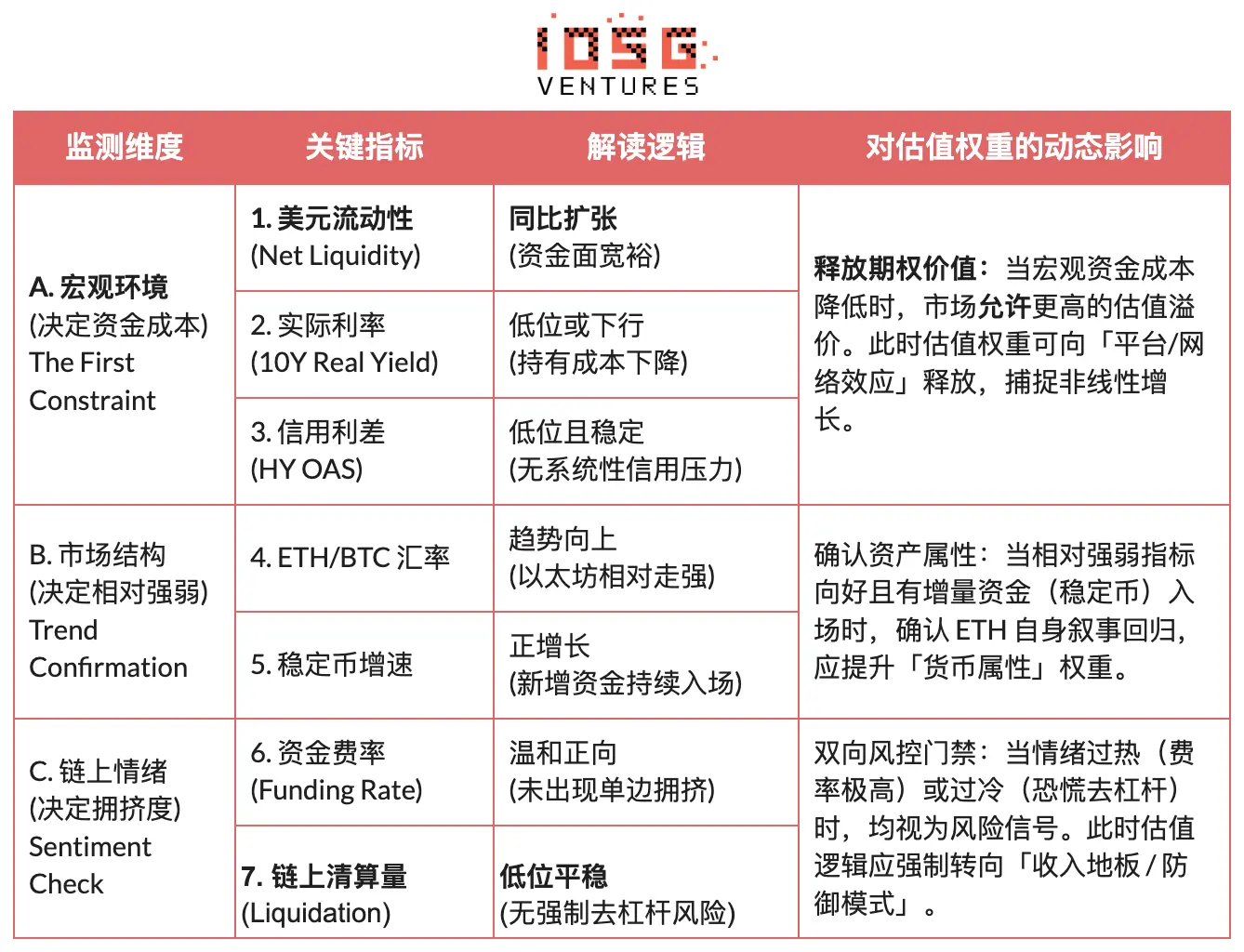
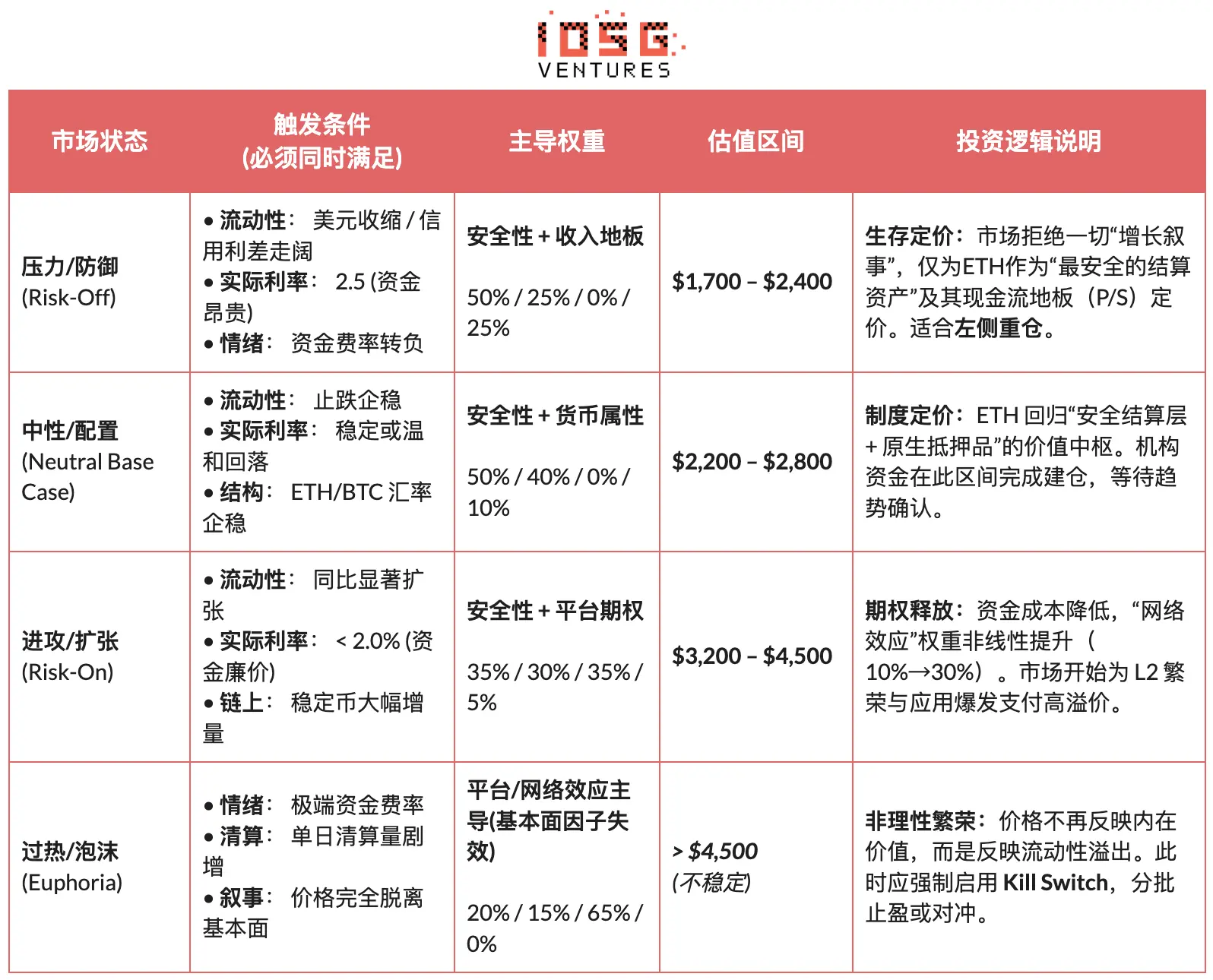
If the previous section established Ethereum's "intrinsic value center," this chapter introduces an external environment adaptation system independent of fundamentals. Valuation cannot operate in a vacuum; it must be constrained by three external factors: macro environment (cost of capital), market structure (relative strength), and on-chain sentiment (congestion). Based on this, we construct a Regime Adaptation mechanism to dynamically adjust valuation weights across different cycles—releasing option premiums during easing periods and retreating to revenue floors during risk-averse periods, thus achieving a transition from static models to dynamic strategies. (Note: Due to space limitations, this article only presents the core logical framework of this mechanism.)
V. Conditions for Institutionalizing the Second Curve
The previous analysis is based on the internal logic of technology, valuation, and cycles within the crypto system, while this chapter discusses a different level of issue: when ETH is no longer priced solely by crypto-native funds but is gradually incorporated into the traditional financial system, how will its pricing power, asset attributes, and risk structure change? The institutionalization of the second curve is not an extension of existing logic, but a redefinition of Ethereum by external forces:
- Changes in Asset Attributes (Beta → Carry): Spot ETH ETFs address compliance and custody issues, but fundamentally still expose price; however, the future promotion of Staking ETFs will be the first to introduce on-chain yields into the institutional system through compliant vehicles. As a result, ETH transitions from a "high-volatility asset with no yield" to a "configurable asset with predictable returns," with potential buyers expanding from trading funds to pension funds, insurance, and long-term accounts sensitive to yield and duration.
- Changes in Usage (Holding → Using): If institutions no longer view ETH merely as a tradable asset but begin to use it as a settlement and collateral infrastructure. Whether it is JPMorgan's tokenized fund or the deployment of compliant stablecoins and RWAs on Ethereum, it indicates that the demand for ETH is shifting from "holding demand" to "operational demand"—institutions not only hold ETH but also complete settlements, clearances, and risk management on it.
- Changes in Tail Risk (Uncertainty → Pricing): As the regulatory framework for stablecoins (such as the GENIUS Act) is gradually established in the future, and with the improvement of Ethereum's roadmap and governance transparency, the regulatory and technical uncertainties most sensitive to institutions are being systematically compressed, meaning that uncertainty is beginning to be priced rather than avoided.
The so-called "institutionalization of the second curve" is a change in the nature of demand, providing a real source of demand for the valuation logic of "security settlement layer + currency attributes," driving ETH from a sentiment-driven speculative asset to a foundational asset that simultaneously carries configurational and functional demands.
VI. Conclusion: Value Anchoring in the Darkest Hour
In the past week, the industry has undergone a severe deleveraging baptism, and market sentiment has plummeted to a freezing point, undoubtedly marking the "darkest hour" of the crypto world. Pessimistic sentiment has spread among practitioners, and as the asset that best represents the spirit of crypto, Ethereum is also at the eye of the storm of controversy.
However, as rational observers, we need to penetrate the fog of panic: what Ethereum is currently experiencing is not a "collapse of value," but a profound "shift in pricing anchors." With the direct advancement of L1 scaling, L2 being redefined as a spectrum of different trust levels, and protocol revenue actively yielding to system security and neutrality, the pricing logic of ETH has structurally shifted to "security settlement layer + native currency attributes."
In the context of high real macro interest rates, liquidity not yet easing, and on-chain growth options not yet allowed to be priced by the market, the price of ETH naturally converges to a structural value range supported by settlement certainty, verifiable yields, and institutional consensus. This range is not an emotional bottom, but rather the value center after stripping away platform growth premiums.
As long-term builders of the Ethereum ecosystem, we refuse to be "mindless bulls" of ETH. We hope to rigorously argue our predictions through a careful logical framework: only when macro liquidity, risk appetite, and network effects simultaneously meet the trigger conditions of market states will higher valuations be re-included by the market.
Therefore, for long-term investors, the key question now is no longer anxiously asking, "Can Ethereum still rise?" but rather to clearly recognize—under the current environment, which layer of core value are we buying at a "floor price"?
Disclaimer: This article was created with the assistance of AI tools such as ChatGPT-5.2, Gemini 3, and Claude Opus 4.5. The authors have made efforts to proofread and ensure the information is true and accurate, but there may still be omissions. It should be noted that the crypto asset market generally exhibits a divergence between project fundamentals and secondary market price performance. The content of this article is for information integration and academic/research exchange only, does not constitute any investment advice, and should not be viewed as a recommendation for buying or selling any tokens.
免责声明:本文章仅代表作者个人观点,不代表本平台的立场和观点。本文章仅供信息分享,不构成对任何人的任何投资建议。用户与作者之间的任何争议,与本平台无关。如网页中刊载的文章或图片涉及侵权,请提供相关的权利证明和身份证明发送邮件到support@aicoin.com,本平台相关工作人员将会进行核查。


