Author: Zen, PANews
As the prediction market continues to divert retail investors' attention, traditional financial institutions and exchanges are clearly unwilling to stand by idly.
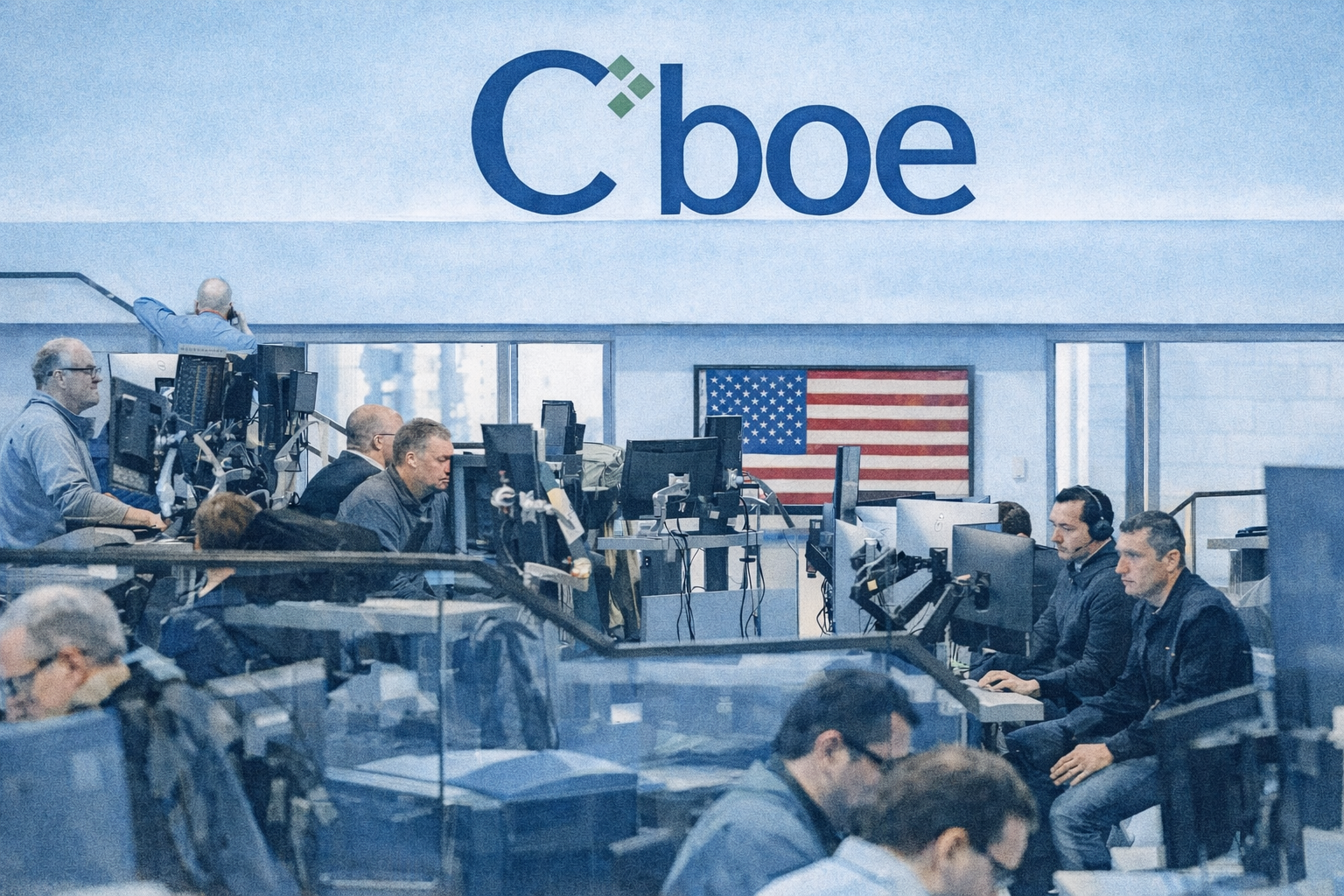
Cboe Global Markets is taking proactive steps to explore the reintroduction of "all-or-nothing" binary options contracts to attract retail investors. These contracts have a simple structure, paying a fixed return (e.g., $100) if predetermined conditions are met at expiration, otherwise they expire worthless.
According to the WSJ, the new product will undergo strict legal and compliance reviews before its official launch, with regulatory oversight potentially falling under the U.S. Securities and Exchange Commission (SEC) or the Commodity Futures Trading Commission (CFTC), and clearing support provided by the Options Clearing Corporation (OCC).
Cboe previously launched binary options linked to the S&P 500 Index (SPX) and the Volatility Index (VIX) in 2008, but ultimately exited the market due to insufficient liquidity. Its return now is particularly noteworthy.
The Initial Attempt 18 Years Ago and Its Disappointing Exit
The "all-or-nothing" options contract is not a novel concept or product; Cboe itself introduced it over a decade ago. However, it was too early to the market and ultimately missed the opportunity.
In July 2008, Cboe announced the launch of binary options linked to the S&P 500 (SPX) and the Cboe Volatility Index (VIX). According to an approval document released by the SEC in May of the same year, Cboe applied to add a framework for "cash-settled, European-style" binary index options to its exchange rules, which also specified that the OCC would be responsible for issuance, clearing, and settlement, necessitating amendments to relevant bylaws and rules.
Compared to the later proliferation of "offshore binary options" on the internet, Cboe's binary options were a standardized, centrally cleared derivative innovation. They compressed the complex payoff curve of options into a fixed payment, allowing traders to express their judgment on whether "the index will reach a certain level" in a more direct manner. At the time of launch, Cboe expected to attract a diverse range of participants, including individual investors and hedge funds, to bet on the movements of the aforementioned indices.
However, Cboe's product did not generate the anticipated market enthusiasm, nor did it achieve a significant scale or sustained trading, ultimately leading to its withdrawal. This was due to both structural issues in the market and deeper problems stemming from its product positioning.
At that time, the market was dominated by institutional investors, with very low retail participation, resulting in insufficient liquidity and low subscription interest. Binary options require a "two-way effort" from brokers and retail investors. However, in the early stages of mobile internet development, the financial communication capabilities of social media were not yet established, and retail investors typically lacked trading motivation and habits.
With demand not materializing, sustaining supply became even more difficult. Light trading would weaken market-making incentives, worsening spreads and further suppressing demand, creating a self-reinforcing "liquidity death spiral." This is also a primary reason why a compliant, centrally cleared binary option failed commercially.
From a positioning perspective, the binary options of 2008 were more like tools aimed at professional traders, serving as a new product complement for existing options participants. Its product language, settlement rules, and underlying selection were more "institutionalized," rather than aimed at the general public. It was linked to SPX and VIX, and the strike price and settlement rules were not intuitive for ordinary investors. Even though its returns were binary in form, the understanding threshold remained high.
In contrast to today's booming prediction markets, these platforms have spread largely because they have replaced the underlying with more intuitive events, including but not limited to political elections and sports events, allowing retail investors to participate in trading without overly complex analytical logic. Cboe did not have such an ecological soil back then.
Reboot Plan After the Timing is Right
Cboe's current reboot plan is closely related to the current market environment. Since the 2024 U.S. presidential election, the trading activity in prediction markets has seen "explosive growth." In January 2026, the combined trading volume of Kalshi and Polymarket exceeded $17 billion, setting a record high.
With the explosion of prediction markets leading to a surge in retail derivative trading, the industry has begun to view it as an emerging growth point and an opportunity for exchanges and financial institutions to develop new businesses, prompting many to join the user acquisition battle. In December 2025, the CME partnered with sports betting giant FanDuel to launch an official prediction market platform in some U.S. states.
Equally noteworthy is the surge in retail investors' enthusiasm for derivative trading. Following the impact of the COVID-19 pandemic in 2020, U.S. options trading volume has repeatedly hit new highs, with significant contributions from retail investors. Data from the Options Clearing Corporation shows that the average daily trading volume in the U.S. options market was about 61 million contracts in 2025, a historic high.
At the same time, the rise of internet brokers and social media has fundamentally changed trading methods, allowing retail investors to quickly access trading strategies and contract information through mobile apps and online communities. In this environment, simple and clear derivative contracts have a natural appeal to retail users.
If the core reason for the failure of binary options in 2008 was "the absence of retail investors," then today's market is the opposite, with distribution channels and product strategies having matured. Cboe realizes that it is time to restart binary options contracts.
Not Nostalgia, but "The Battle for Entry"
Binary options carry an unavoidable historical burden.
In the U.S. regulatory context, the term has been closely associated with internet fraud and manipulation. The CFTC and SEC once jointly issued investor warnings, indicating that regulatory agencies received numerous complaints about fraudulent online binary options platforms, including refusal to return funds, identity theft, and manipulation of trading software leading to customer losses.
Because of this, Cboe's current actions emphasize strict compliance reviews and inclusion under SEC or CFTC oversight before launch, implying the platform's controllability, safety, and transparency. This also explains why traditional exchanges feel a sense of urgency in the wave of prediction markets. They do not want to bet the results of retail demand entirely on a more complex and ambiguous regulatory landscape.
The reintroduced binary options have several key differences from the 2008 version. First, the target audience is different; the product back then primarily targeted institutions and experienced investors, attracting almost no retail traders. This time, it explicitly aims at the retail segment, hoping to provide a simple and understandable entry point for the general investor.
Secondly, there is a difference in product positioning. The contracts launched in 2008 were essentially special options linked to indices (SPX, VIX) for precisely expressing bullish or bearish views on market indices. Now, Cboe emphasizes introducing simpler, event-based contract forms to cater to ordinary investors' interest in betting on event outcomes.
Another key factor is the external environmental changes mentioned earlier. At the market level, Cboe's new product benefits from different technical and channel support in marketing and participation; at the regulatory level, current event contract products in the U.S. are more accepted under CFTC regulation, whereas the binary options of that time required SEC approval, reflecting the regulatory boundary tensions brought about by prediction markets.
Putting these clues together, Cboe's actions can be understood as a reclaiming of the retail trading entry for event outcomes. In 2008, Cboe had early on brought binary options into the exchange system but encountered an era marked by the absence of retail participation, high understanding thresholds, and insufficient distribution channels, ultimately leading to its demise.
Today, however, prediction markets have cultivated a user mindset for betting on intuition and created a vast market imagination space. Meanwhile, the scale of retail options trading has long proven that retail investors are willing to pay for "simple, short-cycle, and clearly defined" derivatives.
The most critical next step may be whether Cboe can provide a trading experience that is sufficiently close to the "intuitive, smooth, and low-friction" nature of prediction markets under compliance constraints. If it fails to do so, it may face a repeat of its past fate; if it succeeds, it will mark a significant event in the "redrawing of boundaries" between traditional exchanges and prediction markets.
免责声明:本文章仅代表作者个人观点,不代表本平台的立场和观点。本文章仅供信息分享,不构成对任何人的任何投资建议。用户与作者之间的任何争议,与本平台无关。如网页中刊载的文章或图片涉及侵权,请提供相关的权利证明和身份证明发送邮件到support@aicoin.com,本平台相关工作人员将会进行核查。


