Author: Ayan Khokhar & Teng Yan
Compiled by: Tim, PANews
1. Market Status
This week, the market has cooled down. The popularity of AI in the crypto space has dropped to an annual low, with the total market capitalization of AI tokens decreasing by 2% to $21.5 billion, and the robotics sector falling by 9% to $1.05 billion.
With the official launch of the Monad mainnet, market attention has shifted to zero-knowledge proofs and the EVM track. Meanwhile, with the release of Gemini 3.0 and Grok's daily active users surpassing 10 million, the usage of general artificial intelligence has reached an all-time high.
After being listed on Binance, KITE surged by 21% due to the AI agent economy boom and new capital inflow.
$ONO ended its consolidation phase with a strong breakout due to a surge in DePIN network revenue and miner holdings, achieving a daily increase of 75%.
Token Launches
- $REPPO launched with a supply of 1 billion and an initial circulation of 16.5%
- $SSS launched with a supply of 1 billion and a circulation of 15.2%
Event Preview
Almanak: Strategy Builder v1 will launch on November 29
2. Chart Perspective
Gensyn testnet transaction volume surpasses 500,000
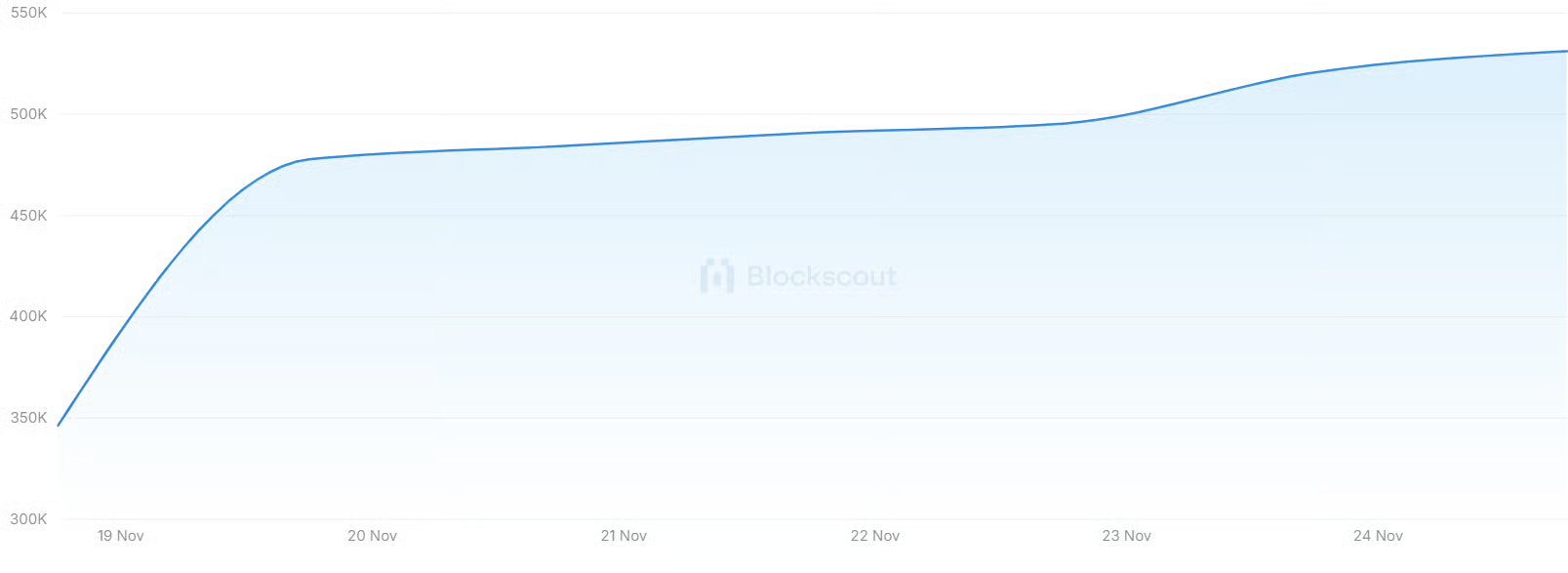
Source: Gensyn Testnet Explorer
A chart that makes you want to look again.
The Gensyn public testnet processed over 500,000 transactions in a single day, continuously rising from about 350,000 in less than a week. The total transaction volume has now exceeded 84 million, serving over 155,000 users.
Most of this comes from early machine learning applications:
- RL Swarm tests distributed reinforcement learning (with over 33,000 connected nodes)
- BlockAssist captures behavioral data from interactive environments (with over 1 million trained models)
- CodeAssist tests editing and reasoning functions in programming tasks (with over 55,000 problem-solving instances)
Currently, most of the usage still comes from Gensyn's native applications. The real test will be how active external developers can be once the network is fully open.
Earlier this week, the testnet did experience RPC issues, causing some nodes to disconnect and go offline; however, the blockchain itself continued to run and could be fixed with a simple restart.
3. Project Analysis
CodecFlow: Replacing Scripts with "Operators"
A few months ago, I came across CodecFlow, which is an execution layer for AI agents and robots. Its core uses the "Optr" (i.e., Operators) model, allowing developers to apply the same set of automation logic to desktop computers or robotic arms without rewriting code.
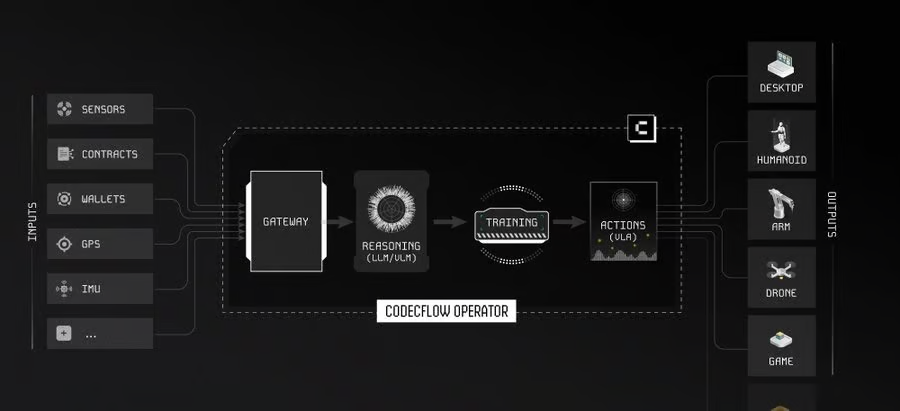
Source: Codec Docs
How It Works
- Operators are small AI agents that continuously monitor the screen or robot camera for dynamics, analyze the information they see, and execute the next steps. This process loops continuously.
- Each Operator runs on an independent microcomputer, transmitting video streams to the AI system and receiving back commands for clicks, keystrokes, or robotic arm movements.
- Training Operators essentially involves demonstrating the task flow to them. After just a couple of manual operations, the system can learn from the demonstration. Once Operators master the skills, they can be released for others to use.
Source: Codec Docs
Considerations
The operation of Operators relies on consistent behavior across different machines. Since real robots and actual environments do not always maintain uniform performance, unexpected situations can arise quickly.
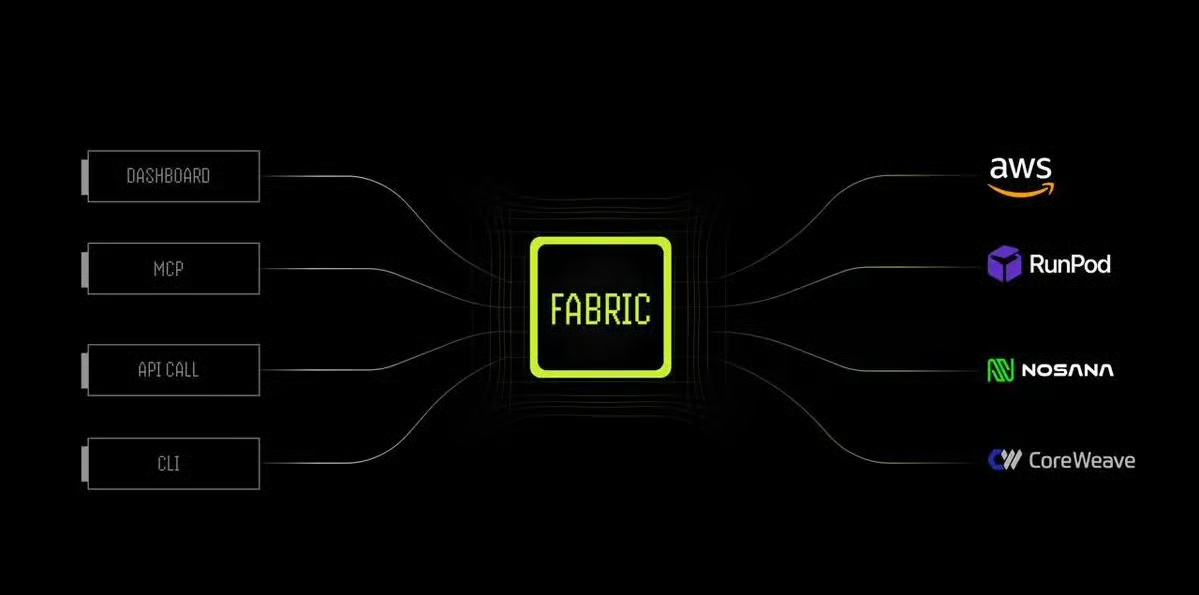
Codec has also developed the Fabric architecture, which can quickly deploy machines running Operators and seamlessly migrate tasks between the cloud, local computers, and real robots without interruption. Its core advantage lies in the fact that each agent operates in an independent, secure, isolated environment, ensuring that the task execution process is not disturbed.
4. Highlight Events
Financing News
- Numerai completed a $30 million Series C funding round at a $500 million valuation to expand its AI-driven hedge fund.
- AlphaTON Capital received $82.5 million in investment to build GPU infrastructure for its Cocoon AI project (related to TON).
- ZENi completed a $1.5 million seed round to build an intelligent data layer for AI agents.
Basic Protocols
- Prime Intellect released INTELLECT-3, the first fully open-source expert hybrid reinforcement learning model with over 10 billion parameters, achieving state-of-the-art performance among models of similar size in mathematics, coding, and reasoning tasks.
- Monad launched the AI Blueprint program to provide comprehensive support for AI applications, including resources and infrastructure assistance to help developers build, launch, and scale projects, with applications now open.
- Akash Network officially launched AkashML hosting inference services, providing hosted inference services for open-source models through its decentralized GPU marketplace.
- Caesar partnered with Centrifuge to become the first AI company to complete on-chain equity issuance, initiating the practice of equity on-chain.
- The AO mainnet is now fully operational, successfully migrating its original computing system to its Hyperbeam architecture.
- Fleek released the Weyl Gen AI API, which provides diffusion model inference services while achieving approximately 80% cost savings while maintaining similar speed and output quality.
AI Agents and Applications
- Heurist AI launched a real-time demonstration of x402 Monopoly on the Base chain, enabling AI agents to autonomously trade using the x402 payment standard.
- WardenChain's mainnet officially launched, enabling an on-chain agent identity system and agent application store, with a verifiable AI network supported by 34 validating nodes.
- Questflow released an AI development platform that supports developers in building and deploying AI agents and multi-agent workflows.
- OpenMid debuted as a native service provider for the x402 payment standard, adding an on-chain identity module and upcoming reputation extension features to the AI agent payment system.
- OpenGradient added a personal memory layer to its digital twin agents, allowing agents to continuously record user context and historical interaction data.
Bittensor Ecosystem
- BitstarterAI, in collaboration with Alpha Core, completed the launch of the first crowdfunding subnet on SN66, attracting over 1,000 participants.
- Zeus partnered with WeatherXM and Sportstensor to integrate data from thousands of weather stations into its validation layer.
- Numinous launched on subnet 6, upgrading its prediction mechanism from submitting prediction results to real-time evaluation of agents in a transparent arena.
- Score partnered with Avia to deploy Vision AI at over 3,000 gas stations, bringing real business workloads onto the network for the first time.
On-Chain Robots
- Virtuals launched the SeeSaw iOS app, crowdsourcing real-world training data for robots through the ACP protocol.
- Auki deployed its first paid pilot project in the U.S., rolling out its spatial AI retail platform Cactus to three locations in New England.
- RoboOS released a beta version of its fleet management dashboard, enabling on-chain robot management, payment, and task orchestration through Solana and the x402 payment protocol.
- Prisma XAI launched a portal leaderboard to reward contributors providing remote operation data for embodied AI models on the Monad mainnet.
免责声明:本文章仅代表作者个人观点,不代表本平台的立场和观点。本文章仅供信息分享,不构成对任何人的任何投资建议。用户与作者之间的任何争议,与本平台无关。如网页中刊载的文章或图片涉及侵权,请提供相关的权利证明和身份证明发送邮件到support@aicoin.com,本平台相关工作人员将会进行核查。


