Author:潮向研究
The energy consumption landscape of AI computing infrastructure is being rewritten. The analysis team of JPMorgan's Asia Pacific Technology Hardware and U.S. Electrical Equipment (Albert Hung, Julian Mitchell, etc.) pointed out in their latest model update report released on November 25, 2026, that due to the upward adjustment of CoWoS packaging capacity allocation and the increase in thermal design power (TDP) of the next-generation ASIC chips, the global data center installed capacity is expected to reach 303GW by 2028, an increase of 4% from the previous forecast, with annual electricity consumption accounting for about 4% of global total demand. Although the pace of high-voltage direct current (HVDC) penetration has slowed, the market for server power supplies and liquid cooling components is expected to record compound annual growth rates of 83% and 128%, respectively, between 2025 and 2028, with Delta Electronics, Qinxin, JianCe, and nVent becoming key beneficiaries.
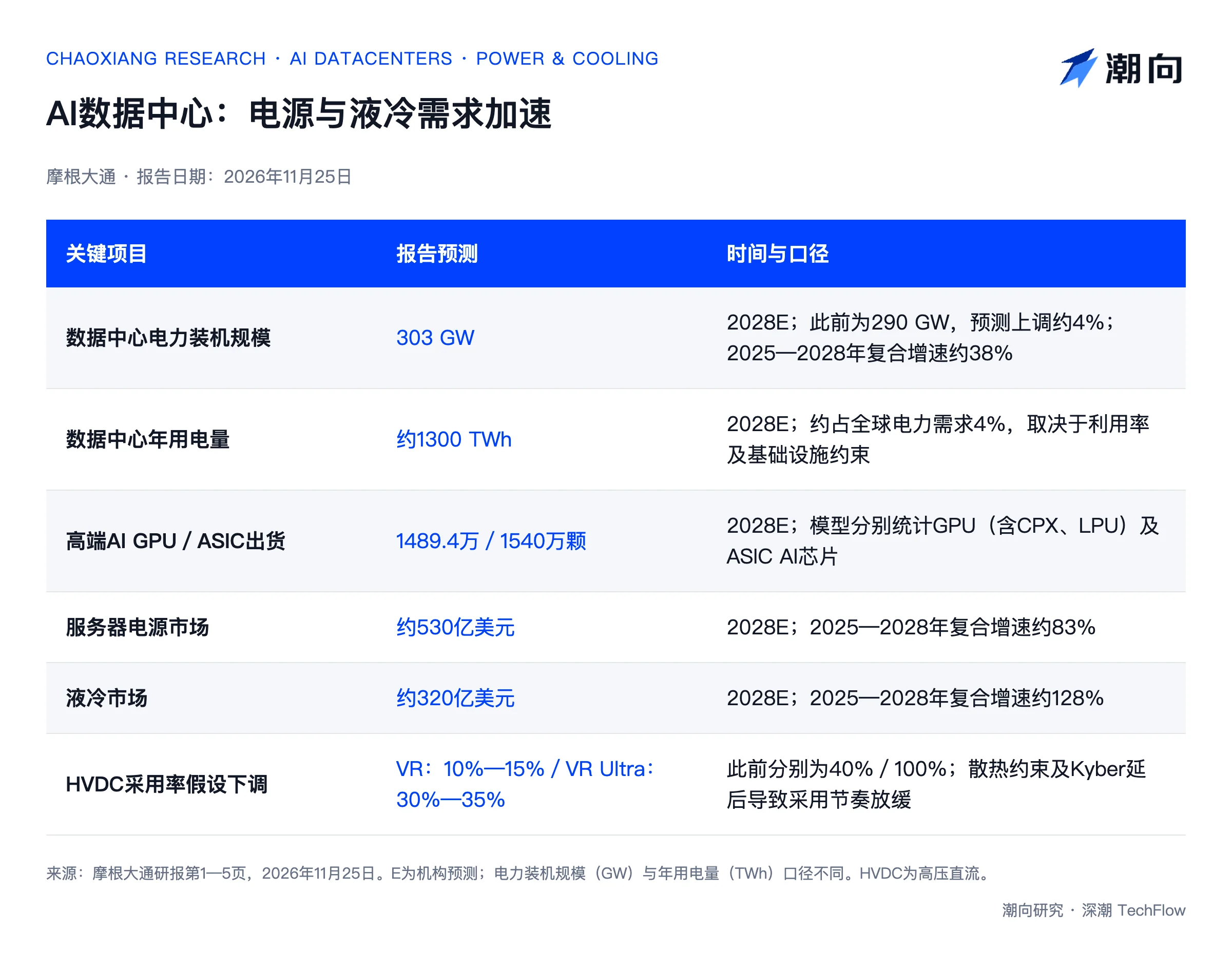
Installed capacity expected to reach 303GW, half of cloud giants' spending goes overseas
The upward revision of computing chips' shipments directly raises the electricity ceiling for global data centers.
JPMorgan has raised its forecast for the installed capacity of global data center electricity to 303GW in 2028 from 290GW (120GW in 2025), with a compound annual growth rate of 38% from 2025 to 2028, significantly exceeding the historical conventional expansion rate of 10% to 20%. By then, the annual electricity consumption of global data centers is expected to rise to about 1,300 terawatt-hours (TWh), with its share of total global electricity demand jumping from 1.7% in 2025 to 4%.
Changes on the chip front are the core drivers. JPMorgan expects that the compound annual growth rate of AI ASIC chip shipments will reach 55% from 2025 to 2028 (14.6 million units in 2028), and the compound annual growth rate of high-end AI GPU shipments will reach 34% (14.89 million units in 2028). At the same time, driven by the demand for intelligent AI inference, the compound annual growth rate of general server shipments has also been raised from 15% to 18% over three years.
Electricity quotas have become the primary bottleneck restricting data center expansions. To circumvent the constraints of the U.S. domestic grid, hyperscale cloud providers (CSP) are accelerating their overseas deployment. JPMorgan's statistics show that about half of the approximately $210 billion in new investment plans announced by the four major cloud giants in North America since the beginning of 2026 are directed towards overseas markets such as Southeast Asia, Northern Europe, and Australia, to support local inference computing power and ease electricity pressure in the U.S., while the adoption of small modular reactors (SMR) and solid oxide fuel cells (SOFC) is also accelerating.
HVDC slows down, power supply market still exceeds $53 billion in 2028
The evolution of power supply architecture has seen adjustments in rhythm, but the increase in the value per watt brought about by high power density remains certain.
Due to cooling limitations restricting aggressive increases in GPU power consumption, combined with delays in the Kyber rack solution, JPMorgan has adjusted its expectations for the penetration rates of high-voltage direct current (HVDC) for NVIDIA's Vera Rubin (VR) and Vera Rubin Ultra (VRU) generations from 40% and 100% down to 10% to 15% and 30% to 35%, respectively. In the baseline scenario, the VRU NVL576 cabinet will come standard with an HVDC power cabinet, while HVDC in the VRU Oberon cabinet remains optional; in addition, ASIC power cabinets have also faced delays due to supercapacitor certification issues.
The power shelf solutions still possess strong vitality in the short term. At the Supercomputing Conference (SC26) in November 2026, the accessibility of 800V direct current power supply is still gradual, but Tesla's sudden release of its 7.4MW medium-voltage solid-state transformer product, Powercore (expected to be operational in 2027), introduces new competitive variables for traditional electrical giants like Eaton (ETN), Vertiv (VRT), and GE Vernova (GEV).
Even with the slowing of HVDC, the server power supply (PSU) market is still poised for explosion. Driven by rapid increases in ASIC power consumption and upward revisions in xPU shipment volumes, JPMorgan projects that the market size for server AC and DC power supplies will expand at a compound annual growth rate of 83% from 2025 to 2028, reaching $5.33 billion in 2028, with an average of about $430 million in power supply demand corresponding to each additional 1GW installed capacity. The industry landscape is highly concentrated, with Delta Electronics holding a 42% market share and Lite-On Technology holding a 25% market share, collectively occupying nearly 70% of the market.
ASIC drives liquid cooling upgrades, double-sided cold plates become standard
Compared to the power supply segment, the liquid cooling market within data centers (white space) has seen more substantial upward revisions.
JPMorgan has raised its compound annual growth rate forecast for the AI server liquid cooling component market from 2025 to 2028 to 128%, predicting that the overall scale will reach $32.5 billion in 2028, with each additional 1GW of installed capacity corresponding to about $270 million in liquid cooling demand. Among these, the heat spreader market has a staggering three-year compound annual growth rate of 210% (reaching $4.7 billion in 2028), and the system-level cold plate module compound annual growth rate is expected to reach 137% (reaching $24.7 billion in 2028).
Customized ASIC chips are becoming the biggest driver of the rise in liquid cooling specifications. By adopting a vertical power distribution (VPD) architecture that moves the power module to the back of the chip, from the fourth quarter of 2026 and into 2027, major projects including Amazon's Trainium 3, Google's TPU v8, AMD MI450, as well as subsequent Meta MTIA and Microsoft's Maia will fully transition to a "double-sided cold plate" design. For example, Amazon's Trainium 3 liquid cooling cabinet has a single cabinet cooling value of up to about $83,000, surpassing NVIDIA's Vera Rubin NVL72 cabinet at $66,300.
Chip-level cooling is also experiencing a simultaneous increase in both volume and price. NVIDIA Rubin Ultra is expected to incorporate a three-piece detachable lid design by 2027, resulting in a cooling value for a single GPU heat spreader that surges to more than six times that of Rubin; meanwhile, Google's TPU v9 is expected to significantly upgrade the heat spreader specifications in 2028, leading to a 5 to 10 times increase in unit value.
Winners diverge, locking in liquid cooling purity and integrated leaders
In the face of the dual scenarios of gradual evolution of power supply architecture and accelerated penetration of liquid cooling, JPMorgan has provided a clear priority ranking for the industry chain.
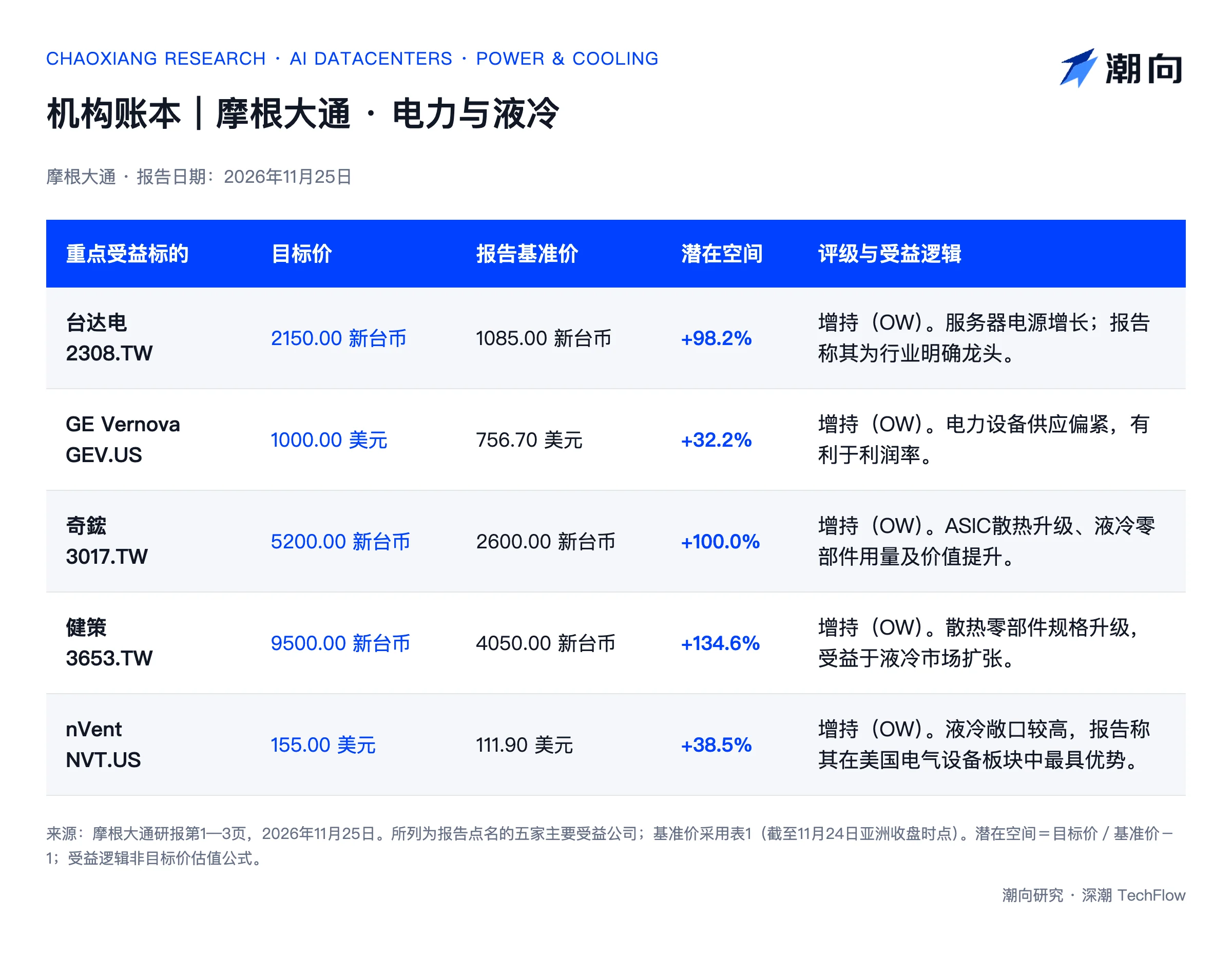
In the Asian hardware supply chain, Delta Electronics (2308 TT, Buy, target price NT$2150) is projected to increase its AI server power revenue share from 13% in 2025 to 33% in 2028, contributing nearly half of its operating profit, thanks to its 42% share in server power supplies and comprehensive layout in HVDC, solid-state transformers, and side CDU. In the liquid cooling sector, Qinxin (3017 TT, Buy, target price NT$5200) not only holds 40% to 50% of NVIDIA's cold plate share but also has secured more than half of the core ASIC projects such as Amazon's Trainium 3; JianCe (3653 TT, Buy, target price NT$9500), as the absolute leader in high-end server heat spreaders, will benefit greatly from the packaging cooling upgrades of Rubin Ultra and TPU v9.
In the U.S. stock electrical equipment sector, due to the possibility of a slowdown in the growth rate of new data center installations in 2028, some institutions are concerned about a decline in equipment order growth rates in 2027. Only those entities with high liquid cooling purity and benefitting from power bottlenecks have stronger certainty. JPMorgan strongly recommends nVent (NVT, Buy, target price $155), whose liquid cooling business accounts for a high double-digit percentage of total revenue and carries no burdens from traditional chiller units; at the same time, it is optimistic about GE Vernova (GEV, Buy, target price $1000) regarding its profit margin expansion potential under tight gas turbine supply and long-term solid-state transformer contracts.
This article is a summary and interpretation of third-party brokerage research reports by潮向研究. The ratings, target prices, earnings forecasts, and related judgments quoted in the text represent the views of the brokerage analysts and only reflect the position of their respective institutions, not representing the views of潮向研究, nor constituting any investment advice.
The market has risks, and decisions should be made independently. This article should not be the basis for buying or selling any securities.
免责声明:本文章仅代表作者个人观点,不代表本平台的立场和观点。本文章仅供信息分享,不构成对任何人的任何投资建议。用户与作者之间的任何争议,与本平台无关。如网页中刊载的文章或图片涉及侵权,请提供相关的权利证明和身份证明发送邮件到[email protected],本平台相关工作人员将会进行核查。