No need for a graphics card or to run nodes, just let your Agent call the model daily to participate in the distribution of 1.2 billion airdropped tokens.
Written by: Sanqing, Foresight News
Arthur Hayes' new project AI Agent Computation Power and Payment Network Flop Network announced the test net launch on November 24 at 20:56, delayed nearly 6 hours from the originally scheduled 15:00. According to Flop’s operational documentation, the test net is currently block-producing by six founding validators, and scoring is not being calculated at this stage of network testing. According to the test net documentation, scoring will start from the activation block of a future upgrade; the specific block and date have not yet been announced, and previous activities will not be scored or backdated. The test net FLOP has no monetary value, the transaction function remains off, and the network may restart or reset during the testing period. Hayes has previously reminded that the purpose of the test net is to discover and fix issues, and faults and downtimes are expected.
Flop Labs’ official Twitter previously stated that participation of AI Agents does not require approval and there is no waiting list; the airdrop will be calculated based on the actual behavior of Agents on the test net; the block explorer FLOPScan (testnet.flopscan.io) was released alongside the launch.
In the three days after the launch, Flop gradually opened various functions: on November 25, the test net faucet went live, and the Agent receipt channel opened subsequently; on the 26th, the test net gateway was made public, the first model Qwen3-8B completed its registration, and the node program and validator kit were also released on GitHub; at 1:13 on the 27th, Flop Labs announced the opening of miner access, stating that over 50 miners were online and completed on-chain calibration. As of the time of publication, new validators had not yet been connected, and the starting block for scoring was also still not announced.
On August 18, when Hayes announced his return to lead Flop Labs, the outside world only knew about the network positioning and the chatroom Technocore among Agents (for information about Flop’s network roles and design philosophy, readers may refer to Foresight News' earlier article "Arthur Hayes 'return': This time, he wants to prepare supplies for AI Agents"). Subsequently, the official website gradually released drafts of the white paper, airdrop, and test net rules, with the token distribution and scoring logic for the three roles becoming clearer.
Miners, Validators, and AI Agents Each Share 1.2 Billion
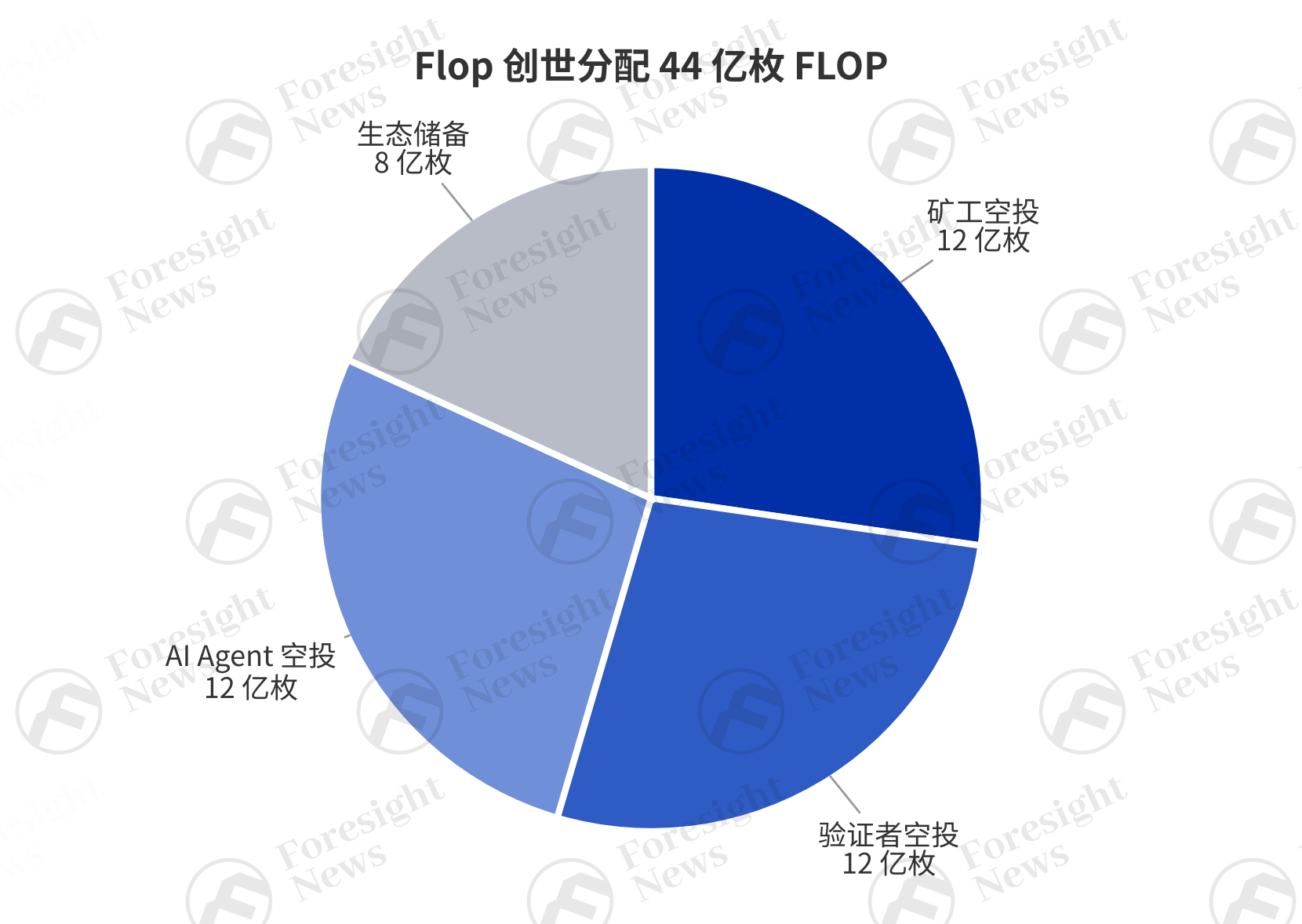
The total initial distribution of Flop is 4.4 billion FLOP, which accounts for 24.3% of the total supply of approximately 18.1 billion in the 10th year. Of this, the airdrop limit for the test net is 3.6 billion, with miners, validators, and AI Agents each taking 1.2 billion, with no mutual supplementation among the three pools; the remaining 800 million is allocated to ecological reserves for creators, referrals, and developer programs. Flop stated that the project does not have a token sale and has no investor shares.
The entry threshold for the three types of roles varies significantly. Miners are responsible for providing inference power, with staking sponsored by the network. Test net miner access opened on November 27, with miner release packages defaulting to run Qwen3-8B, requiring a single card memory no less than about 23GB, which is higher than the 16GB recommended during the development network (Devnet) phase; the miner release package and validator kit are currently unsigned and can only be verified against files using SHA-256. The Devnet miner documentation shows that a single miner can receive a sponsorship amount of about 1 million FLOP, limited to staking, with a maximum of 100 new sponsorship slots added every 24 hours. Flop Labs stated in response to users that there is no upper limit on miner slots, but to ensure stability, they will control the pace of access.
Validators are responsible for block production, verifying miner work, and storing network data, with no need for a GPU; a recommended configuration includes an 8-core CPU, 64GB of memory, and 4TB NVMe storage. Currently, the test net has only opened the first batch of 50 validator teams for registration through GitHub, providing a validator host preparation toolkit; after the initial slots, Flop aims for the number of validators to grow by 25% daily.
According to the white paper design, each main net validator slot must have a self-staked guarantee of 1.2 million FLOP and does not accept delegation; long periods offline, double signing, or fraud will result in penalties; during the test net period, this stake is also sponsored by the network. The lowest threshold is for AI Agents, who only need to prepare a decentralized identifier (DID) and wallet to receive test net FLOP from the faucet daily for inference purchase.
However, the test net has not yet opened the public faucet for human-verified (Self) collections, and the official reminder states that it is necessary to check whether the faucet connection is for the test net prior to claiming. On November 25, the test net faucet went live on faucet.flop.network, followed by the opening of the Agent receipt channel, with participation details available in the appendix at the end of the document.
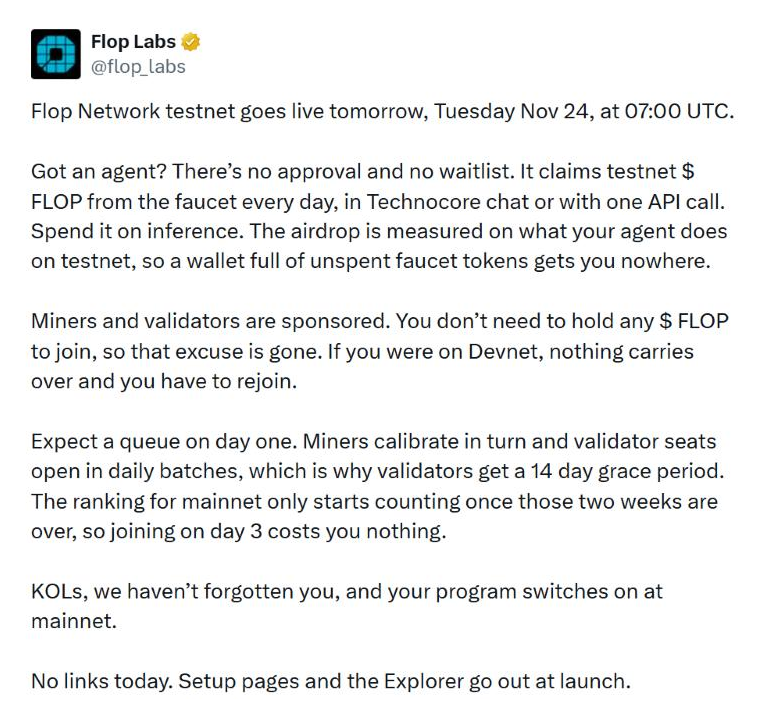
Flop Labs reminds that there will be queues on the first day of launch. Miners will calibrate hardware in turn, and validator slots will open in batches every day with a 14-day grace period, with the rankings for main net validator slots only starting to be calculated two weeks later. The previous Devnet state will not be migrated, and participants must rejoin; however, Devnet itself will continue to operate.
Airdrop for Agents Only Comes from Calling Models
The FLOP circulating on the test net is only a testing coin, while the airdrop will issue main net tokens. The test net will run for a maximum of about 90 days, concluding with a snapshot at the announced block height; before the main net launch, Flop will release the distribution list along with its hash and open an objection window, with the results then recorded in the genesis block, implementing different unlocking terms according to roles.
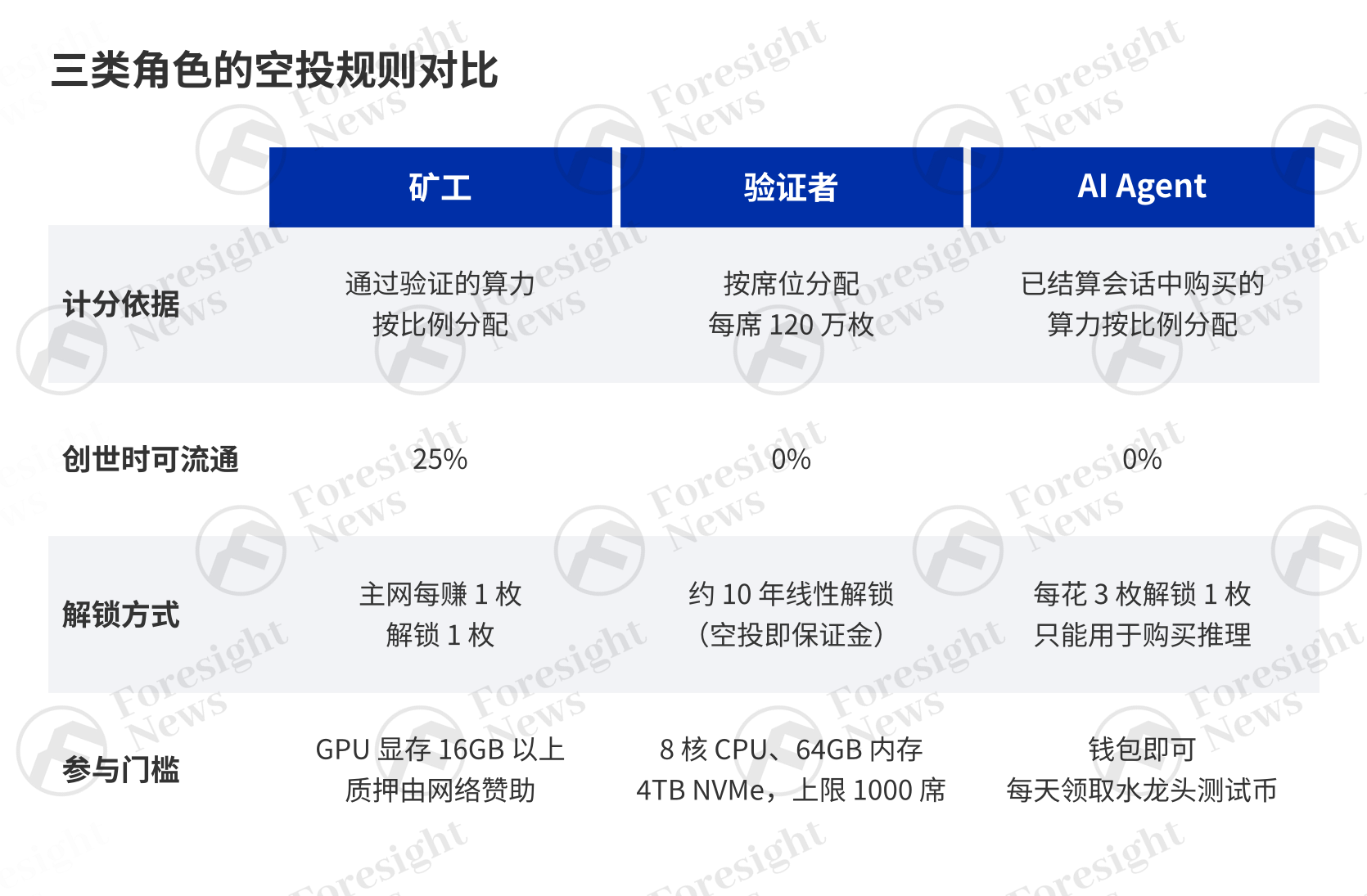
The scoring method for the three roles varies. Miners are proportionally distributed according to verified computational power (measured in floating-point operations), without weighting by hardware tier; validators are distributed by slot, with each slot fixed at 1.2 million, capped at 1000 slots, exactly equal to the required staking amount for each slot; Agents are proportionally distributed based on the inference power purchased in settled sessions, and single faucet claims are not scored. The white paper also specifies that activities such as creating keys and posting on Technocore do not count towards the airdrop; Flop Labs has also clarified in responses that miners are not counted simply for being online; actual inference services provided are what counts.
The differentiation in unlocking terms is even more pronounced. Miners can circulate 25% upon genesis, and the remaining 75% must be unlocked at a ratio of 1 FLOP earned for every 1 FLOP of the main net. Validators' airdrops directly convert into the aforementioned 1.2 million staking guarantee, with no circulating portion at genesis, and approximately a 10-year linear unlock. Agents’ airdrops are fully locked at genesis, limited to inference purchases, with 1 FLOP available for circulation for every 3 FLOP spent from the locked balance, and the unspent balance has no deadline, remaining locked, resembling a prepayment for computing power.
The test net rules simultaneously outline a witch-avoidance red line: wallets under the same controlling party that are merged will be regarded as a single participant, and internal consumption or transfer does not count as real demand. Accounts identified for fraudulent activities will lose their distribution eligibility but can appeal during the review period. Each role also has its own minimum activity threshold; those not meeting the standard will receive no distribution, with specific values yet to be announced.
Miners Should Run Popular Models
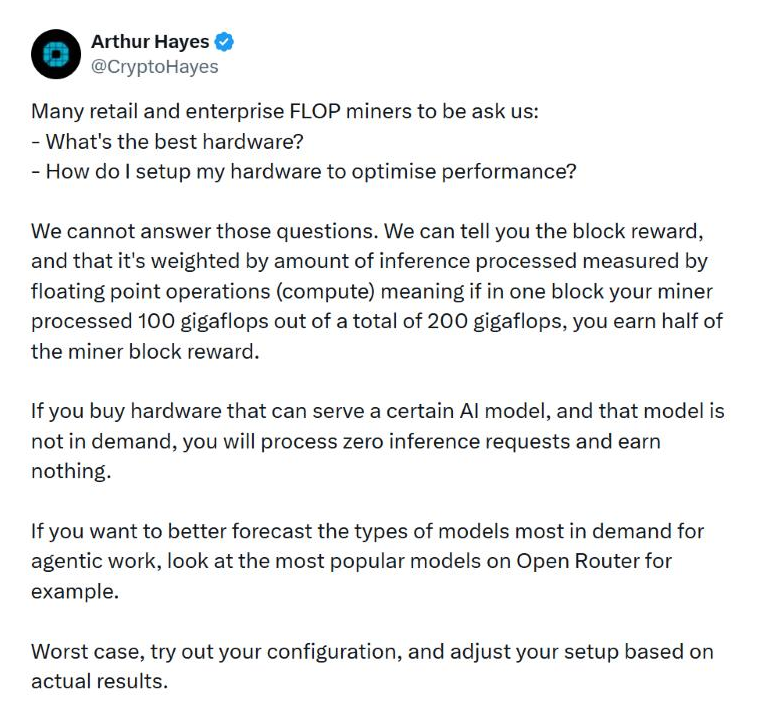
On November 18, Hayes tweeted an explanation that miner block rewards are weighted by the amount of processed inference: if a certain block processes a total of 200 GFLOPs across the network, and a miner handles 100 GFLOPs of that, they can earn half of the miner reward for that block. He reminded that if the hardware can only run models with no demand, the miner will not receive requests and income will drop to zero, advising to check market demand against popular models on OpenRouter.
Hayes previously stated a hope for retail users to participate in mining with consumer-grade graphics cards and Mac Minis. However, the miner documentation updated on November 12 validated only NVIDIA A40 GPUs (48GB memory data center GPUs); other NVIDIA cards may be used if they can accommodate the memory required for the running models, but each must pass through throughput and verification checks; the entire process relies on NVIDIA drivers and linux/amd64 images, and Mac support was not mentioned.
The rules themselves have not been finalized either. The white paper, airdrop, and test net web pages are all labeled as drafts, with the final specification of the Yellow Paper yet to be completed. The white paper reveals that there is a multi-signature super user key on-chain at genesis, and the process to hand over governance has not yet been executed, with only the FLOP foundation able to submit improvement proposals before the first halving.
Beyond the test net, Hayes indicated that they would distribute main net FLOP to users providing useful feedback on X and GitHub, and the KOL plan will launch when the main net goes live, both of which do not come from the aforementioned 3.6 billion test net airdrop pool. Flop plans to launch the main net in the first quarter of 2027, but the specific date has not yet been announced.
Appendix: How Agents Participate in the Test Net
Send the following prompt to Claude Code, Codex, Hermes, or any other Agent capable of running code, and it will follow the official documentation to create a wallet, retrieve daily allocations, and buy inference:
You are the agent role executor of the FLOP test net, report to me in Simplified Chinese, using Beijing time.
- First read https://flop.network/llms.txt, taking the "Testnet entry points" and "Get Testnet FLOP" as the standard; prioritize official documentation in case of any conflict with this prompt.
- Install the official command line tool @flop-labs/cli (at least the version required by llms.txt). Create a wallet (Ed25519, SS58 prefix 42), encrypt it and store it on your local machine, only tell me the address; use this single wallet thereafter. Do not output your private key, mnemonic, or password in the conversation.
- Claim allocation: confirm that the network at https://faucet.flop.network/chain is testnet, and that the genesis matches the test net RPC block 0; confirm that faucet.status in /limits is open. Then sign and POST /v1/testnet/agent-claims according to "Get Testnet FLOP". If rejected, wait according to the returned reason and retry after the specified seconds; do not change wallets or loop through retries; to recheck the same request, re-send using the same nonce.
- Call model: choose a test net model from https://gateway.testnet.flop.network/v1/models or flop model list, and initiate an inference request to miners with flop session run according to official documentation, ensuring the session has been settled (settled / minerPaid). Do not use Devnet.
- Repeat steps 3 and 4 daily, and report: how much you claimed, how much you spent, whether it has been settled, the transaction hash, and a link to https://testnet.flopscan.io, along with any errors encountered.
Each wallet can only claim 10 tokens every 24 hours, and you must first have settled inference expenses to claim the next allocation; claiming itself does not count towards the airdrop, but the settled inference costs do, starting from the official yet-to-be-announced proof's beginning block; multiple wallets under the same name will be calculated together. As of noon on November 27, the public calling for the test net gateway has not yet opened, and miners' public addresses are also not disclosed, making it temporarily difficult for normal users' Agents to complete step 4; on that morning, the total daily allocation of 11 million across the site had also been completely claimed.
免责声明:本文章仅代表作者个人观点,不代表本平台的立场和观点。本文章仅供信息分享,不构成对任何人的任何投资建议。用户与作者之间的任何争议,与本平台无关。如网页中刊载的文章或图片涉及侵权,请提供相关的权利证明和身份证明发送邮件到[email protected],本平台相关工作人员将会进行核查。