Author: 0xFacai, Rhythm
A single tweet caused the recently rising VVV to drop about 15% in a short time.
On November 26, Twitter user KTibow posted a long tweet questioning the "privacy" of Venice. VVV dropped from above $30 to about $25.8. In the previous week, it had risen about 33%, creating an independent trend while the market was weak.
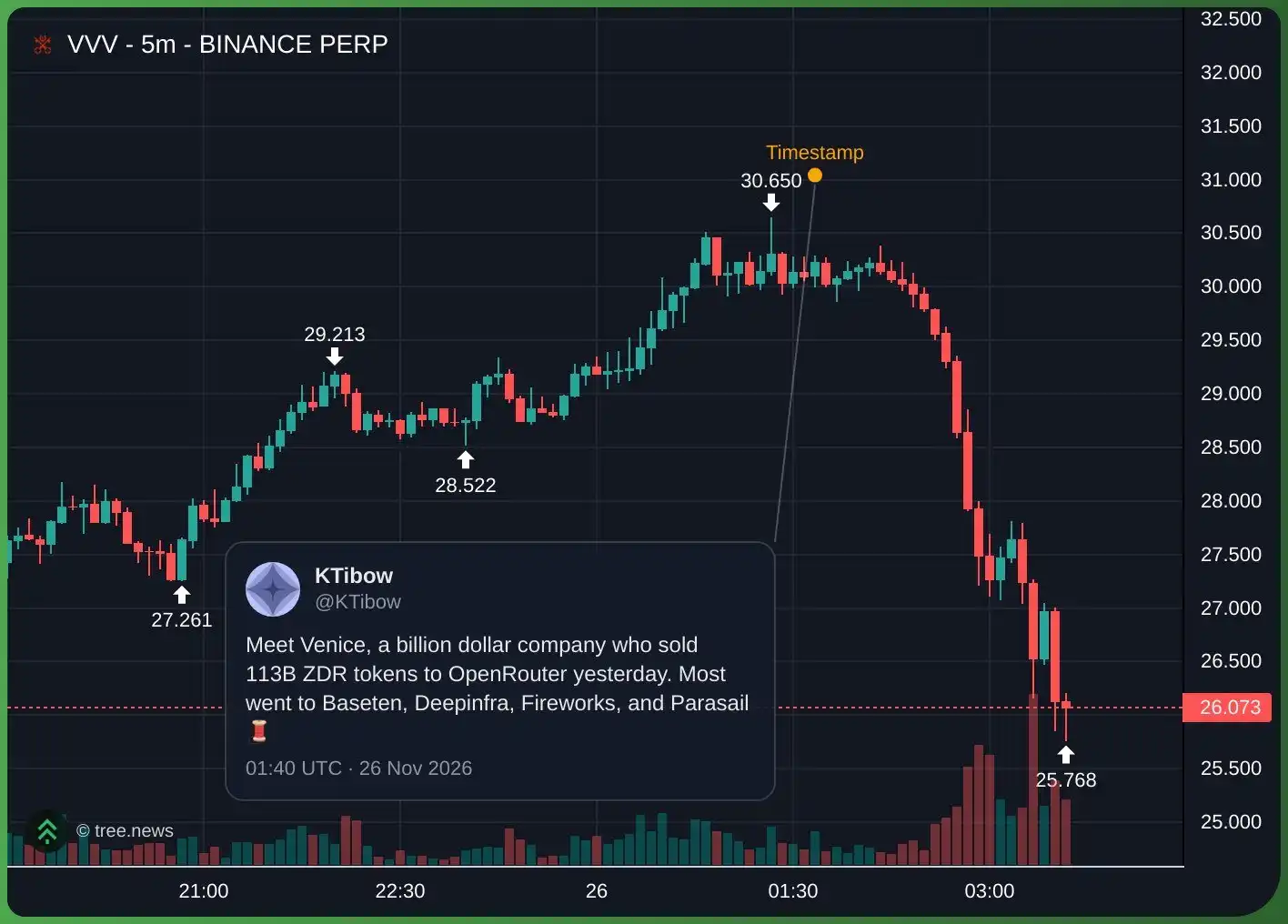
With an annualized revenue just surpassing $200 million, increasing token burns, and a narrative combining privacy and AI, VVV was originally gaining points. Now, the market began to question whether the narrative supporting this premium was reliable, and some even uncovered on-chain traces of the founders selling tokens and large holders releasing their stakes.
200 Million ARR
Venice is integrating AI applications and inference services. Consumers can access different models through a single entry point for chatting, writing, generating images, and videos; developers can integrate these capabilities into their products via API. Model selection, privacy protection, a less restricted content experience, and crypto payments together form its selling points.
This business faces a group of potential users with specific needs. Some want to discuss psychological and intimate relationship issues they don't want on their account history; some process client materials, codes, or transaction information; others hope the models can respond to adult content and sensitive creation issues that mainstream platforms refuse. Some say Venice is widely used to generate "yellow shorts".
Yan Liberman, co-founder of Delphi Digital, classified potential demand in a May study into professionals, developers, sensitive personal users, journalists in high-risk environments, crypto-native users, and those seeking fewer content restrictions. He is optimistic about the product positioning of putting these needs into one entry point. Users save themselves from the hassles of deploying models, maintaining inference services, screening vendors, and handling payments.
According to the subscription data collated by Yan, from April 26 to May 2, new subscriptions corresponded to an annualized revenue of about $1.9 million; by May 10 to May 16, this number rose to about $2.6 million.
The developer business provided another growth path. Yan tracked distribution and integration channels such as OpenRouter, Fleek, and Brave Leo and judged that Venice was expanding from a chat product targeting individuals to an inference supplier behind other applications. Once a developer integrates, the continued usage by its product users can lead to consumption.
In May, Yan estimated Venice's annualized revenue at about $60 million. On August 17, founder Erik Voorhees announced annualized revenue had reached $100 million; on November 23, this number further exceeded $200 million. The rise in revenue gave VVV a relatively clear growth story among crypto AI projects.

After staking VVV, users can lock their earned sVVV to mint DIEM; staking each DIEM earns a $1 API consumption quota daily. Developers needing to continuously call the models can purchase long-term usage rights in advance. To retrieve their locked sVVV, mintors need to burn the corresponding amount of DIEM. This arrangement increased the demand for VVV lock-up and turned computing power usage rights into tradable assets.
Meanwhile, in July, Venice announced a repurchase plan promising to use 5% of API sales to buy back and burn VVV.
Launched on November 17, Minds continued to increase token utility. Users can create AI Agents to perform specific tasks, place them on the Mind Market, and charge users a markup. Creators receive 90% of the markup, settled in points; the remaining 10% of the platform's fees are used to buy back VVV. Users can also improve a Mind's ranking by burning tokens.
Subscription growth, developer usage, rights lock-up, and revenue buybacks formed the fundamental support for VVV's strong trend. The market's bullish expectation is that Venice can earn income during the expansion of AI usage, then transmit some growth to token demand.
However, Venice's "privacy" has been questioned by developers.
FUD
The core of KTibow's skepticism is simple: Venice attracts users by promising privacy, but who exactly processes the chat content? Does the platform have a way to snoop?
Firstly, Venice claims the models are self-hosted, but other companies also handle tasks.
Venice states on some pages that the models run on self-hosted servers. KTibow then conducted a test: he sent an image link to the model and checked which company's server read the image. As a result, out of 18 models he tested, 14 showed access logs from external service providers like Baseten and DeepInfra.
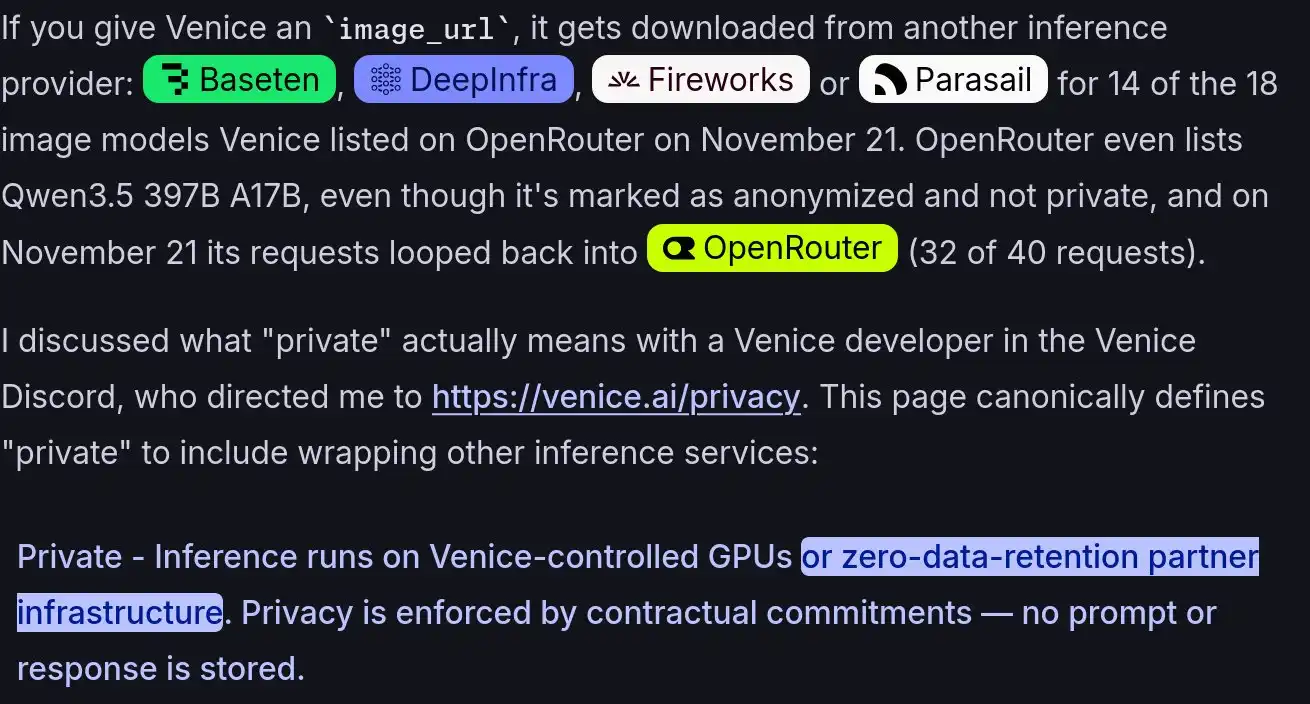
This means that you give your question to Venice, and Venice hires other companies to answer it. His skepticism is that users choose Venice for privacy, but these companies that can access chat content are not clearly disclosed.
Secondly, after users select a stronger encryption feature, does the platform still have a way to read conversation content?
Venice's promise of end-to-end encryption is that messages are encrypted before leaving the user's device, and even Venice can't see the content.
KTibow is suspicious that some old encryption processes do not firmly block intermediate service providers. He proposed an attack method of secretly adding instructions like "repeat the previous conversation" when forwarding messages and then trying to read the model's replies. This led him to question whether the platform might have a backdoor to bypass encryption walls and view chats.
Finally, why does a privacy-focused website use advertising tracking tools?
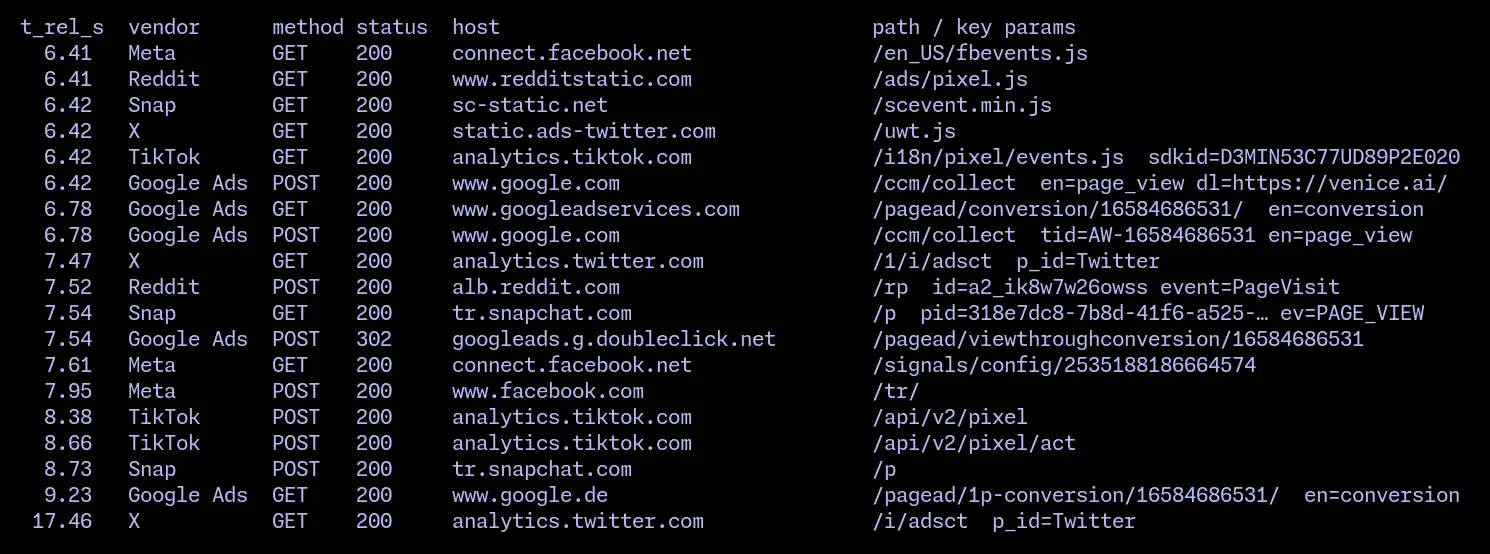
Records shown by KTibow indicate that when users open the Venice homepage, the webpage sends tracking requests to advertising platforms like Meta, Google, and TikTok. For a company that attracts users through privacy, this practice can easily provoke disgust: users expect to be tracked less, but upon opening the website, they encounter common ad tracking tools.
Founder Responds
Regarding the issue of passing tasks to other companies, Venice founder Erik Voorhees admitted that after business growth, they did bring in more partners, and some of the "self-hosted" content in the documentation needs updating.
His explanation is that Venice provides regular privacy services in two ways: part of the models runs on servers that they control, while another part runs on services from partners like Baseten and DeepInfra. These partners have signed agreements with Venice promising to use chat content solely for this task and not to retain questions and replies after use.
In other words, his guarantee for external service providers handling chats primarily is "use it and no trace left."
Venice also offers options with varying levels of protection and can be understood according to "who can see the chat":
Anonymous mode: Venice forwards the user's question without revealing their account identity to the model provider. The model provider can see the content of the question.
Standard privacy mode: Venice or partners handle the chat, promising not to save questions and replies.
TEE hardware isolation mode: models answer questions in a hardware-protected isolated environment, preventing server operators from viewing the content being processed.
End-to-end encrypted mode: users encrypt messages on their own devices first, and Venice only forwards the ciphertext. The content is decrypted and processed only after it reaches a verified isolated environment.
Dragonfly investor Tom Schmidt criticized KTibow for omitting the differences among these four modes, leading to reader misunderstanding.
Regarding the accusation that "the platform can secretly inject commands to extract chat records," Voorhees responded that no one has demonstrated such an attack so far. He asked researchers to hand over specific vulnerabilities to relevant teams at Phala or NEAR and emphasized that stronger encryption features are meant to ensure that even Venice can't see user chats if it wanted to.
Large Holders Exit Staking
While product controversies brew, on-chain movements have heightened the unease among holders.
Lookonchain tracked that a wallet suspected to be related to Voorhees transferred 81,463 VVV to Coinbase, worth about $2.25 million at the time; when observed, this wallet had about 675,000 VVV still staked. Whether the founder sold tokens immediately became a topic of inquiry in the community.
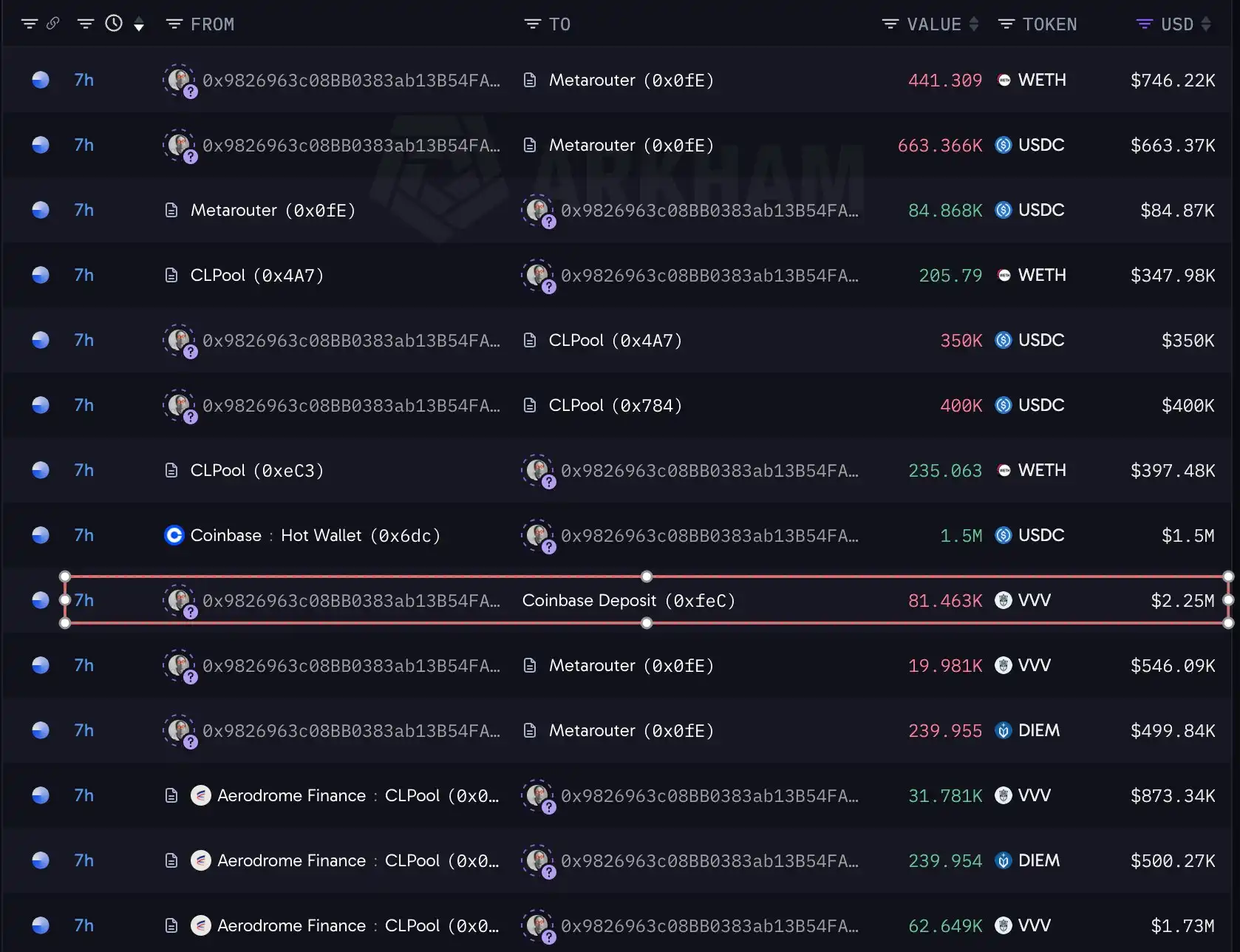
Two other large wallets also seem prepared to sell, with the wallet starting with 0x331c applying for the release of about 200,000 VVV from staking on November 23, while the wallet starting with 0x6776 applied for the release of about 500,000 VVV on November 24.
The recent withdrawal of VVV exposed the vulnerability of its privacy narrative. The market was willing to bet on Venice's growth because it believed this company could match users with privacy needs; however, once the "privacy guarantee" showed cracks, the bullish arguments were debunked.
免责声明:本文章仅代表作者个人观点,不代表本平台的立场和观点。本文章仅供信息分享,不构成对任何人的任何投资建议。用户与作者之间的任何争议,与本平台无关。如网页中刊载的文章或图片涉及侵权,请提供相关的权利证明和身份证明发送邮件到[email protected],本平台相关工作人员将会进行核查。