Written by: Sachin
Translated by: Chopper, Foresight News
The locked value in DeFi (TVL) is 68 billion dollars, of which less than 2% is covered by insurance.
Since 2021, DeFi has evolved from basic lending and liquidity markets to fixed-rate credit, yield layering, and structured yield products; however, insurance protocols have moved in the opposite direction, with a total TVL falling from 1.85 billion dollars in 2021 to only 132 million dollars now.
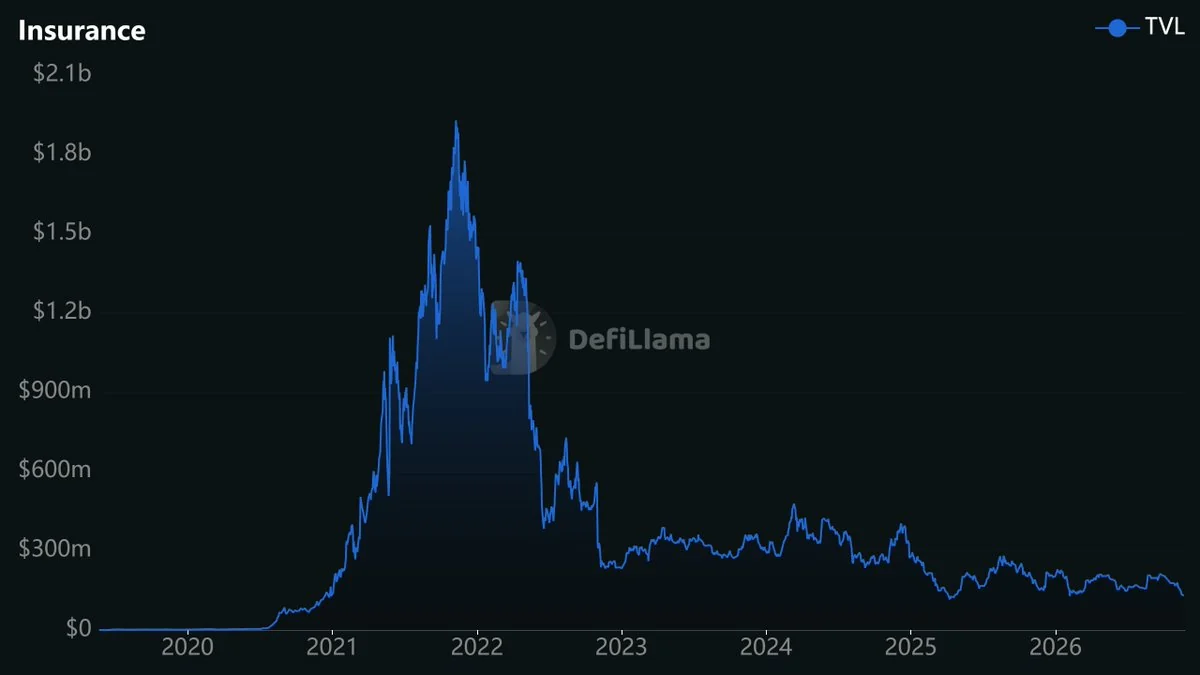
DeFi insurance TVL has significantly declined from its peak in 2021
Insurance as the Fourth Primitive of DeFi
DeFi has established three core financial building blocks:
- AMM enables decentralized trading;
- Lending markets provide credit and yields;
- Cross-chain bridges facilitate cross-chain transfers.
These three collectively create and distribute financial risk. But insurance has always been absent, lacking the ability to price and transfer downside risks. Audits and monitoring can identify failures but cannot absorb losses; insurance defines "financial protection" through coverage limits and payment conditions.
As AI accelerates the discovery of vulnerabilities and attacks 100 times faster and cheaper, why does DeFi insurance still lag behind? Is the issue with the insurance protocols themselves, insufficient supporting infrastructure, or inadequate demand from users and institutions?
Before assessing why DeFi insurance is difficult to scale, it is essential to clarify what risks existing products actually cover.
What Risks Does DeFi Insurance Cover?
When depositing assets into DeFi, one faces more than just market risks. Smart contract vulnerabilities, oracle failures, governance attacks, liquidation failures, depegging, staking penalties, and custodial failures can all lead to losses.
For instance, a vulnerability attack drained 10,000 dollars from a user's deposit in a lending protocol; even if they never made a wrong trading decision, their position still went to zero.
The goal of DeFi insurance is predefined loss events rather than ordinary market volatility or trading losses.

Six types of risks faced by DeFi
Systemic risk is currently deemed uninsurable.
How Existing DeFi Insurance Models Operate: A Case Study of Nexus Mutual
Nexus Mutual is a good example for understanding the existing model. It operates on Ethereum and is a discretionary mutual organization where members pool capital to underwrite specific risks.
Its operational process is as follows:
- Contributors: NXM holders stake or delegate tokens to the underwriting pool.
- Risk selection: Pool managers decide which protocols and risks to cover and set premiums.
- Policy purchase: Users pay premiums to receive protection against predefined loss events.
- Claims: Claims are assessed by a claims committee. Approved payouts are disbursed using the mutual organization's capital, while a corresponding amount of staked NXM is burned to complete the payment.
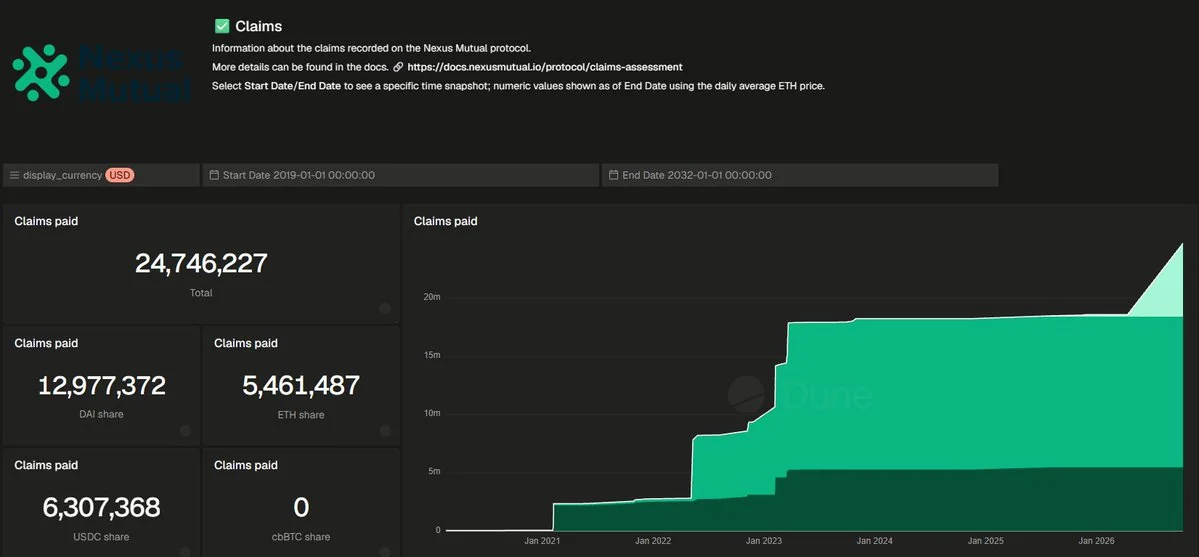
Cumulative claims payouts by Nexus Mutual since 2019
Premiums are dynamically priced based on supply and demand, with policy terms typically ranging from 28 to 365 days. Based on recorded claims history, Nexus Mutual has paid out over 24.7 million dollars cumulatively since 2019.
The DeFi Insurance Ecosystem
The entire DeFi insurance sector has a TVL of about 132 million dollars, with Nexus Mutual and Firelight accounting for approximately 90%. Most of the other protocols have little or no revenue, indicating that this sector is highly concentrated and still in its early stages.
Main participants in the ecosystem:
- Nexus Mutual: A shared mutual organization among members that pools capital to underwrite DeFi risks and provide protection.
- Firelight: Uses staked FXRP as external collateral to provide coverage for DeFi treasuries.
- EaseDeFi: A DeFi insurance protocol providing coverage without the need for upfront premium payments through an "Uninsurance" model.
- Ensuro: An on-chain insurance and reinsurance protocol connecting capitals with underwriters.
- Cozy Finance: Builds an automated insurance market for DeFi users and protocols.
- Ante Finance: Tests staked smart contracts on-chain, enabling verification of agreements made by protocols.
- Sherlock: Combines smart contract security audits and vulnerability payouts.
- USD8: A stablecoin backed by USDC that provides coverage for losses on specific DeFi tokens. Unlike policy-based coverage or FXRP collateral coverage, it uses a shared protection pool and insurance scoring to allocate coverage and payouts.
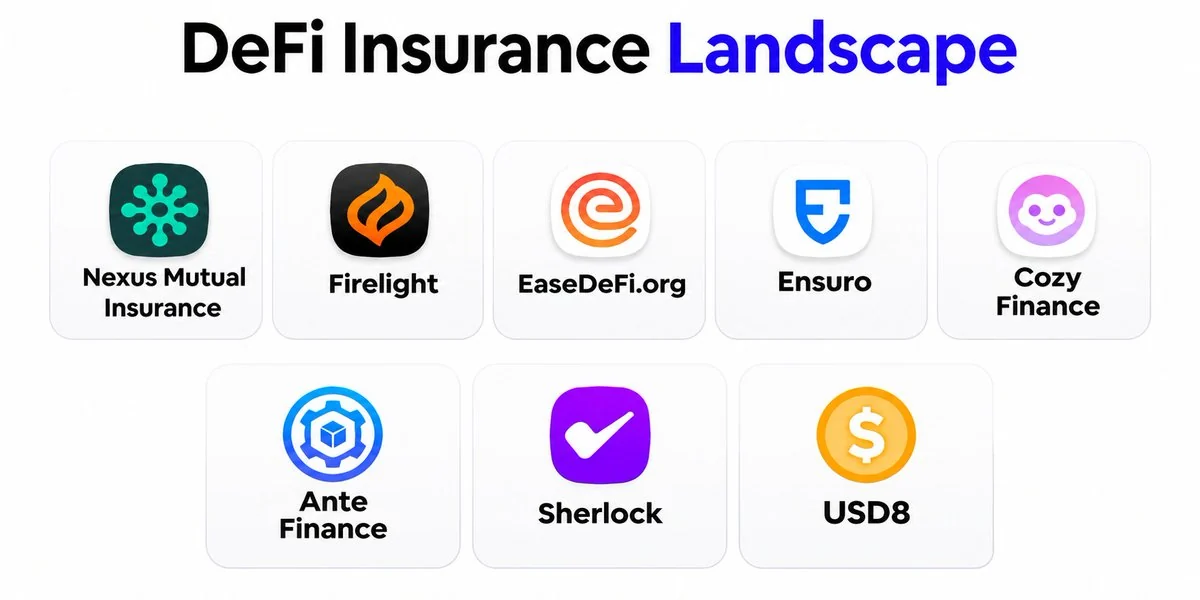
Main DeFi insurance protocols
Looking at TVL alone does not reflect an insurance protocol's payout capability. Effective coverage amounts, capital efficiency, minimum capital requirements, and historical payout records are needed to provide a clearer picture of its underwriting capability and financial health.
Why DeFi Insurance Struggles to Scale
Early DeFi insurance models often used collateral from the same source as the insured risks.
Once the market enters a crisis, claims rise while assets like ETH that support the collateral simultaneously depreciate. As liabilities increase, the value of the collateral decreases.
Early funding pools are also unable to underwrite large protocols and institutional positions.
Firelight took another route: it supports DeFi coverage through XRP-based capital. Users deposit FXRP into the treasury on Flare and receive stXRP in return; the concentrated capital provides coverage for the connected DeFi treasury.
Flow of funds: XRP holders → FXRP → Firelight treasury → DeFi coverage.
This design aims to reduce reliance on "collateral sourced from DeFi," but market, liquidity, and correlation risks still exist.
Firelight founder jrdothoughts spoke about the issues with early insurance models, saying, "One pain point of our predecessors was that they used ETH to insure ETH."
What DeFi Insurance Needs to Change
DeFi suffered losses of 138 million dollars in the first quarter of 2026 due to attacks, yet only about 9 million dollars was recovered. This gap highlights the need for financial protection, but building a sustainable insurance market faces several challenges:
- Capital efficiency: Underwriters must hold sufficient capital to address potential claims while ensuring these capitals remain productive.
- Risk pricing: Limited historical loss data makes it difficult to accurately price risks associated with smart contracts and protocols.
- Correlation risk: A market-wide shock can trigger claims across multiple protocols, while the crypto assets supporting the insurance pool simultaneously depreciate.
- Claims assessment: Not every reported attack qualifies for compensation. Payouts depend on policy terms, exclusions, and claims verification.
- Security of the insurance layer itself: Cozy Finance, which provides the protection market, has also been attacked. The infrastructure used to provide protection is also at risk of being attacked.
These challenges create a tough balance: insurance protocols must have sufficient capital to absorb losses, accurate risk assessments for pricing protection, and reliable infrastructure to effectively pay out when users need it.
DeFi has established mature markets for trading, lending, and yield generation, but the risk transfer aspect remains incomplete. To scale insurance, deeper funding pools, better risk pricing, and reliable claims infrastructure are necessary. Firelight uses external FXRP collateral to support DeFi coverage, while USD8 employs shared protection pools and insurance scoring for payouts.
Only by addressing these issues can DeFi insurance potentially become a core financial component, otherwise it risk remaining in a niche area for the long term.
免责声明:本文章仅代表作者个人观点,不代表本平台的立场和观点。本文章仅供信息分享,不构成对任何人的任何投资建议。用户与作者之间的任何争议,与本平台无关。如网页中刊载的文章或图片涉及侵权,请提供相关的权利证明和身份证明发送邮件到[email protected],本平台相关工作人员将会进行核查。