Author: Kairos_Res
Translation: Baihua Blockchain
Some digital asset treasury (DAT) companies seem to have started to sell off their held cryptocurrencies to drive the market value to net asset ratio (mNAV) closer to 1. In the past few weeks, Silvia (SVIA, formerly ProCap Financial), Bit Digital (BTBT), BTCS (BTCS), Upexi (UPXI), and Solana Company (HSDT) seem to have cumulatively sold approximately 410 BTC, 57,300 ETH, and 986,000 SOL, totaling about 203 million USD based on the token transfer price on the day of the transfer.
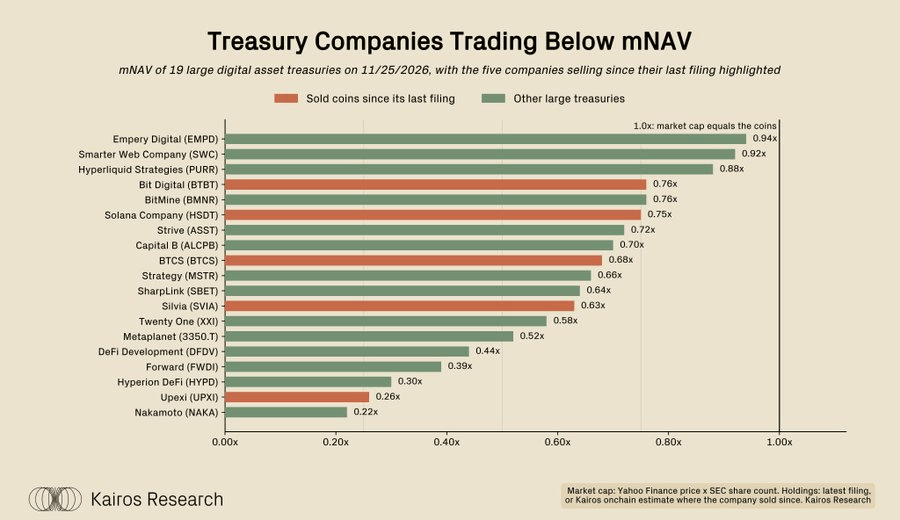
These companies share a commonality in that their stock prices are far below mNAV, making it extremely difficult or even impossible for them to continue employing the expansion model they previously relied on—namely increasing holdings of underlying digital assets through issuing more shares or borrowing, because now issuing one share below the corresponding holding value would dilute rather than enhance the per-share token amount.
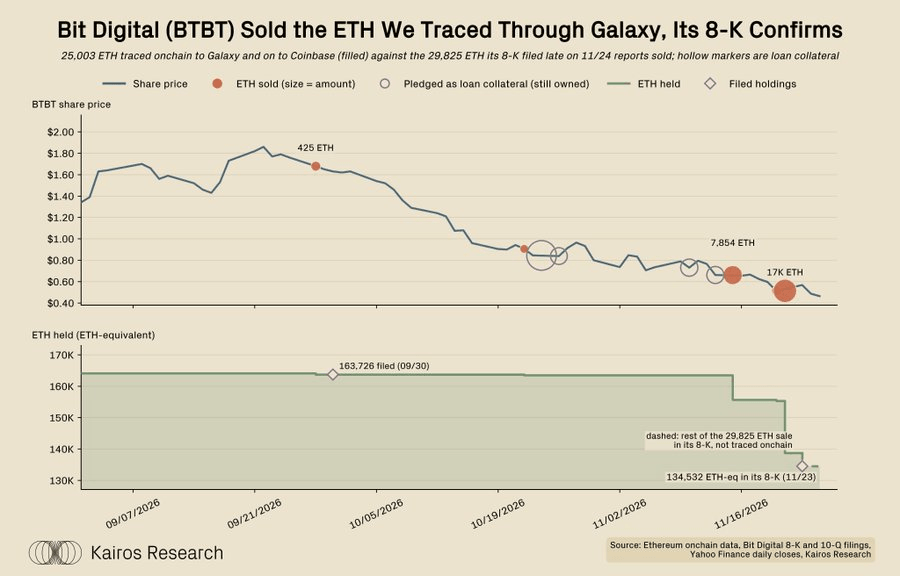
Of the five companies, two have publicly acknowledged this situation. BTCS disclosed in an 8-K report submitted on November 23 that it sold approximately 27,300 ETH on November 20 to repay a loan of 43.8 million USD on the Aave platform; Bit Digital revealed in an 8-K report submitted on the evening of November 24 (just hours after we completed our on-chain tracking of its selling behavior) that it sold 29,825 ETH between November 15 and November 23, cashing out approximately 50 million USD, which will halve its loan with Galaxy. The selling data for the remaining three companies comes from our own on-chain mapping tracking—matching each wallet holding the treasury assets of these companies with every financial report they submitted.
Before categorizing any recent transfers as sales, we verify whether the same set of wallets and the same shipping paths can accurately reproduce the previously reported selling records of each company. This method precisely reproduced Silvia's third-quarter sales volume as 320 BTC (reported as 320), identified Bit Digital as 1,625 ETH (reported as 1,625), matched Solana Company's first-quarter sales amount to 5.459 million USD (reported as 5.452 million USD), and kept Upexi's quarterly net variance error within approximately 4,000 SOL—this gives us full confidence in the movements of these wallets since the last reporting.
Bit Digital's announcement also serves as the first practical test of this method against an unreported sale, and the results passed the test completely: based on on-chain data, we tracked that 24,793 ETH flowed out via Galaxy between November 15 and November 21, accounting for about 83% of the 29,825 ETH it eventually disclosed; calculated its remaining holding of approximately 138,900 in ETH equivalent (latest disclosed as 134,532); and accurately identified that its LsETH transfer in November was collateral added to Galaxy—we accounted for 69,088 LsETH, while the announcement shows that there are still 69,089 LsETH used to secure the loan.
The scale of sales by each company varies significantly relative to their total treasury holdings:
-
BTCS sold nearly half of its ETH holdings reported at the end of September
-
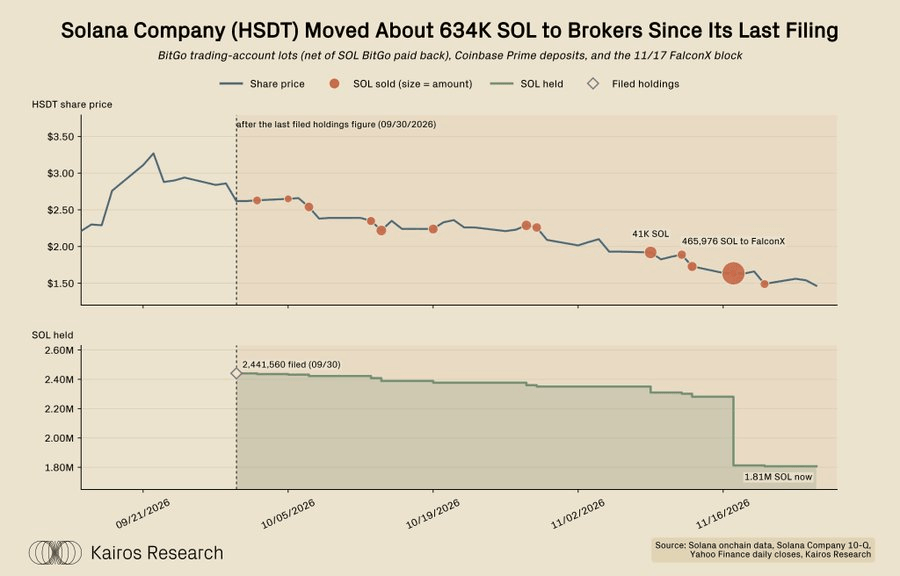
Solana Company transferred approximately one-quarter of its SOL to brokerage and trading accounts, with none returned so far
-
Bit Digital sold about 18%, and Upexi sold about 15%
-
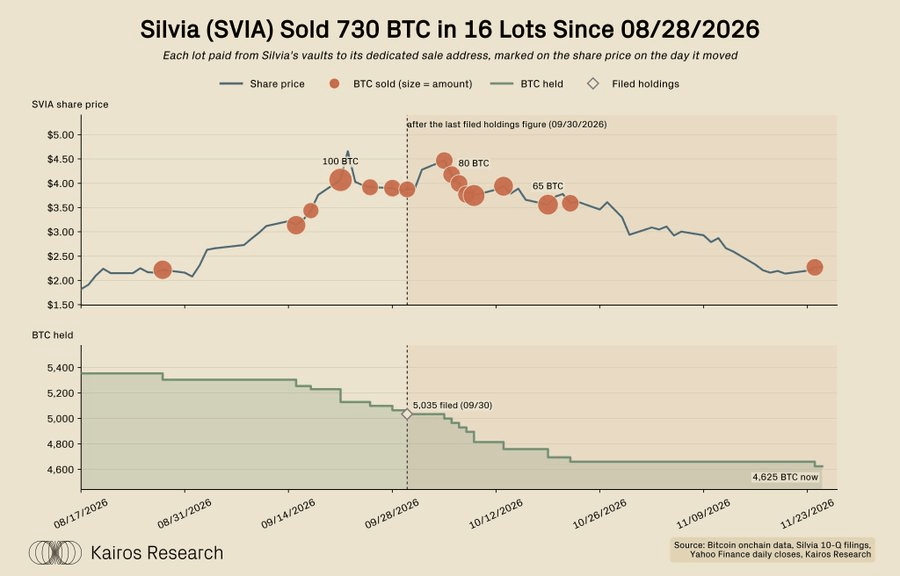
Silvia's sale of 410 BTC accounted for the smallest percentage at 8%, but was the most regular operation: split into nine batches (each batch containing 35 to 80 BTC) transferred to the same receiving address—this address had previously received every historical sale batch from Silvia, and historically only Silvia's wallets transferred all tokens to it through custodians, main brokerage hot wallets, and OTC desks, thus these sales never appeared as large sell orders on public trading platforms. The specific shipping path is as follows:
None of these companies sold directly on the order books of public trading platforms.
-
Silvia: One batch of tokens flowed out mixed in a large transfer of 1,000 BTC to a Cumberland DRW wallet
-
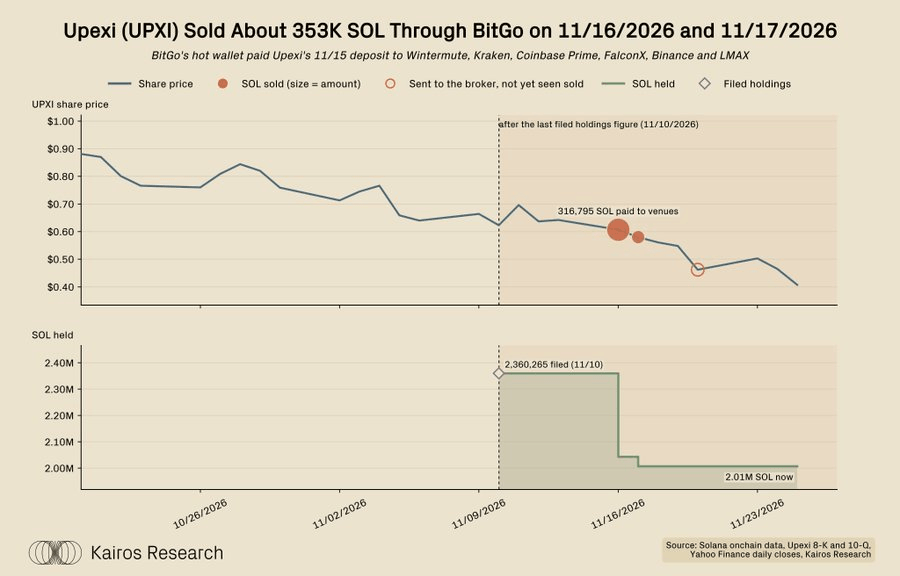
Upexi: On November 15 (Sunday), transferred 329,499 SOL to BitGo's shared hot wallet, then within 36 hours, that wallet transferred 352,530 SOL to market makers and trading platforms such as Wintermute, Kraken, Coinbase Prime, FalconX, BN, and LMAX. This hot wallet usually holds about 198,000 SOL, and Upexi contributed 96% of that wallet's total inflow over those three days, and none of the funds transferred out went to BitGo or any other intermediary—therefore, without Upexi's tokens, these transfers could not have been completed, and this is not a loan collateralization
-
Solana Company: A large transfer of 465,976 SOL entered FalconX, and within a day, an equivalent amount of tokens reached the deposit addresses of OK and Kraken
-
Bit Digital: Galaxy Digital transferred approximately 24,800 ETH via its hot wallet to a Coinbase deposit address within three and a half days, and Bit Digital has confirmed that this batch of ETH has been sold
The timing of the sales indicates that the main driver of the transactions was balance sheet pressure, rather than a change in the companies' views of the underlying assets:
-
BTCS sold to reduce its loan on Aave when ETH fell to around 1,561 USD
-
The same day Solana Company initiated the un-staking, its previously sold 390,000 SOL put options deep in the money expired, resulting in approximately 12 million USD in losses
-
Upexi's sale occurred when SOL dropped to around 70 USD, nearing our estimated 67 USD margin call line (at which point the collateral ratio for its 57.3 million USD BitGo loan would touch the 150% margin call/maintenance threshold), and its sale size was off by less than 1% from the amount required to restore that loan to a 200% collateral ratio
- Bit Digital's outflow occurred when the collateral ratio of the ETH securing its 100 million USD Galaxy loan fell to around 131%, and the company has now stated that the proceeds were used to repay half of that loan
When a treasury company's stock price is below its holding value, once it falls into such a liquidity crisis, they have no cheaper cash sources other than selling their tokens. This is the true meaning of "the end of the script for issuing more shares to buy tokens" at the practical level.
For investors, the key issue is the lag and gap in information disclosure. Silvia, Solana Company, and Upexi all submitted their 10-Q quarterly reports in November, and each report contains a note on "subsequent events."
-
Both Silvia and Solana Company used that note to disclose stock buybacks, new loans, and executive departures, yet made no mention of tokens sold before submitting the report
-
Upexi started selling two days after releasing its financial report and has remained silent since
-
Bit Digital demonstrated what proper disclosure should look like: its 10-Q quarterly report on November 12 was released before the sales began, and the day after the last batch of tokens was sold, the company disclosed through an 8-K report—this is a standard that the other three companies failed to meet
For example, Silvia disclosed in the note that it spent 24.4 million USD to buy back 6.1 million shares between October 1 and November 10, but did not mention that about 375 BTC flowed out of its treasury during the same period to pay for the repurchase. The holding data from public tracking websites is also similarly lagging: they currently show Silvia holding 4,965 BTC, while we observed the actual holding remaining at about 4,625 BTC; Phoenix Group is publicly shown as 559 BTC, while its third-quarter report had already dropped to 331 BTC. Using tokens to repurchase shares does not have the actual effect of boosting mNAV as positively as it seems, which is the harsh arithmetic logic behind the whole turmoil.
-
Silvia's per-share token quantity has changed very little. As the company sold Bitcoin and canceled shares in nearly the same proportion, its Bitcoin holdings per million shares actually slightly decreased, from about 62.2 BTC at the end of September to about 61.8 BTC on November 10
-
The company repurchased shares at full value rather than at a discount. After deducting its 99.6 million USD of convertible notes, the price at which it repurchased shares is equivalent to 1 time net asset value
-
The apparent mNAV exaggerates the discount extent. Calculating based on the same debt deduction standard, Silvia's actual transaction valuation is about 0.98 times net assets, rather than the 0.63 times shown in the first chart, meaning the value-creation space from the repurchase is far smaller than the levels implied by the apparent numbers
- The truly disposable Bitcoin is far less than it appears. Its convertible bond terms include pledged Bitcoin at half price in the collateral value, thus at current prices, about 3,420 BTC must be continually under pledge among its roughly 4,625 BTC holdings, and bondholders have the right to redeem all 99.6 million USD in notes at face value back to the company in June 2027
The market seems yet unaware of these individual sales, which also corresponds to the fact that they were not publicly disclosed when they occurred. The stock trading volume on the days of the sales mostly remained at normal or low levels. Since September 30, four of the five stocks have declined significantly more than the declines in their held tokens, while Solana Company's trend closely followed SOL, indicating that the token selling measures have almost no help in supporting stock prices. The only time a stock price significantly underperformed the underlying token and the closest time window was observed in Bit Digital—when Galaxy transferred its ETH to Coinbase, Bit Digital's stock price fell by 15%, while ETH dropped only 4%. These five companies are not isolated cases; since mid-October, approximately 25 treasury companies and mining enterprises have disclosed selling activities in SEC filings:
-
Complete liquidation: KULR, Hyperscale Data, and Rumble have completely emptied their Bitcoin holdings; GameSquare sold off the majority of ETH to repay ETH-backed notes
-
Massive losses: Empery Digital sold 3,170 BTC this year, realizing a loss of 160 million USD
- Mining company sales: MARA sold 13,597 BTC after the end of the quarter to repay 750 million USD in Bitcoin-backed loans; Riot has cumulatively sold 20,264 BTC this year
-
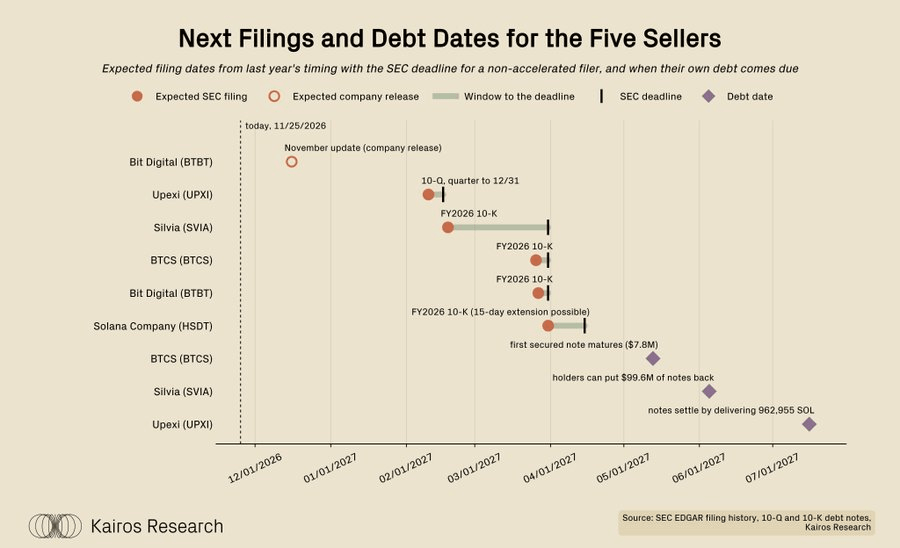
Bit Digital, mid-December: Its November monthly update (part of a company press release rather than an SEC filing) will reveal whether it sold further after reporting 134,532 ETH equivalents on November 23
-
Upexi, around February 10, 2027 (legal deadline February 16, 2027): The first mandatory filing document (the 10-Q report as of December 31) will disclose the proceeds from sales and the SOL balance at year-end
-
Silvia, around mid-February (legal deadline March 31, 2027): It submitted its 10-K annual report on February 18 last year
-
Bit Digital, BTCS, and Solana Company, late March (legal deadline March 31, 2027): Solana Company previously utilized the 15-day extension rule, which might postpone its 10-K annual report to around April 15
Before any statutory disclosure date arrives, on-chain funds are likely to move again. Solana Company has begun to un-stake 218,539 SOL (approximately 14.5 million USD) from its Anchorage margin treasury on November 24, a step similar to the one it took four days before transferring large tokens to FalconX; meanwhile, Upexi still has one wallet lying with 139,870 un-staked SOL, and another 30,000 SOL has been parked in its BitGo account since November 20.
The next potential sellers are most likely the treasury companies with creditors holding compulsory liquidation rights—because low mNAV only blocks the retreat of low-cost equity financing, while cryptocurrencies secured loans with margin call terms set a price red line, and once touched, selling is no longer an option but a forced execution:
-
Nakamoto (NAKA) borrowed 165 million USDT from Kraken by pledging 3,030 BTC, with a collateral ratio of only about 1.07 times at current prices, with 105 million USDT maturing on June 30, 2027
-
Upexi owed BitGo 57.3 million USD as of the end of September, with the loan supported by a 30-day notice recall and a margin call line set at 150% collateral ratio; additionally, its 150 million USD notes will be settled in SOL delivered to holders with value equal to 962,955 SOL on July 16, 2027
-
Solana Company signed a new loan agreement with Maple on November 11, which includes margin requirements and liquidation terms, while as of the end of September, the company had only about 1.1 million USD in cash on the books facing option losses
-
Forward Industries (FWDI) borrowed an additional 50 million USD on November 16 from Erebor Bank using SOL stored at BitGo as collateral, besides the original Galaxy loan
- Metaplanet's loans as of the end of September had reached 17.7% of its Bitcoin holdings' value, surpassing the company's own set 10% cap guideline (previously, the company sold 10,000 BTC and then bought back 11,000 BTC in the third quarter to prove its ability to raise equal financing cash)
Of course, our on-chain observations also have certain limitations:
-
Large transfers at FalconX (about 33 million USD out of a total of 203 million USD). In principle, this transfer by Solana Company may still be collateral or SOL proxy, but the company's own 10-Q quarterly report clearly states that both option margin and new loans from Maple are stored in custodial accounts opened in its own name, rather than directly sent to counterparties; also, it has been eight days since the transfer with no funds returned, thus we judge it with medium to high confidence to be a high probability sale
-
BitGo shared wallet. This wallet serves all BitGo clients, so determining Upexi's sale is based on on-chain inference rather than directly tagged transactions; however, that weekend saw no other client deposits exceeding about 14,000 SOL, and without Upexi's tokens, that wallet could not have completed the subsequent large outflows, and there has been no token return for ten days, hence the inference remains valid
-
OTC matched trades conducted internally by custodians are invisible on-chain, thus the actual total amount sold is only higher than our statistics
- The aforementioned behaviors may not violate any regulatory provisions. Whether selling part of treasury assets falls outside the company’s "ordinary course of business" thus must be submitted with an 8-K report is itself a matter of business judgment
However, the data clearly indicates that for these companies, on-chain mapping tracking is now weeks if not months ahead of official financial documents. We will continue to track these wallets in real-time and release tracking reports as soon as token movements occur before the financial reports are published.
Article link: https://www.hellobtc.com/kp/du/11/6511.html
Source: https://x.com/Kairos_Res/status/2125704827606851897
免责声明:本文章仅代表作者个人观点,不代表本平台的立场和观点。本文章仅供信息分享,不构成对任何人的任何投资建议。用户与作者之间的任何争议,与本平台无关。如网页中刊载的文章或图片涉及侵权,请提供相关的权利证明和身份证明发送邮件到[email protected],本平台相关工作人员将会进行核查。