
Author: Glassnode Insights
Translation: ShenChao TechFlow
ShenChao Guide: This issue's institutional strategy monthly report reveals a subtle shift in the funding landscape of the cryptocurrency market. Although Bitcoin's 30-day net inflow reached a peak of $14.2 billion in mid-October, it subsequently slowed significantly; more critically, the U.S. spot Bitcoin and Ethereum ETFs shifted from net buying to net selling, indicating a noticeable tightening of institutional allocation.
Stablecoins recorded over $6 billion in redemptions in October, with funds not only pausing on-chain but also showing signs of exiting to cash out into dollars. Combined with directional strategy fund drawdowns and a reevaluation of crypto lending risks, the market has entered a cycle of defense and liquidity rebalancing, with arbitrage returns, such as CME futures basis, at relatively low levels.

Report Overview: Six Core Dimensions Tracking
The "Institutional Strategy Weekly Report" (Strategy Watch) aims to meet the market's need for clear signals and objective neutral analysis of fund performance and allocation trends in the digital asset space. Our goal is very clear: to create it as an essential deep reference publication for digital asset investment institutions every month.
This report is divided into six core sections, each focusing on the latest trends from institutions in different dimensions of the digital asset domain:
01 Institutional Flow Monitor: Bitcoin's net inflow peaked in mid-October, while spot ETFs for Bitcoin and Ethereum shifted from net buying to net selling; corporate treasury companies continue to accumulate, while stablecoin funds see net outflows.
02 Fund and SMA Performance: Directional strategy funds experienced an overall drawdown of 7.04%, with event-driven strategies drawing down 16.25%. Market-neutral strategies performed relatively stable, recording -0.08%, with the Binance hacking incident having little impact on their returns.
03 Strategy Deep Dive: Reading the Decline: CoinShares' James Butterfill, Frontiers Capital's Rupam Shrivastava, and Postera Capital's David Finkenstädt delve into the unusual signals from October, the current misconceptions in the market, and key catalysts that could change their views before year-end.
04 On-chain Vault Performance: The yield on dollar vaults has outperformed U.S. government bonds for the fourth consecutive month (0.41% vs. 0.34%), while Ethereum vault yields still lag behind native staking; total deposits in tracked samples slightly decreased by about 2% to $9.5 billion, with most redemptions occurring after the Binance hacking incident.
05 Manager Monitor: The average cash reserve percentage of fund managers rose from 12.2% to 15.7%, above the long-term average; fundraising conversations maintained momentum from September; the proportion of Ethereum's focus among fund managers dropped from 42% to 25%, while Bitcoin's focus climbed from 8% to 22%.
06 Allocation Updates: The U.S. spot Bitcoin ETF recorded its first monthly net outflow since June; hackers stole approximately $6.3 billion in assets from Binance; Room40 Capital is returning funds to external investors; Janus Henderson announced the launch of a fund tracking the Nasdaq 100 index on the Stellar network.
Institutional Flow Monitor
Core Summary: Bitcoin's net inflow peaked in mid-October, Ethereum's inflow nearly halted, and stablecoins continued to flow out of the crypto ecosystem.
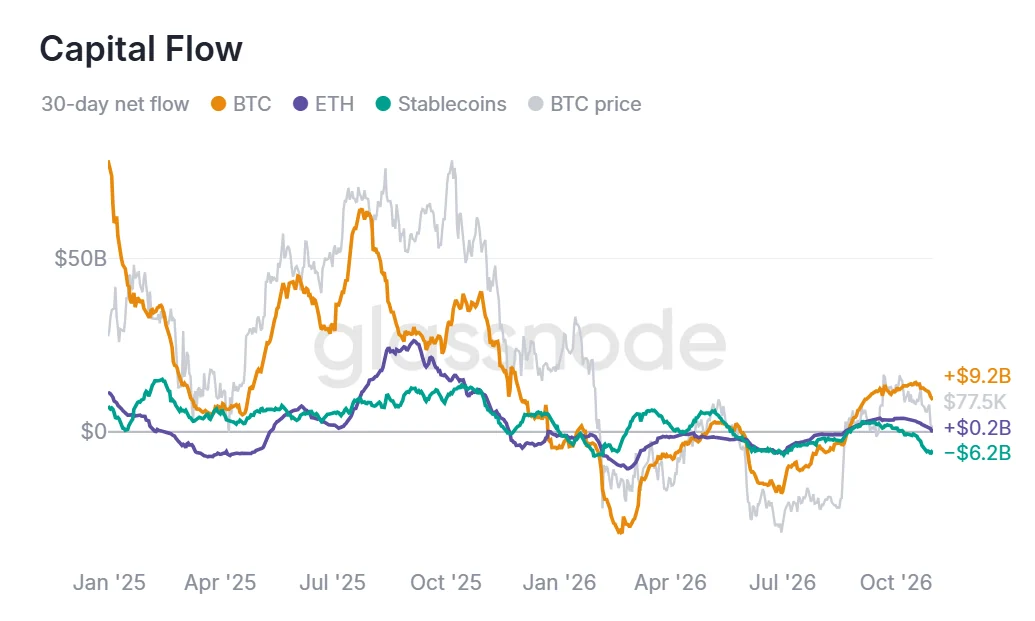
Bitcoin's 30-day rolling net inflow rose in mid-October, peaking at $14.2 billion on October 17, marking the highest level since November 2025. However, by the end of October, the net inflow had retreated to $9.2 billion. This still represents new inflows despite a 7% decline in Bitcoin's price that month. Meanwhile, Ethereum's inflow approached zero.
More critically, the 30-day net flow of stablecoins turned negative on October 7, and the outflow exceeded $6 billion in late October, setting a new record for the largest outflow since early July. Holders are massively redeeming stablecoins for cash, indicating that some funds are completely exiting the crypto market, and this outflow trend intensified in November.
Spot ETF and Corporate Treasury Net Flows
Core Summary: Both spot ETFs for Bitcoin and Ethereum shifted from being net buyers to net sellers, while corporate balance sheet institutions continue to accumulate in opposition to the trend.
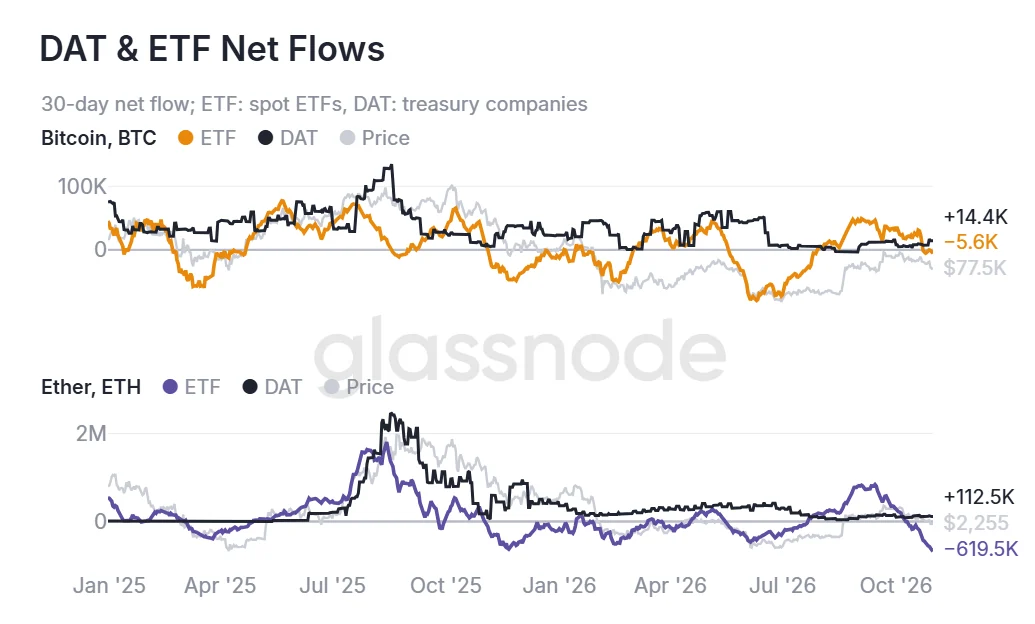
On a 30-day basis, U.S. spot ETFs were still in a buying position at the beginning of October but shifted to net selling by the end of the month. Notably, the Ethereum spot ETF reversed on October 9, followed by the Bitcoin spot ETF two weeks later moving to net outflows.
As of the end of October, the Bitcoin spot ETF recorded a net outflow of 5,600 BTC, marking the first monthly net sales since July; the Ethereum spot ETF's net outflow reached 643,000 ETH, setting the highest record since we started tracking in August 2024. While corporate treasury companies continue to add both assets, the amount of Ethereum purchased is less than one-fifth of the ETF's sale volume. In September, both institutional groups were in a buying mode, but now only corporate treasury companies continue to maintain accumulation.
Ethereum DeFi Locked Value Trends
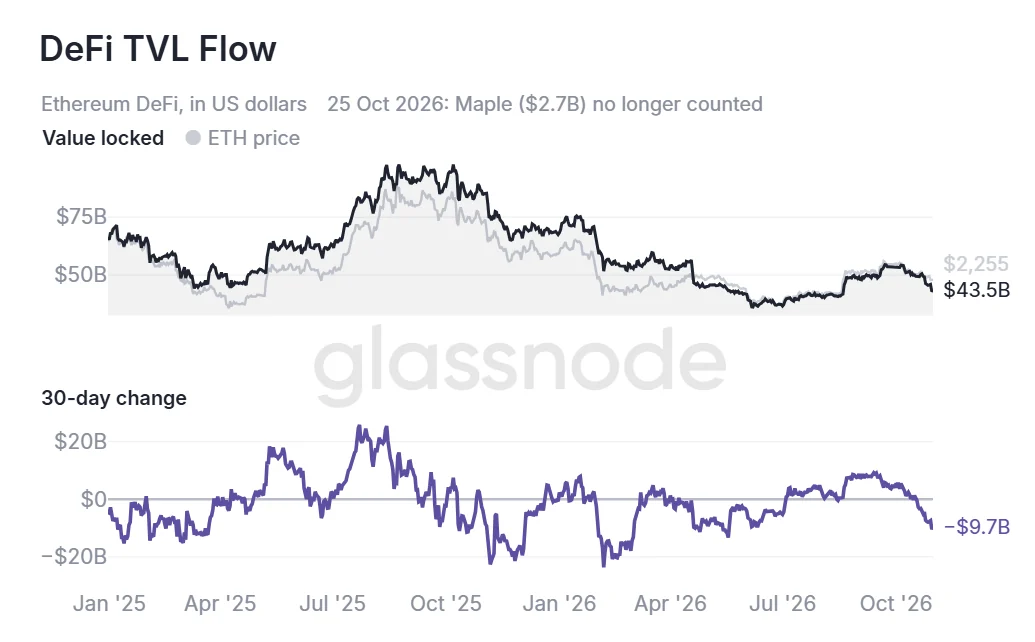
Core Summary: Ethereum DeFi's dollar locked value shrank as ETH prices fell, wiping out more than half of the gains since August.
Total locked value (TVL) refers to the total dollar value of assets deposited in various Ethereum DeFi protocols. As of the end of October, Ethereum's DeFi TVL decreased to $43.5 billion, representing approximately a 13% drop from the beginning of the month. It is important to note that the chart shows a more pronounced decline because the data source stopped including the lending protocol Maple (involving approximately $2.7 billion) in Ethereum on-chain statistics from October 25 onwards.
ETH spot prices dropped by 16% in October; however, TVL proved relatively resilient, mainly because some assets were valued in stablecoins which maintained par. The largest single-day drop occurred during the Binance hacking incident, when Ethereum's TVL fell 7% in one day, while ETH prices dropped 5%, indicating that some depositors were choosing to proactively withdraw their funds.
CME Basis Annualized Yield
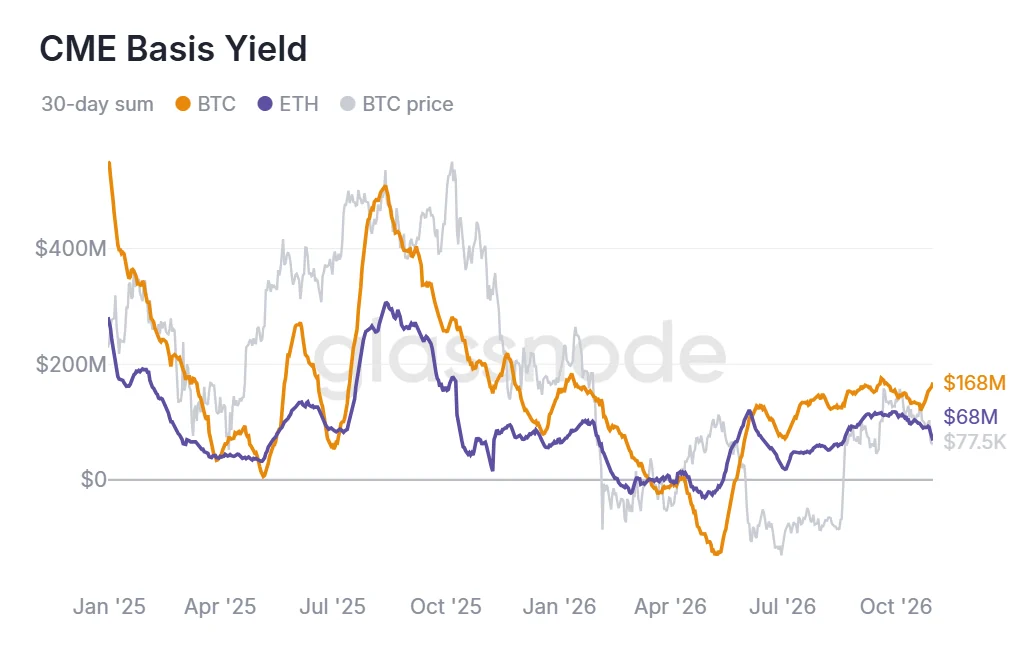
Core Summary: The yield from buying spot and selling futures in basis arbitrage saw some recovery by the end of the month, while Ethereum's arbitrage yield declined by about two-fifths.
This metric measures the 30-day cumulative return captured by traders who buy spot while shorting futures. Bitcoin's basis yield reading dipped to $120 million on October 21 (a new low since July), then recovered to $168 million by month-end, indicating that even with falling prices, traders remain willing to pay a premium to hold bullish futures positions.
In contrast, Ethereum's basis yield fell to $68 million, the lowest level since August. In the last three days of October, Ethereum's funding rates turned negative, and shorts began paying fees to longs. Even after the rebound, Bitcoin's current basis yield level is only one-third of its peak in August 2025, reinforcing feedback from multiple fund managers: the funding rate arbitrage for leading tokens is still generating positive cash flow but far below normalized levels.
Disclaimer
This report does not constitute any investment advice. All data is for informational reference and academic research purposes only. Any investment decisions should not be based on the information provided here, and you assume full legal and financial responsibility for your own investment actions. Exchange asset balances are sourced from the Glassnode comprehensive address label database, generated through a combination of publicly disclosed information and proprietary clustering algorithms.
免责声明:本文章仅代表作者个人观点,不代表本平台的立场和观点。本文章仅供信息分享,不构成对任何人的任何投资建议。用户与作者之间的任何争议,与本平台无关。如网页中刊载的文章或图片涉及侵权,请提供相关的权利证明和身份证明发送邮件到[email protected],本平台相关工作人员将会进行核查。