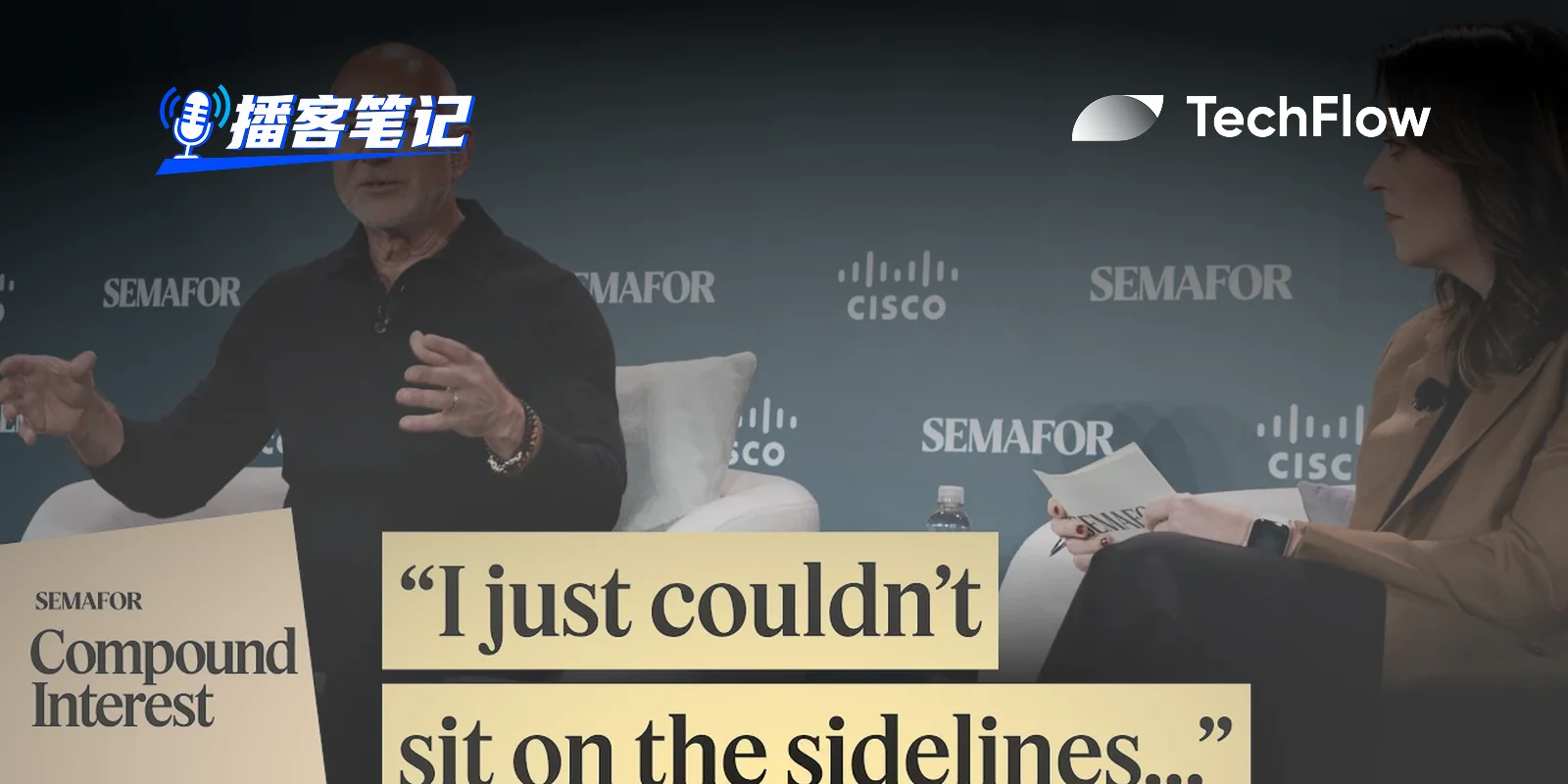
“I really can't sit on the sidelines and watch.”
Compiled & Organized by: Deep Tide TechFlow
Deep Tide Guide: While the vast majority of capital and talent rush toward pure software and large text models, Jeff Bezos quietly returns to the entrepreneurial front lines, co-founding an AI company named Prometheus focused on physical world manufacturing. In the trillion-dollar global manufacturing landscape, AI is transitioning from symbolic computation to atomic simulation, compressing complex industrial designs from months into 12 hours.
Faced with a political cycle where the Democratic Party regains control of the House post-U.S. elections, and tech billionaires become targets again, Bezos keenly points out that politically "picking a villain" is a very effective electoral tactic, but it is the worst means of solving real problems. From the housing supply crisis to NVIDIA governance, the survival of the fittest in the AI investment cycle, to the selection of a new 007, Bezos demonstrates a veteran businessman's profound commitment to the laws and common sense of the physical world.
Guests: Jeff Bezos (Founder and Executive Chairman of Amazon, Founder of Blue Origin), Vik Bajaj (Co-founder and CEO of Prometheus, Former member of Google X founding team, Former Chief Scientist of Verily)
Host: Liz Hoffman (Editor-in-Chief of Semafor Business and Technology)
Podcast Source: Semafor "Compound Interest" (https://www.youtube.com/watch?v=1Z3ro4ocj-Y)
Original Title: Jeff Bezos Wants In On The AI Race | Compound Interest
Broadcast Date: Beijing Time: 2026-11-24 22:20
Key Takeaways
The physical manufacturing sector is a trillion-dollar blue ocean not yet touched by AI: Existing large language models (LLM) are essentially excellent "symbolic operation tools" adept at mastering law and mathematics through reading text across the internet, yet they cannot grasp tolerances, thermodynamics, and assembly details in physical engineering. Even if you put six of the greatest physicists in history in a room together, they would not be able to create a toaster. The scale of the physical manufacturing world where humans exist is trillions of dollars, and the physical world will undergo immeasurable industrial transformation through AI.
Prometheus breaks through "neural surrogate physical simulation," compressing months of design into 12 hours: Prometheus, co-founded by Bezos and Vik Bajaj, comprises about 250 top scientists and engineers, raising approximately $14.5 billion, primarily invested in computational infrastructure. They have trained specialized multi-physics models that reduce simulations of chip designs, high-pressure valves, and pneumatic components, which previously required 6 to 9 months of iteration by teams of 10 to 20 seasoned engineers, to complete end-to-end automation in just 12 hours; a former NASA engineer even used this tool to automatically evolve rotor designs for a helicopter that fits with Mars's thin atmosphere.
The "second type of joy" of entrepreneurship: the instinct of geeks who cannot be bystanders: Regarding why he re-engaged in the crowded AI race after achieving great success, Bezos expressed that after entering the project at the angel round at the end of 2024, he was increasingly shocked, stating he "absolutely cannot sit on the sidelines as a spectator." He described this experience as "Type 2 Fun", similar to climbing a dangerous peak where the journey is painfully arduous, yet there is immense pride upon reaching the summit, witnessing small miracles every day.
"Picking a villain" is a clever political tactic but a disastrous solution to problems: Addressing the regulatory storm around Washington tech billionaires and wealth redistribution issues, Bezos emphasized that the president must listen to real voices from the business front line, and shutting the door is a massive mistake. He pointedly stated that from hating lawyers and occupying Wall Street to now attacking Big Tech, politicians commonly employ "scapegoating" to mobilize voters; yet just as the only effective physical law for solving the housing crisis is "to build more housing," scapegoating not only fails to address inflation and livelihood issues but also destroys the golden goose of wealth generation.
NVIDIA's successor governance should insist on internal promotion; externally parachuting lacks success in complex enterprises: Reflecting on Amazon's well-considered transition to successors years ago, Bezos advised that the NVIDIA board should never parachute in an external CEO. For hardcore companies like NVIDIA with highly specialized business and unique cultural cohesion, the success probability of outside managers is very low; only through cultivating and promoting from within can the company endure.
AI investment is experiencing a healthy "discernment awakening": In every initial round of significant technological breakthroughs, both good and bad projects receive funding; all wild experiments are financed. As the cycle evolves, the free market mechanism will inevitably become more discerning, with capital leaning toward truly valuable hardcore scenarios; this filtering and deflating process is healthy and indispensable.
Confirming a new generation 007: Robert Pattinson is the undisputed James Bond: After Amazon's acquisition of MGM, Bezos was deeply involved in the strict selection of the next 007. The team conducted full prop and real scene auditions among the five final candidates, and although there were initial reservations about Pattinson due to his immense fame, the audition footage astonished everyone, and his traits perfectly matched Bond's calmness and charm.
Outstanding Opinions
“You can read a thousand books about gymnastics, but you are still a terrible gymnast; you can read a thousand books about dance, but you still can't dance. Engineering follows the same principle; understanding Maxwell's equations doesn't help you build a toaster. Knowledge operates on different levels of detail, which is why specialized large models are needed for physical engineering training.”
“I invested in this company at the end of 2024 when it was still just a fledgling project. But I saw the early technological breakthroughs and the more I watched, the more excited I became; I found myself absolutely unable to just sit on the sidelines as a spectator. It's a type of second joy, akin to mountain climbing; the climbing process is excruciatingly painful, yet the sense of accomplishment upon completing the challenge and reaching the peak is irreplaceable. The reward from this dopamine rush is incredibly real, and the team creates small miracles every day.”
“Picking a villain is a great mobilization strategy politically, but it is the worst technique for solving real problems. The role of the villain changes over time, from lawyers to Wall Street, and now to the tech industry. But if a company faces a severe malfunction and employees fail to dig into the root cause and instead just blame others, such a person would likely be fired immediately.”
“To resolve the expensive housing problem, there is only one physical path: build more houses. Policies that subsidize demand while restricting supply will inevitably drive prices up. Any approach that does not increase actual supply but only blames landlords or developers is akin to covering one's ears while stealing the bell.”
“The president needs to hear real voices from the business front line; cutting off communication with business leaders is a fatal mistake. We can have rational debates about wealth distribution and tax policies, but the premise is that wealth must first be created. You can never kill the goose that lays the golden eggs.”
“At the dawn of new technology cycles, there is often a mix of good and bad; all types of projects receive funding, and every experiment is backed. But as time goes on, the market's discernment begins to awaken, with capital saying "no" to bad projects and concentrating valuable resources on genuinely high-value paths. We are experiencing this filtering process, which is the healthiest and most fortunate mechanism of the free market. Though there will be waves of weeding out, the physical value of this technology is undeniable, and no force can prevent its long-term prosperity.”
Complete Dialogue Summary
The Engineering Gap in the Physical World: Why Can't Large Language Models Build a Toaster?
Liz Hoffman: We often hear the term "AI for atoms." In practical terms, what does this really mean? Can you give us a few intuitive examples?
Jeff Bezos: The large language models that everyone is familiar with are essentially excellent "symbolic operation tools." However, if you ask them to design a physical object in detail, they will immediately encounter bottlenecks.
Our way of training cutting-edge large models involves having them read text from the entire human internet. They absorb the complete existing knowledge base, so they excel at solving problems that can be symbolically expressed, like writing code, doing math, and analyzing legal texts; they are very powerful in these areas.
However, in the real world, there is a vast amount of knowledge that cannot be grasped through "reading." You can read a thousand books on how to become a great gymnast, and once you close the book, you are still a terrible gymnast; you can read a thousand books on dance, but you still will not be able to dance.
Engineering and physical manufacturing follow the same logic. We can do a thought experiment: put the six greatest physicists in human history, such as Newton, Einstein, and Maxwell, in a room together and say to them, “Please help me build a toaster.” They would not know where to start. Understanding Maxwell's equations would be of no help in building a toaster because real engineering is filled with meticulous details such as the material tolerances of heating wires, mechanical transmission, thermal insulation, and assembly processes.
Knowledge operates on completely different levels of detail. If you want AI to engage in engineering design and physical manufacturing, you must train highly specialized physical models. That’s our primary focus at Prometheus.
Liz Hoffman: What progress has Prometheus made so far? What exactly are you doing?
Jeff Bezos: This is incredibly exciting. We have assembled an exceptionally talented team of about 250 people. We have raised approximately $14.5 billion, a significant part of which is already committed to high-performance computing clusters. This requires extremely dense computational resources.
Our core breakthrough is building "neural surrogates" for numerical physical simulation and creating a single unified multi-physics model.
In the past, designing a simulated chip, RF device, or high-pressure industrial valve typically required a team of 10 to 20 seasoned engineers working for 6 to 9 months on repeated modeling, simulation, and iteration. With the assistance of Prometheus tools, we can now complete the design and validation end-to-end in just 12 hours.
We have a top engineer from NASA's Jet Propulsion Laboratory (JPL) on the team who was deeply involved in the development of the Mars Helicopter. He tried to have Prometheus redesign the Mars Helicopter from scratch using pure natural language prompts. The AI’s performance was astonishing; it autonomously explored an extremely vast design space: should it use a quad-copter, a coaxial double rotor, or a fixed-wing design? It automatically calculated the rotor’s chord length and aerodynamic profile in Mars’s extremely thin atmospheric environment, and even proactively asked us questions to clarify ambiguities when faced with uncertain requirements. Ultimately, the system evolved a design configuration that remarkably aligns with the actual Mars Helicopter.
The entire physical manufacturing world is breathtaking in its scale. Looking around, every object you can touch was manufactured in a factory. Yet modern AI has hardly touched this domain, representing a transformative boon in the realm of physical industries worth trillions of dollars in the years to come.
Specialized Models and Trillions in Ecosystems: Never Walk the Closed-Walled Path
Vik Bajaj: Liz, this is precisely why the foundational models in the engineering field must be entirely different from general language models. As Jeff said, even when designing a micro RF chip in a phone, years of design knowledge accumulate in the background. Understanding how it works requires a solid grounding in physics; structural packaging needs to balance thermodynamic expansion and mechanical stress characteristics.
You must train vertically specialized models. Even in the pure language model field, we see trends toward specialization; for instance, some models focused on programming perform best at specific times. The heterogeneity and complexity of physical engineering far exceed that of software code; only through thorough specialization can barriers be established.
Liz Hoffman: If you could improve the design and manufacturing efficiency of toasters, jet engines, and skyscrapers by just 3%, would you then personally get into making toasters or engines? Would this be a closed garden or an open enabling platform?
Jeff Bezos: This absolutely cannot be a closed garden because this industry is simply too enormous.
The global physical manufacturing market is a vast market worth trillions of dollars; we cannot possibly manufacture toasters ourselves, nor can we manufacture all jet engines ourselves.
In terms of business models, there will not be a single universal model; it must be diversified. An exciting and very important point for us is that we will invest directly in advanced manufacturing businesses that deeply adopt our toolset as capital partners. We are not only tool providers; we are also investors who will deeply participate in the benefits of the physical industry.
At the same time, these tools will also be made available to a wide array of manufacturing businesses. Behind manufacturing is an incredibly vast and intricate global supply chain system, involving thousands of different manufacturing processes. You can only cooperate with thousands of companies; any attempts to construct a closed-off garden in this area are destined to fail.
Liz Hoffman: Elon Musk is trying to deeply integrate many of his businesses. Have you thought about tightly bundling or even merging Prometheus, Blue Origin, and Amazon in the future?
Jeff Bezos: That idea is intriguing, but currently, I have no plans in that direction, and I have no news to announce today.
Why Restart Entrepreneurship After Success? The "Mountaineering Type of Second Joy."
Liz Hoffman: You are already one of the richest people in the world, sending rockets into space, and recently got married; life seems incredibly rich and exciting. Why start a new, challenging hardcore tech company in such a crowded AI space?
Jeff Bezos: I invested in this company at the angel round at the end of 2024 when it was still just a tiny seed project.
I watched the team's initial technological breakthroughs and progress, and the deeper I delved, the stronger my inner excitement became. I found myself absolutely unable to sit on the sidelines as a cold observer; it was so captivating that I couldn’t sit still.
I find joy in it; it’s a form of “Type 2 Fun.” Much like climbing a snowy mountain, every step of the climb is extremely difficult and painful, and you can’t catch your breath, but upon completing the challenge and reaching the peak, the sense of achievement is irreplaceable from within. This reward from dopamine is incredibly real, and the team creates small miracles every day.
This team has a pure missionary spirit, with everyone working diligently and without distractions. If you are not interested in this pure intellectual and engineering challenge, you probably don’t belong here; but for me, this is Nirvana.
Liz Hoffman: When can we expect to see the first public product or major release from Prometheus?
Jeff Bezos: We are currently conducting private alpha testing with several pioneering industry clients, including Blue Origin. Within Blue Origin, there are two core projects heavily utilizing Prometheus's design tools. As for when we will fully launch to the broader public, we are still focused on refining the underlying technologies and have not yet reached the moment for public disclosure.
Liz Hoffman: Vik, large companies often have a wariness when working with cutting-edge AI laboratories, fearing that they might let a wolf into the fold. They worry external engineers will act like reconnaissance troops, understand their core processes, and then steal their trade secrets and excess profits. How do you gain the trust of these manufacturing giants?
Vik Bajaj: Our core is synergistic empowerment. We help clients accomplish tasks that were previously impossible at a speed far beyond traditional capabilities. More importantly, the engineering sector has a high degree of proprietary secrecy; we strictly isolate proprietary data at the foundational level, using only compliant non-sensitive data for model evolution while fully protecting our clients' intellectual property.
Washington's Political Cycle and the "Villain Trap": The True Technology of Problem-Solving
Liz Hoffman: With the Democrats regaining control of the House in this election, tech billionaires have once again become a focal point for regulation and scrutiny. People like Jamie Raskin have also been very vocal lately. Reflecting on your interactions with past presidents, do you feel you gained something from your communications with the political sphere? Is it worth it in light of possible future political storms?
Jeff Bezos: Since the Clinton administration, I have maintained communication with every American president that followed, and I hope that whenever the country needs, I can still communicate with every elected president.
Trump was a president extremely eager to communicate; he was very accessible, and the frequency of communication was very high—calls were very direct at any time. Obama was also someone very willing to communicate; I still consult him on some important issues, and he has given me many insightful pieces of advice over the years. In contrast, the interactions during the Biden administration have been relatively limited.
But communicating with anyone is not a bad thing. I always stand from the perspective of the country. In my interactions with each president, I have never sought improper benefits for Amazon, for myself, or any of my businesses.
The president and policymakers need to hear real voices from the business front lines. If you shut the door to business leaders, policy will diverge from ground realities. The core engine of American economic prosperity is our vibrant free market mechanism, which generates wealth and innovation that the whole world admires.
We can have thorough and healthy debates about how to reasonably allocate wealth and how to optimize tax systems; but the prerequisite for all of this is that wealth must first be created. If someone advocates killing the goose that lays the golden eggs, that is short-sighted and dangerous. Those sitting on Capitol Hill cannot magically understand the fundamental truths of how businesses operate; broadly listening to industry opinions is critical.
Liz Hoffman: But many people believe that California's tech elites and billionaires are the “villains” of many current social issues.
Jeff Bezos: "Picking a villain" is an age-old technique that often works well in politics. Finding a scapegoat is an excellent political tactic for election campaigns and mobilization; however, if you want to truly solve real problems, it is the worst technique.
The target of the villain shifts throughout history: in earlier years, people enjoyed making jokes about lawyers; then the Occupy Wall Street movement made Wall Street the public villain; sometimes landlords are the villains; and now, Big Tech and the technology industry are painted as the new villains.
But this is not the reality. The vast majority of engineers and practitioners in the tech industry are simply working diligently, dedicated to developing new tools and enhancing productivity across society. I do not believe this is a group of bad people.
If you encounter a serious malfunction in Amazon's warehousing and logistics system, you will look for the root cause, but if someone does not look at the data or find systemic issues and just points fingers at others as scapegoats, I would likely fire them immediately.
Take the currently widespread discontent over the expensive housing crisis as an example; many people routinely blame greedy landlords or investment firms. But if one applies first principles to dig into the root cause of the housing crisis, the answer is clear: we have consistently overstimulated and subsidized demand through policy, while restricting supply through cumbersome zoning regulations and laws.
With demand inflated and supply locked down, prices will inevitably soar. In cities like Austin, where the population has significantly surged over the past decade, measures like abolishing mandatory parking ratios and relaxing land-use approvals have successfully stabilized housing costs. The only real physical path to reducing housing costs is to genuinely build more houses. Blaming villains for emotional release might earn electoral votes, but it can neither draw a blueprint nor lay a brick.
NVIDIA Succession Suggestions and the AI Capital Cycle's Restructuring Moment
Liz Hoffman: I want to ask you about NVIDIA. Amazon has managed a smooth transition from a long-standing founder-led operation to a non-founder CEO. There are constant rumors; do you think Jensen Huang should return to the front lines? If you had to give a piece of advice to the NVIDIA board, what would it be?
Jeff Bezos: As for the details of Jensen Huang's situation, outsiders cannot know the true inside story of the board's closed-door meetings. But I can assure you that Jensen Huang is an extraordinary business leader who established an incredible enterprise through unparalleled diligence and vision, and he deserves eternal respect and admiration.
If I had to advise the NVIDIA board, it would be: always insist on promoting successors from within.
Never attempt to parachute in an external CEO. For a company like NVIDIA, which is extremely complex in business, highly vertical in technology, and deeply ingrained culturally, the chances of success for externally hired CEOs are slim; external hiring should be a last resort. Amazon's transition was a meticulously planned internal process that spanned years and is not comparable.
Liz Hoffman: Reflecting on Amazon's growth journey, it experienced years of losses and only achieved profitability through continuous shareholder subsidies. Now many generative AI startups are queuing to enter public markets; do you think investors will have enough patience for these money-burning AI companies?
Jeff Bezos: That wasn't called a loss, by the way; that's called strategic investment.
As for AI startups, investor discernment is sharply improving, which is an inevitable pattern.
In the early stages of every major technological revolution, the market often struggles to distinguish between disruptive opportunities and mediocre bubbles. Therefore, in the early phase, all types of enthusiastic experiments receive funding; good projects, bad projects, and even ugly speculative projects all attract capital's favor.
But as time passes, market discernment begins to awaken, with capital starting to say "no" to bad projects and concentrating valuable resources on genuinely high-value paths that can be materialized. We are going through this filtering process, which is the healthiest and most fortunate mechanism of the free market. While there will be waves of weeding out, the physical value of this technology is undoubtedly strong; no force can halt its long-term prosperity.
Vik Bajaj: When facing physical sciences such as healthcare and biophysics, we must maintain extreme objectivity in our respect for time cycles. For instance, using machine learning for early cancer blood screening is a long-term arduous process lasting a decade, but now there are mature and reliable testing products in the market; AI-assisted design and clinical validation of drug molecules also undergo a fifteen-year accumulation. In the realm of physical sciences, we must adhere to "underpromise and overdeliver," focusing on resolving core engineering bottlenecks.
Final Highlights: Why Did Bezos Personally Get Involved, and How Was Robert Pattinson Secured as the New 007?
Liz Hoffman: Before we conclude, there's a highly anticipated focus: Amazon acquired the rights to 007 after buying MGM, and it's said you were deeply involved in selecting the next James Bond. How did you ultimately finalize Robert Pattinson?
Jeff Bezos: Yes, I was deeply involved in the entire process. The selection mechanism was extremely rigorous and professional, and we finally made our decision just last Friday.
We initially screened from a large list of candidates in rounds, eventually narrowing it down to five finalists. We then organized very authentic traditional full package screen tests: each actor changed into a full set of custom costumes and acted alongside other professional actors in real movie settings, shooting three classic scenes with different emotional tensions.
On that Friday, our entire core decision-making team spent several hours frame by frame watching and repeatedly comparing the audition performances of these five candidates. I must admit that all five actors who made it this far are world-class talents.
However, in the audition footage for the big screen, Robert Pattinson's performance had an extraordinary charm. Everyone, including the director, Danny, reached a unanimous and undisputed consensus almost instantaneously. Frankly, we had a bit of hesitation about him at the beginning due to his immense fame, as we preferred to find a relative unknown face.
But when you truly see his demeanor, handling, and aura on the monitor, that conclusion is indisputable: he is the true James Bond.
Liz Hoffman: Can we exclusively publish those secret audition videos on Semafor's website?
Jeff Bezos: Haha, publish what? Dream on!
Liz Hoffman: Thank you very much to Jeff and Vik for their wonderful sharing!
免责声明:本文章仅代表作者个人观点,不代表本平台的立场和观点。本文章仅供信息分享,不构成对任何人的任何投资建议。用户与作者之间的任何争议,与本平台无关。如网页中刊载的文章或图片涉及侵权,请提供相关的权利证明和身份证明发送邮件到[email protected],本平台相关工作人员将会进行核查。