
On Monday, November 23, 2026, U.S. cybersecurity giant CrowdStrike unexpectedly disclosed its earnings report originally scheduled for release the following week. At the same time, the company announced plans to acquire zero-trust cybersecurity leader Zscaler.
Bernstein analysts Peter Weed and Luwei Yang released a follow-up report on November 24, 2026, breaking down this merger, which is set to reshape the cybersecurity landscape, along with the third-quarter earnings report.
Advance earnings report by one week, just to announce the acquisition of Zscaler
This transaction is expected to close in the second half of fiscal year 2028 (i.e., the second half of calendar year 2027).
Bernstein clearly pointed out in the report that this deal aligns well both financially and strategically. From a financial leverage perspective, CrowdStrike's stock is at a historic high range, giving it an acquisition premium advantage, while Zscaler’s previous valuation was significantly undervalued relative to its fundamentals, making it very cost-effective to exchange high premium equity for undervalued quality assets.
The management disclosed in a follow-up call that Zscaler's existing sales and marketing system will be retained after the closing, and there will not be a destructive forced integration of sales teams. Zscaler's CEO, Jay Chaudhry, will continue to oversee that business segment and will join CrowdStrike's board of directors to ensure business continuity during the transition period.
The merger is expected to drive an incremental $1 billion ARR and $500 million in cost savings
To alleviate market concerns about digestion difficulties with large mergers, CrowdStrike provided a quantitative synergy roadmap.
The company expects that about two years after the transaction closes, it will release more than $1 billion in incremental annual recurring revenue (ARR) and achieve $500 million in cost synergies.
Bernstein believes that the $1 billion incremental target is actually quite conservative. According to analyst estimates, even without considering the acquisition, Zscaler is expected to exceed the market consensus by about $300 million by the end of fiscal year 2029. Cross-selling and upselling between both firms' massive customer bases seems almost inevitable.
Specifically, CrowdStrike has deep expertise in the small and medium-sized business (SMB), channel partner, and managed security service provider (MSSP) areas, allowing it to extend Zscaler's zero-trust products to the lower market. Additionally, there remains a significant number of companies within Zscaler's customer base that have not deployed Falcon endpoint probes, presenting an easily accessible incremental opportunity.
Integrating endpoint and cloud to build a single probe, completing the security puzzle for the AI era
At the product level, the overlap between the two companies is much less than outsiders imagine, as they are more naturally complementary in control points.
For example, in enterprise browser security, CrowdStrike's Seraphic focuses on directly injecting protection into the browser kernel, while Zscaler's SquareX emphasizes the browser extension level. In the data loss prevention (DLP) space, CrowdStrike excels at endpoint control, while Zscaler holds network-side traffic visibility and policy enforcement.
Deeper changes involve unifying the underlying architecture. Both parties plan to integrate Zscaler's capabilities into a single Falcon probe (Agent) and connect the policy engine with telemetry data, allowing enterprise customers to move away from the cumbersome experience of maintaining two sets of probes.
This integration targets the core pain points of future AI security. As autonomous AI agents frequently traverse between endpoints and the cloud, the fusion of endpoint telemetry and network traffic will produce richer training datasets, enhancing the accuracy of AI-driven threat detection.
Moreover, Zscaler has about 200 network access points (PoP) globally, and this edge infrastructure will open up new business opportunities for CrowdStrike in local AI inference, sovereign AI, and data sovereignty.
Abandoning identity security sector, doubling down on $185 billion network and SASE market
During the management communication, an analyst posed a sharp question: why choose to acquire Zscaler rather than a giant like Okta in the identity security space?
The management provided a very clear logic. In the identity security domain, CrowdStrike has already achieved organic growth through Signal and its upcoming agentic identity capabilities, and will continue to maintain an ecological collaboration with Okta, thus there is no need to spend heavily to fully acquire it.
In contrast, cybersecurity is currently a much higher strategic priority than identity security. Zero trust, cybersecurity, and secure access service edge (SASE) boast a vast potential market of approximately $185 billion, while CrowdStrike's exposure in this area has been very limited. Acquiring Zscaler effectively completes the most critical piece of the cybersecurity platform landscape.
Third-quarter earnings exceed expectations, Flex subscription model adds $500 million ARR in a single quarter
Putting aside the acquisition spotlight, CrowdStrike's own third-quarter earnings report for fiscal year 2027 (as of October 31, 2026) also delivered an unexpected performance.
During the reporting period, the company's total revenue reached $1.583 billion, a year-on-year increase of 28%, surpassing market consensus expectations by 4%. Non-GAAP operating income reached $405 million, a year-on-year increase of 53%, and operating margin improved to 26%. Diluted earnings per share (EPS) recorded $0.34, exceeding consensus expectations by $0.03.
The metric most closely watched by Wall Street, ending ARR, reached $6.251 billion, a year-on-year increase of 27%. Among this, the net new ARR growth rate further accelerated to 58%, with the single-quarter performance exceeding guidance by $74 million and driving the company to raise its full-year expectation by $107 million.
The core engine of this strong momentum comes from the Falcon Flex flexible subscription model. In the third quarter, Flex contributed a record $500 million in sequential new ARR, with a year-on-year growth rate of 100%. Data shows that over 1,100 new Flex customers were added during the quarter, and the average contract value after transitioning from traditional standard contracts increased by over 40%. Additionally, approximately 900 existing Flex customers chose to renew and expand (Re-Flex), also breaking historical records. This has boosted the company's net retention rate (NRR) from the 111% low in the second quarter of fiscal year 2026 to a steady recovery to 118%.
High valuation suppresses short-term space, Bernstein adjusts target price to $174
Despite bright fundamentals and acquisition logic, Bernstein maintains a calm valuation restraint.
As of the close on November 23, 2026, CrowdStrike's stock price was $208.97, corresponding to an adjusted price-to-earnings ratio of 160.5 times for fiscal year 2027, with an enterprise value multiple (EV/Sales) of 34.3 times.
Due to the overall volatility increase in the software sector, Bernstein raised the company's beta coefficient to 1.15 in the valuation model, while the weighted average cost of capital (WACC) was adjusted from 10% to 11%. Based on a mixed valuation approach of 50% future 12-month projected price-to-sales ratio (25 times) and 50% cash flow discount (DCF, perpetual growth rate of 3%), Bernstein slightly adjusted the independent target price from $177 to $174, maintaining a "Market Perform" rating.
However, analysts also calculated a merger account. Before the transaction officially closes, the model will not incorporate consolidated financial statements; however, if only the synergies promised by management are stacked onto the existing model, the company's fair value per share will increase by over 15% compared to the non-merger baseline scenario, with a corresponding valuation of up to $202.
Institutional Ledger
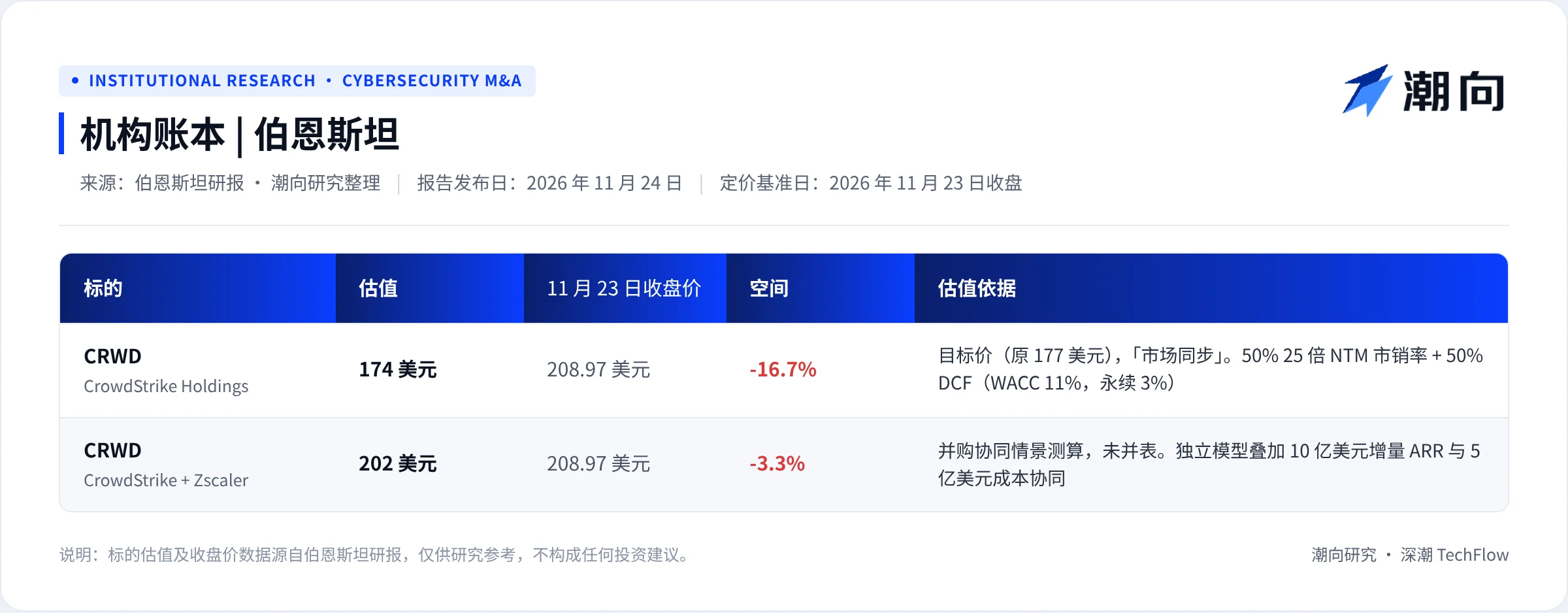
Note: Bernstein has not yet included the merger consolidation in the baseline model. The second line "Including merger synergy scenario calculations" is a potential valuation reference based on the synergy targets disclosed by management.
Fixed statement regarding the content of the research report (broker opinions, not Tide Research opinions)
This article is a compilation and interpretation of third-party broker research reports by Tide Research. The ratings, target prices, profit forecasts, and related judgments cited in the text are solely the opinions of the analysts from that brokerage and represent only the positions of their respective institutions, not the opinions of Tide Research, nor do they constitute any investment advice.
Investment in the market has risks, and decisions should be made independently. This article should not be used as a basis for buying or selling any securities.
免责声明:本文章仅代表作者个人观点,不代表本平台的立场和观点。本文章仅供信息分享,不构成对任何人的任何投资建议。用户与作者之间的任何争议,与本平台无关。如网页中刊载的文章或图片涉及侵权,请提供相关的权利证明和身份证明发送邮件到[email protected],本平台相关工作人员将会进行核查。