Author: qinbafrank
Currently, within both parties in the United States, there exists a divide that is more difficult to handle than the traditional left-right struggle: both agree that the United States must win the next round of technological competition and contain its main strategic rivals, but they differ on who should benefit, who should pay the costs, and how much power the government can wield in order to win.
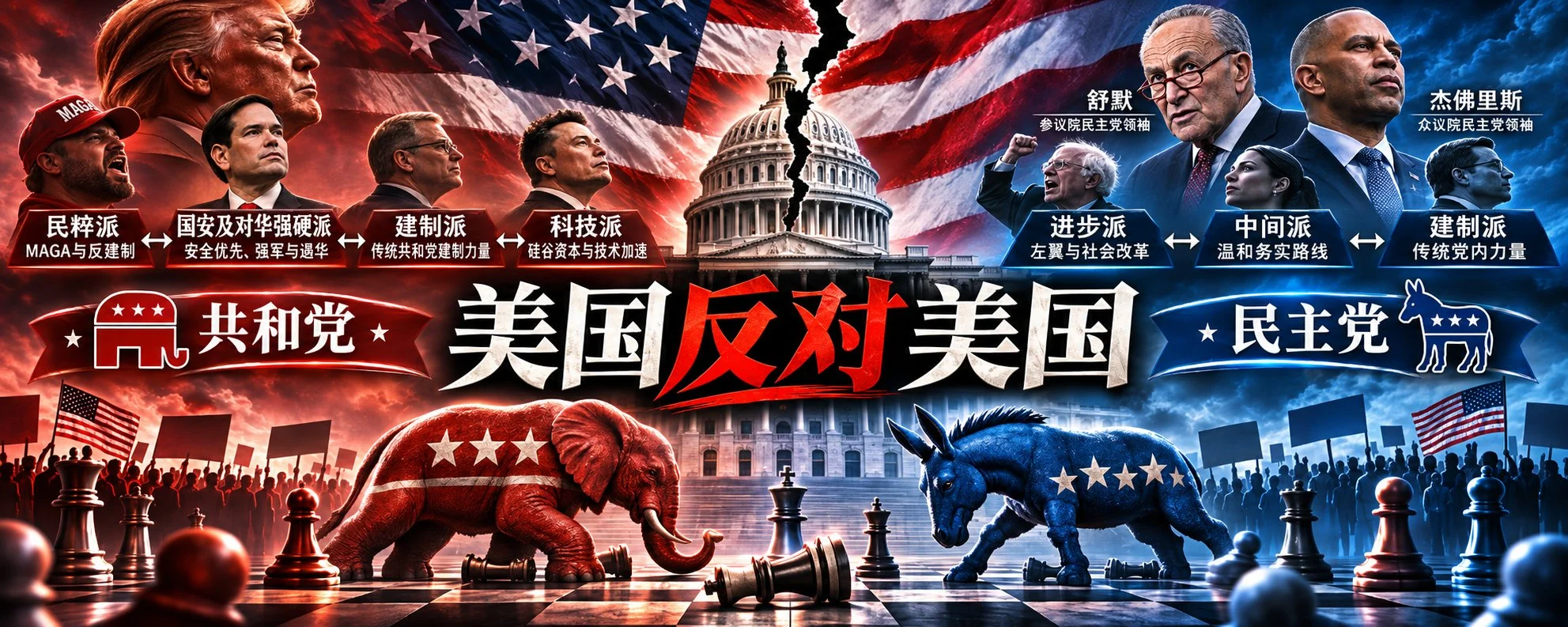
Looking at the Republican Party: Bannon can align with Rubio on limiting chip exports to China, is closer to Vance in opposing long-term wars in the Middle East, and can join far-left Sanders in calling for constraints on AI giants. Looking at the Democratic Party: Schumer can prepare to investigate Trump while being challenged by fellow party members over the case of Huang Renxun.
Using fixed camps to explain, there will be exceptions every few days; breaking down disputes into specific policies reveals that many seemingly contradictory positions actually have an underlying logic.
Forty years ago, a scholar from Fudan went to the United States for exchanges and wrote a book that is now very valuable, titled “America Opposes America.” One point in the core meaning is particularly relevant today: the proposition “America opposes America” reveals that the United States is not a homogeneous whole, but a complex body filled with inherent structural contradictions, negative forces, and self-conflict. From this perspective, one can actually understand well the current state of struggle within the two parties in America and the intra-party games.
1. Factional Divisions in the Republican Party, Trump Can Actually Be Placed in a Separate Category
1. MAGA Economic Populists
Represented by Bannon and his media and grassroots mobilization networks. Bannon can influence how supporters understand a policy but does not hold executive signature authority. They advocate for prioritizing American resources for domestic laborers. They oppose long-term military spending in the Middle East, dislike tech giants taking profits while workers bear unemployment risks, and advocate for strict limitations on advanced chip supplies to China.
2. National Security and Hardline Stance on China
Rubio, as well as Besant, and the Republican chairs of the House committees on China issues, foreign affairs, and intelligence. Their power comes from executive security assessments, congressional investigations, and export control legislation. Their priority is to prevent U.S. technology from enhancing China's strategic capabilities. They focus on which customers and third countries chips pass through, and whether cloud computing power can be used remotely. As for whether to use military force in the Middle East, it depends on personal threat assessments.
3. Advocates for Accelerating AI Development and Expanding the U.S. Technology Market
Sachs is a representative, Vance overlaps with this faction on open-weight models, and Lutnik controls the Department of Commerce's licensing and trade policy tools. They worry that if the U.S. restricts too much, overseas customers will be pushed toward alternative platforms like Huawei. Sachs defends conditional sales of the H200, one reason being to retain the market position of American platforms. Conditional exports of certain generations of products and opening frontier products to China remain two distinct policies.
4. Presidential Power Centered on Trump
Trump controls executive personnel, negotiating agendas, and the ability to communicate directly with supporters while also bearing the political consequences of the stock market, wars, and prices. He hopes to keep the space for case-by-case decision-making. At one moment, he might adopt the hardline faction's export restrictions, and the next moment, for the sake of industrial competition and market confidence, personally push for Huang Renxun's return. If Congress writes restrictions into law, the first thing to be constricted is the president's negotiation space.
Each of these factions has different points of disagreement or collaboration:
1) For example, Bannon's anti-war stance, opposition to the impact of AI on employment, and advocacy for restricting China's computing power are not in contradiction with each other.
Bannon measures policies using a relatively stable metric: Does this enhance the position of ordinary American workers, or does it bolster the power of Washington and large corporations? In his political narrative, long-term wars in the Middle East waste U.S. resources, while tech giants promoting automation may weaken the bargaining power of domestic workers. Selling advanced computing power to China may help a competitor. All three judgments can be made from an economic nationalism perspective. Here, "America First" does not equate to soft-sell foreign policy; it can fully support both military restraint and technological blockades.
However, Bannon's collaboration with Sanders on AI does not make it justifiable to claim both support the same complete policy set. They both indeed called for stricter AI oversight together in September. Sanders and AOC have their own clear federal legislative proposals, demanding a halt to new AI data centers until relevant safeguards are in place. The concern about tech monopolies and the employment impact overlaps between the left and right wings; whether they accept the same conditions for halting construction, labor systems, and wealth redistribution plans remains a different matter.
2) Vance is the link between MAGA grassroots and tech capital, with the Iran war exposing his difficulties the most.
“Vance supports AI development but is skeptical about long-term foreign wars,” and after the midterm elections, he publicly connected the Republican Party’s losses with the Iran war. On November 20, he was in the same venue as Trump facing reporters, yet Vance still refused to clearly answer whether he would authorize strikes again if it were his decision. His response was that the decision at that time was made by Trump, and the role of the vice president is to support the president. Meanwhile, he also explicitly demanded substantial reductions in Iran's nuclear enrichment capabilities as a condition for ending the war in October. This reflects a position sensitive to the costs of war, yet willing to pressure negotiation counterparts.
Putting this in the context of the Huang incident, Vance also proactively pushed for reinstatement. According to Reuters, Trump and Vance worry that the open-weight model in the U.S. may lose a key figure who is both willing to support and possesses the computing power and industrial resources to back it. Vance wants to place technology investment and economic nationalism within the same political alliance. As long as AI is understood as a tool for U.S.-China competition, these two parts can coexist very well; once local voters interpret it as rising electricity costs, job cuts, and subsidizing the wealthy, conflicts will arise. For someone intending to compete for the 2028 presidential nomination, this question is even tougher than “friendliness towards Silicon Valley.”
As for entrepreneurs like Musk and Huang Renxun, they also need to be viewed separately from White House officials. Businesses have interests regarding customers, shareholders, supply chains, and product line routes, while Vance is constrained by votes and internal succession within the party. The Secretary of Commerce must also be accountable for licenses and enforcement procedures. They can become allies in “reinstating Huang,” but they need not agree on which models are exportable or which customers should be blacklisted. The “tech faction” can explain a united action but find it hard to summarize each individual’s complete stance.
2. The Huang Incident as a Concentrated Reflection of Different Factional Positions within the Republican Party
Previously, here (Related Reading “Who is 'Dismantling Huang': The Power and Interests Behind Huang's Departure, and the Next Steps in U.S.-China Tech Relations”) detailed the actions of various Republican factions during the “Save Huang Movement,” highlighting that before Trump’s prestige and influence in the Republican Party were greatly weakened, he could rely on his own authority and influence to suppress dissenting opinions within the party, not allowing other voices to emerge fully. However, this devastating defeat greatly reduced Trump’s influence, negative voices regarding inflation, people's livelihood, and the trend of AI data center development were amplified, as they are direct reasons for the crushing defeat, and since it has happened, Trump cannot deny it. Therefore, politicians in the Republican Party holding different views have started to become more active and assertive.
Why could Huang return? The market crash made everyone recognize Huang’s significance, and Trump, riding the wave of the market downturn, suppressed hardliners within the party and actively pressured to persuade the Nvidia board.
Yet through this incident, each faction within the Republican Party also achieved certain results:
Trump and Vance won personnel decisions, the national security faction got some regulatory results (remote computing power restriction rules, Commerce Department documents even explicitly state that the drafting is led by the Treasury and National Security Council, a National Security Committee was established in Nvidia's board, and subsequently Nvidia's chip sales compliance requirements should be more stringent).
The Democrats, meanwhile, gained an investigative line that could trace to the Commerce Department and even the White House. No faction exited this game due to Huang's reinstatement.
3. What Factions Exist Within the Democratic Party? “Establishment” and “Centrist” Should Be Understood Separately
The Democratic Party is a tent with justifiable inclusivity,
the establishment describes who controls party groups, fundraising, and agenda resources; the centrist describes what policies and electoral compromises a person is willing to accept. Therefore, Jeffries can be part of the establishment while also leaning towards the left on healthcare. A moderate who wins a seat in a red state might also support replacing Schumer. More worth discerning within the Democratic Party are the following powers:
Congressional Leadership and Party Organization
Schumer, Jeffries. Their primary responsibility is to maintain a majority across blue states, swing states, and newly acquired red states, positioning items that have the votes to pass at the forefront. They tend to favor initially addressing Medicaid subsidies, cost of living, and government accountability. The left seeks to convert victory into structural reforms. Average members and committees may demand leaders to relinquish some agenda-setting power.
Centrist, Pro-Growth, and Pragmatic Governance Factions
The House has a formal “New Democrat Coalition.” Its agenda covers housing, healthcare, energy, care, and daily necessities. Pennsylvania governor Shapiro represents a local governance orientation: willing to introduce industrial investments while setting hard conditions for developers like self-funded power costs. They have clear differences with the left regarding halting new data centers, expanding direct government supply, and to what extent corporations should be regulated.
Economic Progressives and Democratic Socialist Left
The progressive faction has a broad range, with AOC and independent senator Sanders aligned with the Democratic socialist route. Economic progressives like Ro Khanna emphasize universal healthcare, wealth taxes, and higher minimum wages. Common concerns include corporate concentration, political donations, and workers' bargaining power. They question whether leadership reforms are too slow and whether centrists can rely only on investment growth and market competition to improve distribution. The progressive caucus has its own cost of living proposals, not just protest agendas.
Labor and Local Industry Alliances span the factions mentioned above. Construction and electrical unions care about whether projects can proceed and if contracts will create local union jobs; communities hosting data centers are more concerned with electricity prices, water supply, and developers' commitments. Even if both sides believe they represent workers, they may vote differently on the same project. For example, the electrical unions supporting the construction alliance alongside OpenAI, Blackstone, etc., is a concrete instance.
The National Security Faction Also Spans the Democratic Party
Former intelligence analyst, Michigan Senator Slotkin, emphasized national security and oversight when criticizing Trump's interference with Nvidia. Pennsylvania Governor Shapiro discusses the system's bias towards top-tier individuals, while Ro Khanna from Silicon Valley argues that stock prices should not exempt companies from export accountability. All three support investigations, explaining why the “anti-Trump” sentiment allows them to unite quickly, and also why divisions will re-emerge when it comes to what laws to establish next.
4. Why Are Democrats Starting to Plan Accelerated Investigations?
Firstly, it is naturally to hope to use investigations to suppress Republicans and accumulate advantages for the 2028 elections by securing votes for that year. But there are more immediate motivations:
Voters have indeed authorized them to strengthen oversight. An AP survey found that about seventy percent of voters feel that Congress does not sufficiently check Trump, including about forty percent of Republican voters. Meanwhile, among those who voted for Democratic candidates, around one-fifth still have a negative overall evaluation of the Democratic Party. This means a considerable portion of people have very specific thoughts: I am willing to let you investigate the White House, but I have not yet decided whether I want you to take over the White House. If Democrats interpret all investigations as actions for the 2028 campaign, they will miss out on this segment of voters who genuinely demand procedural integrity and good governance.
To cater to voters' demands—the Democratic Party is well aware that their massive victories in the midterms were primarily due to voter dissatisfaction with Trump and Republican policies. Thus, after securing a majority in Congress, they aim to actively initiate investigations that expose the misconduct, corruption, and insider activities of Trump and the Republican Party over the past two years, making the public's opposition to Trump even stronger. This further solidifies their advantage in the next election.
Yesterday, Jeffries, as the incoming Speaker, issued this statement, which I see as the Democratic Party's battle call, clearly outlining the direction for future investigations and competitions.
On November 19, House Democrats sent a letter to Lutnik, investigating whether Nvidia influenced the Commerce Department's enforcement regarding Megaspeed. On the 23rd, Jeffries called for investigations and pushed for export legislation following Huang's reinstatement, while Schumer promised to pursue any potential misconduct after gaining the majority. Hassan also requested information from Vance in another Venezuelan oil licensing case and reviewed yesterday, stating that Democrats are indeed active now. The Democratic Party is demonstrating how it intends to use its majority power in Congress;
Internally, Van Hollen reiterated the incident with Nvidia to argue for the need to reform Senate agenda-setting, challenging Schumer on December 1. The investigations into Trump have also become material for competition over leadership among Democrats.
Thus, the Democratic Party also faces a genuine risk: investigations can easily unite the party caucus but do not necessarily resolve policy choices within it. A single hearing may satisfy the national security, anti-corruption, and anti-tech monopoly factions simultaneously. Yet the next healthcare vote must decide who to cover and how much to spend; a data center project must decide whether to approve it and who will bear the costs. If for months, only executives and ministers appear on TV while families’ insurance premiums, electricity costs, and housing burdens show no visible improvement, Republicans will have the opportunity to throw the question back: After gaining both houses, what have you accomplished for the voters?
5. Does the Democratic Party Have a Constructive Agenda?
On November 22, a CBS host directly asked Jeffries what his first bill would be after taking control of the House. He did not provide a first bill that had already secured votes and was numbered, but listed five early tasks: to promote the end of the Iran war, reverse Medicaid cuts, restore SNAP food aid, address Trump’s tariffs, and extend tax credits for premiums under the Affordable Care Act. The first two categories correspond to oil prices and cost of living, and low-income family healthcare and food expenditures. The Democratic leadership can already articulate which policies they intend to modify. As for whether the president will sign it, how funding will be raised, and which item to trade first, that is another layer of questions.
From a timing perspective, these policies were also not pieced together hastily after the election. The centrist “New Democrat Coalition” proposed plans to lower five types of family costs as early as February, and again released a governing agenda in May. The House progressive caucus also rolled out its cost of living plan in April. The Democratic Party has this formal basis for its 2024 national party platform; therefore, the current state is that various factions have submitted their answers, but the party has not yet synthesized these answers into one.
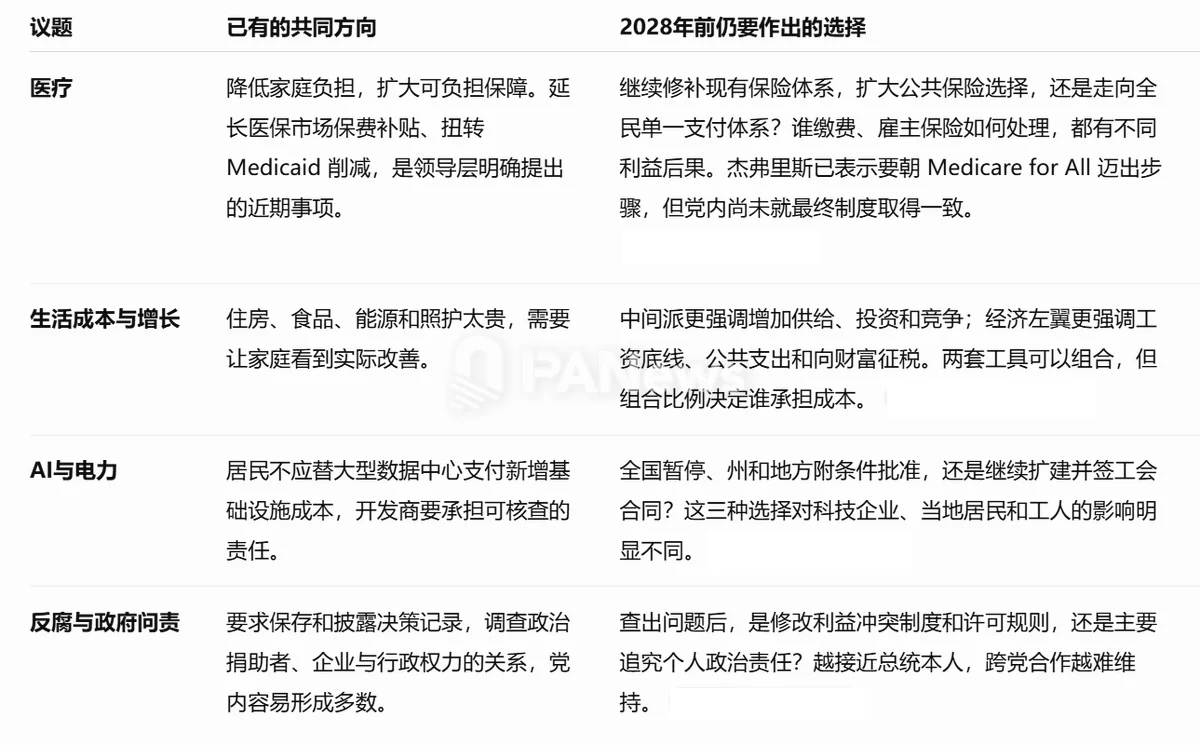
A point that is most easily overlooked here is that “lowering living costs” can become a common agenda because different factions acknowledge the existence of the problem; it is not sufficient yet to become a complete economic governance framework because the factions have different diagnoses of why prices are high. For example, facing rising electricity prices, a centrist governor might believe the problem lies in slow expansion of the power grid and that large customers should bear part of the connection costs; left-wing legislators might think the problem stems from tech companies having too much site selection and bargaining power and call for a halt to new loads. The former diagnosis would lead to more electrical investment, while the latter would delay some computing power construction. For residents, both sides promise to protect electricity prices; but for the supply chain, this leads to distinctly different policy directions.
6. Moving from 2026 to 2028, the Toughest Question for Both Parties
The Republican Party needs to solve how to keep tech capital and economically populist voters accepting the same growth strategy. Vance can advocate for both accelerating U.S. AI development and reducing costs from the Middle East wars, which are compatible at the national strategic level. The gaps between Bannon and Sachs on these issues are more challenging to bridge than their shared consensus that “China is a competitor.”
The Democratic Party needs to figure out how to turn a congressional election that can be won by individual states into a governing plan that national voters are willing to entrust. In 2026, Democratic candidates in Texas and Kansas can appeal to voters using beliefs, local identities, and moderate language, while progressives can win in other places with more distinct economic demands. However, in 2028, there will only be one set of presidential and vice-presidential candidates. Moreover, according to models estimating voting blocks by The Washington Post, about seventy percent of the Democratic Party's advantage relative to 2024 stems from changes in voter composition, while around twenty percent comes from cross-party shifts; thus, the Democratic Party cannot take this year's mobilization advantage as a solidified national majority.
The Democratic Party already has a shared agenda powerful enough to initiate the next Congress and several quite specific constructive plans. What it has not decided is which of these plans will serve as the governance roadmap that national candidates must defend in 2028.
The distinction here lies in:
To say that the Democratic Party will only investigate Trump underestimates the policy preparations it has already made; to claim that this midterm landslide resolves the Democratic Party's roadmap issue overestimates what the electoral results can inform us.
Thus, while the Democratic Party achieved a significant victory in the midterm elections and the Republican Party suffered a crushing defeat, it does not mean that the Democratic Party has become the “incumbent governing party” for 2028; it still depends on: which piece of livelihood legislation it prioritizes, whom it is willing to compromise with to pass it, and whether it can transform an investigation into a system that even if Democrats govern in the future, they are willing to adhere to. The first task tests priority, the second tests whether a majority has formed within the party, and the third tests whether their accountability commitments can extend beyond simply targeting opponents.
免责声明:本文章仅代表作者个人观点,不代表本平台的立场和观点。本文章仅供信息分享,不构成对任何人的任何投资建议。用户与作者之间的任何争议,与本平台无关。如网页中刊载的文章或图片涉及侵权,请提供相关的权利证明和身份证明发送邮件到[email protected],本平台相关工作人员将会进行核查。