Author: Michael Dempsey, Founder of Compound
Compiled by: Deep Tide TechFlow
Deep Tide Introduction: As the current purest vendor of cutting-edge models, Anthropic does not carry the C-end consumer burden like OpenAI, nor does it have the ecological synergy of tech giants. Its business model seems simple: package basic computing power, which costs a few dollars per hour, and sell it as cutting-edge intelligence tokens for dozens or even hundreds of dollars per hour.
However, as open-source weighted models rapidly catch up within four to twelve months, the value of existing intelligence continues to face inflationary compression. In the face of diminishing marginal returns of computing power and towering capital expenditures of up to hundreds of billions of dollars, whether Anthropic can maintain a premium through continuously emerging high-value scenarios becomes the key battle determining its fate.
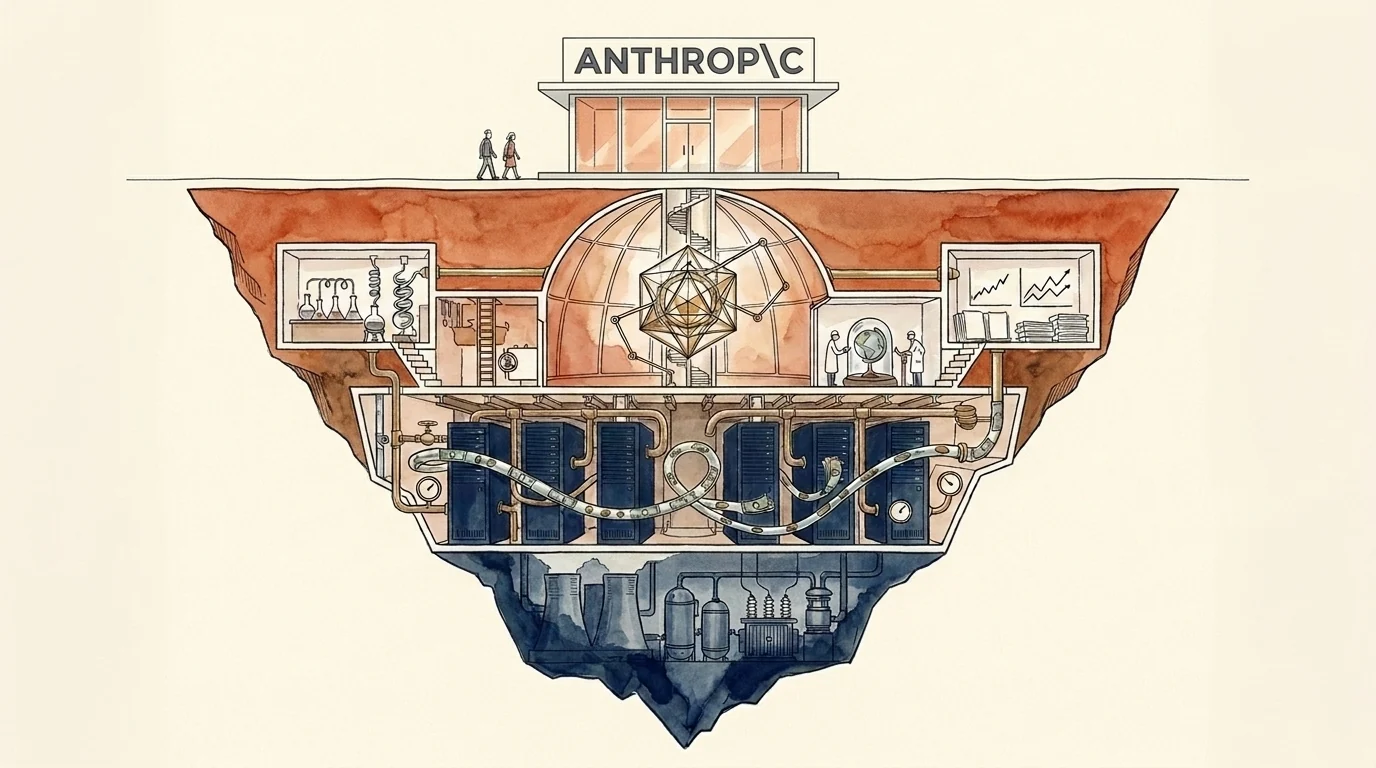
Abstracting cutting-edge model laboratories into a business model is surprisingly simple: they sell intelligence via API.
Abstracting cutting-edge model laboratories into a business model is surprisingly simple: they rent GPU machines and sell intelligence via API.
Abstracting cutting-edge model laboratories into a business model is surprisingly simple: they raise capital from investors to rent or purchase GPUs, then sell intelligence via API.
Abstracting cutting-edge model laboratories into a business model is surprisingly simple: they obtain massive funding through structured forms such as equity, debt, or computing power commitments to assist other companies in building data centers for renting out GPUs; subsequently, they not only sell intelligence via API and an unlimited subscription model but sometimes also build upper-layer software products around this intelligence; in certain cases, they even own their own data centers personally.
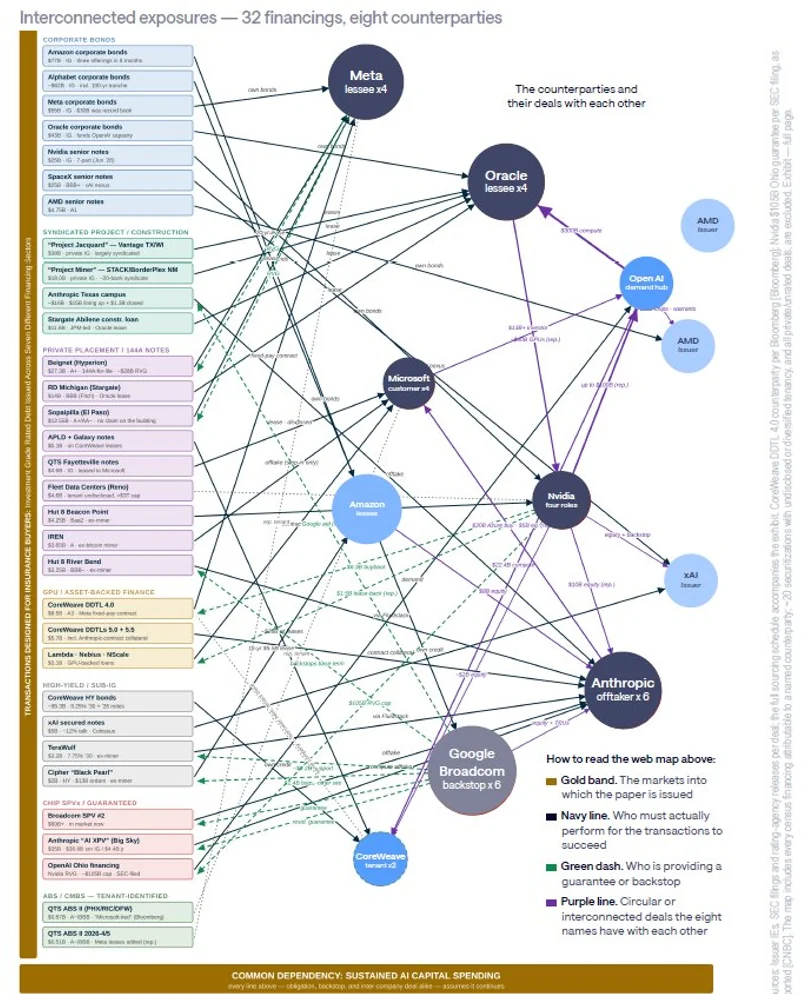
As clearly illustrated in the above image, visualizing the complex capital-raising flow of cutting-edge laboratories is also "remarkably simple". Next, we will focus on Anthropic. Among all cutting-edge laboratories, it is the purest "intelligence seller", without the heavy C-end consumer burden of OpenAI, and without the vast positive business synergy and diversification monetization pathways like Alphabet or Meta.
Having clarified what cutting-edge laboratories are actually doing in business, we might as well put aside the well-known key variables in bilateral transactions (such as whether they can fulfill their massive computing power commitments, how the speed of data center construction and real-world implementation affects this cash flow race, and whether anyone is truly forced to pay when the bills come due, or if both parties are merely mutually shirking responsibility), and proceed to thoroughly distill the essence of Anthropic's business (this is by no means a pun on model distillation).
To understand the core of Anthropic, you only need to clarify one thing: over time, can they continuously find new application scenarios for frontier tokens to outpace the rapid compression of existing intelligence value?
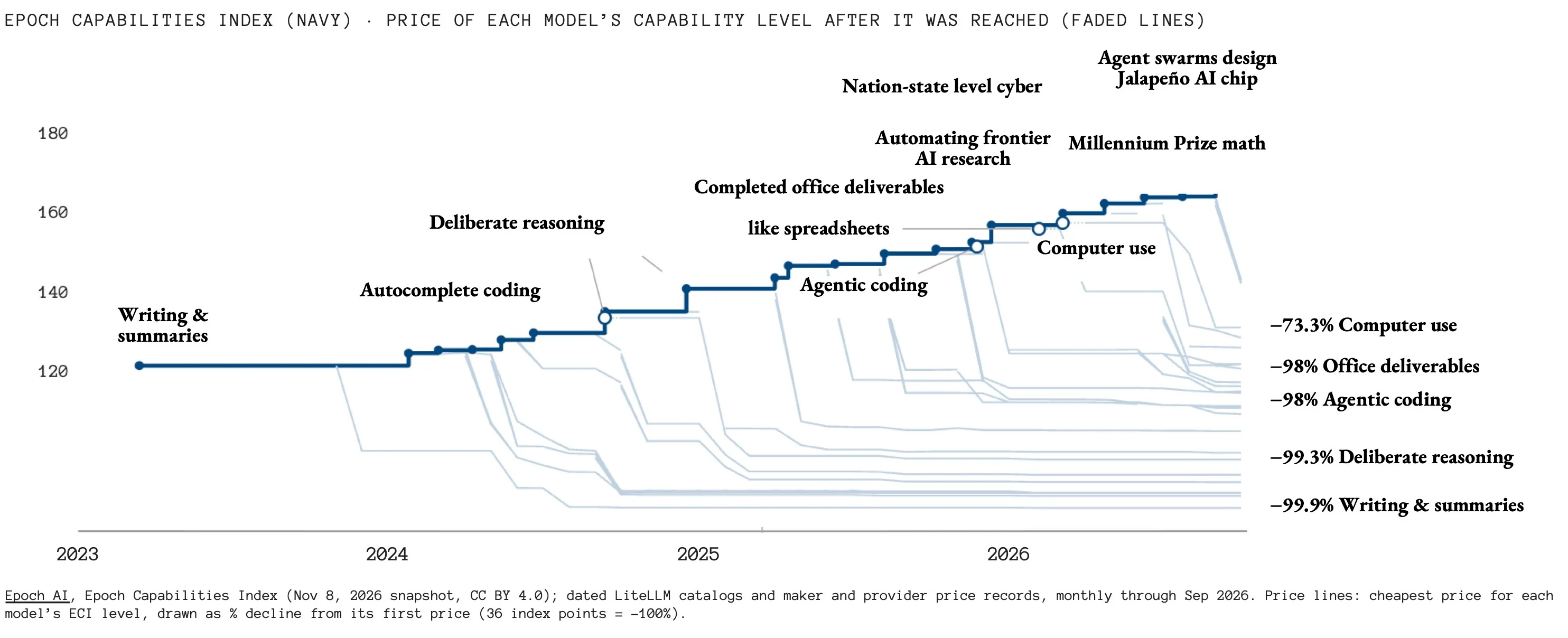
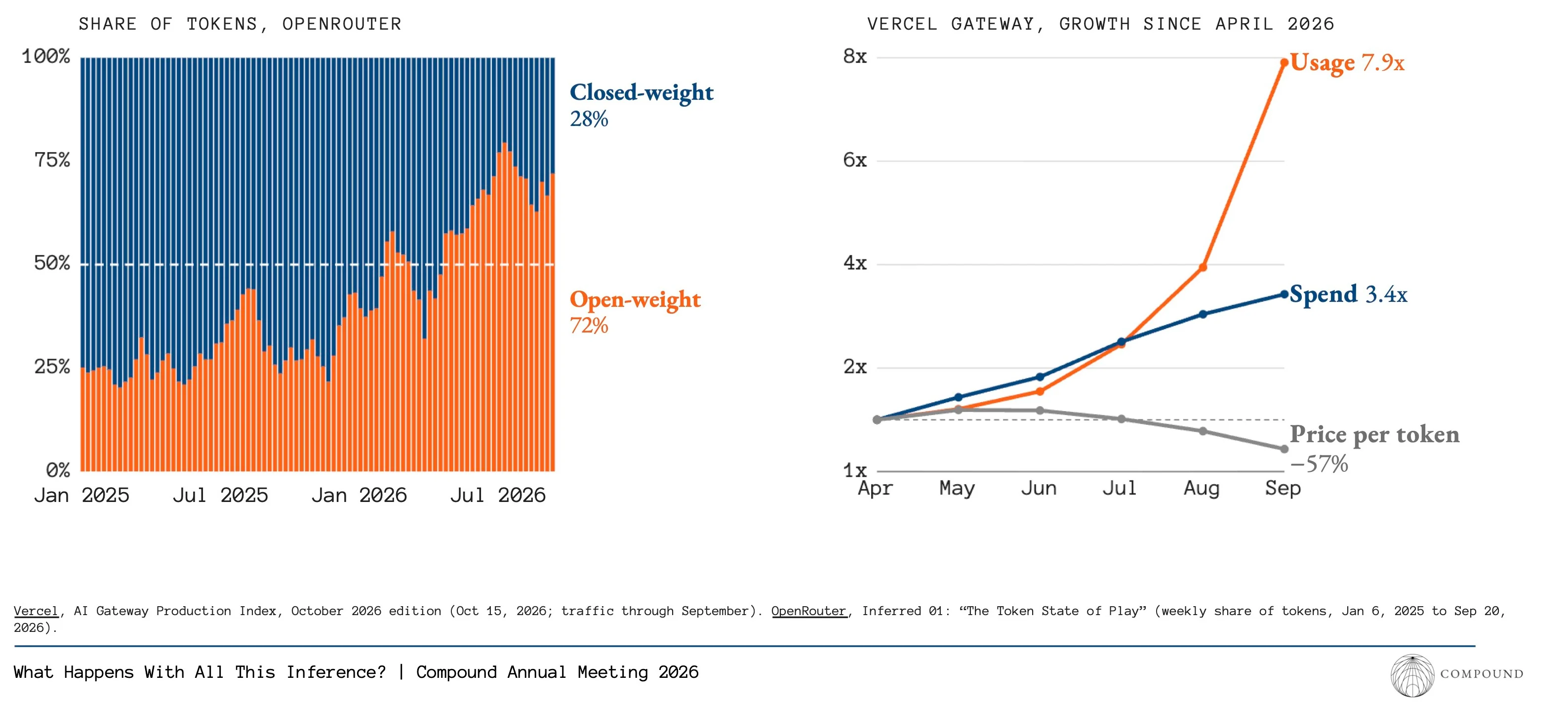
The reason we focus intensely on this question is that historical experiences suggest that as model efficiency continues to improve and competitors quickly catch up, the so-called costs of frontier tokens are irreversibly trending toward zero. The above image shows various application scenarios at different stages, while the below one reveals that the demand for these tokens (note the number of tokens rather than the amount) is continuously flowing towards open-source weighted models at the sub-frontier or frontier edges.
The entire market's expenditure scale is expanding, but this raises a core suspense: who can truly maintain profitability within this massive expenditure? Before open-source models catch up in 4 to 12 months, can frontier laboratories continue to sell fleeting leading windows?
This means you must lock in and clarify a particularly special niche: during periods when cutting-edge intelligence maintains an edge over sub-frontier intelligence, this niche continually presents a dynamically sliding window of high return on investment (ROI). They mostly belong to zero-sum games or highly asymmetric arenas, where a slight advantage translates into a stark disparity in outcomes; alternatively, human expert labor is so expensive that directly investing $50 per hour in computing power to solve a problem is an obviously worthwhile transaction.
This dynamic window is where frontier tokens hold the greatest value, with typical representatives including financial trading, cybersecurity, national defense and industry, and software engineering.
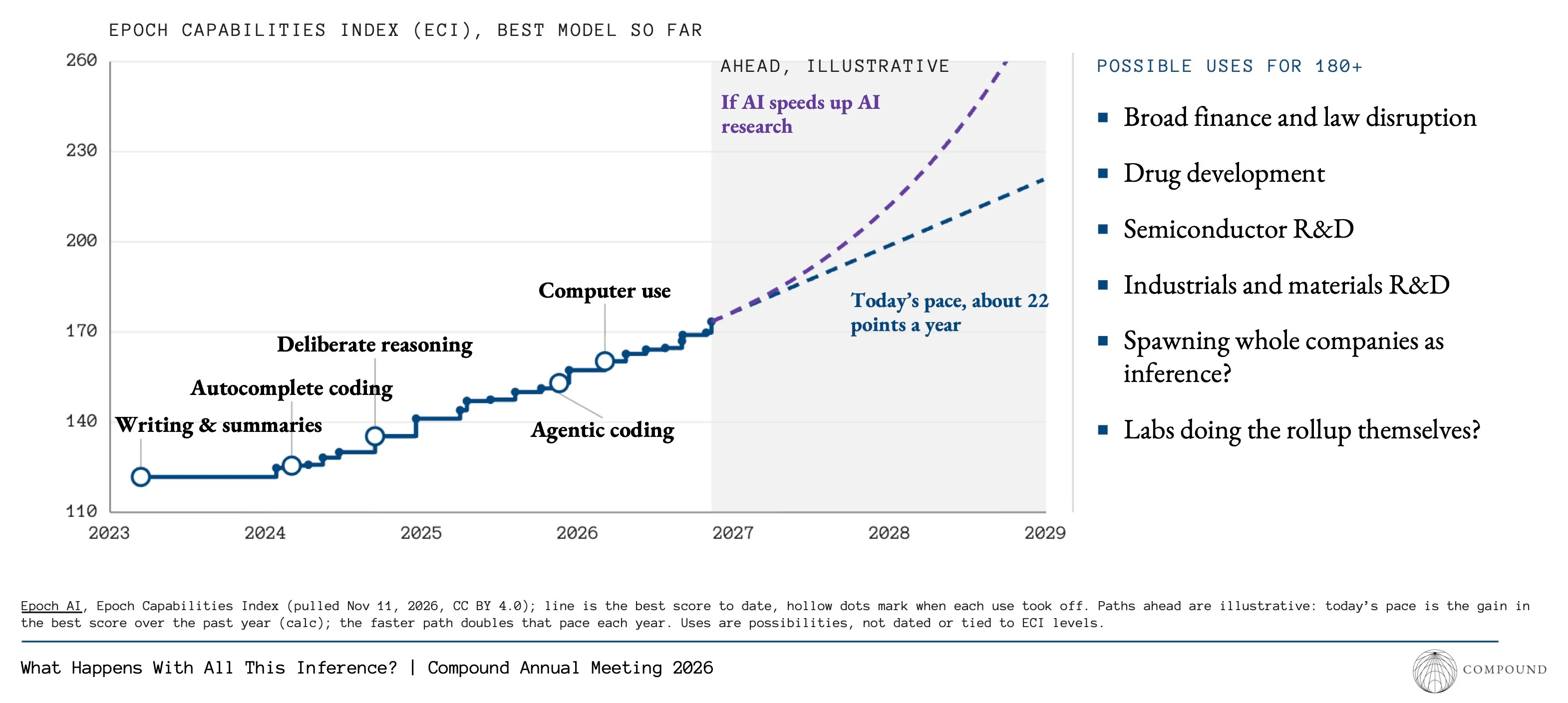
From this, you can subtly glimpse the evolution trajectory of all high-value scenarios and begin to assess whether the real economy can reasonably digest superhuman levels of cognitive ability in these categories. Perhaps the revolution and diffusion of technology possess an irresistible gravitational pull.
Another perspective is that Anthropic is essentially engaging in "computing power alchemy". It transforms commodity computing power worth only $2 to $9 per hour (per B200 GPU machine hour) into a high-premium asset averaging $20 to $50 per hour, which can even exceed $100 in cutting-edge scenarios; subsequently, it uses this substantial margin to cover the costs of its remaining GPUs purely dedicated to research and development. In contrast, hosting open-source weighted models like DeepSeek earns only about $5 to $9 per hour, nearly equivalent to bare GPU leasing, leaving almost no excess profit for underlying R&D.
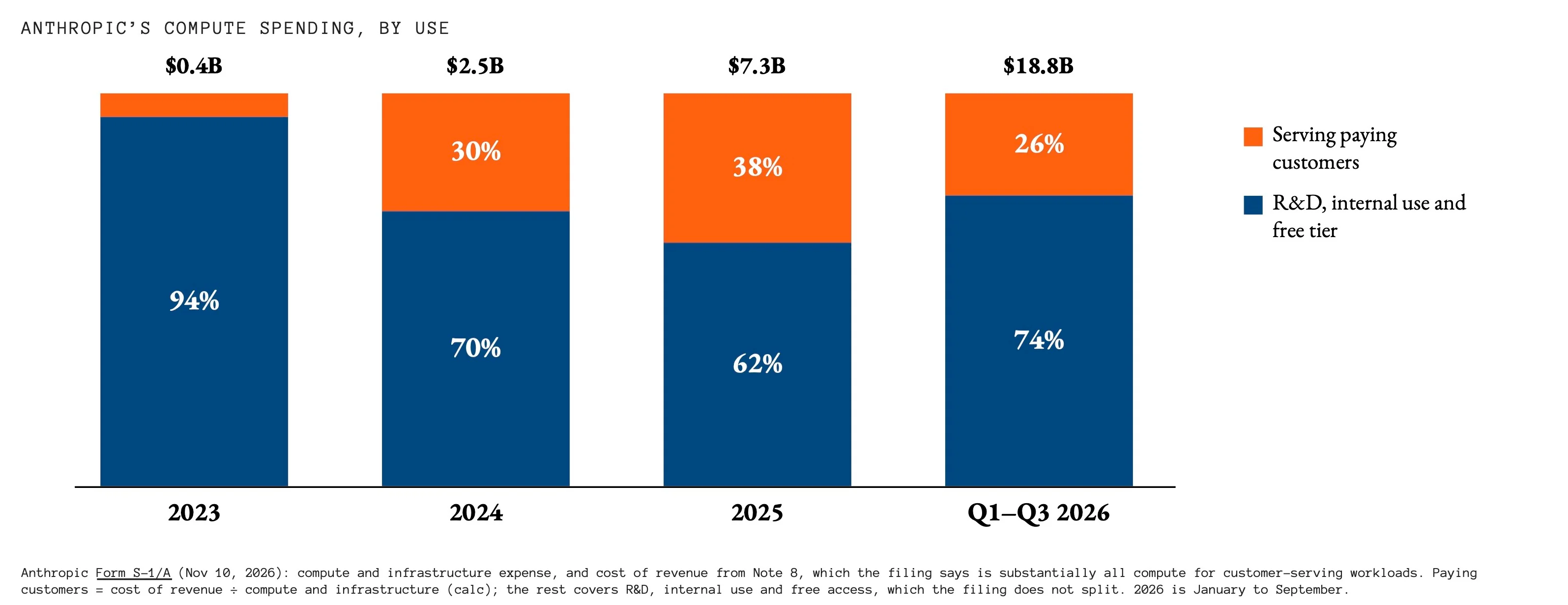
This also explains why the computing power allocation structure shown in the above image resembles a Rorschach inkblot: even if the paid customers' computing power doubles in absolute terms, their share of total computing power still declines to 26%; meanwhile, internal R&D and self-used computing power have exploded by more than four times. This pattern inevitably gives rise to two entirely contrasting interpretations.
The pessimistic perspective is: "Oh my, even though Claude Code performs stunningly and paid customers' computing power has more than doubled, to merely maintain its position at the forefront, the rate of consumption of R&D and free-tier computing power is still forced to soar at twice the speed of the paid segment."
Conversely, the optimistic perspective is: "Incredible, Anthropic's annualized computing power investment in R&D and internal use this year is as high as approximately $18.5 billion. They must be very well aware of what they are doing and have ample reason to bet on future internal scenarios that will bring substantial returns."
This drastic reversal in market narrative parallels the experience of hyperscale cloud providers in capital expenditure: at the beginning of 2026, the market was still immersed in the excitement of "look at how much funding these giants have raised for AI capital expenditures, which is simply a super positive for AI"; by October 2026, the winds had suddenly shifted to "look at how much these giants are burning on AI capital expenditures, which is simply a catastrophic negative for AI," followed closely by a brutal drop in the valuations of all secondary market AI concept stocks.
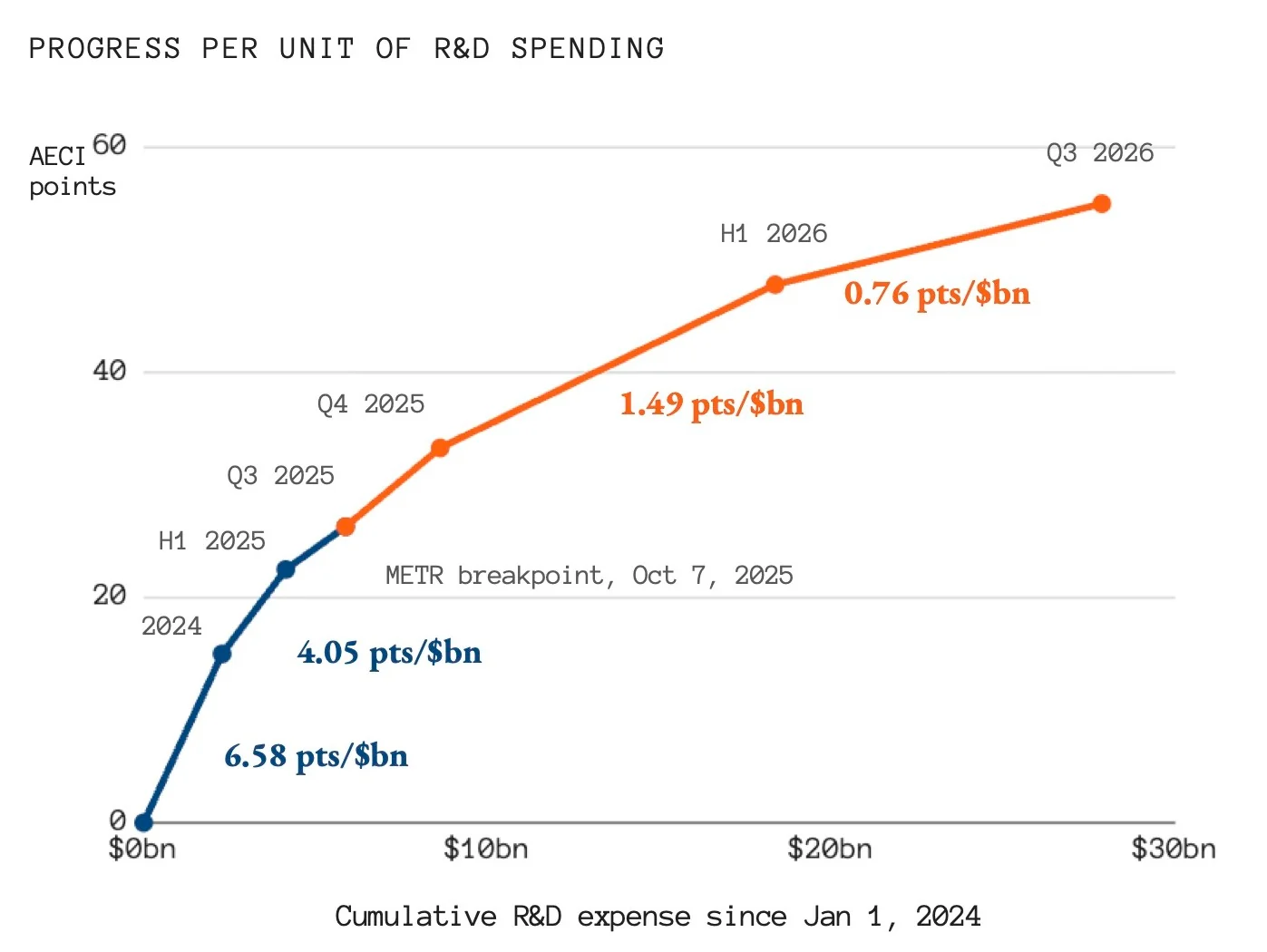
Currently, a severe dilemma is that the money needed to extract slight improvements in cutting-edge intelligence performance is rising exponentially. The incremental situational intelligence index (ECI) gained from every $1 billion in R&D investment has plummeted from 6.58 points in 2024 to 0.76 points in the third quarter of 2026. The obvious counterargument from bullish investors is that the ECI index's corresponding economic value is likely not linear. An increase from 120 to 130 unlocked text summarization; crossing from 150 to 165 unlocked intelligent agent programming and operating computers; reaching above 170 may directly unlock financial alpha yield mining or new drug development. Therefore, at the pyramid's pinnacle, every $1 billion exchanged for 0.76 points may create economic returns that completely surpass the lower stage's 6.58 points.
Nonetheless, even if this logic holds, the real economy must rapidly digest these capabilities (the benchmark for this digestion speed precisely being the lag time for open-source models to catch up with closed-source frontiers) to validate the rationality of this massive expenditure. Otherwise, you must firmly believe in two alternative hypotheses: either the team can advance model training and performance breakthroughs more efficiently through automated R&D (but if seriously considering safety issues, this is far from easy); or new application scenarios have yet to be adequately mined in pre-training and mid-training corpuses, thus still providing low-cost performance climbing dividends.
Starting from Scale and Mercor: A Cognitive Reflection on Data Annotation
In the early stages of my career, I deeply investigated first-generation deep learning data annotation companies represented by Scale, Labelbox, and Crowdflower. At that time, I made two judgments and ultimately chose to completely abandon investments in the entire track.
Firstly, I seriously underestimated the vitality and market scale of the human-annotated data market.
Secondly, and more crucially, I fundamentally misjudged the core assets that this type of company (as well as emerging platforms like Mercor) truly builds: they are essentially precision machines capable of continuously aligning with the ever-moving "data collection, annotation, and training goalposts." In this model, even if you might still face the risk of high customer concentration, you also enjoy a pseudo-network effect and possess an intensely competitive ecosystem, allowing the value of data collection to remain evergreen as long as application scenarios continue to evolve. In 2016, I truly believed in AI, but looking back now, my faith in the scaling law was clearly not firm enough.
Returning to Anthropic: The Commercial Underpinning and Outcome Projection of the Frontier Leader
Thus, restoring Anthropic to a business model is actually exceptionally straightforward: they precisely target computing power worth tens of billions of dollars at the ever-shifting goalposts, selling valuable leading time and absolute performance barriers to customers whose demand for cutting-edge intelligence is increasingly urgent and willing to pay for it.
This last point is crucial because it is the lifeline for Anthropic to maintain high profit margins under the relentless approach of sub-frontier models. These sub-frontier models can potentially reach or even exceed the frontier level through post-training, thus encroaching on the premium space of Anthropic’s frontier tokens. Conversely, even if the development of open-source weighted models stagnates due to various external factors (be it constraints on the computing environment, frontier laboratories cutting off model distillation, or domestic capital retreating), the previously mentioned "pure model vendor dilemma" remains unavoidable: Google or Meta could easily dump sub-frontier intelligence at near-cost prices because they can monetize it from mature ecological businesses.
We should naturally question: if Anthropic fails to achieve the ideal business flywheel described above and its profit margin suffers irreversible erosion, what choices will they make?
The answer is: a full-stack expansion along the upstream and downstream of the industrial chain.
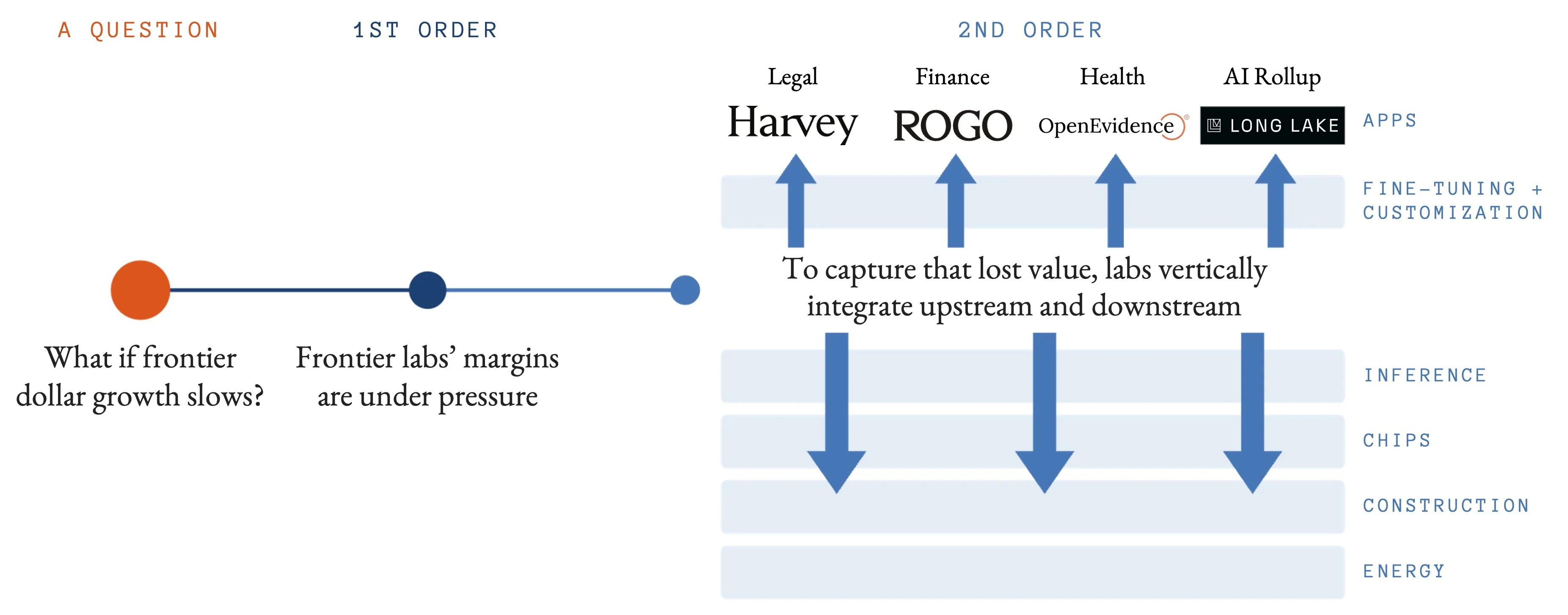
Extending downstream to infrastructure (including self-developed inference optimization, custom chips, data center construction, and even energy supply) is a defensive means to protect profit margins when demand soars and per-unit revenue growth slows; however, this also gradually transforms a top-tier intelligence laboratory into a utility company operating heavy assets, dragging the enterprise back into the intricate capital financing maze mentioned at the beginning of the article.
Expanding upstream to the application layer (including model fine-tuning services, vertical industry applications, new forms of software, and ecological integration acquisitions) allows it to capture more workflow value; but this move places it in the awkward position of directly competing with its own best API clients, pushing these core clients to accelerate their transition to the open-source model camp. More importantly, this strategy also harbors a fragile assumption: that the key core that drives Claude Code to achieve remarkable results (a deep understanding and native fitting of "software engineering" culture) can also be seamlessly replicated in those ambiguous, complex non-software businesses. Anthropic might argue that "AI will take care of it all for us," and attempt to shape itself into the "last publicly listed giant" in human commercial history.
If the narrative progresses to this stage, you will ultimately witness one of two inevitable outcomes:
First, Anthropic eventually transforms into a high-leverage utility company with its own R&D department;
Second, Anthropic evolves into a super predator relying on cutting-edge intelligence but ultimately shatters its best customers.
Special thanks to Mackenzie and Max for their contributions to the views expressed in this article.
Disclaimer: This article does not constitute any investment advice; Compound may hold long or short positions in the various securities mentioned in this article at any time.
免责声明:本文章仅代表作者个人观点,不代表本平台的立场和观点。本文章仅供信息分享,不构成对任何人的任何投资建议。用户与作者之间的任何争议,与本平台无关。如网页中刊载的文章或图片涉及侵权,请提供相关的权利证明和身份证明发送邮件到[email protected],本平台相关工作人员将会进行核查。