

Every Monday, Wednesday, and Friday, focus on the cryptocurrency market, Japan, South Korea, A-shares, and Hong Kong stocks. Review the market with data and grasp opportunities with trends, produced by PANews.
Bitcoin Struggles to Reclaim $60,000, $53,200 Becomes Last Line of Defense
Bitcoin has given back all of Monday's gains. The news of Jensen Huang's return to NVIDIA had caused BTC to surge 5% within half an hour, approaching $64,600 at one point. Within six hours, the price reverted to its starting point. Glassnode stated that Bitcoin is the "canary in the coal mine." It gave up gains earlier than the stock market, leading to a subsequent drop in the Nasdaq. The correlation between Bitcoin and the Nasdaq 100 has risen to the highest level since September 2022, indicating instability in the stock market and the difficulty for coin prices to strengthen alone. Additionally, in the past 20 trading days, there has been a cumulative outflow of $4.3 billion from the U.S. spot Bitcoin ETF, marking one of the largest outflows since its inception.
The external macro environment is equally severe, with the U.S. dollar index holding above 104, a high not seen since March 2025. As the Trump administration plans to restart tariff offensives, market concerns about inflation rebounding have intensified. Trader Ted Pillows believes that Monday's rebound was merely short-covering and that the current market is in a phase of chronic blood loss.
From a technical standpoint, the previously strong buying area between $62,000 and $66,000 has been breached and now serves as strong resistance above. Analyst Lennaert Snyder pointed out that Bitcoin was blocked at a daily gap of $63,400 during the New York session, and he has opened a short position at $63,300. Trader Killa believes that $64,000 to $65,000 will form resistance in the short term and predicts that prices may oscillate between $48,000 and $66,000 in the coming weeks.
The market is highly attentive to liquidity around the $55,000 range. Trader wulf noted that there are many buy orders below this price, while Max Trades believes that there is a long liquidation zone below $59,300, suggesting prices could clear this area before seeking a rebound. In terms of nearby support, $58,000 to $58,500 has been repeatedly mentioned. Killa emphasized $57,700 as the low of the previous rising range, and if it holds, there is still a chance for a rebound.
Moreover, sentiment in the options market is extremely bearish. Glassnode data shows that last week the ratio of put options to call options reached 1.7, the highest since June 2022. In terms of open interest, this ratio is the highest since May 2021. This is an insurance policy against declines; the increasing number of buyers indicates that the market is pricing in lower prices. Between $58,000 and $64,000, options market makers are in a "negative gamma" state, lacking hedging support, which may amplify volatility. Conversely, in the ranges of $56,000 to $58,000 and $64,000 to $66,000, market maker hedging may dampen volatility.
Multiple institutions are focused on the "realized price," which is the average holding cost across the market, currently around $53,200. 21Shares Research Director Élizer Ndinga pointed out that historically, every bear market has fallen below this level, with bottoms typically 24% to 61% lower. If history repeats itself, the potential bottom could be around $43,800. Ndinga also emphasized that this is merely extrapolation and does not guarantee a drop to that level. Glassnode believes that the market shows signs of "capitulation," with nearly 90% of long leverage above the realized price being cleared. If BTC closes below the June low of $58,500, the market may continue to explore the $53,200 level. Notably, throughout history, every bear market has eventually fallen below the realized price.
In regard to Bitcoin's bottom, institutions are notably more cautious:
- MN Capital founder Michaël van de Poppe believes the probability of a V-shaped reversal for Bitcoin is less than 30% because it needs to reclaim the 21-week, 21-day, and 200-day moving averages simultaneously. He also stated that if the closing price for the month is high, subsequent dips often present opportunities.
- 42 Macro founder Darius Dale predicts that if the S&P 500 index falls more than 20% from its October high before Christmas, Bitcoin could further drop to $38,400.
- Into the Cryptoverse founder Benjamin Cowen is even more pessimistic, targeting a "fair price" of $35,000 to $39,000 (distinct from the realized price, the fair price also factors in the holding period of Bitcoin and the transfer of long-dormant capital, serving as a deeper valuation reference during historical bear markets). Cowen believes the next 4 to 7 weeks will be Bitcoin's most fragile phase and if it doesn’t make new lows during this period, bearish sentiment may gradually reverse by early 2027, creating conditions for a rebound from March to June. (Related reading: "2027 Asset Allocation Trends: Which Hits Bottom First: Bitcoin, U.S. Stocks, or Gold?")
The market is currently highly focused on the U.S. October PCE data to be released at 9:30 PM tonight, with market expectations for core inflation to rise to 3.2% year-on-year. Hot data will suppress risk assets, while cool data may leave room for a rebound. Additionally, U.S. stocks will be closed on Thursday for Thanksgiving, leading to reduced liquidity, which could provoke late-session volatility. For Bitcoin to stabilize again, it needs to see inflows into ETFs, net buying on Coinbase, and price stability above $60,000; if it closes below $58,500, the next key support will directly point to the cost line of $53,200.
ETH Falls Below $1,700, $1,500 Seen as the "Iron Bottom" Since 2023
ETH fell about 6.5% this week, down 65% from the peak of $4,946 in August 2025. Technically, trader Bayard believes that Ethereum may have a demand for mean reversion after the sustained decline, with $1,900 to $2,000 potentially becoming a short-term rebound zone, but until it reclaims the 21-day moving average, the rebound can only be regarded as technical repair. If inflation cools, crude oil retraces and pushes down U.S. Treasury yields, ETH may gain a better rebound environment.
Currently, $1,650 to $1,722 has turned into a short-term resistance zone. Trader Alex Marzell pointed out that $1,722 is a key reclaim point; if it can hold the $1,650 support, a revisit to $1,770 is possible; if it falls below $1,650, the next stop will point to $1,540. Several traders see $1,500 as the "iron bottom" since 2023, but they also caution about the risk of dipping to $1,350. Legendary trader Peter Brandt even issued an extreme warning, stating that if ETH cannot hold above $1,383, it will lose effective buying structure below, potentially dropping back below $500.
Today's Highlights:
Sophon Mainnet Will Shut Down, Users Must Withdraw Assets by Today
Humanity (H) Unlocks Approximately 266 Million Tokens, Valued at About $3 Million
ChainOpera AI (COAI) Unlocks Approximately 19.55 Million Tokens, Valued at About $3.4 Million
Plasma (XPL) Unlocks Approximately 228 Million Tokens, Valued at About $10.4 Million
Upbit 24-Hour Trading Volume Rankings: BTC, EGLD, XRP, BIGTIME, SKY
Bitcoin Spot ETF Had a Total Net Outflow of $232 Million Yesterday, Continuing a 6-Day Net Outflow
Ethereum Spot ETF Had a Total Net Outflow of $6.4249 Million Yesterday, Continuing an 8-Day Net Outflow
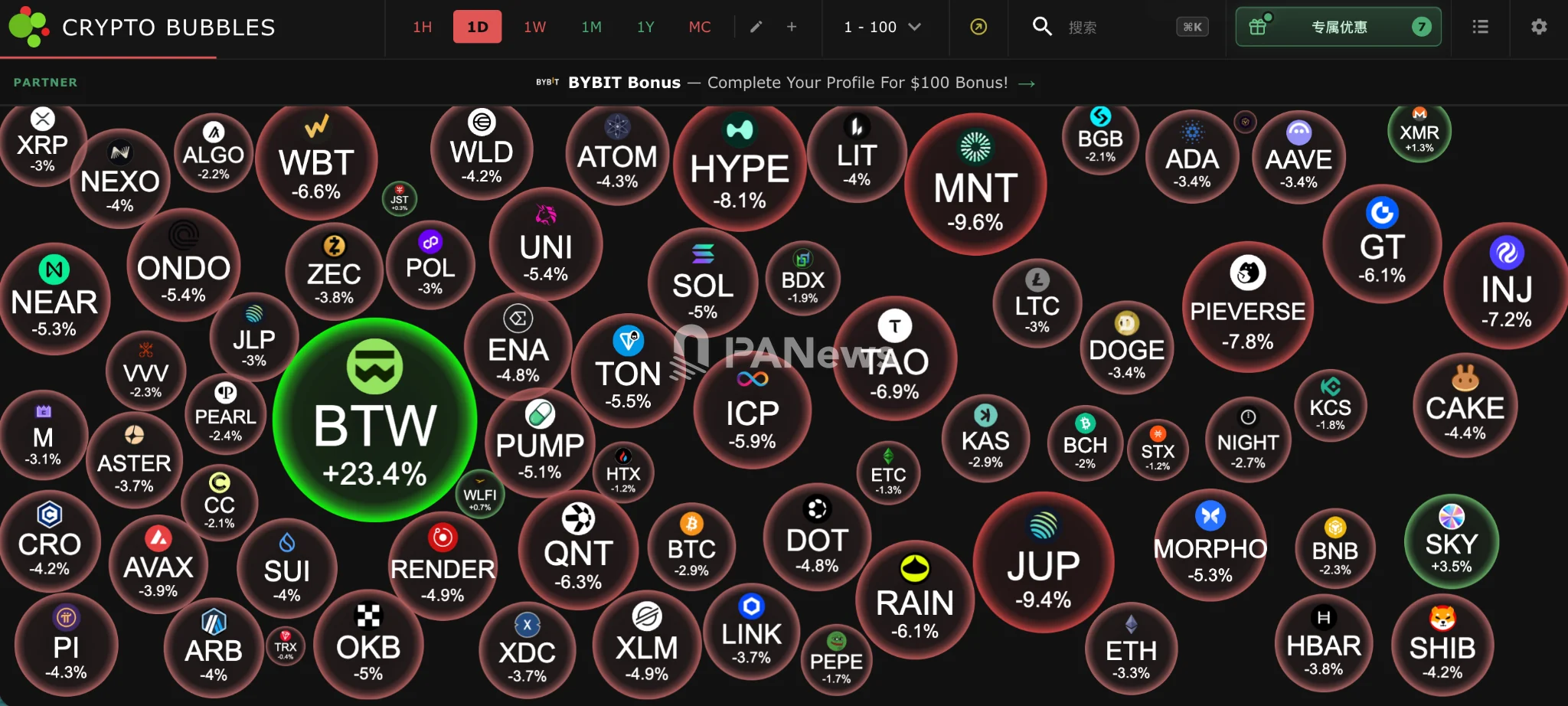
Today's Top Gainers Among the Top 100 Cryptocurrencies: BTW Up 22.4%, SKY Up 3.5%, XMR Up 0.9%, WLFI Up 0.5%, JST Up 0.5%.
AI Trading Retreats Sweep Asia-Pacific: South Korea's KOSPI Plunges 6.16%, Nikkei Falls Below 58,000 Points, A-Shares Semiconductor Faces Heavy Blow
The Nasdaq's overnight drop of 1.48% and the Philadelphia Semiconductor Index's terrifying plunge of 7.88% this morning have fully transmitted panic to the Asia-Pacific markets, leading to indiscriminate sell-offs in overvalued tech stocks.
South Korea's stock market was the first to suffer, with the Korea Composite Stock Price Index (KOSPI) plunging 6.16% throughout the day. Core heavyweight stocks were trampled by panic-selling funds, with the storage giants SK Hynix down 11.05% and Samsung Electronics down 9.87%. Overseas institutions have expressed concentrated fears of a peak in the HBM and storage chip cycle, with Goldman Sachs and UBS bluntly stating that this is a major repositioning caused by tightening liquidity and valuation cushioning.
The Japanese market also did not escape unscathed, as the U.S. semiconductor chain’s overnight collapse across chips to optical communications took its toll, with the Nikkei 225 index closing down 2.78%. SoftBank Group fell 14.83%, Tokyo Electron fell 12.53%, while International Electric, Yageo, Kioxia, and Murata Manufacturing all saw declines of over 14%. On the flip side, Sony rose 4.42%, Toyota Motor rose 2.87%, and Fast Retailing rose 2.53%, with pharmaceutical stocks leading the gains, with Ono Pharmaceutical rising 10.71% and Astellas Pharma rising 6.49%.
The Hong Kong stock market is also under pressure, with all three major indices collectively declining. The Hang Seng Index closed down 1.14%, and the Hang Seng Tech Index closed down 2.56%. Semiconductor stocks led the market decline, with Wallin Technology falling over 24%, Days Intelligent Chip falling over 18%, Hua Hong Semiconductor falling over 17%, with Zhaoyi Innovation and Changguang Chuangxin falling over 13%, SMIC down 7.55%. Notably, SMIC has had its target price cut by more than 30% by CICC due to industry valuation decline and differentiated downstream demand. The lithium battery sector fell broadly, with CATL down 12.23%, and both Zhong Chuang Innovation and Longpan Technology down over 7%. Market analysis indicates that the decrease in the concentration of the power battery industry and loosening shares of leading enterprises are the main reasons. In addition, the mobile phone supply chain, non-ferrous metals, and securities brokerage stocks all performed poorly, with CICC down 7.06%.
A-shares are also experiencing a significant adjustment, as all three major indices opened low and continued to weaken. The Shanghai Composite Index fell 2.03% and fell below 3,500 points, the Shenzhen Component Index fell 3.24%, while the ChiNext Index and the Sci-Tech Innovation 50 Index plummeted 4.19% and 5.12% respectively, with over 4,900 stocks in the two markets declining. On the board, the semiconductor, PCB, and robotics concepts led the decline, with Nandu Optoelectronics and Canxin shares plummeting more than 10%, as funds strongly withdrew from high-position computing hardware, turning instead to safe havens like pharmaceutical commerce, retail consumption, and undervalued banks. CICC believes that the recent adjustments are mainly influenced by external shocks, and A-shares are expected to recover through oscillation, with no need to be pessimistic in the mid-term.
免责声明:本文章仅代表作者个人观点,不代表本平台的立场和观点。本文章仅供信息分享,不构成对任何人的任何投资建议。用户与作者之间的任何争议,与本平台无关。如网页中刊载的文章或图片涉及侵权,请提供相关的权利证明和身份证明发送邮件到[email protected],本平台相关工作人员将会进行核查。