
Author: Nancy, PANews
Bitcoin's downward trend continues, and the chill in the market persists, as Wall Street institutions that were once actively entering the market are now struggling.
What once injected upward momentum into the crypto market, the spot ETF, has now become a point of bloodletting for the market. Over the past two months, Bitcoin and Ethereum spot ETFs have continuously recorded net outflows, with no signs of a reversal in the trend of institutional capital withdrawal. Among them, Bitcoin spot ETFs set a record for the largest single-month net outflow in November.
The continuous withdrawal of institutional funds not only weakens the market's incremental buying power but also further undermines investor confidence, making an already weak market sentiment even worse.
Record outflows from ETFs, institutional buying cools
For more than two years, Bitcoin and Ethereum spot ETFs have become important entry points for Wall Street to layout in the crypto market, opening the door for traditional institutions to allocate crypto assets and bringing hundreds of billions of dollars in incremental funds to the market. However, entering the fourth quarter of this year, this important channel for institutional entry is facing headwinds, with a sharp decline in fund flows, ushering in the most severe market test since their listings.
SoSoValue data shows that since the fourth quarter, Bitcoin spot ETFs have accumulated a net outflow of over $5.22 billion. In November alone, $4.71 billion flowed out, about 9.2 times that of October's $510 million and setting a record for the largest single-month net outflow since the ETF was listed.
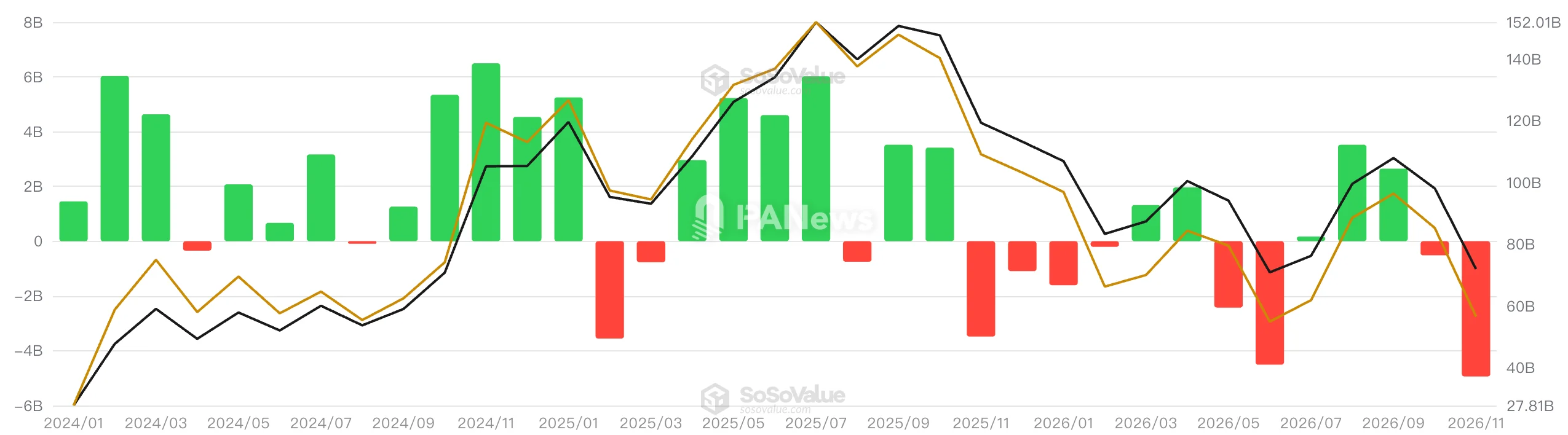
Notably, right after the new week opened, Bitcoin spot ETFs again saw a net outflow of nearly $570 million, exceeding one-third of last week's net outflow scale. Although the Bitcoin price has fallen below $60,000, there has been no significant inflow of ETF funds, which may indicate that institutional investors' willingness to buy on dips remains weak, maintaining a cautious attitude toward future market trends. The continued momentum of institutional capital withdrawal further weakens the market's incremental buying power, putting more downward pressure on Bitcoin prices.
In this wave of institutional withdrawal, BlackRock's IBIT is at the forefront. As a leading product in the Bitcoin spot ETF market, IBIT was once an important channel for institutional funds to flow in, but it has now become the main outlet for this round of fund withdrawals. In November, IBIT experienced a net outflow of over $4.17 billion, ending the previous months of consecutive net inflows, with its outflow accounting for 88.5% of the overall net outflow of Bitcoin spot ETFs for that month.
This tide of capital retreat has also spread to the Ethereum market. Since the fourth quarter, Ethereum spot ETFs have also said goodbye to the net inflow state that lasted for several months, with a cumulative net outflow of over $2.84 billion. Although the scale is smaller than Bitcoin, the trend of capital withdrawal is equally evident.
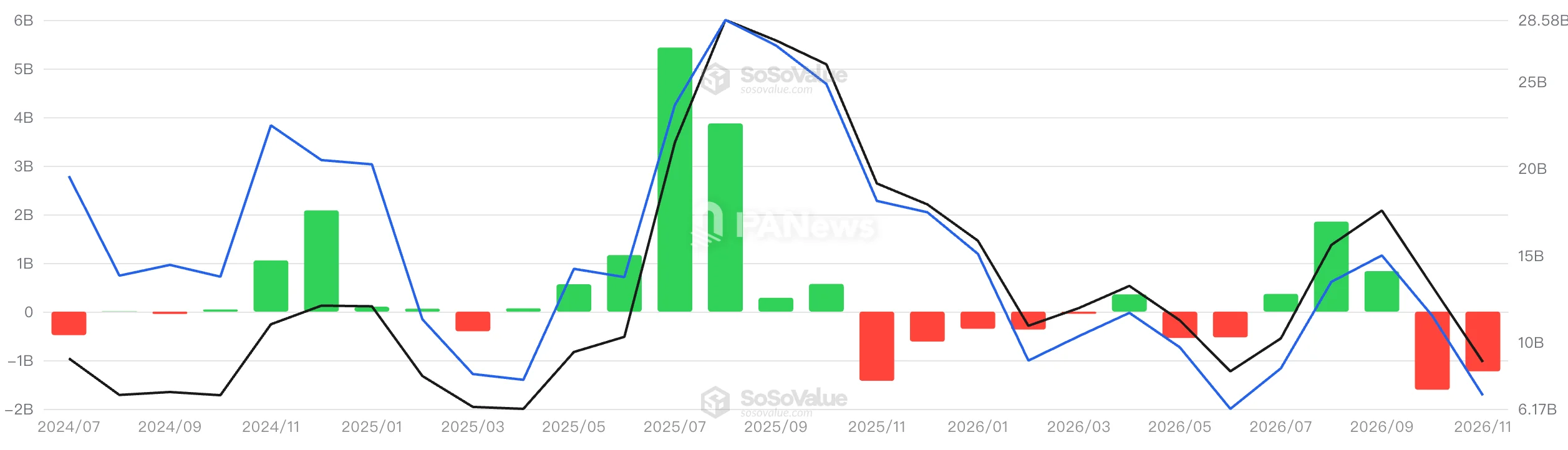
Among them, October was a particularly concentrated month for the capital withdrawal from Ethereum spot ETFs, with a single-month net outflow of $1.61 billion, setting the largest single-month net outflow record since the product's launch. The week of October 9 saw a concentrated redemption, with the single-week net outflow ranking as the second highest of the year.
Similar to the Bitcoin market, BlackRock's ETHA remains the main source of redemptions, accumulating a net outflow of about $2.44 billion since the fourth quarter, accounting for 85.9% of the overall net outflow of Ethereum spot ETFs.
Hundreds of billions in paper losses, Wall Street stands guard at high positions
In the third quarter, Wall Street experienced a wave of enthusiastic buying for Bitcoin ETFs.
Recently, an analysis by Galaxy Research of 13F filings showed that in the third quarter, institutional investment managers increased their holdings in U.S. Bitcoin spot ETFs, equivalent to purchasing 49,229 BTC, reversing the previous three consecutive quarters of net selling trend. The total amount held by institutional reports also climbed to 356,491 BTC, valued at approximately $29.8 billion, setting a historical new high, even exceeding the previously reduced total of 47,054 BTC over the past three quarters.
Behind this surge in institutional buying is the increasing number of traditional financial institutions starting to include Bitcoin in their asset allocations. Galaxy's research director, Alex Thorn, pointed out that this quarter's increase was mainly driven by dozens of large institutions, among which investment advisors and wealth management platforms contributed half of the net increase in Bitcoin spot ETF shares.
According to the latest disclosures from Bloomberg ETF analyst James Seyffart, as of September 30, the number of institutions holding Bitcoin ETFs has exceeded 2,200, with investment advisors dominating among the disclosed holdings. In his view, this is a positive signal because investment advisors typically have a longer holding period. Notably, Wells Fargo has become the largest institutional holder of Bitcoin ETFs.
At that time, Wall Street's enthusiasm for Bitcoin allocations was still high, injecting considerable incremental funds into the market, pushing Bitcoin prices to briefly rebound to $87,000. However, there is a certain lag in the disclosure of 13F filings, which reflects more of the institutions' configuration situation from the previous quarter and does not represent their current investment attitude.
Entering the fourth quarter, the market direction began to shift dramatically. Institutions that were previously actively buying started to withdraw, and ETF fund flows turned from net inflows to large-scale net outflows. As the coin price continues to dip, the once-bustling Wall Street buying has also felt the chill of standing guard at high positions.
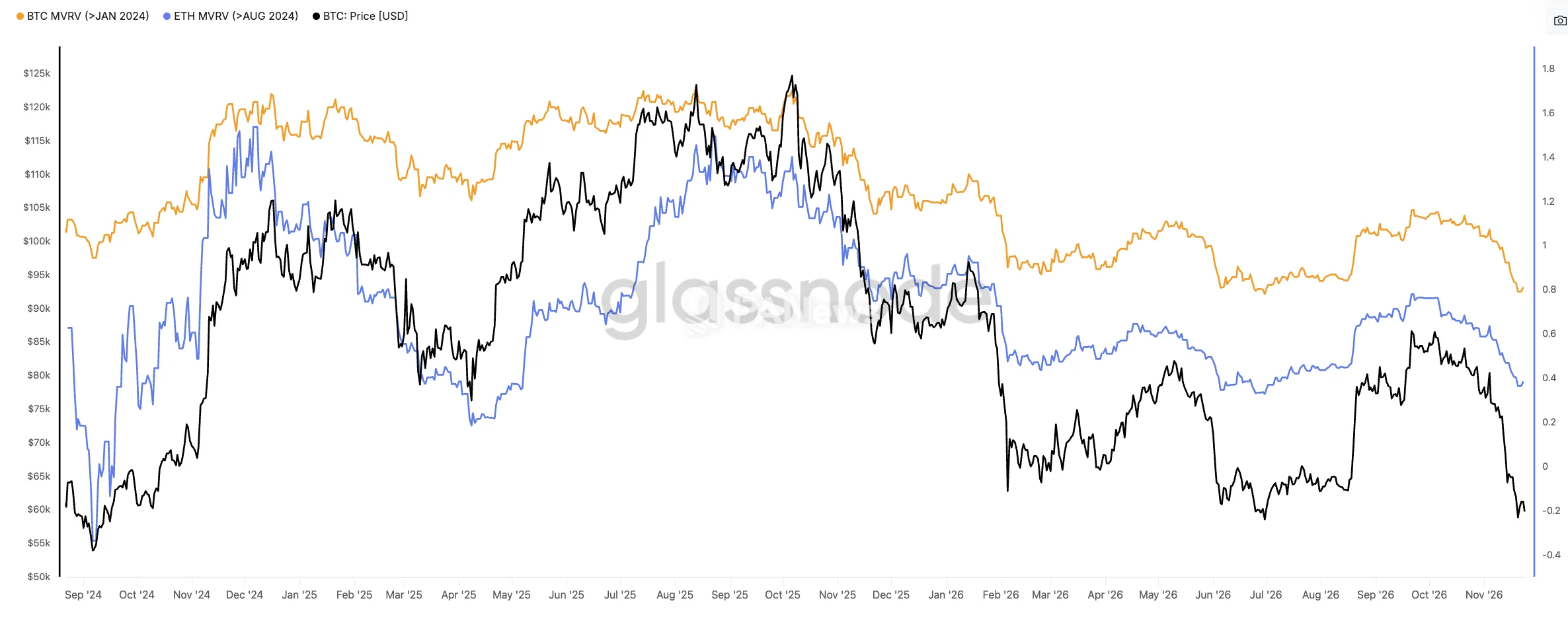
Glassnode data shows that as of November 23, the MVRV ratio of the U.S. spot Bitcoin ETF has dropped to 0.81, while the MVRV ratio of the Ethereum spot ETF has fallen to 0.38. MVRV measures the relationship between the current market value of ETF holdings and the average cost of the holdings, where 1 represents the breakeven line; below 1 signifies that the overall holdings are in a state of floating loss.
Meanwhile, data from CryptoETF.today also shows that as of November 23, the average cost of holding Bitcoin spot ETFs is about $80,164, approximately 35.7% higher than the current Bitcoin price, resulting in a total floating loss of about $22.76 billion for holders. The situation for Ethereum ETF investors is even more difficult, with an average holding cost of about $2,974, while the current Ethereum price is only $1,655, leading to a total floating loss of about $7.18 billion.
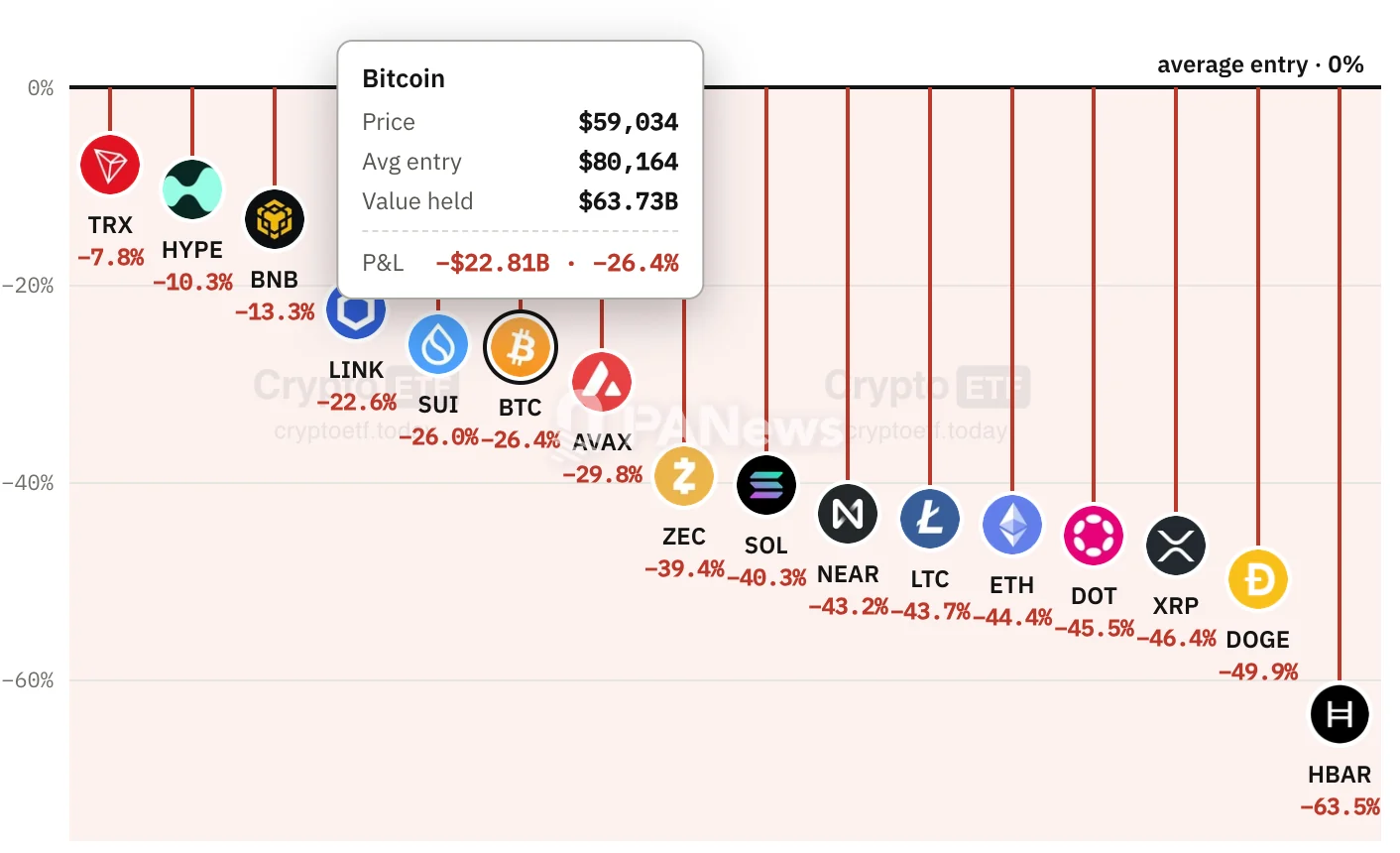
Not only are ETF investors facing these issues, but publicly traded companies holding a large amount of crypto assets are also facing significant paper losses. The two leading DAT companies, Strategy and BitMine, have paper losses on their Bitcoin and Ethereum holdings exceeding $14.1 billion and $10.3 billion, respectively.
In other words, Wall Street, which was actively chasing prices in the third quarter, is now burdened with hundreds of billions in paper losses. For these institutions that entered the market at high positions, continuing to hold implies enduring further price drop risks.
For Wall Street, paper losses may not be the most pressing issue. The real test lies in the increasing risks that institutions must bear by continuing to hold crypto assets as the market continues to weaken. Currently, factors such as tightening macro interest rate environments, valuation adjustments of AI-related assets, and market liquidity contraction are compounding to increase market uncertainties, placing greater holding pressures on ETF investors who entered at high positions. Meanwhile, the continuous outflow of ETF funds further weakens market buying power, exacerbating market pressures.
In summary, the current market environment is insufficient to support institutions quickly rekindling their allocation enthusiasm. Next, whether ETF funds can turn back to net inflows and when institutional allocation demands will recover may become significant signals affecting the crypto market's ability to emerge from its slump.
免责声明:本文章仅代表作者个人观点,不代表本平台的立场和观点。本文章仅供信息分享,不构成对任何人的任何投资建议。用户与作者之间的任何争议,与本平台无关。如网页中刊载的文章或图片涉及侵权,请提供相关的权利证明和身份证明发送邮件到[email protected],本平台相关工作人员将会进行核查。