Embodied intelligence and the humanoid robot sector are transitioning from concept demonstrations to commercialization, and the penetration rate S-curve is steepening. The Morgan Stanley Asia Pacific equity research team pointed out in a report released on November 24, 2026, that with breakthroughs in large models, Tesla accelerating mass production, and China intensively introducing industrial policies, the focus of industry competition has shifted towards real data flywheels and customer return on investment. The firm raised the target price for Yushu Technology to 1060 Chinese Yuan (potential upside of about 50%), and upgraded the rating for UBTECH to "Overweight," with a new target price of 77 Hong Kong dollars (potential upside of about 28%).
Saying Goodbye to Demonstrations, Data and Return Rates Become the Key
The industry is undergoing a brutal rite of passage.
After closed-door discussions with executives from four leading robotics companies at the Morgan Stanley Technology Innovation and Growth (TIG) conference, it was found that the market narrative has completely changed. In the past, the competition was about whose demonstration video was cooler; now, the competition is about who can bridge the simulation-to-reality gap and convert technology into replicable business invoices.
The iteration of cutting-edge large models is pushing the "ChatGPT moment" of physical AI forward. As leading multimodal models like GPT-6 Astra and Anthropic Fable demonstrate stronger reasoning and long-term planning capabilities, some executives optimistically predict that robot zero-shot generalization and multitasking execution capabilities may achieve breakthroughs as early as 2027.
However, smarter models are just the first step.
In real factories and commercial scenarios, the life-and-death decision still depends on the operational accuracy of "the last few millimeters." Executives reached a consensus that, considering deployment costs, continuous operation duration, and customer ROI, industry scaling will be a gradual process. Crossing the critical point may require hundreds of thousands or even millions of robots to collect failure and feedback data on the real front lines.
Technical architecture and data formulas have also come to the forefront. The industry currently tends to adopt a layered architecture where cutting-edge large models act as the slow-thinking "System 2" responsible for intent understanding and task decomposition, while the fast-response "System 1/0" specializes in motion control and safe execution. On the data side, the "training data pyramid" has become a core secret—the quality of true-machine remote operation data is the highest but costly, while first-person human demonstrations and simulation-generated data are used to low-cost expand coverage. Morgan Stanley predicts that in the next 2 to 3 years, the industry will experience severe reshuffling and merger integration.
Tesla Unifies the Brain, China Sets the Tone for Mass Production
Industry giants and policymakers on both sides of the ocean are simultaneously stepping on the gas.
Tesla across the ocean is attempting to unify the physical world with the same AI foundation. With the upgrade of FSD V15, Tesla has integrated autonomous driving (FSD), robot taxis (Robotaxi), and humanoid robots (Optimus) under the same visual encoder and world model. This means that the perception and planning experience accumulated by millions of cars in complex road conditions can directly feed back into the operational training of the robots.
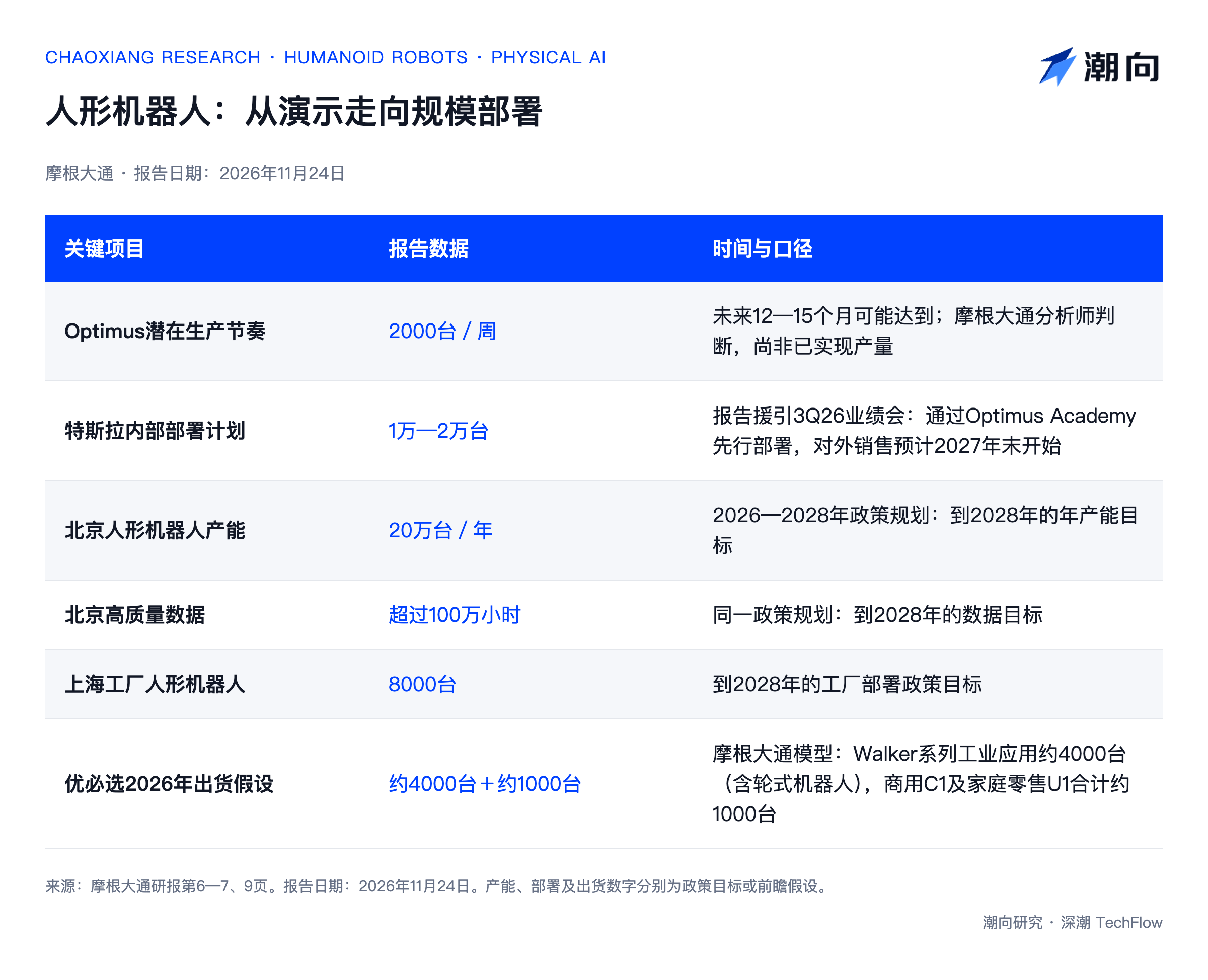
The mass production timeline is also being accelerated. Tesla plans to deploy 10,000 to 20,000 robots in its internal "Optimus Academy" for self-play and task refinement, steering towards external sales by the end of 2027. Morgan Stanley's auto analyst expects that within the next 12 to 15 months, Optimus will likely sprint to a production ramp-up speed of 2,000 units per week, equating to an annualized production scale of about 100,000 units, while the most optimistic research from the Chinese supply chain points to about 200,000 units shipped by 2027. Although the dexterous hand's tactile response and durability remain challenging, Tesla will initially focus on standardized safety positions for material handling, which will not hinder the commercialization start.
The Chinese market is driving industrial implementation with real investment and hard indicators.
Recently, the Ministry of Industry and Information Technology, Beijing, and Shanghai have densely launched practical roadmaps. The Beijing action plan for 2026 to 2028 clearly states the intention to cultivate 10 leading domestic humanoid robot manufacturers by 2028, forming an annual production capacity of 200,000 units and accumulating over 1 million hours of high-quality data. Shanghai aims to deploy 8,000 humanoid robots in factories by 2028, concurrently introducing smart grading and dexterous hand industry standards. Additionally, the special plan for elderly care and childcare robots released on November 23, 2026, is directly pushing service robots into the urgent needs of aging and labor shortages.
Focusing on Core Components, Yushu Optimistically Upgrades UBTECH's Rating
In the face of the accelerating industrial inflection point, Morgan Stanley has clarified its top-down stock selection ranking: prioritizing core component leaders with technological barriers and scale effects, while whole machine manufacturers focus on ecology and execution.
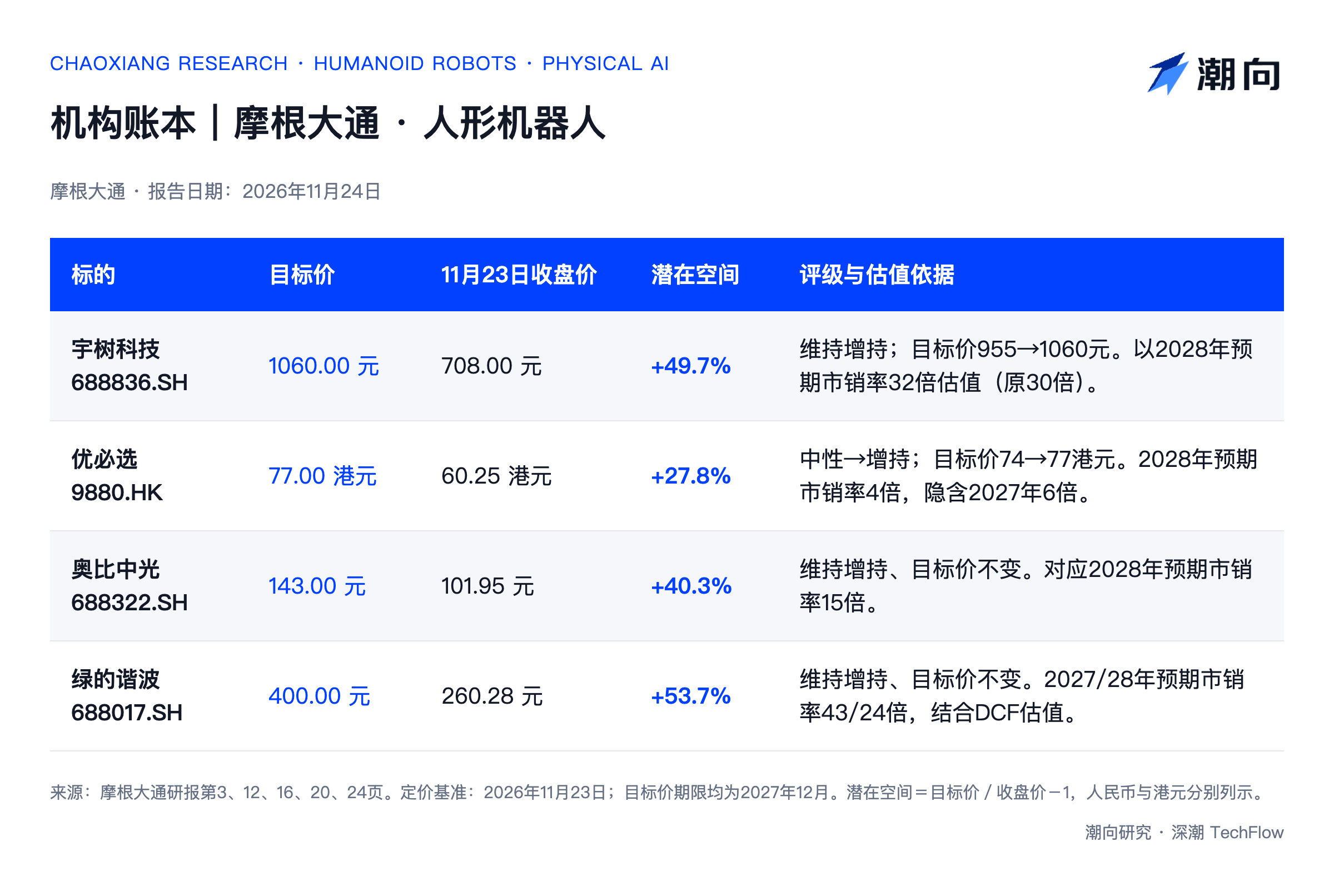
On the supply chain side, Morgan Stanley reiterated four "Overweight" preferred targets. The domestic whole machine supply chain sees strong potential in 3D vision leader Orbbec (target price 143 Yuan, potential upside 40%) and harmonic reducer leader Harmonic Drive (target price 400 Yuan, potential upside 54%), with the former holding over 70% market share in domestic service and humanoid robot visual hardware, while the latter has deep binding with mainstream domestic whole machine manufacturers. For Tesla's robot supply chain, the preferred picks are Hengli Hydraulic (target price 126 Yuan, potential upside 35%) and Sanhua Intelligent Control (A-share target price 50 Yuan, potential upside 48%; H-share target price 38 Hong Kong dollars, potential upside 78%).
For whole machine manufacturers, Yushu Technology (688836.CH) remains Morgan Stanley's number one choice.
Analysts point out that the market is reevaluating Yushu's value—it not only has a globally leading hardware mass production scale but is also fully committed to enhancing "brain" computing power and developer ecology. Although the financial forecasts for 2026 to 2028 remain unchanged (expected revenue to soar from 2.819 billion Yuan in 2026 to 13.383 billion Yuan in 2028), Morgan Stanley has raised Yushu's target price-to-sales ratio from 30 times to 32 times for 2028, corresponding to a target price of 1060 Yuan in December 2027 (implying approximately 50% upside from the closing price of 708 Yuan on November 23).
UBTECH (9880.HK) is seeing a rating reversal, upgraded from "Neutral" to "Overweight."
Since September 28, 2026, UBTECH's stock price has retreated by a cumulative 18%, significantly underperforming the Hang Seng Index's 8% decline and Yushu's 54% gain over the same period. In conjunction with communications at the TIG conference, Morgan Stanley has slightly adjusted the shipment expectations for UBTECH's 2026 industrial Walker series (including wheeled models) to about 4,000 units, with commercial C1 and domestic U1 series each around 1,000 units, and the revenue forecasts for 2026 to 2028 have been lowered by an average of 10%. However, the firm believes that the earlier price drop has sufficiently absorbed negative sentiment, and as leading large models lower the threshold for independent development, UBTECH's progress in scenario implementation and data flywheels is coming to fruition, assigning a 4x price-to-sales ratio for 2028, with the target price raised to 77 Hong Kong dollars (potential upside of about 28%). The report also cautions that UBTECH's cash on the books had decreased to 2.4 billion Yuan by mid-2026, with accounts receivable turnover days reaching 242 days; ongoing cash recovery and financing rhythm will remain crucial observation points.
This article is a summary and interpretation of third-party brokerage research reports by Chao Xiang Research. The ratings, target prices, earnings forecasts, and related judgments quoted in the article are the views of the brokerage analysts and represent their institution's stance, not the views of Chao Xiang Research, and do not constitute any investment advice.
The market has risks, and decisions must be independent. This article should not serve as the basis for buying or selling any securities.
免责声明:本文章仅代表作者个人观点,不代表本平台的立场和观点。本文章仅供信息分享,不构成对任何人的任何投资建议。用户与作者之间的任何争议,与本平台无关。如网页中刊载的文章或图片涉及侵权,请提供相关的权利证明和身份证明发送邮件到[email protected],本平台相关工作人员将会进行核查。